
TL;DR:
- Booking travel requires careful attention to documentation, insurance timing, and booking methods to avoid costly mistakes. Ensuring passport validity beyond six months, matching booking names exactly, and purchasing insurance promptly are crucial steps. Choosing direct bookings often offers better refunds and loyalty rewards, while understanding fees and cancellation policies helps save money.
Booking a trip should be exciting. But one wrong move — a name typo, a missed insurance deadline, or a refund policy you never read — can turn your vacation into a financial nightmare before you even leave home. The mistakes to avoid when booking travel aren’t always obvious, and the most costly ones tend to be the ones you don’t realize you’ve made until it’s too late. This guide breaks down the specific errors that catch travelers off guard, from documentation disasters to insurance traps, so you can book smarter every single time.
Table of Contents
- Key takeaways
- Mistakes to avoid when booking travel: start with your documents
- Direct vs. third-party booking: which one is actually safer?
- Common flight and hotel booking errors that cost real money
- How to use travel insurance without getting burned
- My honest take on where travelers go wrong
- Book smarter with Pilottraveldeals
- FAQ
Key takeaways
| Point | Details |
|---|---|
| Passport validity is non-negotiable | Many countries require your passport to be valid 3-6 months beyond your trip dates, not just your departure date. |
| Direct bookings offer real advantages | Booking directly with airlines and hotels unlocks loyalty perks, faster refunds, and better cancellation flexibility. |
| Insurance timing matters enormously | Missing the 14-21 day purchase window after your first deposit disqualifies you from key coverage options. |
| Hidden fees inflate cheap tickets | Baggage fees, seat selection, and change fees can make a low headline price far more expensive than it looks. |
| Third-party refunds are slower | OTA refunds can take weeks or months compared to the 7-business-day standard for direct bookings. |
Mistakes to avoid when booking travel: start with your documents
Most travel disasters begin long before the airport. They begin at a desk, with paperwork that was never double-checked.
Passport validity is the most underestimated trap in international travel. Many countries require a passport valid for at least three to six months beyond your trip’s end date, not just the departure date. If you’re flying to Europe in October with a passport expiring in December, you may be denied boarding. Check the entry requirements for every country on your itinerary, not just your final destination.
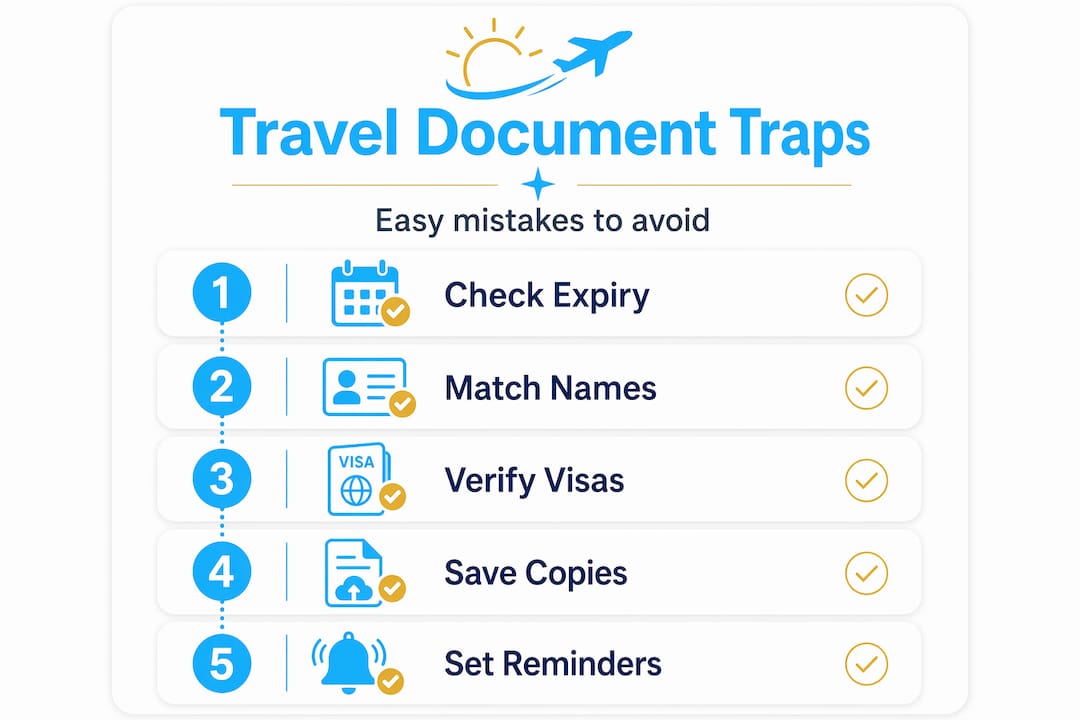
Name mismatches are another silent trip-killer. Name discrepancies on bookings are among the most frequent reasons travelers get denied boarding. Your booking must match your passport exactly. That means middle names, suffixes, and any legal name changes after a marriage or divorce need to be reflected in both your passport and your reservation. Don’t assume a minor difference won’t matter. Airlines enforce this strictly.
Here are the documentation checks you should run before booking anything:
- Confirm your passport is valid for at least six months past your return date
- Verify your name on the booking matches your passport character by character
- Research visa requirements for every country you’re visiting, including layover countries
- Check vaccination or health documentation requirements where applicable
- If traveling with children, confirm that their passports haven’t expired and that custody documentation is available if required
For trips requiring a visa, booking consistency becomes even more critical. Discrepancies across your booking documents and visa application can trigger refusals or boarding denials. If you change a flight after submitting a visa application, notify the consulate and update all related paperwork immediately.
Pro Tip: Set a calendar reminder six months before any international trip to check your passport’s expiration date. It takes eight to twelve weeks to renew a U.S. passport through standard processing.
Direct vs. third-party booking: which one is actually safer?
This is one of the most debated travel booking topics, and the answer isn’t as simple as “always book direct” or “always use a deal site.” It depends on what you’re buying and what happens when things go wrong.
Here’s a side-by-side look at both approaches:
| Factor | Direct booking | Third-party (OTA) |
|---|---|---|
| Loyalty points | Full points earned | Often excluded |
| Refund speed | 7 business days standard | Weeks to months |
| Cancellation flexibility | Better, especially for airlines | Often restricted by OTA terms |
| 24-hour free cancellation | Legally guaranteed (U.S. flights) | Does not apply to OTAs |
| Bundle deals | Rarely offered | Common, with trade-offs |
| Price | Sometimes higher | Often lower headline price |
The 24-hour free cancellation rule is one that surprises a lot of travelers. That federal rule only applies to direct airline bookings for flights departing at least seven days out. If you book through an OTA and want to cancel within 24 hours, you’re at the mercy of that platform’s own policy. Some are generous. Many are not.
Direct hotel bookings typically unlock member savings around 10%, full loyalty point accumulation, and priority service during high-occupancy periods. When a room issue comes up or a storm cancels your plans, the hotel’s front desk will prioritize guests who booked directly.
OTA bundles can look like great deals, but they carry a specific risk: bundled components often must be changed together, meaning if your flight changes, your hotel booking may not be adjustable independently. Opaque pricing in bundles also makes it difficult to verify whether you’re actually saving anything.
To understand the full picture of where booking sites genuinely help budget travelers, check out the advantages of booking sites broken down by Pilottraveldeals.
Pro Tip: Screenshot or download every confirmation you receive, including the exact price, cancellation terms, and booking reference number. Email yourself a copy so it’s accessible even if the app goes down.
Common flight and hotel booking errors that cost real money
Even experienced travelers make these mistakes. The good news is that once you know what to watch for, they’re almost entirely avoidable.
The most common travel booking pitfalls in this category include:
- Wrong dates or times. Time zone confusion catches travelers constantly. A 6:00 AM departure in a city two time zones away may require you to leave your hotel at 3:00 AM local time. Always convert your departure time to local time at the origin airport.
- Ignoring total trip cost. Baggage fees, seat selection charges, and nonrefundable fares can make a cheap ticket significantly more expensive than a slightly pricier direct booking. Add up every fee before assuming you’ve found the best deal.
- Booking non-refundable hotel rates by default. Most booking platforms default to the cheapest rate, which is usually non-refundable. Paying a small premium for a flexible rate is worth it unless your plans are completely fixed.
- Skipping cancellation policy review. Hotels, airlines, and rental companies all have different policies. Read them. A “free cancellation” label doesn’t always mean what you think it means, especially when partial refunds or credit vouchers are involved.
- Not accounting for check-in time restrictions. Booking a hotel that doesn’t allow early check-in when your flight lands at 7 AM means you’re waiting in a lobby for hours. Call ahead or book a property that explicitly offers flexible check-in.
For practical tips on maximizing the value and flexibility of your hotel stay, the Pilottraveldeals guide on hotel comfort and value is worth bookmarking before your next trip. You’ll also want to run through a solid hotel booking checklist to catch common errors before they happen.
How to use travel insurance without getting burned
Travel insurance is one of the most misunderstood products in the travel industry. Most travelers either skip it entirely or buy it expecting far more protection than the policy actually provides.
Here’s how to do it right:
-
Buy it immediately after your first deposit. This is not optional advice. Missing the 14-21 day purchase window after your initial trip deposit eliminates eligibility for pre-existing condition waivers and Cancel For Any Reason (CFAR) coverage. Most travelers don’t realize this until it’s too late.
-
Understand what CFAR actually covers. If you want the flexibility to cancel for any reason, you need a CFAR add-on. CFAR reimburses 50 to 75% of nonrefundable costs, requires purchase within 7 to 21 days of your first payment, and requires you to cancel at least 48 hours before departure.
-
Don’t assume worry is a covered reason. Standard policies cover specific named events: illness, injury, death of a covered family member, natural disasters, and similar. Fear, anxiety, or general bad feelings about a destination are not covered reasons. Neither are work schedule changes or relationship problems. If you want true flexibility, CFAR is the only option.
-
Read the fine print on medical coverage. Many credit card travel protections provide limited or zero medical coverage abroad. If your health insurance doesn’t cover international emergencies, get a policy that does.
-
Keep documentation for every potential claim. If your flight gets canceled, get a written statement from the airline. If you get sick, see a doctor and keep the receipts. Claims without supporting documentation are routinely denied.
Pro Tip: Purchase travel insurance the same day you make your first trip payment. Set a 15-minute reminder on your phone to complete the insurance purchase before doing anything else after booking.
My honest take on where travelers go wrong
I’ve watched travelers make the same costly errors over and over, and what strikes me most is that the expensive mistakes rarely come from ignorance. They come from overconfidence.

The traveler who books the cheapest ticket without reading the baggage policy isn’t uninformed. They’ve just convinced themselves it won’t matter this time. Prioritizing the lowest headline price without accounting for hidden fees is the single most common path to a trip that costs far more than it should. I’ve seen $150 “savings” disappear under $60 in bag fees and a $45 seat selection charge.
The documentation piece is where I see the most genuine shock, though. Someone spends months planning a honeymoon, arrives at the airport, and gets denied boarding because the booking name says “Elizabeth” and the passport says “Beth.” That’s not a bureaucratic technicality. That’s a rule airlines enforce without exceptions.
My honest advice: treat the booking process like a contract you’re signing, because that’s exactly what it is. The cheapest option isn’t the best option if it offers zero flexibility. And buying travel insurance three weeks after your deposit is often not worth the cost, because you’ve already lost access to the coverage that actually matters.
— Asher
Book smarter with Pilottraveldeals
Avoiding the most common travel booking errors is easier when you have the right tools and resources at your side before you commit to anything.
Pilottraveldeals makes it straightforward to compare flights across multiple providers, so you’re not just chasing the lowest number but actually seeing what each booking includes. For accommodations, the hotels search tool lets you filter by cancellation policy, location, and price so you can match your booking to your actual plans. Heading somewhere international? Don’t forget to pick up a local SIM card so you stay connected without expensive roaming charges. Pilottraveldeals brings together deals, guides, and booking tools in one place, so the research that usually takes hours takes a fraction of the time.
FAQ
How early should I check my passport before traveling?
Check your passport at least six months before any international trip. Many countries require your passport to be valid for three to six months beyond your return date, so borderline expirations can lead to denied boarding.
Does the 24-hour flight cancellation rule apply to third-party bookings?
No. The 24-hour free cancellation rule is legally guaranteed only for direct airline bookings on flights departing at least seven days out. Third-party booking platforms set their own policies, which are often far more restrictive.
When should I buy travel insurance?
Buy travel insurance within 14 to 21 days of making your first trip deposit. Missing this window disqualifies you from pre-existing condition waivers and CFAR add-ons, which are among the most valuable parts of a comprehensive policy.
What does Cancel For Any Reason insurance actually cover?
CFAR reimburses 50 to 75% of nonrefundable trip costs and lets you cancel for reasons a standard policy wouldn’t cover. It requires purchase within 7 to 21 days of your first payment and cancellation at least 48 hours before departure.
Is it better to book hotels directly or through a deal site?
For flexibility and loyalty perks, direct booking is usually better. Direct hotel guests typically earn full loyalty points, receive priority service, and get refunds within the hotel’s standard timeline rather than waiting weeks through a third-party platform.
Recommended
- Top tips for booking last-minute travel deals in 2026 – PilotTravelDeals.com
- 7 Essential Hotel Booking Tips 2025 for Smart Travelers – PilotTravelDeals.com
- Benefits of Booking Early Flights: Save More in 2026 – PilotTravelDeals.com
- Tricks to find cheap flights: expert tips for 2026 – PilotTravelDeals.com