Booking multi-stop flights often leads to a tangled mess of terms and hidden costs. Many travelers confuse a stopover with a quick airport layover, only to miss out on real sightseeing savings. For budget-conscious explorers, knowing the real difference between stopovers and layovers can turn a basic itinerary into a cost-effective adventure. This guide sorts myths from facts, revealing practical strategies for squeezing extra value and discovery from every ticket.
Table of Contents
- Defining Stopover Flights And Common Misconceptions
- Types Of Stopover Flights And Key Differences
- How Stopovers Work In Air Travel Itineraries
- Stopover Flight Costs, Visa Requirements, And Fees
- Risks, Pitfalls, And Mistakes To Avoid
- Comparing Stopovers To Layovers And Multi-City Itineraries
Key Takeaways
| Point | Details |
|---|---|
| Understanding Stopovers | Stopovers are intentional breaks lasting 24 hours or more, allowing travelers to explore a connecting city. They differ from layovers, which are brief stops typically under four hours. |
| Financial Considerations | Stopover programs can be cost-effective, often offering similar prices to direct flights while enabling additional city visits. However, travelers must account for accommodation and other expenses to evaluate total trip costs. |
| Visa and Baggage Policies | Research visa requirements and baggage handling rules specific to your airline and stopover city to avoid complications during travel. Know whether your luggage will be checked through to your final destination. |
| Timing and Planning | Build in extra time for connections and plan your itinerary carefully to maximize your stopover experience without over-scheduling activities. Balance exploration with relaxation to ensure a fulfilling trip. |
Defining Stopover Flights and Common Misconceptions
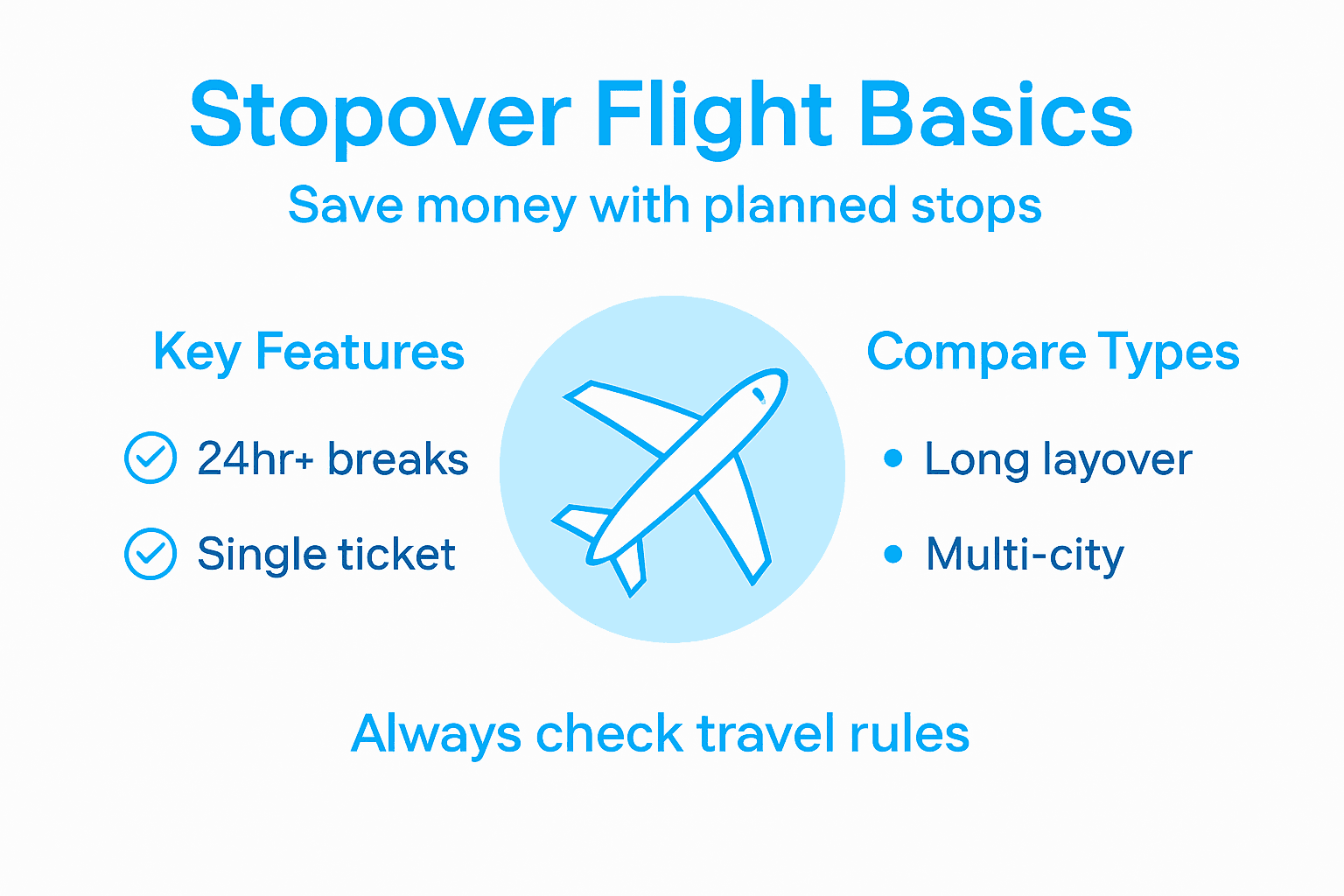
A stopover flight is an intentional, scheduled break in your journey where you pause for multiple days (typically 24 hours or more) before continuing to your final destination. Unlike a quick layover where you’re trapped in an airport terminal for a few hours, a stopover gives you the freedom to actually leave the airport, explore a city, and rest before hopping on your next flight. Think of it as turning a connecting point into a destination itself. Airlines and travel platforms now actively market stopover flights because they appeal to travelers who want to see more of the world without paying premium prices for separate round-trip tickets.
Here’s where most people get confused: they assume all ground time during a flight itinerary falls into the same category. Not true. The difference between a layover and a stopover comes down to duration and intentionality. Multi-day refueling periods distinguish true stopovers from simple rest stops, meaning if you’re on the ground for less than 24 hours, you’re experiencing a layover, not a stopover. A layover is typically an involuntary wait between connecting flights where you stay in the airport or spend a few hours exploring a nearby area. A stopover, by contrast, is something you deliberately book because you want to spend real time in that location. You might arrive in Barcelona on Tuesday evening, spend three full days exploring the city and beaches, then depart Friday morning on your flight to your final destination. That’s a stopover.
Common misconceptions also blur the line between stopovers and regular multi-city bookings. Some travelers believe that booking flights from New York to London to Paris to Rome is the same thing as booking stopover flights. The key distinction: with stopover flights, you’re typically paying one base airfare that includes multiple destination stops, often through a single airline or airline alliance. With multi-city bookings, you’re essentially booking separate flights or routes independently, which can cost more and offer less flexibility. Additionally, many people wrongly assume that stopover flights are only for tourists taking leisurely vacations. Business travelers, remote workers, and budget-conscious explorers all benefit from stopover bookings. You could fly from San Francisco to Singapore with a stopover in Tokyo, spend three days working from a coworking space there, then continue to Singapore. You’re combining work, exploration, and savings all at once.
Another prevalent myth is that stopover flights always cost significantly more than direct flights to your primary destination. Reality tells a different story. When you use stopover programs offered through airlines, you’re often paying nearly the same fare you would for a direct flight but gaining the ability to visit an additional city at no extra charge. On PilotTravelDeals.com, you can compare these stopover options across multiple carriers to see exactly where these money-saving opportunities exist. The catch? You need to know which airlines offer stopover programs and which destinations qualify. That’s what separates savvy budget travelers from those who overpay.
Pro tip: _When comparing stopover flights on booking platforms, filter specifically for “stopover allowed” options rather than treating every connection as a potential stopover opportunity, since not all flights permit the extended ground time that makes stopovers worthwhile.
Types of Stopover Flights and Key Differences
Stopover flights come in several distinct varieties, and understanding which type you’re looking at fundamentally changes how you plan your trip and where you’ll find the best deals. The main distinction separates airline-sanctioned stopover programs from independently booked stopovers. With airline stopover programs, you book through a specific carrier that explicitly allows you to break your journey for one or more designated cities without paying extra. Iceland’s Icelandair pioneered this strategy, offering free stopovers in Reykjavik for passengers flying between North America and Europe. You pay a single base fare, and the airline absorbs the cost of letting you stay for several days. With independent stopovers, you’re essentially booking multiple flight segments yourself, cobbling together different airlines or routes to hit your target cities. You have complete flexibility but bear the full cost for each flight segment. This approach requires more legwork but sometimes yields better pricing when you hunt across platforms like PilotTravelDeals.com.
Beyond these booking structures, stopovers also differ based on their functional purpose. Some stopovers exist primarily as geographic bottlenecks, where the routing of international flights naturally funnels travelers through particular cities. If you’re flying from Sydney to London, you might pass through Singapore or Dubai regardless of your intentions. That’s a routing stopover, dictated by flight paths and airline networks rather than your desires. Then there are planned refueling stopovers, where you deliberately schedule extra time in a city specifically because it offers what you need: lower airfare prices due to competitive routes, affordable accommodations, exceptional food scenes, or cultural experiences you actually want. A traveler flying from Toronto to Bangkok might build in a four-day stopover in Bangkok not because they have to, but because refueling stations provide opportunities to restore energy and explore a destination that makes the overall journey worthwhile. You’re maximizing both your budget and your experience.
Duration creates another important dividing line. Short stopovers typically span 24 to 48 hours, giving you an evening and one full day to explore a city before catching your next flight. These work well for cities that don’t require heavy time investment, like quick food tours in Bangkok or day trips to nearby attractions from major hubs. Medium stopovers run three to five days, the sweet spot for most travelers. You can actually settle in, take your time, eat without rushing, see major attractions, and recover from jet lag. Extended stopovers stretch beyond a week, transforming your journey into a full travel experience. You might spend ten days in Tokyo with the Tokyo stopover from Tokyo to Sydney, essentially making it a co-destination rather than a brief pause. The longer your stopover, the more you need to consider accommodation costs versus airfare savings. Sometimes an extra day costs you more in hotels than you saved on airfare, so run the numbers before committing.

One more critical distinction separates single stopovers from multi-city stopovers. A single stopover journey looks like New York to London to Tokyo, where you break once in London. Multi-city stopover itineraries let you hit three, four, or even five destinations on one booking. You might fly New York to London to Paris to Barcelona to Madrid, collecting experiences across multiple European cities without rebooking flights at each step. Airlines increasingly restrict this option to their premium fare classes, but when available, multi-city stopovers represent exceptional value for travelers willing to plan complex itineraries.
When you’re comparing stopover options, the key strategic approach involves checking whether stopovers actually save you money compared to booking separate flights independently. Sometimes they do, sometimes they don’t. Airlines design stopover programs to make their routes more appealing, not necessarily to undercut all other options. Your job is to verify that the stopover routing actually beats alternatives before you commit.
Pro tip: Filter stopover flights by type and duration on booking platforms, then compare the total journey cost against booking your primary and stopover destinations separately to confirm you’re actually saving money rather than paying more for the novelty of a stopover routing.
How Stopovers Work in Air Travel Itineraries
Understanding how stopovers actually function within your flight booking is crucial because the mechanics differ depending on your airline, routing, and the specific stopover program. When you book a stopover flight, you’re essentially working within the hub-and-spoke system that modern airlines use to route passengers efficiently. Think of it like this: an airline has major hub cities (like Amsterdam for KLM or Dubai for Emirates) where most of their flights converge. Your route might naturally pass through one of these hubs, and airlines can leverage that geography to offer you stopover opportunities. Instead of rushing you through the hub in a three-hour connection, they let you stay for two, three, or even five days while keeping you on the same overall itinerary. From the airline’s perspective, they benefit from increased passenger engagement, higher hotel and restaurant spending in the stopover city, and stronger ties to tourism boards that help them market the route.
The booking mechanics themselves can be surprisingly different depending on how you structure your stopover. When you book an airline stopover program directly through the carrier’s website, you’re selecting a pre-designed routing with built-in stopover options. You choose your origin city, your stopover city, and your final destination, then pick your flights. The airline controls the entire package and determines which cities qualify, how long you can stay, and what the pricing looks like. These programs are straightforward to book but offer limited flexibility. Alternatively, if you’re piecing together an independent stopover, you’re booking two or more separate flight segments through whatever channels offer the best prices. This requires more manual work but gives you complete control over dates, airlines, and stopover duration. Many budget travelers use the connecting flights guide to understand the differences between layovers and longer stopovers, which is essential when booking independent segments.
Once your stopover is booked, several operational details affect how smoothly your journey flows. Your luggage handling works differently depending on your booking structure. If you booked one continuous itinerary with a stopover, your luggage typically gets checked all the way through to your final destination, which means you won’t see it until you arrive at your ultimate goal. This is convenient but limiting if you want to bring souvenirs from your stopover city. If you booked independent flight segments, your baggage may only check to the stopover city, requiring you to claim and recheck it before your next flight. Additionally, you must handle visa and entry requirements for the stopover country yourself. Some nations require visas for even short visits, while others offer visa-free entry to certain nationalities. This isn’t the airline’s responsibility, so research your destination’s requirements before booking. Stopover tourism involves intentional breaks allowing exploration, but only if you can legally enter the country. You’ll also need to coordinate timing carefully. If you book the first flight too late in the day, you lose valuable stopover time. If you book your onward flight too early, you won’t have time to explore. Most experienced stopover travelers aim to arrive in their stopover city by evening and depart two or three days later in the afternoon or evening to maximize their time on the ground.
The financial mechanics also differ from standard bookings. With airline stopover programs, you typically pay one base fare that covers your entire journey, regardless of how many cities you visit. With independent bookings, each flight segment has its own price tag, and you’re essentially paying for multiple one-way tickets that happen to connect. This is why comparing stopover programs against independent bookings is so critical. Sometimes the program pricing beats independent booking by hundreds of dollars. Sometimes independent booking is cheaper when you find sales on individual segments. The key is checking both approaches before committing to a route.
Pro tip: Before finalizing a stopover booking, verify baggage policies and entry requirements for your stopover country, and calculate whether your saved airfare actually covers accommodation costs in the stopover city, since paying 50 dollars less for flights but 200 dollars more for hotels erases your savings.
Stopover Flight Costs, Visa Requirements, and Fees
The financial reality of stopover flights extends far beyond your airfare. While the base ticket price might be competitive or even cheaper than alternatives, hidden costs can quickly erode your savings if you don’t plan carefully. Accommodation represents your largest potential expense during a stopover. A three-day stopover in Tokyo, Barcelona, or Amsterdam could easily cost 150 to 400 dollars in hotels, depending on your standards. Budget travel accommodations like hostels or Airbnb might drop this to 60 to 150 dollars, but you’re still looking at real money. Calculate this upfront. Sometimes paying 100 dollars more for a flight gets you through a cheaper stopover city, resulting in net savings. Sometimes the opposite is true. Additionally, consider ground transportation, food, and activities. These vary wildly by destination. A stopover in Southeast Asia costs significantly less than one in Western Europe for the same duration. Use platforms like PilotTravelDeals.com to compare total journey costs, not just airfare, since bundling flights with accommodation deals can reveal which stopovers actually make financial sense.
Visa requirements represent another cost layer that catches many budget travelers off guard. Whether you need a visa for your stopover country depends on your nationality and the country’s policies. A United States citizen stopping in the European Union for three days typically needs no visa thanks to visa-free travel agreements. But that same American citizen stopping in Vietnam requires a visa that might cost 25 to 100 dollars and take several days to process. The timeline matters because visa applications that require weeks of processing might make your stopover booking impossible. Some countries offer visa-on-arrival programs where you pay the visa fee when you land, adding 20 to 50 dollars to your stopover costs but saving processing time. Electronic travel authorization systems like ESTA cost 14 dollars for United States citizens entering the United States on return flights, but this fee applies to many stopover flights too. Research your specific nationality and destination combination well before booking because visa costs and processing times can make or break a stopover plan. Some nations require visas for even 24 hour stays, while others offer 90-day visa-free entry. You cannot assume.
Airline fees layer onto your base stopover fare in ways that aren’t always obvious. Baggage fees vary dramatically. Some airlines include two free checked bags on international flights, while others charge 30 to 80 dollars per bag. If you’re checking a bag through to your final destination with a stopover, the fee structure depends on your specific routing. Some carriers charge per leg of the journey, meaning a stopover effectively becomes two separate bookings with two separate baggage allowances. Seat selection fees might seem minor at 15 to 40 dollars, but they add up across multiple passengers. Change fees can be punishing if you need to adjust your stopover dates after booking. Some airline stopover programs allow free changes, while others charge 75 to 200 dollars per change plus any fare difference. Read the fine print before committing. Additionally, many budget airlines add fuel surcharges and facility fees that aren’t immediately visible in your initial quote. These can add 20 to 100 dollars to your total cost depending on the route and airline.
Then there’s the often-overlooked category of travel insurance and documentation fees. Travel insurance for a stopover flight costs 15 to 80 dollars depending on your age, trip duration, and coverage level. It’s optional but important if you’re spending significant money on flights and accommodation. Some nationalities require travel insurance specifically for certain destinations. Vaccination certificates, travel permits, or health documentation might be required for entry, though these typically have no associated fee beyond any required vaccinations themselves. Visa reciprocity tables and fees show that some countries charge more for entry visas than others, with fees ranging from free to 300 dollars depending on your destination and citizenship. If your stopover is in a destination with high visa fees, this might eliminate your cost savings entirely.
Let’s get practical about the math. Say you find a stopover flight from New York to London to Tokyo for 850 dollars. Looks great compared to separate bookings at 1200 dollars. But add a three-day London stopover: 250 dollars in hotels, 80 dollars in food and transport, and you’ve added 330 dollars to your cost. You’re now at 1180 dollars total, barely below the separate booking option. Swap London for Bangkok and those same three days might cost only 120 dollars in accommodation and 40 dollars in activities. Now you’re at 1010 dollars total and actually saving money. The stopover value depends entirely on your destination choice.
Below is a summary of common hidden costs to consider when evaluating stopover flights versus other options:
| Expense Category | Typical Stopover Additional Cost | Layover Cost Impact | Multi-City Cost Impact |
|---|---|---|---|
| Accommodation | High—hotel or Airbnb required | None (airport stay) | High—multiple cities |
| Visa Fees | Varies by country, sometimes required | Rarely applies | May apply for each city |
| Baggage Fees | May be higher for multi-carrier or per segment | Usually once per booking | Charged for each ticket |
| Ground Transport | Needed for city access | Not required | Needed in each city |
Pro tip: Create a detailed spreadsheet comparing your total stopover journey cost including flights, accommodation, visas, baggage fees, and daily expenses against booking your primary destination separately, because the lowest airfare rarely equals the lowest total trip cost.
Risks, Pitfalls, and Mistakes to Avoid
Stopover flights look attractive on paper until something goes wrong. The most common mistake budget travelers make is booking a stopover without understanding their airline’s specific policies. Every carrier handles stopovers differently, and assumptions can cost you money or even strand you mid-journey. Some airlines charge fees for stopovers beyond a certain duration. Others require advance notice that you’re taking a stopover versus a simple layover. Some don’t allow stopovers at all on certain routes, even if the routing suggests you could pause. Always read the fine print before booking. Similarly, many travelers underestimate tight connection windows between their incoming and outgoing flights. If your first flight arrives late and your stopover is only supposed to be 24 hours, you might miss your onward flight entirely. Airlines aren’t responsible for rebooking you if you miss a connection on a multi-segment stopover booking where you booked the segments independently. Build in buffer time. A 48 hour stopover is riskier than a 72 hour one when dealing with international connections because weather, mechanical delays, or customs issues can eat into your ground time fast.
Another critical pitfall involves inadequate research on visa requirements and processing times. You cannot book a stopover in Vietnam, for example, and assume you can get a visa on arrival if your booking only gives you 36 hours in country. Visa-on-arrival can have long lines, processing might take hours, and you could miss your onward flight if you’re cutting it close. Some countries require visas to be obtained before arrival, which can take weeks. If you discover too late that your stopover destination requires advance visas, you’re looking at expensive last-minute changes or cancellations. Additionally, travelers frequently overlook baggage complications with stopovers. If you book independent flight segments, your first airline might not check your bag through to your final destination. You’ll need to claim it, potentially clear it through customs, and recheck it for the next flight. This adds time and stress to your stopover. Some baggage items might be restricted on your outbound carrier but allowed on your return carrier, creating rejection headaches. And if a bag gets lost between stopover segments, the liability gets murky because you technically booked two separate flights.
Misunderstanding stopover geography and city characteristics creates another common problem. You book what looks like an inexpensive stopover in a city without realizing it’s far from the airport or has minimal tourist infrastructure. You arrive at 11 PM, need a hotel for the night, spend 200 dollars on accommodation and transport, then have only one usable day before your onward flight. Suddenly your budget stopover costs more than your airfare. Research your stopover city thoroughly. Check transportation costs from the airport to the city center. Verify there are accommodations in your budget. Confirm that attractions you want to see are actually accessible during your stopover window. A 24 hour stopover in a city two hours from the airport might net you only three or four hours of actual ground time after travel and sleep.
Weather and seasonal disruptions represent risks you cannot fully control. If your stopover falls during typhoon season in Southeast Asia or winter storms in Northern Europe, you face increased odds of delays that compress or eliminate your stopover time. You booked those hotels and activities based on having three days. Now you have one day because your incoming flight was delayed by weather. No refund is coming. Understanding habitat disturbances and adverse weather impacts on travel disruptions highlights how external factors beyond your control can derail carefully planned itineraries. Similarly, political instability or sudden travel restrictions in your stopover destination can upend plans. A country experiencing protests, strikes, or sudden border closures might make your stopover impossible or unsafe. Booking travel insurance that covers trip cancellation and delays is critical.
Perhaps the most expensive mistake is not comparing total trip costs thoroughly before booking. A stopover looks like a great deal until you calculate flights plus accommodation plus meals plus activities plus visa costs plus baggage fees. You might discover that booking your primary destination and stopover separately actually saves money. Or you might find that a stopover in a different city entirely costs 40 percent less overall. Many travelers commit to a stopover routing without doing this math, then realize too late they made a poor choice. Equally problematic is over-booking your stopover itinerary. You have two days in Barcelona and try to fit in eight major attractions, multiple restaurants, museums, and day trips. You end up exhausted, stressed, and miss half the experiences because you rushed through them. Stopovers succeed when you treat them as genuine breaks rather than compressed versions of two-week vacations.
Pro tip: Book stopover flights through your airline directly when possible rather than third-party booking sites, verify baggage policies and visa requirements specific to your nationality before payment, build 24 additional hours into your stopover timeline as a buffer against incoming flight delays, and always compare your total journey cost including accommodation against booking primary and stopover destinations separately.
Comparing Stopovers to Layovers and Multi-City Itineraries
The distinction between stopovers and layovers seems simple until you realize how much confusion surrounds these terms in real booking scenarios. A layover is a brief, involuntary connection between flights, typically lasting under four hours. You land, maybe grab coffee, use the bathroom, and board your next flight within the same airline terminal or a nearby gate. You don’t leave the airport. You’re not exploring a city. You’re just waiting. Airlines schedule layovers to route you to your final destination efficiently. A stopover, by contrast, is an intentional pause that lasts at least 24 hours, often stretching to several days. You leave the airport, stay in a hotel, explore the city, eat real meals, and return to catch your onward flight. The fundamental difference comes down to time and freedom. Stopovers allow travelers to leave the airport and stay in a connecting city, sometimes at no extra fare, while layovers are brief airport stays without leaving the terminal. Budget travelers often confuse these because some bookings show connections that look like stopovers on paper. You might see a nine-hour gap between flights and think you have time to explore. Not necessarily. That nine hours disappears with customs processing, baggage claims, airport procedures, and rechecking luggage. A true stopover requires overnight accommodation, which layovers don’t provide.
Understanding this distinction matters financially because stopovers and layovers have different pricing structures. An airline might route you through their hub on a stopover program and charge you a standard fare that includes the stopover as a feature. You’re getting value by visiting multiple cities for one price. With a layover, you’re simply paying for the most efficient route to your destination. The layover happens whether you want it or not. However, sometimes travelers can turn unavoidable long layovers into quasi-stopovers. A six-hour layover in Istanbul might give you time to shower at an airport hotel, nap, and grab a meal without leaving the terminal. A 12-hour layover in Bangkok might let you venture into the city for a few hours if you’re aggressive with timing. These aren’t true stopovers, but they’re better than sitting in the airport. The key is checking visa requirements and airline policies before attempting to leave the airport on a short layover.
Here’s a concise comparison of stopovers, layovers, and multi-city itineraries to help clarify their differences:
| Aspect | Stopover | Layover | Multi-City Itinerary |
|---|---|---|---|
| Minimum Duration | 24 hours or more | Under 24 hours | Flexible, user-defined |
| Booking Structure | Usually one carrier, single fare | Automatic with ticket | Multiple separate tickets |
| Main Benefit | City exploration at no extra fare | Quick airport transfer | Maximum route flexibility |
| Typical Cost | Comparable to direct fare | Standard route fare | Often higher total cost |
Multi-city itineraries represent a different beast entirely, and many budget travelers conflate them with stopover bookings. A multi-city itinerary involves visiting three, four, or more destinations but typically through separate bookings or distinct fare structures. You might book New York to London as one ticket, London to Paris as another ticket, and Paris to Rome as a third ticket. You control the dates independently. You choose the airlines independently. You have maximum flexibility but pay full price for each segment without the bundling discount that stopover programs offer. Some travelers prefer this approach because they want different airlines for different legs or specific dates that stopover programs don’t accommodate. The downside? You’re paying for multiple one-way tickets, which almost always costs more than booking a stopover package through a single airline. Stopovers allow multiple stops while remaining distinct from multi-city itineraries with specific fare rules governing duration and pricing. The difference might be 200 to 500 dollars depending on your routes. Sometimes that extra cost is worth it for the flexibility. Often it isn’t.
Here’s the practical comparison: You want to visit London, Paris, and Rome from New York. Option one involves booking a multi-city itinerary separately. You pay roughly 400 dollars for New York to London, 150 dollars for London to Paris, 120 dollars for Paris to Rome, plus potential baggage fees on each segment if they’re different airlines. Total cost around 670 to 800 dollars plus fees. Option two uses an airline stopover program if available. You might pay 650 dollars all-inclusive from New York to Rome with free stopovers in London and Paris. Lower cost, less flexibility on dates and airlines. Which wins? Check both before booking. Some routes offer excellent stopover deals. Others don’t. Some routes lack stopover programs entirely, forcing you toward multi-city bookings.
The real savings opportunity for budget travelers comes from understanding when each option makes sense. Stopovers work best when you want to visit specific additional cities that the airline’s network naturally passes through, you have flexible dates, and the airline’s stopover program is actually cheaper than booking independently. Multi-city bookings make sense when you want very specific dates that stopover programs don’t offer, you want to mix airlines for different legs, or you’re visiting destinations that don’t fit into any airline’s stopover network. Layovers make sense when you have no choice, though savvy travelers occasionally exploit long layovers as bonus time in cities they would never otherwise visit.
Pro tip: Before booking any multi-stop journey, check three options in this order: direct flights to your primary destination, airline stopover programs through that destination’s hub, and independent multi-city bookings, comparing the total cost of each including baggage fees and accommodation before selecting the cheapest and most convenient option.
Unlock Incredible Savings with Stopover Flights on PilotTravelDeals.com
Stopover flights offer a powerful way to maximize your travel experience while saving money, but navigating airline policies, visa requirements, and total trip costs can be overwhelming. If you want to turn stopovers into real adventures without the headache of complex bookings and hidden fees, PilotTravelDeals.com is here to help. Our travel comparison platform lets you effortlessly explore the best stopover deals across multiple airlines, so you can find options that fit your exact itinerary and budget. Say goodbye to costly guesswork and hello to savings.

Discover how you can combine budget-friendly fares with meaningful stops in exciting cities around the world. Visit our Uncategorized category for tips and insights on smart travel planning. Ready to book your next trip with built-in stopovers that enhance your journey and your savings? Start your search now at PilotTravelDeals.com and compare flight offers tailored to your travel goals. Don’t miss out on the chance to turn layovers into unforgettable experiences while keeping your travel budget in check.
Frequently Asked Questions
What is a stopover flight?
A stopover flight is a scheduled break in your journey that lasts 24 hours or more, allowing you to leave the airport and explore a city before continuing to your final destination.
How do stopover flights differ from layovers?
Stopover flights involve a longer layover of 24 hours or more, allowing you to explore, whereas layovers are typically short connections of less than 24 hours where you usually remain in the airport.
Are stopover flights more expensive than direct flights?
Not necessarily. Stopover flights can often be priced similarly to direct flights, and some airlines offer cost-effective packages that allow you to visit additional cities at no extra charge.
How can I find the best stopover flight options?
You can find the best stopover flight options by using booking platforms that filter for “stopover allowed” flights, and by comparing the total costs of combined flights versus independent bookings.
Recommended
- Stopover Flights: Saving Money and Exploring More – PilotTravelDeals.com
- Connecting Flights Explained: Complete Travel Guide – PilotTravelDeals.com
- Cheap Airfare Tips to Find the Best Deals Easily – PilotTravelDeals.com
- 7 Best Apps for Cheapest Flights: Save More on Every Trip – PilotTravelDeals.com
- 7 Expert Tips for Planning a Day Trip Itinerary Europe – Next View Tours