Most American travelers are surprised to learn that budget airlines can offer fares up to 70 percent lower than traditional carriers. With flight prices being a top concern for families, students, and anyone watching their spending, understanding the real differences between airline types is essential. This guide will break down how budget airlines truly work, which myths deserve to be busted, and how smart travelers can save money without sacrificing safety or comfort.
Table of Contents
- Defining Budget Airlines and Common Myths
- Types of Budget Airlines Worldwide
- How Budget Airlines Operate Differently
- Typical Services and Fees Explained
- Comparing Budget and Traditional Airlines
- Hidden Costs and How to Save Money
Key Takeaways
| Point | Details |
|---|---|
| Budget Airlines Prioritize Affordability | These airlines offer significantly lower ticket prices by minimizing operational costs and providing an à la carte service model. |
| Safety Standards are Maintained | Budget airlines adhere to the same rigorous safety regulations as traditional carriers, ensuring passenger safety is not compromised. |
| Unique Operational Strategies | Efficiency is key; budget airlines standardize their fleet and minimize turnaround times to optimize costs and increase accessibility. |
| Understanding Fees is Critical | Travelers should be aware of potential hidden costs, including baggage and seat selection fees, to effectively manage their travel budgets while booking through budget airlines. |
Defining Budget Airlines and Common Myths
Budget airlines represent a revolutionary approach to air travel that prioritizes affordable transportation over traditional premium services. These carriers have dramatically transformed how people approach travel by offering significantly lower ticket prices compared to legacy airlines. Budget airlines, also known as low-cost carriers (LCCs), operate with an innovative business model designed to minimize operational expenses and pass those savings directly to consumers.
The core strategy of budget airlines involves stripping away non-essential services to reduce costs. This means passengers typically pay only for their base ticket and can choose additional services à la carte. Low-cost carriers focus on minimizing operating costs to offer lower fares, which allows them to provide significantly cheaper travel options. Unlike traditional airlines, budget carriers often eliminate complimentary meals, assigned seating, and include strict baggage restrictions as part of their cost-cutting approach.
Contrary to popular misconceptions, budget airlines do not compromise on safety standards. These carriers adhere to the same rigorous aviation regulations as full-service airlines, maintaining identical safety protocols and maintenance requirements. Many travelers mistakenly believe that lower prices indicate reduced safety, but this is a myth. Budget airlines achieve cost savings through operational efficiencies like using a single aircraft type, optimizing fuel consumption, and minimizing ground time between flights. For instance, some Asian budget airlines have demonstrated remarkable cost efficiency, with carriers like AirAsia X achieving an average cost per kilometer as low as $0.07, proving that affordable travel does not mean sacrificing quality or safety.
The benefits of budget airlines extend far beyond just lower prices. They have democratized travel, making previously expensive routes accessible to a broader range of travelers. By challenging traditional airline models, these carriers have introduced competitive pricing strategies that benefit consumers across multiple markets. Whether you’re a student, a young professional, or a budget-conscious traveler, budget airlines offer an opportunity to explore destinations that might have been financially out of reach in the past.
Types of Budget Airlines Worldwide
Budget airlines have emerged as a global phenomenon, transforming air travel across different continents with unique regional variations. Budget airlines operate globally, with notable examples spanning multiple continents, creating a diverse ecosystem of affordable air transportation. These carriers have adapted their business models to suit local market conditions, creating distinct categories of low-cost carriers that reflect regional economic landscapes and traveler preferences.
Regional Budget Airline Categories include distinct segments tailored to specific market needs:
- North American Budget Airlines: Characterized by extensive domestic networks and point-to-point routes
- European Low-Cost Carriers: Known for extensive cross-border connectivity and aggressive pricing strategies
- Asian Budget Airlines: Rapidly expanding with ultra-low-cost models and significant market growth
- South American Discount Carriers: Focusing on emerging market opportunities and regional connectivity
In North America, airlines like Southwest have pioneered the budget airline model, offering no-frills transportation with transparent pricing and a focus on operational efficiency. European carriers such as Ryanair and EasyJet have similarly revolutionized air travel by providing extremely affordable cross-border routes, enabling budget-conscious travelers to explore multiple countries at unprecedented low costs.
Asian budget airlines represent perhaps the most dynamic segment of the global low-cost carrier market. Carriers like AirAsia have dramatically expanded air travel accessibility in developing economies, creating unprecedented opportunities for millions of first-time flyers. These airlines leverage advanced cost management techniques, modern fleet technologies, and innovative pricing strategies to make air travel increasingly affordable across rapidly growing markets.
How Budget Airlines Operate Differently
Budget airlines have revolutionized air travel through innovative operational strategies that fundamentally differ from traditional carriers. Budget airlines minimize operating costs by implementing unique fleet and infrastructure management techniques, creating a dramatically different approach to air transportation that prioritizes efficiency and affordability.
Key Operational Differences that distinguish budget airlines include:
- Fleet Standardization: Using a single aircraft type to reduce maintenance complexity
- Rapid Turnaround Times: Minimizing ground time between flights
- Secondary Airport Usage: Selecting lower-cost airport locations
- Unbundled Service Model: Charging separately for additional services
- Digital-First Customer Interactions: Emphasizing online booking and minimal customer service overhead
The core of budget airline operational efficiency lies in their ability to streamline every aspect of air travel. Low-cost carrier terminals (LCCTs) play a critical role in reducing operational expenses, providing simplified facilities that dramatically cut infrastructure costs. These terminals typically feature bare-minimum amenities, focusing solely on essential passenger processing functions rather than providing luxurious waiting areas or extensive services.
Budget airlines also differentiate themselves through aggressive cost management in areas most travelers never see. They optimize fuel consumption, negotiate bulk purchasing agreements for aircraft and supplies, and create highly efficient crew scheduling systems. By treating every minute of flight time and every square inch of aircraft space as a potential revenue opportunity, these carriers can offer significantly lower prices while maintaining profitability. Their model transforms air travel from a premium service to an accessible transportation option for millions of budget-conscious travelers worldwide.
Typical Services and Fees Explained
Budget airlines typically offer basic services with an innovative pricing approach that fundamentally transforms how travelers perceive air transportation. Unlike traditional carriers, these airlines implement an à la carte service model where passengers pay only for the specific amenities they want, creating a more transparent and customizable travel experience.
Common Budget Airline Fees travelers should expect include:
- Baggage Fees: Charges for checked luggage
- Seat Selection: Additional cost for choosing specific seats
- Priority Boarding: Extra fee for early aircraft access
- In-Flight Meals: Separate pricing for food and beverages
- Carry-On Restrictions: Potential charges for carry-on bags beyond a small personal item
The pricing strategy behind these fees is strategic and calculated. Budget airlines have perfected the art of creating extremely low base fares while generating revenue through carefully structured additional services. These airlines have been especially successful in markets like Asia, where low-cost carriers dominate by offering significantly reduced ticket prices, demonstrating that travelers are willing to trade traditional amenities for substantial cost savings.
Understanding these fees requires a shift in travel mindset. Savvy travelers learn to navigate this system by carefully selecting only the services they truly need, often resulting in total trip costs that remain substantially lower than traditional airline pricing. The key is transparency and personal choice – budget airlines empower passengers to build their own travel experience, paying only for what they value most while avoiding unnecessary expenses.
Comparing Budget and Traditional Airlines
Traditional airlines and budget carriers represent two fundamentally different approaches to air travel, each designed to meet distinct passenger needs and expectations. The core difference lies in their service delivery model, pricing strategy, and overall passenger experience.
Key Comparison Points:
-
Pricing Structure
- Budget Airlines: Ultra-low base fares with à la carte service fees
- Traditional Airlines: Higher base fares with more services included
-
Service Inclusions
- Budget Airlines: Minimal complimentary services
- Traditional Airlines: Comprehensive service package
-
Passenger Experience
- Budget Airlines: Streamlined, no-frills travel
- Traditional Airlines: More comfortable, full-service experience
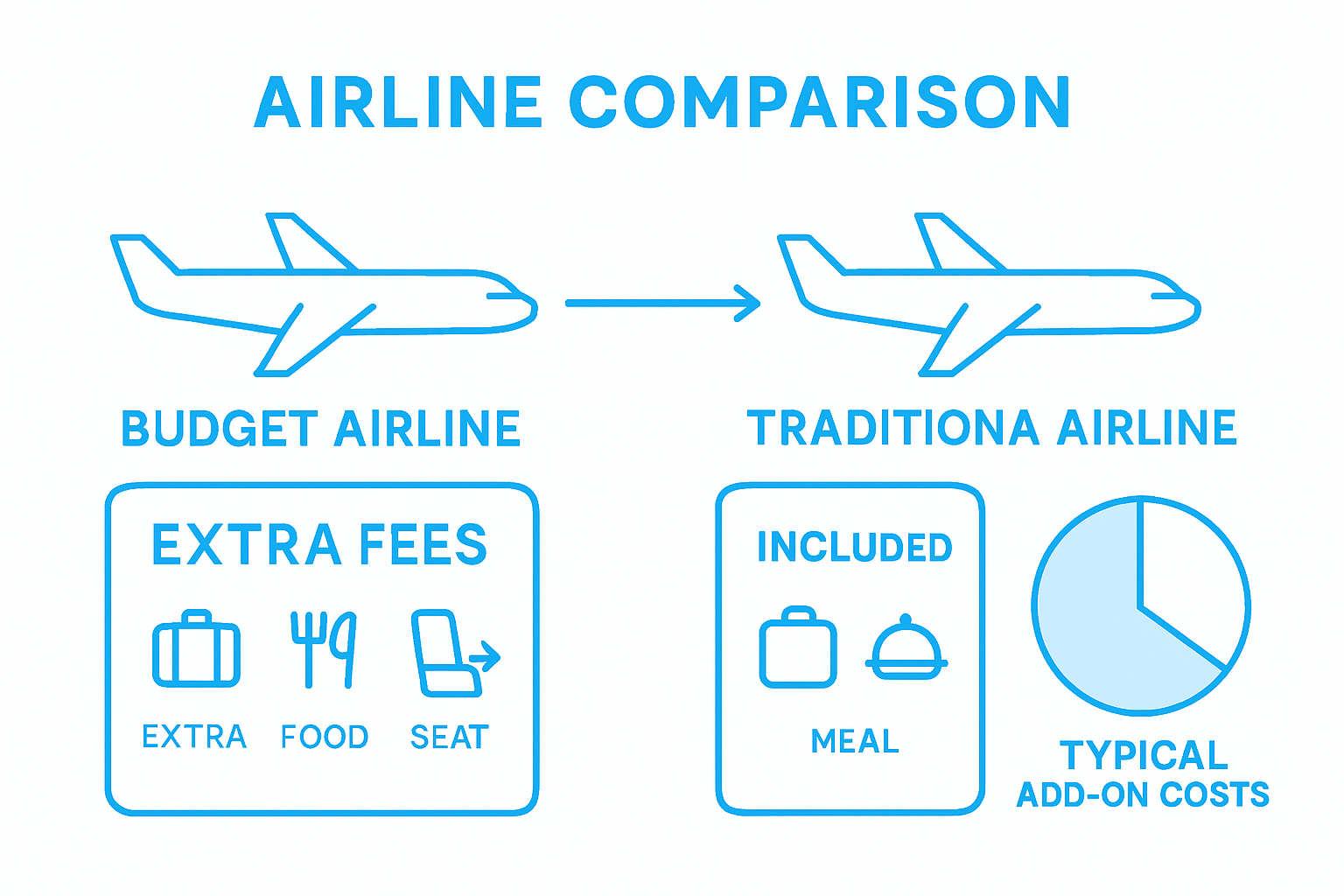
Budget airlines achieve lower fares by operating with significantly reduced overhead costs, creating a dramatically different travel ecosystem. Traditional carriers include services like complimentary meals, assigned seating, and checked baggage in their ticket prices, while budget airlines charge separately for each of these amenities. This approach allows budget airlines to offer base fares that can be up to 70% lower than traditional carriers.
Ultimately, the choice between budget and traditional airlines depends on individual traveler preferences, trip requirements, and personal budget constraints. Savvy travelers understand that each model offers unique advantages – budget airlines provide extreme affordability and flexibility, while traditional carriers offer comprehensive comfort and convenience. The key is understanding your specific travel needs and selecting the airline model that best matches your priorities and financial considerations.
Hidden Costs and How to Save Money
Budget airlines operate on a complex pricing strategy that requires travelers to carefully navigate potential hidden expenses, transforming the traditional understanding of ticket pricing. While base fares appear incredibly attractive, smart travelers must anticipate and strategically manage additional charges to maintain their overall travel budget.
Common Hidden Costs Travelers Encounter:
-
Baggage Fees
- Checked luggage charges
- Overweight luggage penalties
- Carry-on bag restrictions
-
Check-In Expenses
- Online vs. airport check-in fees
- Printing boarding passes
-
Seat Selection Charges
- Premium seat assignments
- Exit row pricing
- Family seating arrangements
Budget travelers can significantly reduce unexpected expenses by understanding airline fee structures in advance, which allows for more accurate total trip cost calculations. Proactive strategies like packing light, checking baggage restrictions beforehand, and avoiding last-minute service additions can help minimize these additional charges.
The ultimate goal is transforming budget airline travel from a potential financial minefield into a strategic, cost-effective transportation option. Savvy passengers approach these airlines with a calculated mindset, treating each potential fee as a negotiable expense. By understanding the nuanced pricing model, researching specific airline policies, and planning meticulously, travelers can unlock substantial savings while enjoying the fundamental benefit of dramatically reduced base fares.
Discover How Budget Airline Travel Can Save You More on Every Trip
Understanding the true cost of traveling with budget airlines can be overwhelming. You want to enjoy affordable fares without hidden fees and confusing add-ons. This article breaks down key concepts like unbundled services and baggage fees so you can make smarter choices. But why stop at knowledge when you can take action to secure the best travel deals now

Start mastering budget travel with ease through PilotTravelDeals.com, your trusted platform to compare and snag the deepest discounts on flights and more. Visit our Uncategorized – PilotTravelDeals.com section to explore real traveler tips and travel hacks related to budget airlines. For insights beyond airfare, check out Miscellaneous – PilotTravelDeals.com. Don’t wait to transform the way you travel. Head to PilotTravelDeals.com to plan your next adventure with unbeatable savings today.
Frequently Asked Questions
What are budget airlines?
Budget airlines, also known as low-cost carriers (LCCs), are airlines that offer significantly lower ticket prices by minimizing operational costs and providing fewer included services.
How do budget airlines differ from traditional airlines?
Budget airlines focus on providing ultra-low base fares with a la carte service fees, while traditional airlines typically include more comprehensive services in their higher base fares.
Are budget airlines safe to fly?
Yes, budget airlines adhere to the same rigorous safety standards and regulations as traditional airlines, ensuring passenger safety during travel.
What should I expect in terms of fees when flying with budget airlines?
Budget airlines often charge additional fees for services like checked luggage, seat selection, in-flight meals, and priority boarding, which are separate from the base ticket price.