Travel plans rarely go exactly as expected, especially when solo adventurers juggle changing work schedules or families face unpredictable school calendars. Flexibility in booking is now more than a perk, it is a lifeline for anyone who wants control over their itinerary without risking heavy financial penalties. Discover how flexible booking policies provide peace of mind, challenge common myths, and help you protect your travel budget even when life throws a curveball.
Table of Contents
- Flexible Booking Defined And Common Myths
- Types Of Flexible Booking Options Explained
- How Flexible Booking Systems Benefit Travelers
- Comparing Flexible And Non-Flexible Deals
- Potential Costs, Limitations, And Savings
Key Takeaways
| Point | Details |
|---|---|
| Understand Flexible Booking | Flexible booking allows modifications or cancellations without heavy penalties, providing crucial control over travel plans. |
| Myths to Dispel | Many believe flexible options are always more expensive; however, they can often be competitively priced and save money by avoiding last-minute penalties. |
| Types of Flexible Options | Familiarize yourself with types like free cancellation, date modification, pay-later options, and partial refunds to select the best for your needs. |
| Cost-Benefit Analysis | Analyze the upfront cost versus potential savings from avoiding penalties to determine if flexible bookings are worth the investment for your situation. |
Flexible Booking Defined and Common Myths
Flexible booking means booking travel arrangements (flights, hotels, car rentals) with the ability to modify or cancel your reservation without heavy financial penalties. Rather than being locked into rigid dates and non-refundable rates, flexible booking gives you control over your travel plans when life gets unpredictable. This approach has become increasingly valuable for budget-conscious travelers because it lets you secure a reservation without the pressure of committing to fixed dates that might change. Flexible booking policies shift away from traditional all-or-nothing booking models by allowing date changes, cancellations, and reduced upfront commitments, which directly addresses how modern travel rarely stays perfectly on schedule.
However, several myths about flexible booking persist and prevent travelers from taking full advantage of these options. The biggest misconception is that flexible booking always costs significantly more upfront. While some flexible rates do carry higher initial prices, many providers now offer flexible options at competitive rates, and the actual savings come from avoiding last-minute penalties or losing entire deposits when plans change. Another common myth is that “flexible” means uncertain or risky for the travel provider. In reality, flexible booking enables travelers to modify bookings without heavy fees, which actually improves customer satisfaction and repeat bookings rather than creating chaos. Many solo travelers and families also believe flexible booking is only useful for corporate or last-minute travel. This ignores the reality that personal travel plans shift constantly: a family emergency might force date changes, a job opportunity could accelerate your timeline, or seasonal weather patterns might make different dates more appealing. Even budget-conscious planners who book months in advance benefit because flexibility provides a safety net against the unexpected.
The distinction between refundable and flexible bookings also creates confusion. Refundable bookings return your full payment if canceled, while flexible bookings allow you to change dates or other details with minimal fees, though your money stays within the system. Some providers combine both benefits. On comparison platforms like PilotTravelDeals.com, you can filter bookings by flexibility options, letting you identify exactly what changes are permitted before committing. This transparency helps you choose the right level of flexibility for your specific trip.
Pro tip: When comparing prices on deal sites, always check the cancellation and modification policies attached to the rate, not just the nightly cost, since a cheaper rate with heavy penalties often costs more in the long run than a moderately priced flexible option.
Types of Flexible Booking Options Explained
Flexible booking comes in several distinct varieties, each designed to address different travel scenarios and concerns. Understanding these options helps you select the right protection level for your specific trip. The main types break down into categories that airlines, hotels, and car rental companies now commonly offer.
Free cancellation policies represent the most straightforward flexible option. You can cancel your reservation up to a specified date, usually 24 to 72 hours before arrival, and receive a full refund with no penalties. This works well for leisure travelers who book weeks or months ahead but want an escape route if plans shift. Free cancellation policies accommodate sudden schedule shifts with lower penalties than traditional bookings, making them ideal for families managing school calendars or solo travelers with unpredictable work schedules. Hotels frequently advertise free cancellation as a selling point, and many airlines now offer this as a standard or low-cost upgrade.
Date modification options allow you to change your travel dates without losing your reservation or paying full rebooking fees. Instead of a flat cancellation fee, you pay only the difference between your original rate and the new date’s rate. If you booked a hotel at $120 per night and want to shift your stay to a higher-demand period that costs $150, you pay the $30 difference. This flexibility proves invaluable for solo adventurers dealing with work deadlines or families navigating unexpected events. Some providers waive the difference entirely if the new dates are cheaper, putting money back in your account.
Pay-later options eliminate upfront financial pressure by letting you reserve now and pay closer to your travel date. You secure your rate and availability without handing over payment immediately, reducing the risk of losing money if circumstances change before you pay. This benefits budget-conscious travelers who want to confirm plans with travel companions or await paycheck timing before committing funds.
Partial refund policies fall somewhere between rigid bookings and full cancellation coverage. You receive a portion of your payment back if you cancel, typically 50 to 75 percent, balancing the provider’s need for revenue protection with your need for flexibility. The remaining amount usually applies as a credit toward future bookings, keeping your money within the travel ecosystem rather than losing it entirely.
When using comparison platforms like PilotTravelDeals.com, you can filter by these specific flexible options to identify exactly which type aligns with your travel style and comfort level.
Pro tip: Stack your flexibility by combining a hotel with free cancellation, an airline with date change options, and a pay-later car rental to maximize your safety net across all aspects of your trip.
Here’s a summary of popular flexible booking types and who benefits most:
| Flexible Option | Key Benefit | Ideal For |
|---|---|---|
| Free cancellation | Risk-free trip adjustment | Families, early planners |
| Date modification | Easy rescheduling | Solo travelers, freelancers |
| Pay-later | No upfront payment stress | Budget travelers, groups |
| Partial refund | Some money back if canceled | Casual travelers, seasonal shifts |
How Flexible Booking Systems Benefit Travelers
Flexible booking systems transform how you approach travel planning by removing the stress that comes with rigid reservations. When you book with flexibility built in, you gain the ability to make changes without financial penalties hanging over your head. This shift fundamentally changes your travel experience because you can book with confidence rather than anxiety. Flexible bookings significantly reduce travel stress by enabling last-minute adjustments without significant penalties, which means you can adjust your plans as your circumstances evolve without dreading the cost of cancellation fees.
The practical benefits extend across several key areas of your travel life. First, you can book earlier without fear. Budget-conscious travelers typically want to lock in lower rates weeks ahead, but rigid bookings force you to choose between cheaper prices and uncertainty about whether your dates will work out. Flexible systems let you have both. You secure favorable rates while maintaining the option to shift dates if a work conflict emerges, a family emergency disrupts your timeline, or a better travel window opens up. Second, you avoid the domino effect of cascading cancellations. If your flight changes unexpectedly, a flexible hotel booking lets you adjust without losing your deposit, preventing one problem from creating multiple financial losses. Third, you can respond to life’s unpredictability without paralysis. Solo travelers with unstable work schedules, families managing school calendars, and freelancers juggling multiple projects all benefit from this agility.
Flexible booking systems provide peace of mind through clear cancellation and amendment policies that remove uncertainty from the planning process. You know exactly what can change, when you can change it, and what it will cost, which eliminates the surprise fees that derail budgets. This transparency enables better financial planning because you can calculate your actual costs upfront rather than hoping nothing goes wrong. Flexible systems also empower you with control over your itinerary, shifting from a model where providers dictate restrictions to one where you shape your own travel experience. This customer-centric approach means providers compete on flexibility, driving better options across airlines, hotels, and car rentals. For families specifically, flexible bookings reduce the guilt associated with changing plans due to unexpected childcare needs or school scheduling. For solo travelers, they eliminate the pressure of committing to dates months in advance when work situations remain unpredictable.
The financial advantage becomes clearer when you compare total costs rather than just base rates. A slightly higher upfront price for flexible options often proves cheaper than losing an entire deposit on a rigid booking that you ultimately cannot use. Comparison platforms like PilotTravelDeals.com let you see both the base rate and flexibility options, enabling you to make informed decisions about what protection level your situation actually requires.
Pro tip: Book your primary accommodations with free cancellation, then search for flights with date change options, giving you multiple adjustment points if plans shift without needing to cancel everything.
Comparing Flexible and Non-Flexible Deals
Choosing between flexible and non-flexible deals requires understanding the real trade-offs involved. The core difference sits squarely on a spectrum between price and control. Non-flexible deals typically offer lower upfront prices because you’re accepting restrictions in exchange for that discount. You pay less money but commit to fixed dates with no refunds, meaning if circumstances change, you lose your entire investment. Flexible deals cost more upfront but provide the ability to alter travel plans with minimal penalties, giving you an escape route if life intervenes. The question becomes not which option is universally better, but which aligns with your specific situation and risk tolerance.
When your travel plans are absolutely locked in, non-flexible deals make financial sense. If you’ve confirmed dates with family, committed to a conference, or booked around fixed vacation time that cannot shift, the lowest price wins. You save money by eliminating the flexibility premium you don’t need. However, this strategy fails spectacularly when plans actually change. Solo travelers with unpredictable work, families with school-aged children, and freelancers managing client deadlines should scrutinize non-flexible bookings carefully. The savings disappear instantly if you need to cancel and rebook. Budget-conscious travelers often discover too late that saving $50 on a non-flexible hotel means losing $400 when an unexpected situation forces cancellation.

Flexible deals allow free cancellation or changes up to a deadline at a higher price point but with lower risk of financial loss. This protective layer costs something real. You might pay 15 to 25 percent more for the same accommodation with flexibility included. The critical calculation involves asking yourself: what is the probability I’ll need to change these plans, and what would it cost me if I do? If that probability is low and your plans genuinely feel confirmed, non-flexible pricing makes sense. If uncertainty exists at all, the flexible option becomes insurance you’re actually likely to use.
Modern travelers increasingly recognize that uncertainty is not a flaw in planning but a reality of contemporary life. Work schedules change. Family emergencies happen. Travel companions shift plans. Rather than pretending these situations won’t occur, building flexibility into your bookings acknowledges how life actually works. The price difference between flexible and non-flexible options often shrinks when you account for the cost of rebooking at worse rates or losing deposits entirely.
Quick comparison: A non-flexible flight at $280 versus a flexible flight at $320 seems like a $40 difference. But if you need to cancel the non-flexible ticket and rebook at $420, your total cost becomes $560 while the flexible option only required the original $320. Platforms like PilotTravelDeals.com display both options side by side, letting you see exactly what flexibility costs and make that decision with full information.
Pro tip: Use non-flexible rates only for trips where every detail is genuinely confirmed, and default to flexible bookings for anything with even minor uncertainty about dates or plans.
This table compares the financial impact of flexible and non-flexible bookings:
| Booking Type | Upfront Cost | If Plans Change | Overall Value |
|---|---|---|---|
| Non-flexible | Lower price | Lose full amount | Good only for fixed plans |
| Flexible | 10-25% higher | Minimal or no penalty | Best for uncertain dates |
Potential Costs, Limitations, and Savings
Flexible booking comes with real costs that you need to understand upfront. The most obvious expense is the price premium. Flexible rates typically run 10 to 25 percent higher than their non-flexible counterparts for the same accommodation or flight. A hotel room at $100 per night with a non-refundable rate might cost $115 to $125 with flexible cancellation included. This premium represents what flexibility actually costs in the market. Airlines charge similar premiums for changeable tickets compared to basic economy fares locked in stone. For budget-conscious travelers booking multiple accommodations or flights, these premiums stack up across your entire itinerary. However, flexible bookings reduce financial losses from last-minute cancellations or modifications, which often proves more economical than losing entire deposits.
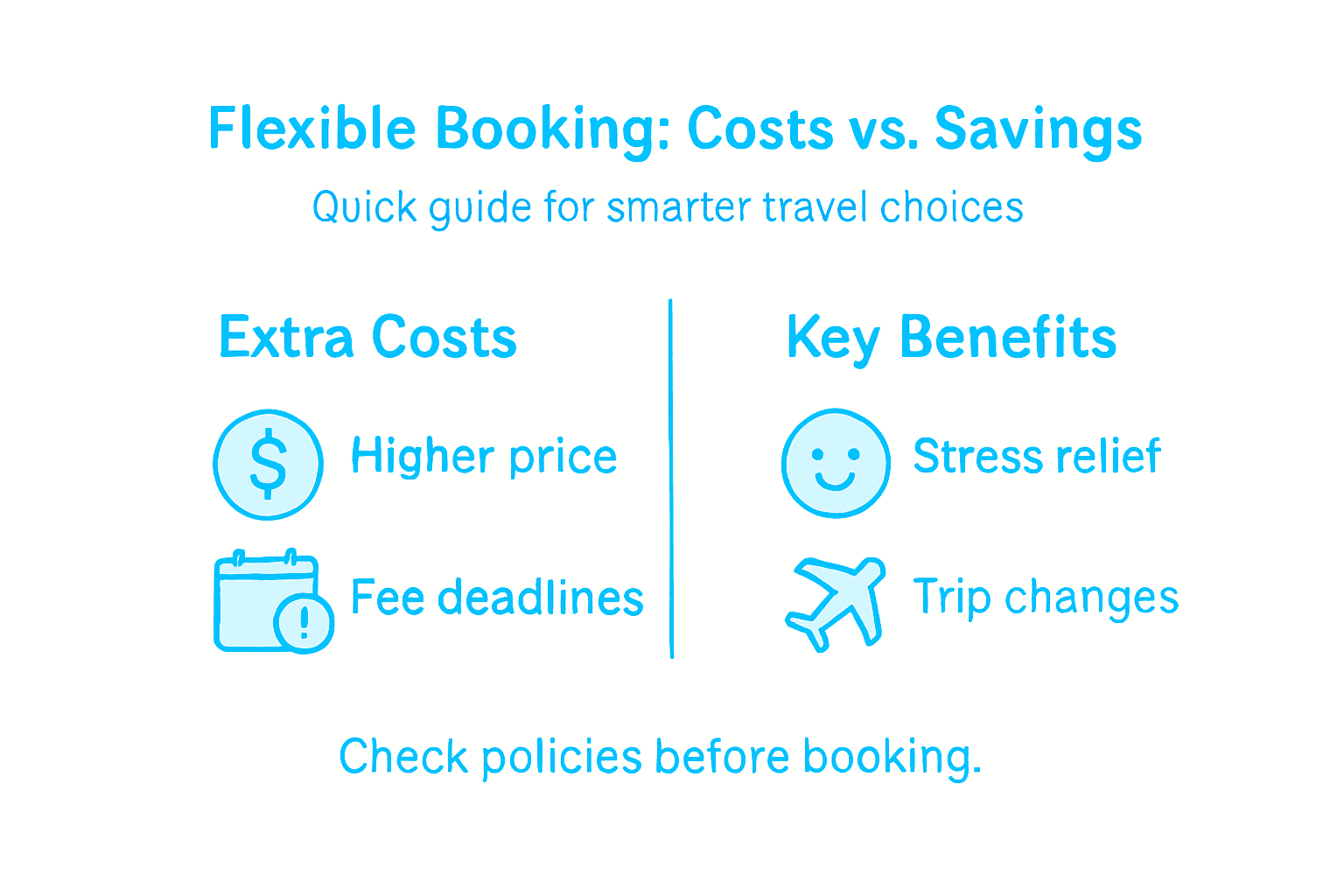
Beyond upfront costs, flexibility comes with specific limitations you must understand before booking. Most policies include cutoff times for free cancellations or changes. You might get free cancellation up to 48 hours before arrival, but canceling 24 hours before means you forfeit everything. Some providers require changes to be made during business hours or through specific channels. Date modifications sometimes involve paying the difference between your original rate and the new date’s rate. If you originally booked at $100 per night and shift to peak season dates at $150, you owe the $50 difference even with a flexible policy. Eligibility criteria also matter. Some flexible rates exclude certain room types or dates, or they may not be available during peak travel seasons. Understanding these boundaries prevents surprises when you actually need to make changes.
The real financial calculation involves comparing what you save against what flexibility costs. Flexible bookings save money by eliminating expensive change or cancellation penalties that rigid bookings impose. Imagine booking a non-flexible hotel at $90 per night for five nights, totaling $450. If you need to cancel, you lose the entire amount. That scenario costs you $450. Alternatively, booking the same hotel with flexibility at $105 per night costs $525 total. If you cancel using the flexible option, you lose nothing. In this case, the flexibility premium of $75 protected you from losing $450, making the premium an excellent investment. The math shifts when your plans definitely will not change. If you’re 100 percent certain your dates are fixed, the non-flexible option saves real money.
For solo travelers managing unpredictable work schedules, families with school-age children, and anyone booking several months in advance, the savings from avoiding penalties typically exceed the upfront flexibility premium. Budget-conscious travelers often find that when they account for the real possibility of schedule changes, flexible bookings deliver better financial outcomes. Platforms like PilotTravelDeals.com show you both the base rate and the premium cost side by side, allowing you to calculate the actual difference and decide whether that premium represents worthwhile protection for your situation.
Pro tip: Calculate your breakeven point by comparing the flexibility premium against the total cost of your booking, then honestly assess the probability you’ll need to change plans, because that determines whether flexibility is worth the extra investment.
Discover Flexible Booking Deals That Fit Your Life
The challenge of unpredictable plans can make booking travel overwhelming. If you want control over your trip without risking heavy penalties or lost deposits, flexible booking options are your solution. This article highlights the importance of free cancellation policies, date modification options, and pay-later deals to safeguard your travel investments. At PilotTravelDeals.com, we understand how crucial it is for modern travelers—whether solo adventurers, families, or budget-conscious planners—to find bookings that adapt to life’s changes.

Start exploring an extensive selection of flexible flight and hotel deals today with our easy-to-use platform. Tap into Travel Tips – PilotTravelDeals.com to learn how to maximize savings while securing flexible travel. Don’t wait until uncertainty forces costly last-minute changes. Visit PilotTravelDeals.com now and turn travel unpredictability into confidence by choosing options tailored for flexibility and value. For a broad range of unique offerings, check out Miscellaneous – PilotTravelDeals.com and gain insider access to deals that keep your plans fluid and your budget secure.
Frequently Asked Questions
What is flexible booking and why is it important for travelers?
Flexible booking allows travelers to modify or cancel their reservations without heavy penalties, providing peace of mind in case plans change. This is crucial in today’s unpredictable environment, helping travelers avoid financial loss.
How do flexible booking options work?
Flexible booking options include free cancellation, date modification, pay-later options, and partial refunds. Each type offers different levels of flexibility to accommodate various travel scenarios, allowing travelers to adjust their plans as necessary.
Are flexible bookings usually more expensive than non-flexible options?
Yes, flexible bookings often come with a price premium of 10 to 25 percent more than non-flexible options. However, the additional cost often outweighs the risk of losing money on non-refundable bookings when plans change.
What are the potential limitations of flexible booking policies?
Most flexible booking policies have cutoff times for cancellations and may charge fees for certain modifications. Additionally, some options may not be available during peak travel seasons or for specific room types, so it’s essential to read the terms carefully.