
TL;DR:
- Comparing multiple booking channels and using refundable rates optimize hotel savings.
- Timing your booking 30 to 60 days in advance often yields the best prices.
- Flexibility and monitoring prices regularly are key to capturing hotel discounts and avoiding extra fees.
Most travelers assume that the cheapest hotel deal is always sitting right there on their favorite booking app. That assumption costs real money. The truth is that hotel prices shift constantly, and no single platform wins every time. Knowing how to layer your strategies, picking the right booking window, using the right tools, and sidestepping hidden fees, is what separates budget travelers who consistently save from those who overpay for the same room. This guide walks you through every step, from where to look to how to rebook after prices drop, so you walk away with a practical system you can use before your next checkout.
Table of Contents
- Understand your booking options: Where and how to hunt for hotel deals
- Time your booking: How booking dates change hotel prices
- Compare, monitor, and rebook: Advanced tactics for slashing hotel rates
- Avoid common pitfalls: Fees, rate types, and reward traps
- The real secret: Flexibility beats loyalty every time
- Ready to put these hotel booking tips into action?
- Frequently asked questions
Key Takeaways
| Point | Details |
|---|---|
| Compare all booking sites | Don’t rely on one website—always compare several channels to get the lowest rate. |
| Book flexible, monitor prices | Choose refundable rates and check for price drops so you can rebook and save money. |
| Avoid hidden fees | Read the fine print on rates and look for add-on fees to ensure the deal is truly the best. |
| Timing matters | Your booking window can seriously affect prices, with last-minute and midweek reservations often cheaper. |
Understand your booking options: Where and how to hunt for hotel deals
With the confusion about where to find the best deals, let’s break down the different hotel booking channels available to you and what each one actually costs you in the long run.
There are four main ways to book a hotel room:
- Hotel websites directly. Brands like Marriott, Hilton, or independent boutique hotels often offer loyalty perks, free breakfast, or room upgrades for direct bookings. You get flexible cancellation terms more often here, and you avoid third-party fees. The downside is you only see one hotel’s inventory.
- Online travel agencies (OTAs). Sites like Booking.com, Expedia, and Hotels.com aggregate thousands of properties. You can filter by price, neighborhood, rating, and amenities. The tradeoff is that some listings carry service fees baked into the final price, and your cancellation relationship is technically with the OTA, not the hotel.
- Membership or private rate platforms. Services like Costco Travel, AAA, or corporate discount programs offer pre-negotiated rates. These can run 10 to 25% cheaper for qualifying members, but the deals are narrow and room selection is limited.
- Price comparison tools. Platforms like Google Hotels, Trivago, and Kayak pull rates from dozens of sources and display them side by side. They don’t book directly but send you to the cheapest confirmed source.
Here’s a quick breakdown to make the choice clearer:
| Booking channel | Best for | Watch out for |
|---|---|---|
| Hotel direct | Loyalty perks, flexibility | No rate comparison |
| OTAs | Wide selection, easy filters | Service fees, less direct support |
| Membership platforms | Guaranteed discounts for members | Limited inventory |
| Price comparison tools | Spotting the lowest rate fast | Redirects, varying cancellation terms |
The biggest mistake budget travelers make is picking one channel and sticking to it religiously. Comparison is always worth the extra three minutes. A step-by-step hotel booking process that checks at least two or three channels before confirming will almost always surface a lower rate.
One crucial point: refundable rates let you rebook when prices drop, which makes flexibility a powerful cost-saving strategy on its own. If you lock in a non-refundable rate because it looks cheap today, you lose the ability to capture a lower price tomorrow. For most budget travelers, that tradeoff simply isn’t worth it.
Research consistently shows that travelers who stay open to multiple platforms and room types save meaningfully compared to those who default to one source. The margin can be anywhere from 10% to 30% on the same property for the same dates.
Time your booking: How booking dates change hotel prices
Now that you know your options, it’s time to understand how timing your reservation can affect what you pay. The difference between booking six weeks out versus two weeks out can be $40 to $80 per night on the same room.
Here’s how average hotel prices tend to behave across booking windows:
| Time before check-in | Price behavior | Best action |
|---|---|---|
| 3 months out | Rates are moderate, high availability | Book refundable, monitor for drops |
| 1 month out | Often the sweet spot for urban hotels | Compare and confirm with refundable rate |
| 1 week out | Prices can spike for popular destinations | Rebook if you find a better rate |
| 1 to 2 days out | Last-minute deals appear but are unpredictable | Risk-tolerant travelers only |
For regular leisure trips in non-peak seasons, booking about three to four weeks ahead tends to yield competitive rates without the scarcity premium that kicks in at the last minute. For holiday weekends or major events, booking two to three months out protects you from sold-out inventory and price spikes.

Last-minute deals are real, but they are more fiction than fact for most people. Budget properties in high-demand cities like New York, Paris, or Tokyo rarely drop their prices two days before a weekend. Last-minute deals work better for flexible travelers who can adjust destination, dates, and property type on the fly, which is a small subset of real-world budget travelers.
Here’s a numbered breakdown of the smartest timing approach:
- Start monitoring prices 60 to 90 days out for trips to popular destinations or during peak travel seasons.
- Book a refundable rate at the best current price around 30 days out for most destinations.
- Check prices again 14 days out. Hotel revenue managers often adjust rates at this window.
- Check one final time 3 to 5 days before check-in. Some hotels drop rates to fill empty rooms.
- Cancel and rebook immediately if you find a lower refundable rate at the same property.
Pro Tip: Set a calendar reminder to recheck prices at each of these windows. Most travelers book and forget, missing meaningful savings that happen after their initial reservation.
Refundable rates plus price monitoring is one of the most underrated strategies in budget travel. It costs you nothing to book refundable, and it gives you the ability to act when prices fall. You can explore last-minute booking strategies for situations where spontaneity actually works, and pair that with smart hotel booking tips for a complete timing playbook.
Studies show that the average traveler overpays on hotels by 15 to 20% simply by failing to monitor prices after an initial booking, leaving real savings on the table with minimal effort required to capture them.
Compare, monitor, and rebook: Advanced tactics for slashing hotel rates
Knowing when to book helps, but comparing and monitoring rates puts you in the driver’s seat. Most budget travelers stop at the first decent price they see. Experienced deal hunters keep looking.
The most effective tools for ongoing price monitoring include:
- Google Hotels. Shows prices across OTAs and direct hotel sites in one grid. You can track a specific property and get alerts when rates change.
- Kayak. Offers a “Price Forecast” feature that predicts whether prices are likely to rise or fall based on historical data.
- Hopper. Better known for flights but increasingly useful for hotels, with color-coded calendars that show the cheapest nights.
- Trivago. Pulls rates from 400-plus booking sites, useful for a broad sweep of options in one destination.
- Hotel brand apps. Marriott Bonvoy, Hilton Honors, and IHG apps sometimes surface member rates that are invisible on third-party sites.
The system that works best is simple: book a refundable rate through the cheapest platform you find, then set a price alert for the same property through Google Hotels or Kayak. Check back at the timing windows outlined in the previous section. If prices drop, cancel and rebook at the lower rate.
“Refundable rates plus price monitoring and rebooking can capture significant price drops. Avoid non-refundable rates unless your plans are completely certain.” — timing research from HerMoney
This system is so effective because hotel pricing is dynamic. Revenue management software adjusts room rates dozens of times per day based on occupancy, competitor pricing, and demand signals. That same volatility that can push prices up can also push them down, and you want to be positioned to capture the downswing.
Pro Tip: Don’t just monitor one platform. Check the direct hotel website alongside your OTA of choice because sometimes the hotel undercuts the aggregator, especially close to your stay date.
For a deeper look at platform selection, smart ways to save on hotels covers more advanced comparison approaches. And if you want to understand how to evaluate which deal is genuinely better across multiple variables, choosing the best travel deals gives you a practical decision framework.
Avoid common pitfalls: Fees, rate types, and reward traps
Mastering deal hunting is crucial, but sidestepping common mistakes ensures your savings aren’t wiped out before you even check in. The hotel industry has become creative with fees, and budget travelers often underestimate their impact.
The most common hidden costs that inflate your hotel bill:
- Resort fees. Common at Las Vegas hotels and beach properties, these can add $30 to $50 per night and aren’t always shown upfront. Always scroll to the final price breakdown.
- Destination fees. Urban hotels in cities like New York now charge “destination fees” that bundle amenities you may never use, like a gym credit or bottled water.
- Parking. Self-parking at a mid-range city hotel can cost $25 to $45 per night. Valet can exceed $60.
- Breakfast. Many European hotel rates advertise “breakfast included” as a selling point, but when you compare the base rate without breakfast, it’s often cheaper to eat locally.
- Taxes and local levies. City hotel taxes in places like Chicago, San Francisco, or Amsterdam can add 15 to 25% on top of the base rate.
Pro Tip: Always click through to the final payment page before confirming a booking to see the total price with all taxes and fees. A rate that looks $30 cheaper can easily become $20 more expensive after fees.
Beyond fees, non-refundable rates deserve a direct warning. They look attractive because they’re typically 10 to 15% cheaper than refundable rates. But if your plans shift even slightly, you lose that money. Travel disruptions, flight cancellations, and schedule changes are common. According to timing research on hotel flexibility, avoiding non-refundable rates unless you are completely certain about your plans is strongly recommended for budget-conscious travelers.
On the loyalty points question: hotel reward programs are not bad, but they are often oversold. If chasing points leads you to book a more expensive hotel or a non-refundable rate, you are trading real dollars for hypothetical future value. Points programs devalue over time, add-on fees can erode rewards, and for infrequent travelers the benefits rarely materialize. Direct cash savings beat abstract points almost every time. You can review an essential hotel booking tips checklist that covers all these pitfalls in a single quick reference.
The cleanest rule for budget travelers: calculate the total price after all fees, always book refundable unless you are 100% certain of your plans, and treat loyalty points as a bonus rather than a primary goal.
The real secret: Flexibility beats loyalty every time
Let’s wrap up with a reality check on what makes the biggest difference for your hotel budget.
Most travelers we hear from fall into one of two camps. The first books everything through one app out of habit. The second obsessively chases hotel points and status, sometimes paying more per night just to hit a tier threshold. Neither camp consistently gets the best prices. Flexible travelers do.
Here’s a scenario we see often. Two travelers book the same hotel in Barcelona for the same dates. Traveler A locks in a non-refundable rate three months out at $140 per night because it looks like a deal. Traveler B books a refundable rate at $155 per night the same day. Four weeks later, prices drop. Traveler B cancels and rebooks at $118 per night. Traveler A pays $22 more per night with zero recourse.
That’s not a hypothetical. That’s how dynamic hotel pricing actually works. The hotel booking essentials we recommend are built around this reality: flexibility is the strategy, and every other tactic supports it.
The willingness to rebook, to check prices twice, and to refuse a non-refundable rate when your plans aren’t locked is worth more than any loyalty program or single-platform habit. Build your hotel booking process around flexibility and comparison, and savings become a predictable outcome rather than a lucky accident.
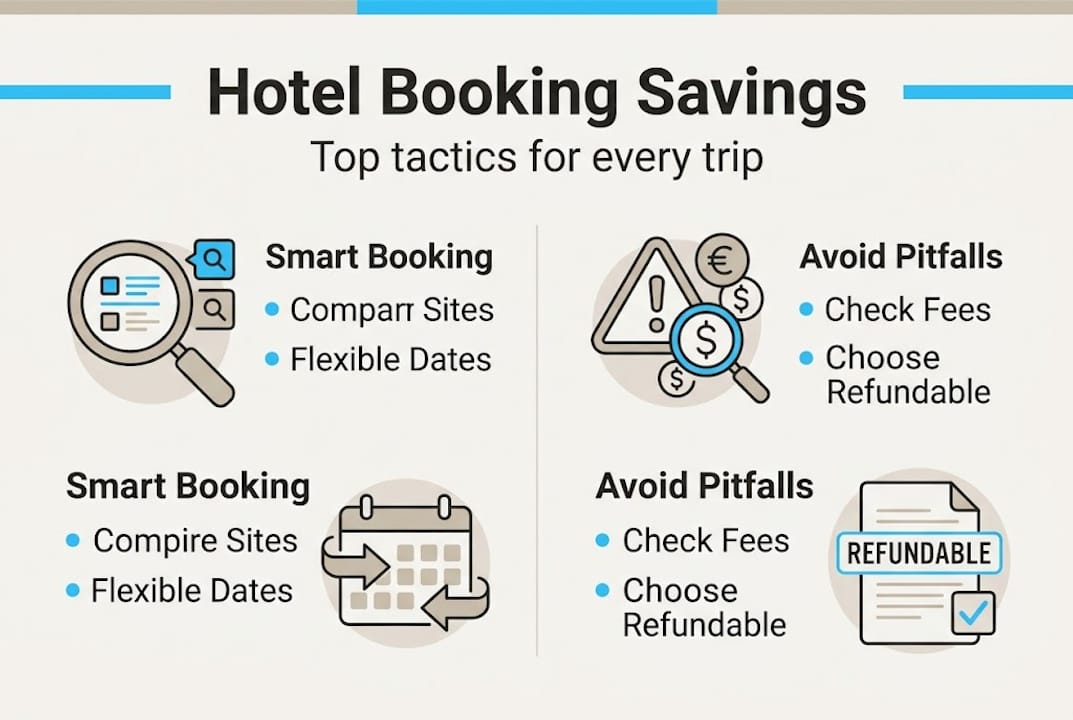
Ready to put these hotel booking tips into action?
You’ve got the framework. Now it’s time to apply it. At PilotTravelDeals.com, we’ve built a platform specifically for budget travelers who want to stop guessing and start saving with confidence.

When you’re ready to search for your next stay, use our tools to compare hotel deals across multiple providers in seconds, all in one place. We aggregate rates so you don’t have to tab-hop across a dozen sites. And if you want to go deeper, our guides on more hotel savings strategies give you advanced tactics for every type of trip. From quick weekend getaways to month-long adventures, we have the resources to help you book smarter, not just cheaper.
Frequently asked questions
Is it cheaper to book hotels last minute or in advance?
Hotel prices often drop close to the stay date in some markets, but booking a refundable rate early and rebooking when prices fall gives you the best of both approaches without the risk of sold-out availability.
What are the biggest extra fees to watch for when booking hotels?
Resort fees, local taxes, parking, and breakfast charges are the most common add-ons that inflate the final bill, and many don’t appear until the payment screen. Always check the total price breakdown before confirming your reservation.
Does booking direct with hotels really get you better rates?
Direct bookings sometimes come with perks like free upgrades or flexible cancellation, but comparison shopping across multiple platforms frequently surfaces a lower base rate than what the hotel advertises on its own website.
Are non-refundable hotel rates worth the risk for savings?
Only choose a non-refundable rate if your travel dates and plans are completely confirmed, because avoiding non-refundable bookings is the smart move when there’s any chance your schedule could change.
What is the best strategy for getting hotel price drops after booking?
Book a refundable rate, then monitor prices regularly through Google Hotels or Kayak alerts so you can cancel and rebook instantly if a lower rate appears before your check-in date.
Recommended
- 8 Smart Ways to Save on Hotels for Every Type of Traveler – PilotTravelDeals.com
- How to Book Multiple Flights and Save Money on Every Trip – PilotTravelDeals.com
- Step by Step Travel Booking: Save More on Your Next Trip – PilotTravelDeals.com
- How to Travel on a Budget and Save More on Every Trip – PilotTravelDeals.com