TL;DR:
- Airlines often drop fares close to departure, especially for unsold seats, if you act fast.
- Flexibility in dates, airports, and destinations significantly increases chances of finding last-minute deals.
- Setting up alerts on multiple travel apps and acting quickly upon deal notifications is crucial for savings.
You open your laptop, punch in a last-minute flight search, and the prices feel like a penalty for not planning ahead. It stings. But here’s what most travelers don’t realize: airlines routinely drop fares on unsold seats close to departure, and the right tools can put you first in line for those deals. This guide walks you through exactly how to set yourself up, search smarter, act faster, and land a genuinely affordable ticket even when your departure window is measured in hours, not weeks.
Table of Contents
- What you need before starting your search
- Maximize flexibility for lower fares
- Use flight tracking tools and alerts for real-time deals
- Act fast: how to secure a short notice flight
- Why most travelers miss out on true last-minute flight deals
- Get more travel for your money with PilotTravelDeals
- Frequently asked questions
Key Takeaways
| Point | Details |
|---|---|
| Flexibility saves money | Open travel plans help you find the lowest last-minute fares. |
| Set alerts early | Flight tracking tools notify you the moment prices drop on your route. |
| Act fast on deals | Hesitation can mean missing out as prices change within seconds. |
| Prepare before searching | Have all documents and payment ready for instant booking. |
What you need before starting your search
Now that you know last-minute flights don’t have to break the bank, let’s look at what you’ll need to have in place before you search. Think of this stage like laying out your gear before a race. If you’re fumbling for your credit card while a discounted fare disappears, you’ve already lost.
Documents and payment: get them within arm’s reach
Before you open a single search tab, gather everything required to complete a booking in under two minutes. That means:
- Your passport or government-issued ID (and expiration date memorized or noted)
- A credit or debit card that has enough available credit for a round trip, plus room for fees
- Your frequent flyer numbers for any airline programs you belong to
- The email address tied to your travel accounts so confirmation emails land instantly
Sounds simple, but under time pressure even basic steps become obstacles. A deal that’s live at 6:03 PM may be gone by 6:07 PM. Having every piece of information ready removes friction from the process.
Set up accounts on the right platforms
You need active accounts, not just apps downloaded. The difference matters because creating an account mid-search adds 90 seconds of form-filling right when you need to move fast. Prioritize these platforms:
| Platform | Primary strength | Alert type available |
|---|---|---|
| Google Flights | Route and date tracking | Price drop notifications |
| Skyscanner | “Everywhere” destination search | Email alerts |
| Hopper | AI-based price prediction | Push notifications |
| Kayak | Price forecast and filters | Email and app alerts |
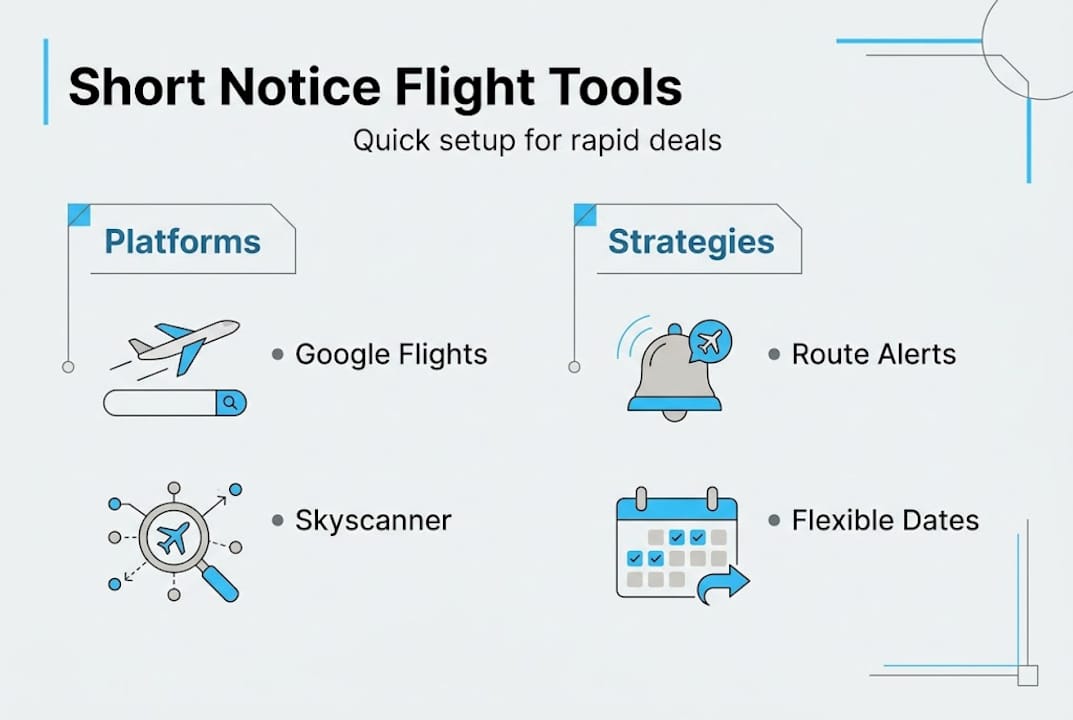
Each of these tools gives you a slightly different angle on available inventory. Google Flights is the starting point for most experienced deal hunters because it supports tracking specific flights, routes, and dates with automated price drop alerts sent directly to your inbox.
Create a dedicated travel email filter
One often-overlooked setup step is filtering your inbox so price alert emails from these platforms skip the promotions tab and land in your primary folder. On Gmail, right-click any flight alert email, choose “Filter messages like this,” and set it to “Never send to spam” and “Always mark as important.” This tiny move means you won’t miss a flash deal while it’s still live.
Pro Tip: Check out these proven tips to find cheap flights before your next search session to build habits that work whether you’re booking three days out or three weeks out.
Have a backup payment method ready
Cards get declined. It happens at the worst possible moments. Keep a secondary payment method logged into your browser’s autofill or your PayPal account authenticated. That redundancy has saved more than a few spontaneous trips from collapsing at the checkout screen.
Maximize flexibility for lower fares
With the basics ready, the next key step is maximizing your chance to find true deals: flexibility. This is where most budget travelers leave real money on the table. They search with rigid parameters, then complain that last-minute flights are always expensive. The two things are directly connected.
Why rigidity kills deals
When you lock in a specific airport, a specific date, and a specific destination, you’re competing for the same narrow slice of inventory as every other traveler with the same fixed plans. The moment you loosen even one of those constraints, your available options multiply dramatically. Being flexible with dates, airports, and destinations is one of the most reliable ways to increase your odds of landing a genuine last-minute deal.

Comparison: flexible vs. rigid search outcomes
| Search parameter | Rigid approach | Flexible approach |
|---|---|---|
| Departure airport | One specific airport | Any airport within 100 miles |
| Travel dates | One fixed date | Any day within a 5-day window |
| Destination | One city | Any warm-weather destination |
| Average fare options | Limited, often expensive | Significantly broader, often 30-60% cheaper |
The numbers in that table aren’t hypothetical. Travelers who search with open destination tools routinely find fares that rigid searchers never even see.
Practical flexibility tactics
Here are the adjustments that make the biggest difference:
- Nearby airports: Flying out of a smaller regional airport instead of a major hub can shave $80 to $200 off a domestic ticket. For international routes, the savings can be even larger.
- Date shifting: Moving your departure by even one day, especially from Friday to Thursday or Sunday to Monday, can produce meaningfully lower fares.
- Open destinations: If your goal is a beach or a mountain town rather than one specific city, use Skyscanner’s “Everywhere” feature to search all destinations simultaneously and sort by price.
- One-way combinations: Sometimes two separate one-way tickets on different airlines beat a round-trip fare by a wide margin.
Understanding why flexible travel dates matter is genuinely one of the highest-leverage skills you can build as a budget traveler. Once you internalize it, you’ll never approach a flight search the same way again.
Pro Tip: Use a destination-agnostic tool like Skyscanner’s “Everywhere” search as your very first move. Let the price map show you where flights are cheapest right now, then decide where you want to go. This reverses the normal decision order and consistently surfaces deals that goal-first searching misses. You can also explore the complete guide to flexible travel dates to sharpen your approach even further.
The advantages of flexible travel dates go beyond just price. Flexible travelers also face less competition for seats, encounter fewer sold-out situations, and often end up with better flight times simply because they had more options to choose from.
Use flight tracking tools and alerts for real-time deals
After you’ve set your search parameters, harness technology to catch fleeting deals as soon as they appear. Manual searching is reactive. Alert-based searching is proactive. The difference in results is significant.
Step-by-step: setting up Google Flights price alerts
- Go to Google Flights and enter your origin city.
- In the destination field, either type a specific city or leave it open if you want to browse.
- Select your approximate travel dates or use the “Flexible dates” option.
- Click the toggle that says “Track prices” near the top of the search results.
- Make sure you’re signed into your Google account so the alert saves properly.
- Choose whether you want alerts for that specific flight or the entire route.
- Check your Gmail regularly, or enable Google app notifications on your phone.
That’s it. Google Flights will notify you of price drops on both specific flights and broader route trends, including changes in the minimum monthly price for a given corridor. This is especially powerful when you’re watching a route but haven’t committed to exact dates yet.
Why “any dates” alerts are particularly powerful
If you can genuinely travel on short notice with no fixed date in mind, set your alert to cover the broadest possible date range. Google Flights will flag whenever the monthly minimum for your chosen route drops. Hopper takes this a step further with its machine learning price engine, which predicts whether a fare is likely to rise or fall and sends a push alert when it recommends buying immediately.
“Last-minute flight prices can change in seconds. The moment a deal appears, you need to act immediately or risk losing it entirely.” This reflects the reality that last-minute prices shift rapidly, making alert-based monitoring far more effective than periodic manual checks.
Combine multiple platforms for maximum coverage
No single tool surfaces every deal. Each platform draws from slightly different inventory pools and airline feeds. Running alerts on three platforms simultaneously means you’re covering far more ground:
- Google Flights for broad route tracking and Gmail integration
- Hopper for AI predictions and push notifications when prices bottom out
- Skyscanner for international routes and the “Everywhere” destination feature
Pro Tip: Check random cheap flight deals regularly to see what’s genuinely on sale right now, even before your alerts fire. Flash sales sometimes appear and disappear before automated systems catch them.
Running this three-platform approach costs nothing and requires maybe 15 minutes of initial setup. The return on that time investment can be hundreds of dollars saved on a single booking.
Act fast: how to secure a short notice flight
With your alerts set, swift action makes the difference between a steal and a splurge. This section is about execution, the moment between spotting a deal and actually owning your seat.
Why seconds genuinely matter
This isn’t an exaggeration for effect. Airlines use dynamic pricing systems that update in near real-time based on booking volume, time to departure, and demand signals. A fare that appears when you first click an alert link may already be at a higher price by the time you enter your payment details if you’re moving slowly. Rapid booking is essential once a deal appears, because the window on the best prices is genuinely narrow.
Quick booking checklist
Before you even start looking at flights actively, have this list checked off:
- Passport and ID information noted and accessible
- Primary credit card autofill enabled in your browser
- Secondary payment method authenticated as a backup
- Frequent flyer number stored in your browser autofill or notes app
- Email address confirmed and accessible for booking confirmation
- Travel insurance app or card benefit noted if you use it
Numbered process for booking under pressure
- Open the deal link from your alert immediately, ideally on desktop for faster form completion.
- Confirm the fare shown matches what the alert described before proceeding.
- Enter traveler details using autofill, then manually verify spelling against your ID.
- Select your seat quickly. Middle seats in the back are almost always cheaper and available.
- Skip optional add-ons on the first pass. You can often add bags or seat upgrades later.
- Enter payment details using autofill and submit without pausing.
- Screenshot the confirmation page and wait for the confirmation email before closing anything.
Common stumbling blocks that cost people their deal
Mistyping your name is surprisingly common under pressure and can cause serious problems at the airport if it doesn’t match your ID exactly. Double-check name fields before hitting submit. Payment declines are the other major hazard. If your primary card fails, don’t wait for it to cycle again. Go straight to your backup method. Delays at that stage of checkout can trigger a fare recalculation.
The habits covered in last-minute booking practices go deeper into what separates travelers who consistently execute fast from those who hesitate. Combine that with the broader top tips for last-minute travel deals to build a complete short-notice booking system.
Why most travelers miss out on true last-minute flight deals
Here’s the uncomfortable truth: the majority of people who complain about expensive last-minute flights are searching wrong, not searching unlucky. They pick a destination first, lock in a date, then look for a cheap flight to match. That sequence almost guarantees disappointment. Real last-minute savings flow in the opposite direction. The price leads. The destination follows.
What separates consistent deal-finders from frustrated shoppers is decisiveness combined with a genuinely wide net. Most travelers spend too long comparing options after a deal appears, looking for something even better. By the time they decide, the fare is gone. The essential tips to book cheap flights that actually work are almost always about speed and breadth, not cleverness or secret hacks.
The other mindset trap is overcomplicating the process. You don’t need to game airline pricing algorithms or master hidden city ticketing to save money on short notice. You need good alerts, genuine flexibility, and the discipline to act without overthinking. Travelers who book spontaneously and consistently save money aren’t lucky. They’ve just accepted that the deal sets the agenda, not the other way around.
Get more travel for your money with PilotTravelDeals
If you want to take your travel savings even further, here’s how PilotTravelDeals can help.
Spotting one great flight deal is satisfying. Building a system that finds great deals every time you need to travel is genuinely life-changing for your budget. PilotTravelDeals brings together curated deal guides, real-time flight comparisons, and practical travel hacks in one place so you’re never starting from scratch.

Beyond flights, you’ll find deep-dive resources on cheap airfare tips that walk through exactly where to look and when to book for maximum savings. And when your flight lands, the savings don’t have to stop. The cheapest hotel hacks guide covers how to find accommodations at a fraction of standard rates, so your entire trip costs less, not just the flight. Start exploring and see how far your travel budget can actually take you.
Frequently asked questions
How far in advance can I still find cheap flights?
With the right alerts and genuine flexibility, you can often find deals even 24 to 48 hours before departure. Being flexible with dates and airports significantly improves your odds of finding a workable fare in that tight window.
Which websites or apps are best for short notice flight deals?
Google Flights is the strongest starting point because you can set up price tracking alerts for specific routes and dates with minimal setup. Skyscanner and Hopper are strong complements for broader coverage and AI-driven predictions.
Is flexibility really key to finding the best last-minute fares?
Yes, it’s the single biggest factor. Flexibility with dates, airports, or destinations dramatically increases the pool of available deals and reduces head-to-head competition with other travelers for the same seats.
Should I book directly with airlines or through a third-party site?
Booking directly with the airline typically makes changes and refunds easier to manage, but third-party comparison sites often surface deals you won’t find by going straight to the airline’s website. Check both before committing to get the full picture of available fares.
How can I avoid scams when rushing to book last-minute?
Stick with well-known platforms like Google Flights, Skyscanner, or airline websites directly, and always verify the URL in your browser before entering any payment information. Urgency is exactly what scam sites count on, so take two seconds to confirm you’re on a legitimate site before you pay.
Recommended
- Best Hacks to Get Cheaper Flights for Big Savings – PilotTravelDeals.com
- How to find affordable domestic flights and save big – PilotTravelDeals.com
- Proven Tips to Find Cheap Flights and Save Big on Travel – PilotTravelDeals.com
- Best Tips for Cheap Flights: Save More on Airfare – PilotTravelDeals.com