Social media is now the primary engine of travel inspiration worldwide, moving people from idle scrolling to actual bookings through a chain of visual content, peer validation, and algorithmic nudges. Research published in PMC confirms that social media content directly influences destination perception, trip planning, and purchase intent. The platforms driving this are four: TikTok, Instagram, YouTube, and Pinterest — each playing a distinct role in the journey from dreaming to departure.
Key platforms at a glance:
- TikTok: Algorithmic discovery through short-form video; reaches people who weren’t actively searching
- Instagram: Visual curation, Reels, and Stories that build destination desire and community
- YouTube: Long-form planning content that validates decisions and builds deep destination knowledge
- Pinterest: Searchable, evergreen inspiration boards that feed logistics and itinerary planning
Table of Contents
- How does social media create travel inspiration?
- From inspiration to booking: how does the social media travel funnel work?
- Which platform is best for travel inspiration?
- How do travel influencers and UGC actually build trust?
- How do travel brands and DMOs use social media to capture demand?
- What are the ethical risks of travel social media?
- What does the research actually say? Key evidence and statistics
- What should travelers do next? Practical actions and trends to watch
- Key Takeaways
- The gap between a beautiful feed and a real trip
- Turn your inspiration into a real trip with Pilottraveldeals
- Further reading: authoritative sources on social media and travel
How does social media create travel inspiration?
The mechanism isn’t complicated, but it’s powerful. A 15-second beach reel lands in your feed, the color grading makes the water look unreal, and before you’ve consciously decided anything, you’ve saved it. That’s the visual-first hook: social platforms deliver high-impact imagery at zero friction, and the brain responds to aspirational visuals before rational evaluation kicks in.
Three forces amplify this effect. First, algorithmic amplification — platforms like TikTok and Instagram surface content based on engagement signals, not just follower relationships. A video of an obscure Oaxacan village can reach millions of people who never searched for Mexico. Second, social proof compounds the effect: when you see a post liked by thousands, with comments like “I went last spring and it was everything,” the destination feels validated before you’ve read a single review. Third, aspirational framing — the selective editing of travel content, the golden-hour shots, the empty beaches — shifts perception of a destination’s accessibility and desirability. Places that were once considered off-the-beaten-path get repositioned as must-sees.
The content formats doing the heaviest lifting vary by intent. A short beach reel seeds desire instantly. A local food carousel (think six frames of street tacos, a market stall, a rooftop dinner) makes a destination feel culturally rich and approachable. A 20-minute experiential vlog on YouTube does something different: it converts vague interest into genuine planning intent by showing logistics, costs, and real moments alongside the highlights. Each format hits a different part of the brain and a different stage of the decision process.
Statista’s data on social media and travel shows that a substantial share of travelers report social media shaping their destination choices and overall travel experiences. The implication for anyone planning a trip: what you see on social media isn’t a neutral window into a destination. It’s a curated, algorithm-filtered version that tends to overrepresent photogenic moments and underrepresent the ordinary.
From inspiration to booking: how does the social media travel funnel work?
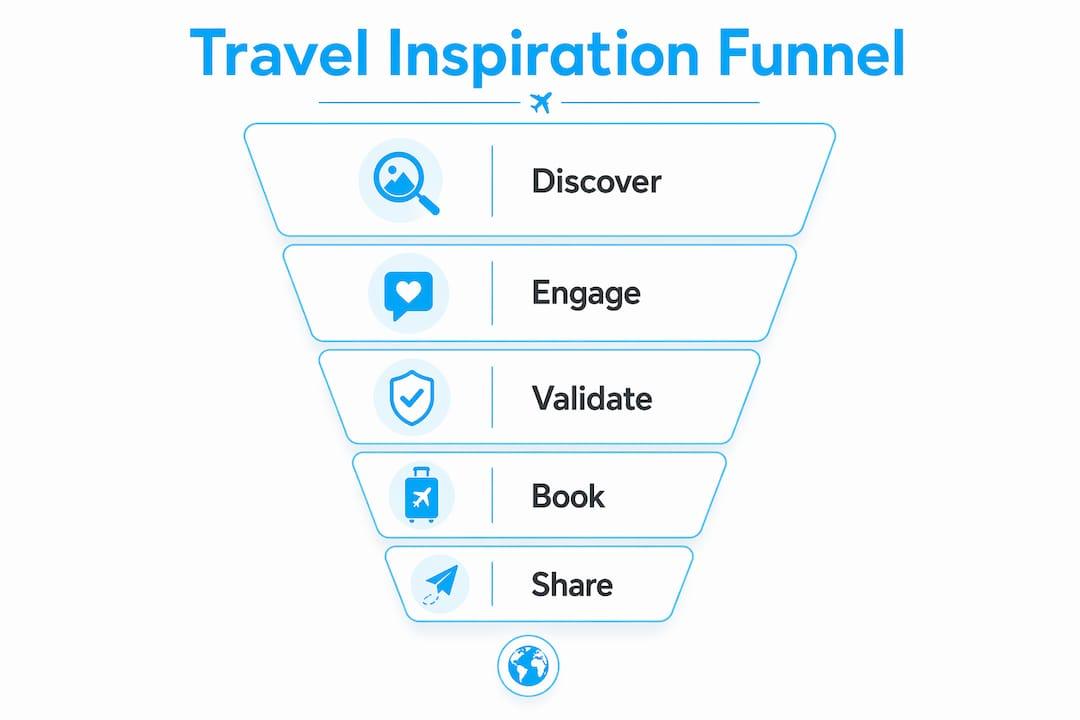
The path from a saved Reel to a confirmed hotel booking isn’t a straight line, but it follows a recognizable pattern. Understanding the stages helps you use social media more deliberately.
-
Dreaming/Inspiration. A short-form video or a stunning photo introduces a destination. The traveler saves it, shares it, or simply files it mentally. No active research yet. TikTok and Instagram dominate here.
-
Research/Validation. The traveler starts actively searching: YouTube vlogs, Reddit threads, travel blogs, Google reviews. They want to know if the destination is as good as it looked. Stage-specific social interactions matter here — influencer content and UGC are critical at discovery, while detailed community reviews and long-form guides carry more weight during validation.
-
Logistics/Planning. Flights, hotels, visa requirements, budget. Pinterest boards get built. Comparison sites get opened. The traveler is now in problem-solving mode, not inspiration mode.
-
Booking. The decision crystallizes. A shoppable post, a limited-time deal, or a direct link in a creator’s bio can close the loop here. In-app booking features on Instagram and TikTok are shortening this stage.
-
Post-trip sharing. The traveler becomes a content creator, generating UGC that feeds the top of the funnel for someone else. The cycle restarts.
A real user path: Someone scrolling TikTok at 10 PM sees a 22-second clip of the Faroe Islands in fog. They save it. Two days later, they search “Faroe Islands travel” on YouTube and watch three vlogs. They build a Pinterest board of itineraries. They check flight prices on a comparison site. Three weeks later, they book. That entire journey started with a 22-second video they didn’t ask for.
The practical lesson: the gap between inspiration and booking is where most trips die. Travelers who actively move through the validation and logistics stages — rather than staying in the dreaming loop — are the ones who actually go.
Which platform is best for travel inspiration?
Each platform has a distinct personality, and using them interchangeably is a mistake.
TikTok
TikTok’s algorithm is the most aggressive discovery engine in travel. It surfaces content to people who have zero prior interest in a destination, based purely on engagement patterns. A video can quickly increase from a few hundred to millions of views within a couple of days. The format is short (15 seconds to 3 minutes), the editing style is fast, and the tone is personal. TikTok excels at the top of the funnel: seeding desire in people who weren’t looking. The downside is longevity — a TikTok video’s traffic spike is usually short-lived.
Instagram sits at the intersection of aspiration and community. Reels drive discovery, Stories build intimacy, and the grid functions as a visual portfolio that travelers and brands curate carefully. Platform strategy research identifies Instagram as the strongest platform for brand discovery and community-building. Travel experiences on Instagram tend to be more polished than TikTok, which can cut both ways: beautiful, but sometimes less believable. Saves and shares are the key engagement signals for travel content here.
YouTube
YouTube is where inspiration becomes a plan. Long-form vlogs provide travelers the depth they need to validate a destination: real costs, honest assessments of crowds, practical logistics. The search function means a well-made video about “two weeks in Vietnam on a budget” can drive traffic for years. YouTube sits firmly in the research and validation stages of the funnel.
Pinterest behaves more like a search engine than a social network. Users come with intent: they’re building itineraries, saving packing lists, collecting hotel inspiration. A well-optimized Pinterest pin can surface in searches for years, making it the highest-longevity platform for travel content. It’s most valuable in the logistics and planning stages. Local cuisine content performs particularly well on Pinterest, where food-focused travel boards are among the most-saved categories.
Current trends worth noting: Short-form video now dominates discovery across every platform. Creator-led local content (a guide from someone who actually lives in Lisbon, not a travel influencer passing through) is gaining trust faster than polished brand content. Shoppable posts and in-app booking features are collapsing the gap between inspiration and transaction.
How do travel influencers and UGC actually build trust?
The academic framework that best explains influencer effectiveness in travel is the Stimulus–Organism–Response (S-O-R) model. Applied to travel content, it works like this: the stimulus is the content itself (a creator’s post), the organism is the viewer’s attitude and emotional response, and the response is booking intention or actual behavior.
Research published in Frontiers in Communication identifies three influencer attributes that most effectively shift user attitude and drive booking intent: attractiveness (visual appeal of content and creator), expertise (demonstrated knowledge of the destination), and trustworthiness (consistency, transparency, and credibility). When a creator combines all three, the effect on booking intention is measurably stronger than any single attribute alone.
The macro vs. local creator distinction matters more than most travelers realize. A macro influencer with a large follower count can put a destination on the map overnight. But a local creator with a smaller, engaged audience who posts about their city every week often delivers something more valuable: seasonal nuance, honest assessments of crowds, and tips that don’t appear in any guidebook. Local creators frequently surface less-touristed options and practical context that experienced travelers actually want. For culinary travel specifically, a local food creator’s recommendation carries more weight than a celebrity chef’s sponsored post — the culinary experience travel niche is a good example of where local expertise consistently outperforms reach.
User-generated content (UGC) operates differently from influencer content. It’s unpolished, unsponsored, and often more persuasive for exactly those reasons. A photo posted by a regular traveler with 300 followers, showing the actual view from their hotel room, can be more convincing than a brand’s professional shoot.
Pro Tip: Before trusting a creator’s recommendation, check four things: (1) Are posts dated? Recent content matters for seasonal accuracy. (2) Does the creator show real logistics (costs, transit, crowds) or only highlights? (3) Are sponsored posts disclosed? (4) Do the comments show genuine engagement, or are they generic? A creator who passes all four is worth following into a booking decision.
How do travel brands and DMOs use social media to capture demand?
Destination marketing organizations (DMOs) and online travel agencies (OTAs) have learned that social media inspiration doesn’t automatically convert to bookings without deliberate strategy. The gap between a saved post and a confirmed reservation is where most brands lose travelers.
Effective campaigns typically combine three elements: organic creator seeding (partnering with creators who already have authentic relationships with an audience), paid amplification (boosting high-performing organic content to extend reach), and shoppable or direct-response posts (adding booking links, promo codes, or in-app purchase options to close the loop). A DMO running a campaign for a regional destination might seed 10–15 local and mid-tier creators, identify the two or three posts with the strongest organic engagement, then put paid spend behind those specific pieces.
The measurement challenge is real. A traveler might see a TikTok video in January, save an Instagram post in March, read a blog in April, and book in May through a Google search. Attribution models that only credit the last click miss the entire inspiration chain. Brands that track “saves” and “shares” alongside clicks get a more honest picture of how social content is actually working. Understanding mobile booking behavior is increasingly important here, since inspiration and booking often happen on different devices and across multiple sessions.
The Statista chart on media influences on travel destination choices shows social media ranking among the top influences on destination selection, alongside word-of-mouth and traditional media. For brands, this means social isn’t a nice-to-have channel — it’s where destination perception is formed before a traveler ever visits a booking site.
What are the ethical risks of travel social media?
The same mechanisms that make social media so effective at inspiring travel also create real problems. The risks fall into three categories: for destinations, for travelers, and for the people who live there.
Risks to destinations and communities:
- Overtourism driven by viral content flooding fragile sites (Antelope Canyon, the Amalfi Coast, Iceland’s Fjaðrárgljúfur canyon) with more visitors than they can absorb
- Environmental strain from increased foot traffic, waste, and carbon emissions concentrated in newly “discovered” spots
- Misrepresentation of local life: filtered, idealized content that erases the economic realities and daily struggles of residents
- Displacement of local businesses when tourism infrastructure caters exclusively to the social-media-driven visitor profile
Risks to travelers:
- Real-time posting reveals location and routines, increasing burglary risk at home and enabling social engineering attacks; security experts advise delaying posts until after you return
- Geotags on photos can expose exact locations of accommodations, making travelers targets
- Public Wi-Fi risks: using a VPN and avoiding sensitive accounts on open networks reduces exposure significantly
- Over-reliance on curated content that sets unrealistic expectations, leading to disappointment or poor planning decisions
For creators and brands: Disclosure obligations under FTC guidelines require clear labeling of sponsored content. Posting at sensitive cultural or religious sites without permission is increasingly recognized as disrespectful and, in some jurisdictions, illegal. Campaign impact assessments — asking whether a campaign will drive sustainable or damaging volumes of visitors — are becoming a baseline expectation for responsible DMO work.
The authenticity question cuts through all of this. Destinations that are over-exposed on social media often see a backlash: travelers arrive expecting the filtered version and leave disappointed, posting negative reviews that undercut the original inspiration. Long-term destination health depends on honest representation, not just beautiful content.
What does the research actually say? Key evidence and statistics
The academic and industry evidence for social media’s role in travel inspiration is substantial and growing.
| Finding | Source | Key Takeaway |
|---|---|---|
| S-O-R model: attractiveness, expertise, and trustworthiness drive booking intent | Frontiers in Communication (2025) | Creator credibility mediates the link between content and booking behavior |
| Stage-specific social interactions shape the traveler journey | Springer (2025) | UGC and influencers dominate discovery; reviews and community posts dominate validation |
| Social media ranks among top influences on destination selection | Statista | Social content shapes destination perception before search or booking begins |
| Social media shapes travel experiences broadly | Statista | Travelers report social media affecting destination choice, expectations, and on-trip behavior |
| Local creators provide deeper, context-aware destination knowledge | About-Travel (2026) | Prioritizing local creators improves authenticity and practical trip planning |
| PMC peer-reviewed study links social content to destination perception and booking intent | PMC | Visual social content directly influences purchase intent and destination image |
The S-O-R model maps cleanly onto observed traveler behavior. A creator’s visual appeal (attractiveness) captures attention and generates saves. Their demonstrated knowledge of a destination (expertise) converts passive interest into active research. Their consistency and transparency (trustworthiness) push the viewer from research into booking. When any one of the three is missing, the conversion chain weakens. A gorgeous feed with no practical depth keeps followers dreaming but rarely gets them booking. A deeply knowledgeable creator with poor visual content struggles to build the initial audience. The combination is what works.
The peer-reviewed evidence from PMC and the Springer study together suggest that treating social media as a single-stage tool misses the point. Discovery content and validation content serve different psychological functions and need to be evaluated separately.
What should travelers do next? Practical actions and trends to watch
The evidence points to a clear set of behaviors that make social media a more useful and safer planning tool.
Practical actions for travelers:
- Use TikTok and Instagram for initial discovery, but treat what you see as a starting point, not a complete picture
- Move to YouTube for validation: search “[destination] honest review” or “[destination] travel mistakes” to get past the highlight reel
- Build Pinterest boards for logistics, not just aesthetics — pin itineraries, packing lists, and budget breakdowns alongside the pretty photos
- Vet creators using the four-point checklist above (dated posts, real logistics, disclosed sponsorships, genuine engagement)
- Prioritize local creator content for seasonal accuracy and off-the-beaten-path options
- Delay posting your own travel content until after you return home, and disable geotags on photos taken at your accommodation
- Use a VPN on public Wi-Fi and keep sensitive accounts (banking, email) off open networks while traveling
- Cross-check social inspiration against official tourism sites, recent TripAdvisor reviews, and government travel advisories before booking
Trends to watch:
Augmented reality previews are moving from novelty to utility: several platforms are testing AR features that let users “try” a destination experience before committing. Live streaming with in-stream booking is already active in parts of Asia and is expanding in the US market — a creator can broadcast from a resort and viewers can book a room without leaving the stream. The role of AI in surfacing personalized travel content is growing fast; AI-driven booking tools are beginning to connect social inspiration signals directly to deal recommendations.
The single most important habit for any traveler using social media to plan: treat inspiration and validation as separate steps. A video that makes you want to go somewhere is not the same as evidence that you should go there, when, and how. The Springer research is clear that the travelers who get the most from social media are the ones who use it as an ecosystem, not a single source.
Key Takeaways
Social media drives travel inspiration through visual-first content, algorithmic amplification, and peer validation, with each platform serving a distinct stage from dreaming to booking.
| Point | Details |
|---|---|
| Visual-first inspiration drives discovery | Short-form video on TikTok and Instagram seeds destination desire before active search begins. |
| Platform roles are distinct | TikTok = discovery, Instagram = community, YouTube = validation, Pinterest = long-term planning traffic. |
| Influencer trust has three dimensions | Attractiveness, expertise, and trustworthiness together drive booking intent per S-O-R research. |
| Safety requires deliberate habits | Delay posts until after returning home, disable geotags, and use a VPN on public Wi-Fi. |
| Inspiration needs validation | Cross-check social content with reviews, official sources, and YouTube before booking. |
| Pilottraveldeals bridges inspiration and booking | After social media sparks the idea, Pilottraveldeals lets you compare flights, hotels, and deals to make it real. |
The gap between a beautiful feed and a real trip
The thing that strikes me most about the research on social media and travel is how well it explains something most travelers already sense but rarely articulate: the platforms are optimized for desire, not decision-making. The S-O-R framework from Frontiers in Communication makes this concrete. Attractiveness captures attention. Expertise builds intent. Trustworthiness closes the loop. But most of what floods your feed is heavy on attractiveness and light on the other two.
What actually surprises me in the data is how much local creators outperform high-reach influencers on the metrics that matter for actual trip quality. A creator with 40,000 followers who lives in Porto and posts about the city every week will give you better seasonal advice, better restaurant picks, and a more honest picture of crowds than a travel celebrity passing through for a sponsored weekend. The algorithm doesn’t reward that kind of depth, which is why you have to go looking for it.
The practical action: the next time a video makes you want to go somewhere, open a new tab and search for a local creator from that place. Following their updates over time before booking can provide valuable insights. What they post in that time will tell you more about whether the trip is right for you than any amount of aspirational content ever could.
Turn your inspiration into a real trip with Pilottraveldeals
Once a destination catches your eye on social media, the next step is figuring out what it actually costs. Pilottraveldeals aggregates flight and hotel deals from multiple providers, so you can move from “I want to go there” to “here’s what it costs this month” in a few minutes.
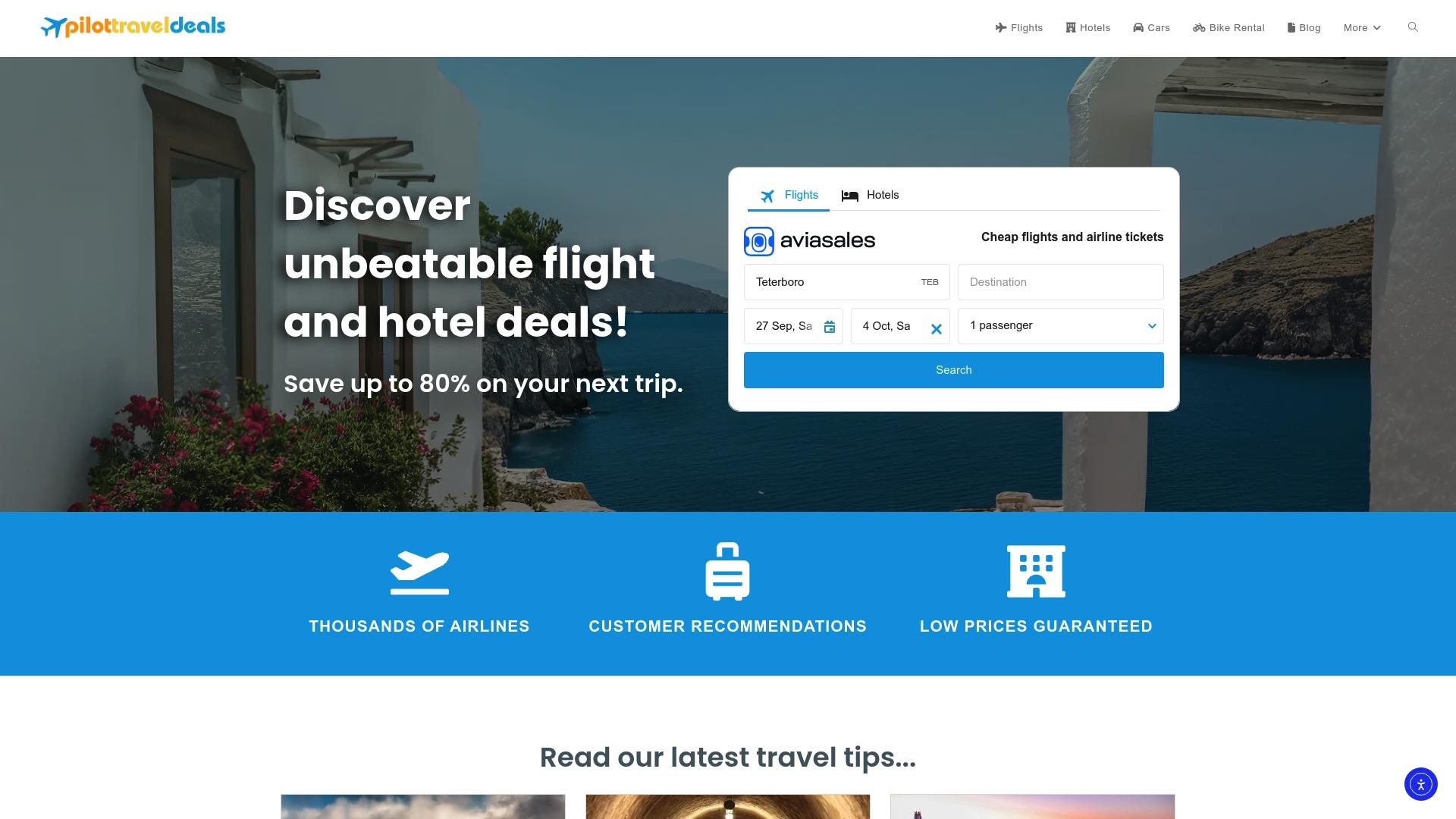
The workflow is straightforward: search your destination, compare dates to find the lowest fares, and check the hotel deals page for accommodation options that fit your budget. If flights are the variable, the cheap airfare tips page breaks down exactly how to find the best prices without spending hours on it. Pilottraveldeals also covers travel comparison workflows for travelers who want to understand how to get the most out of deal aggregation. Inspiration is free. The trip just needs a price tag.
Further reading: authoritative sources on social media and travel
- PMC: “From likes to luggage” — Peer-reviewed study on how social media content shapes destination perception and booking intent; the strongest academic source on this topic.
- Frontiers in Communication (2025) — S-O-R model applied to travel influencers; identifies attractiveness, expertise, and trustworthiness as the three dimensions that drive booking behavior.
- Springer (2025) — Research on stage-specific social media interactions across the traveler journey; essential for understanding funnel dynamics.
- Statista: Social Media and Travel — Industry data on how social media shapes travel experiences and destination choices.
- Yahoo Travel / Security Experts — Expert guidance on the single biggest social media mistake travelers make (real-time posting); practical safety advice.
- Roamki: Social Media Safety While Traveling — Practical privacy and security steps including VPN use, Wi-Fi hygiene, and account management while abroad.
- About-Travel: Using Social Media to Improve Your Trip — Industry guide recommending local creators for seasonal and practical destination advice over purely commercial influencer content.
- Explurger Blog: Social Media Tips for Travel Bloggers — Platform-specific strategy guide covering content mix, cadence, and the long-tail value of Pinterest for sustained traffic.