TL;DR:
- A status match airline program allows travelers to gain elite status without qualifying flights by proving existing loyalty.
- Timing, documentation, and route fit significantly impact whether the match provides real savings and benefits.
A status match airline program is one of the most underused tools in frequent flyer strategy. The concept is straightforward: an airline grants you elite status in its own loyalty program because you already hold elite status with a competing carrier. You skip the months of qualifying flights, the minimum spend thresholds, the segment counting. You show proof of what you’ve already earned elsewhere, and the new airline hands you a comparable tier, usually for a trial period.
Here’s what that looks like in practice:
- Immediate perks access: Priority boarding, lounge access, and upgrade eligibility start right away, with no qualifying flights required upfront.
- Trial period structure: Most matched status lasts 90 days, after which you typically need to meet a spend or flight requirement to keep it.
- Fresh mileage balance: Your new account starts at zero. Matched status does not transfer your accumulated miles or elite-qualifying credits from the original program.
- Documentation required: You’ll need proof of current status, usually a screenshot or PDF of your status page, your membership card, and sometimes recent boarding passes.
- Not always tier-for-tier: A top-tier status at one airline often maps to a mid-tier at the new one. Exceeding-tier matches are rare.
- Active programs in 2026: Delta SkyMiles, Alaska Airlines, and Flying Blue each offer publicly available status match programs with distinct eligibility and retention requirements.
Table of Contents
- How does a status match actually work?
- Status match vs. status recognition: why the difference matters
- What are the real benefits and risks of status matching?
- How budget travelers can get the most from a status match
- Key Takeaways
How does a status match actually work?
The application process is more deliberate than most travelers expect. You don’t just email an airline and ask nicely. You submit documentation, wait for review, and then manage a challenge period if one applies.
The typical steps:
- Enroll in the target airline’s frequent flyer program if you haven’t already.
- Locate the airline’s status match or challenge page (some, like United MileagePlus, have a dedicated portal; others require contacting customer service directly).
- Submit proof of your current elite status. Documentation standards vary by airline: a screenshot of your status page works for some, while others want a PDF statement, a photo of your physical membership card, or even boarding passes showing recent paid flights on the competing carrier.
- Wait for approval, which can take anywhere from a few hours to several weeks depending on the program.
- Once approved, your account updates to the matched tier. You can start using benefits immediately without waiting for a physical card.
Delta’s Medallion Status Match Challenge is the clearest example of the hybrid model: you receive temporary Medallion status right away, then have 90 days to hit a Medallion Qualifying Dollar threshold to convert that trial into a full-year status. American Airlines runs its Instant Status Pass as a three-phase challenge, each phase lasting four months, open to elite members of Delta, JetBlue, Southwest, and United. The eventual tier, Gold through Executive Platinum, depends on which program you’re matching from.
One hard rule: falsifying status documentation can result in permanent account suspension. Airlines cross-reference submissions, and the risk is not worth it.
Status match vs. status recognition: why the difference matters
Travelers mix these up constantly, and the confusion costs them real opportunities.
Status recognition happens automatically inside an airline alliance. If you hold United Global Services status and fly Lufthansa, you receive priority treatment at check-in and in the lounge because both carriers belong to Star Alliance. No application, no new enrollment. The benefits flow through the alliance agreement, not through any action on your part. You remain a United member; Lufthansa simply honors your tier.
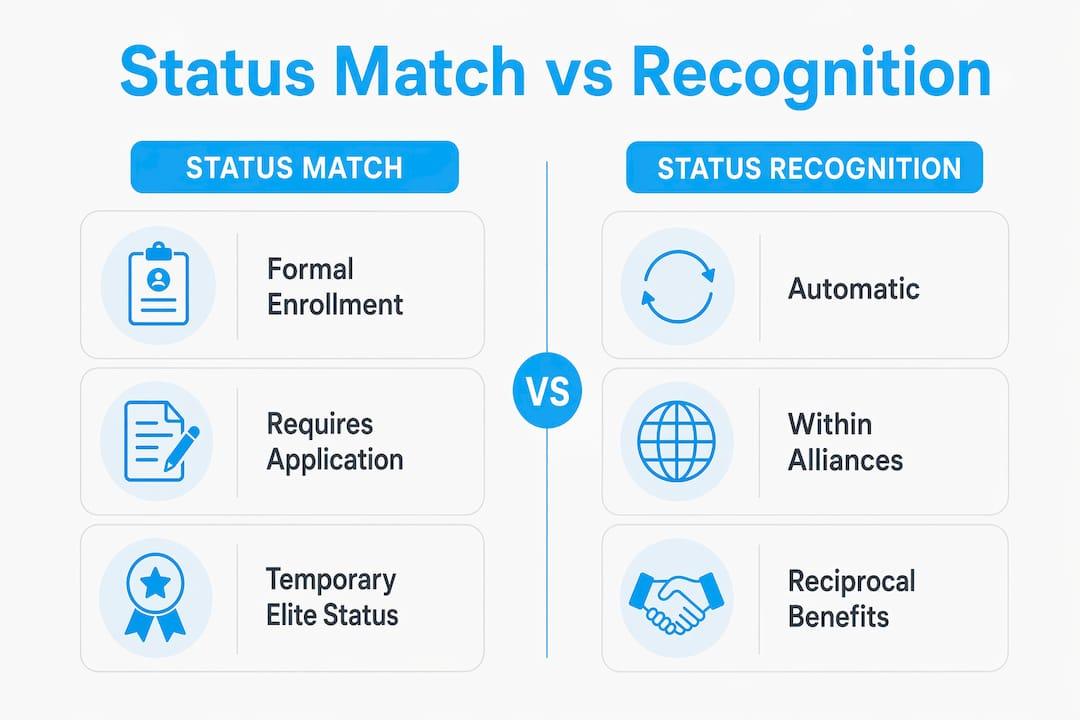
A status match is a formal enrollment in a second airline’s program at an elite tier. You become a member of that program, with your own account, your own elite tier, and full access to that program’s benefits, upgrades, and phone lines. The two situations are fundamentally different: recognition is passive and alliance-dependent, while a match is active and program-specific.
Why does this matter for budget travelers? Because burning a one-time status match on a route already covered by alliance recognition is a waste. If your Star Alliance Gold status already gets you lounge access on partner carriers, you don’t need to formally match into each of those programs. Save the match for a carrier outside your alliance, or one where you genuinely want to build a second loyalty relationship. Understanding how airline alliances work before you apply for any match is the smartest first step.
What are the real benefits and risks of status matching?
The upside is real. A well-timed status match gives you elite perks on a second airline without a single qualifying flight, which is particularly valuable when your travel patterns shift, your home airport hub changes, or you want flexibility across carriers on a specific trip.
Strategic benefits:
- Immediate access to priority boarding, seat upgrades, and dedicated phone lines.
- Lounge access on routes where your primary carrier has no presence.
- Flexibility to split travel across two programs without starting from zero on either.
- Useful when a corporate account shifts carriers or you relocate to a new hub city.
The risks are just as real. Status matches are often one-time or limited-use per airline, which means burning one during a slow travel quarter can lock you out of a better opportunity later. Miles Mosaic frames this as the core opportunity cost problem: travelers who apply during low-activity periods rarely complete the challenge requirements, lose the matched status anyway, and can’t apply again.
Tier equivalency is another trap. A top-tier status with one airline might match only to mid-tier at another because programs define equivalence differently. You might expect Executive Platinum-level treatment and receive Gold. Matched status also grants no retroactive elite-qualifying miles or credits, so your new account balance starts fresh regardless of your history elsewhere.
The expert consensus from Miles Mosaic: treat elite status as a cost-control tool, not a trophy. The question isn’t whether you can get a match. It’s whether the perks you’ll actually use offset the cost of meeting the challenge requirements.
How budget travelers can get the most from a status match
Timing is everything. The single most consistent advice from frequent flyer experts is to target a Q3 or Q4 match so the challenge period falls during the higher-flying holiday months. A match started in October, for example, runs through the winter travel surge, giving you the best chance of hitting spend or flight thresholds organically.
Before you apply, run through this checklist:
- Confirm your current status is valid and not expiring within the next few months. Many programs won’t match status that’s about to lapse.
- Verify the target airline actually serves your most-traveled routes. A matched status on a carrier you’ll fly twice is worth almost nothing.
- Read the retention requirements before you commit. Some challenges require minimum qualifying spend, others require a set number of segments. Know the number before you start the clock.
- Check whether the match is truly one-time or if the program allows reapplication after a set period. United and Delta are notable exceptions to the one-time rule, offering matches on multi-year cycles.
Pro Tip: Reserve your status match for a program that genuinely fits your travel patterns. A match to an airline you’ll fly heavily in the next 90 days is worth far more than a match to a carrier you chose because the application was easy.
Once you have matched status, use every benefit available. Priority boarding saves time. Upgrade opportunities on paid tickets can turn a budget fare into a premium experience. Partner benefits, including hotel status links and car rental upgrades, often come bundled with elite tiers and cost you nothing extra.

Pairing a status match with smart booking habits compounds the savings. Finding cheap airfare deals on the matched carrier means you’re flying at a lower base cost while enjoying elite-level treatment. Pilottraveldeals also tracks hotel deals that align with airline partner programs, so your status perks can stretch further across your whole trip.
Key Takeaways
A status match grants temporary elite airline status based on existing status elsewhere, but timing, documentation, and route fit determine whether it actually saves you money.
| Point | Details |
|---|---|
| Matched status starts fresh | Your new account balance begins at zero; no retroactive miles or elite credits transfer. |
| Trial periods are 90 days | Most matches require meeting spend or flight thresholds within that window to retain status. |
| Status match differs from recognition | Alliance recognition is automatic; a formal match enrolls you in a new program at an elite tier. |
| Timing drives value | A Q3 or Q4 match timed to high-travel months gives you the best chance of completing a challenge. |
| One-time use is common | Most airlines limit matches to once per lifetime per account, making strategic timing non-negotiable. |
Recommended
- Airline Alliances Explained: Maximizing Travel Savings – PilotTravelDeals.com
- How to Get Cheap Domestic Flights for U.S. Travelers – PilotTravelDeals.com
- Flight Comparison Checklist: Secure the Best Airline Deals – PilotTravelDeals.com
- Smart ways to save money on flights every time – PilotTravelDeals.com