Did you know that over 1.3 billion passengers fly with budget airlines every year? These carriers have made travel accessible for millions who once saw air travel as out of reach. With ultra-low fares and a pay-only-for-what-you-need approach, budget airlines challenge many long-held myths. Understanding how they work, what fees to expect, and how they compare to traditional airlines can help travelers make choices that stretch their travel dollars much further.
Table of Contents
- Defining Budget Airlines And Common Myths
- Types Of Low-Cost Carriers Worldwide
- How Budget Airlines Operate And Keep Fares Low
- Typical Service Features And Extra Charges
- Comparing Budget Airlines Vs Traditional Airlines
- Smart Booking Tips And Hidden Costs
Key Takeaways
| Point | Details |
|---|---|
| Budget Airlines Focus on Cost Efficiency | They operate on a pay-per-service model, dramatically lowering base ticket prices while unbundling services to provide flexibility to travelers. |
| Understanding Hidden Costs is Crucial | Travelers should be aware of additional charges such as baggage fees and seat selection costs that can inflate the overall price of a ticket. |
| Types of Low-Cost Carriers Vary Globally | Different regional budget airlines have adapted their business models to meet local travel demand, including ultra-low-cost and hybrid models. |
| Smart Comparison Enhances Travel Choices | It’s essential to compare specific offerings between budget and traditional airlines to make informed travel decisions and maximize savings. |
Defining Budget Airlines and Common Myths
Budget airlines represent a revolutionary approach to air travel, transforming how people traverse the globe by offering dramatically reduced ticket prices. According to Wikipedia, these carriers operate with a strategic focus on minimizing operating costs while providing no-frills services that substantially lower passenger expenses.
The core philosophy of budget airlines centers on unbundling traditional travel services. Instead of including everything in one ticket price, these carriers break down costs, allowing passengers to pay only for the services they actually want. This means you might pay separately for baggage, seat selection, in-flight meals, and other amenities that legacy carriers typically bundle together. As research from Wharton Knowledge indicates, this approach has fundamentally challenged traditional carriers and led to a significant transformation in how air travel is perceived and purchased.
Common myths about budget airlines often prevent travelers from recognizing their true value. Many people mistakenly believe that lower prices automatically mean uncomfortable or unsafe travel experiences. However, budget airlines must still meet strict safety regulations and often operate modern, efficient aircraft. The primary differences lie in service model, not safety standards. By understanding budget travel planning, travelers can unlock significant savings without compromising their travel experience.
Key characteristics that define budget airlines include:
- Ultra-low base ticket prices
- Pay-per-service model
- Typically point-to-point routes
- Simplified boarding processes
- Newer, more fuel-efficient aircraft
- Minimal in-flight amenities
Smart travelers understand that budget airlines aren’t about cutting corners, but about providing affordable, efficient transportation that puts money back in your pocket for experiencing destinations, not just getting there.
Types of Low-Cost Carriers Worldwide
Low-cost carriers have dramatically transformed global air travel, with distinct regional variations that reflect unique market demands and economic landscapes. According to research from Atlantis Press, regional budget airlines have emerged across different continents, each adapting the low-cost model to local travel needs and preferences.
In Europe, airlines like Ryanair and EasyJet have pioneered the ultra-low-cost approach, offering extremely competitive prices by maximizing operational efficiency. Across the Atlantic, Southwest Airlines dominates the United States market with a similar strategy of minimizing costs and offering no-frills transportation. As International Journal of Tourism and Hospitality Management highlights, Asia presents another fascinating landscape with carriers like AirAsia revolutionizing regional travel.
The global low-cost carrier ecosystem can be broadly categorized into several distinct types:
- Ultra-Low-Cost Carriers: Absolute minimum pricing strategy
- Regional Budget Airlines: Focused on specific geographic routes
- Hybrid Low-Cost Models: Offering some traditional airline amenities
- Long-Haul Budget Carriers: Specialized in extended international routes
Travelers seeking affordable ways to explore the world will find that understanding these carrier types can unlock significant savings and travel opportunities. Each model offers unique advantages, enabling budget-conscious travelers to select the most suitable option for their specific journey.
How Budget Airlines Operate and Keep Fares Low
Budget airlines have mastered the art of cost reduction through innovative operational strategies that fundamentally transform traditional airline economics. According to World We Travel, these carriers maintain ultra-low fares by strategically unbundling services, charging separately for extras like baggage, seat selection, and in-flight meals that legacy carriers typically include in ticket prices.
Research from Atlantis Press reveals multiple behind-the-scenes tactics budget airlines employ to minimize expenses. These include standardizing aircraft fleets to reduce maintenance complexity, maximizing aircraft utilization through rapid turnaround times, and implementing highly efficient operational protocols. By reducing ground time and streamlining processes, these airlines can schedule more flights and generate additional revenue streams while keeping base ticket prices remarkably low.
The core operational strategies of budget airlines include:
- Single aircraft type fleet for simplified maintenance
- Minimal ground time between flights
- Point-to-point route planning
- Secondary airport usage
- Strict baggage weight limitations
- No complimentary in-flight services
Travelers looking to understand who sets airline fares and why it matters will appreciate how these strategic approaches enable budget airlines to offer unprecedented affordability. The model is not about cutting corners, but about radical operational efficiency that passes savings directly to passengers.

Typical Service Features and Extra Charges
Budget airlines operate on a pay-per-service model that fundamentally differs from traditional carrier approaches. According to Wikipedia, basic economy fares come with significant restrictions, including no complimentary seat selection, no ticket changes, and additional fees for services that mainstream airlines typically include in their standard pricing.
Research from NLD Travel highlights the critical strategy of advertising extremely low base fares while generating revenue through numerous supplementary charges. These extra fees can transform an initially attractive ticket price into a much more expensive travel experience. Passengers must carefully calculate the total cost by considering potential additional expenses such as baggage fees, seat selection, priority boarding, and even printing boarding passes at the airport.
Typical extra charges budget travelers should anticipate include:
- Checked baggage fees
- Seat selection charges
- Priority boarding
- In-flight meal purchases
- Printing boarding passes at airport
- Overweight or oversized luggage penalties
- Ticket change or cancellation fees
Travelers can strategically minimize these additional costs by reviewing tips for saving on flights and planning meticulously. The key is understanding each airline’s specific fee structure and preparing accordingly, transforming potential surprise expenses into predictable travel costs.
Comparing Budget Airlines vs Traditional Airlines
The airline industry is undergoing a remarkable transformation, with traditional carriers and budget airlines increasingly blurring their traditional boundaries. According to Wharton Knowledge, budget airlines have fundamentally challenged established carriers by offering lower fares and no-frills services, forcing a significant convergence in service strategies.
Research from McKinsey reveals that traditional airlines are now adopting retailing strategies remarkably similar to budget carriers. This includes unbundling services and creating additional revenue streams through ancillary products. The key differences between budget and traditional airlines are becoming increasingly nuanced, with both models moving toward more flexible, à la carte service offerings.
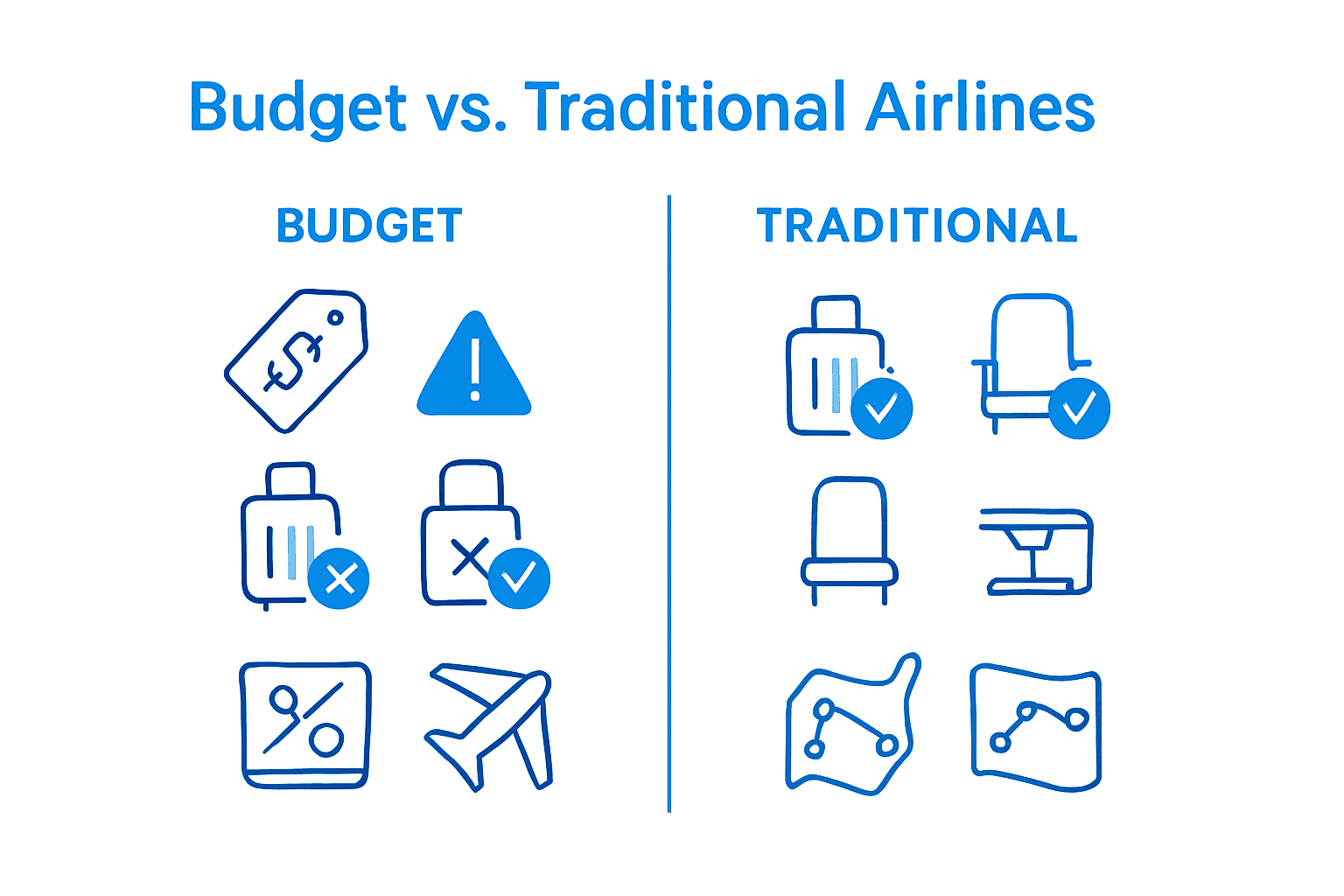
Core comparison points between budget and traditional airlines include:
Here’s a summary of how budget and traditional airlines compare:
| Feature | Budget Airlines | Traditional Airlines |
|---|---|---|
| Base Ticket Price | Ultra-low fare | Higher, includes services |
| Baggage Policy | Strict, pay-per-bag | More generous, sometimes included |
| Seat Selection | Extra cost | Often complimentary |
| In-Flight Amenities | Minimal, purchased separately | Comprehensive, often included |
| Route Structure | Point-to-point | Hub-and-spoke |
| Aircraft Fleet | Single type, newer models | Mixed fleet, various ages |
| Change/Cancellation | High fees | More flexible, sometimes included |
- Ticket Pricing
- Budget: Ultra-low base fares
- Traditional: Higher base fares with more included services
- Baggage Policies
- Budget: Strict weight limits, pay-per-bag
- Traditional: More generous baggage allowances
- Seat Selection
- Budget: Paid additional service
- Traditional: Often complimentary or included
- In-Flight Amenities
- Budget: Minimal, purchased separately
- Traditional: More comprehensive, often included
Travelers can make more informed choices by understanding why to check budget airlines for smart travel, recognizing that the line between budget and traditional carriers continues to evolve. The most successful approach involves comparing specific offerings rather than relying on broad categorical assumptions.
Smart Booking Tips and Hidden Costs
Navigating the complex world of budget airline bookings requires strategic planning and keen awareness of potential additional expenses. According to NLD Travel, travelers must be prepared for hidden charges that can significantly inflate the seemingly attractive base ticket price, particularly through extra fees for services like seat selection, baggage, and in-flight meals.
Research from World We Travel reveals that budget airlines generate substantial revenue through ancillary services, making it crucial for passengers to calculate total travel costs beyond the initial fare. This means scrutinizing every potential additional expense and understanding each airline’s specific fee structure before completing a booking.
Key smart booking strategies include:
- Book directly on airline websites
- Check baggage requirements in advance
- Avoid last-minute airport charges
- Pack light to minimize extra fees
- Pre-purchase any required services
- Compare total costs across multiple airlines
- Use online check-in to avoid printing fees
Travelers can maximize their savings by exploring smart examples of travel booking hacks and developing a comprehensive understanding of budget airline pricing models. The most successful approach involves treating the base fare as just the starting point in your total travel expense calculation.
Unlock the Full Potential of Budget Airlines with PilotTravelDeals
Traveling on a budget does not mean you have to sacrifice comfort or convenience. The article highlights common challenges travelers face with budget airlines like hidden fees, understanding the pay-per-service model, and choosing the right carrier type for their journey. At PilotTravelDeals.com, we understand these pain points and offer a simple way to compare flights, hotels, and travel services while uncovering the best deals that help you avoid unexpected costs.
Explore our Miscellaneous collection for insider tips and insights on budget travel. Then visit PilotTravelDeals to start searching for flights and deals tailored to your budget and preferences. Taking action today empowers you to travel smarter, save up to 80 percent, and experience the world without stress or surprises. Don’t wait to turn your travel dreams into reality with savings and confidence.
Frequently Asked Questions
What are budget airlines?
Budget airlines are carriers that provide drastically reduced ticket prices by minimizing operating costs and offering no-frills services. They typically unbundle travel services, allowing passengers to pay only for the amenities they actually use.
How do budget airlines keep their fares low?
Budget airlines maintain low fares by employing various strategies, such as using a single type of aircraft to reduce maintenance costs, maximizing aircraft utilization through fast turnaround times, and charging separately for additional services like baggage and in-flight meals.
What extra charges should I expect when flying with a budget airline?
Common extra charges on budget airlines include fees for checked baggage, priority boarding, seat selection, in-flight meals, and penalties for overweight luggage or ticket changes. It’s essential to understand these costs when budgeting for your trip.
How do budget airlines differ from traditional airlines?
Budget airlines differ from traditional airlines primarily in their service model. Budget carriers offer lower base ticket prices but charge for additional services, whereas traditional carriers include many amenities in the ticket price. Additionally, budget airlines often focus on point-to-point routes while traditional airlines typically operate a hub-and-spoke model.