
Controlling corporate travel costs often feels like solving a moving puzzle for every American business. With trips spanning the United States and beyond, even small choices can quickly add up, challenging managers to trim expenses without cutting traveler satisfaction. This guide highlights effective expense management solutions, strategic policies, and technology trends proven to help organizations in North America make smarter, more data-driven travel decisions while maintaining service quality.
Table of Contents
- Corporate Travel Savings Explained
- Major Categories of Travel Expenses
- Effective Deal Sourcing and Comparison Tools
- Leveraging Technology for Cost Reduction
- Influencing Employee Booking Behavior
- Avoiding Common Costly Mistakes
Key Takeaways
| Point | Details |
|---|---|
| Implement Clear Travel Policies | Establishing and communicating transparent travel policies can help organizations manage expenses effectively and ensure compliance among employees. |
| Leverage Technology for Expenses | Utilizing AI-driven tools and centralized systems for expense tracking enhances visibility and control over travel costs, enabling better decision-making. |
| Influence Employee Behavior | Aligning incentives with budgetary goals encourages cost-effective decision-making, fostering a culture of financial responsibility throughout the organization. |
| Avoid Booking Errors | Implementing mandatory pre-travel approvals and promoting advance booking practices can significantly reduce unnecessary expenses and errors in corporate travel. |
Corporate Travel Savings Explained
Corporate travel expenses represent a significant portion of organizational budgets, requiring strategic management and innovative cost-control approaches. Corporate travel spending trends demonstrate that companies must balance essential business interactions with financial prudence.
Successful corporate travel savings strategies involve multiple interconnected approaches:
- Establishing clear travel policy guidelines
- Leveraging technology for expense tracking
- Negotiating corporate rates with airlines and hotels
- Implementing pre-approval processes
- Encouraging cost-conscious traveler behaviors
Companies can dramatically reduce travel expenditures by adopting data-driven decision-making techniques. This means carefully analyzing historical travel spending, identifying inefficiencies, and creating targeted reduction plans. Expense management becomes critical, requiring comprehensive tracking of not just transportation costs, but per diem allowances, accommodation fees, and incidental expenses.
Tax considerations also play a crucial role in corporate travel savings. Organizations can potentially reduce financial burdens by understanding professional expense relief opportunities that offset travel-related expenditures.
Pro tip: Implement a centralized travel booking system that automatically compares prices and enforces company travel policy to maximize savings and compliance.
Major Categories of Travel Expenses
Corporate travel expenses encompass a complex array of financial considerations that require meticulous tracking and strategic management. Business travel expense classifications reveal multiple critical spending categories that organizations must carefully monitor and control.
The primary categories of corporate travel expenses include:
- Transportation costs
- Airfare
- Ground transportation
- Vehicle rentals
- Mileage reimbursement
- Accommodation expenses
- Hotel stays
- Corporate housing
- Extended stay facilities
- Meal and per diem allowances
- Breakfast, lunch, and dinner expenses
- Incidental meal costs
- Miscellaneous business expenses
- Communication charges
- Parking fees
- Internet access
- Conference or meeting registration
Expense management requires a comprehensive approach to understanding and categorizing these spending areas. Companies must develop robust business travel expense regulations that provide clear guidelines for what expenses are eligible for reimbursement and how they should be documented and processed.

Modern organizations are increasingly leveraging technology to track and optimize travel spending, using sophisticated expense management software that can automatically categorize and analyze expenditures in real-time. This data-driven approach allows financial teams to identify potential cost-saving opportunities and enforce travel policy compliance more effectively.
Pro tip: Implement a digital expense tracking system that automatically categorizes and flags unusual spending patterns to improve financial oversight and control.
Effective Deal Sourcing and Comparison Tools
Corporate travel managers face increasing pressure to identify and leverage the most cost-effective travel arrangements. Deal sourcing platforms have emerged as critical technological solutions for streamlining travel procurement and reducing organizational expenses.
Key features of effective deal comparison tools include:
- Advanced search and filtering capabilities
- Price comparison across multiple vendors
- Real-time availability tracking
- Customizable search parameters
- Comprehensive vendor evaluation tools
- Historical pricing analysis
- Vendor reliability ratings
- Performance metrics and reviews
- Integration capabilities
- Seamless connection with expense management systems
- Automated reporting functionality
- Corporate policy compliance checks
Procurement strategies have transformed with the introduction of sophisticated government sourcing playbooks that provide structured guidance for identifying and negotiating optimal travel deals. These tools leverage artificial intelligence and data analytics to provide unprecedented insights into travel spending patterns and potential cost-saving opportunities.
Modern organizations are increasingly adopting intelligent comparison platforms that go beyond simple price matching. These advanced systems analyze multiple variables, including travel time, convenience, amenities, and potential hidden costs, to deliver comprehensive recommendations that align with corporate travel policies and budgetary constraints.
Pro tip: Implement a multi-stage vendor comparison process that evaluates not just price, but overall value, reliability, and alignment with your organization’s specific travel requirements.
Leveraging Technology for Cost Reduction
Corporate travel management has entered a transformative era driven by technological innovation. Emerging technologies in corporate travel are revolutionizing how organizations approach travel spending, cost control, and operational efficiency.
Key technological strategies for reducing travel costs include:
- Artificial Intelligence (AI) Solutions
- Automated expense tracking
- Predictive pricing analysis
- Smart travel route optimization
- Cloud-Based Management Platforms
- Real-time budget monitoring
- Centralized expense reporting
- Integrated travel policy enforcement
- Advanced Analytics Tools
- Comprehensive spending pattern identification
- Vendor performance evaluation
- Cost-saving opportunity detection
Digital transformation has become critical, with corporate travel industry technology adoption driving significant operational improvements. These technological solutions enable organizations to move beyond traditional expense management, providing unprecedented insights and control over corporate travel budgets.
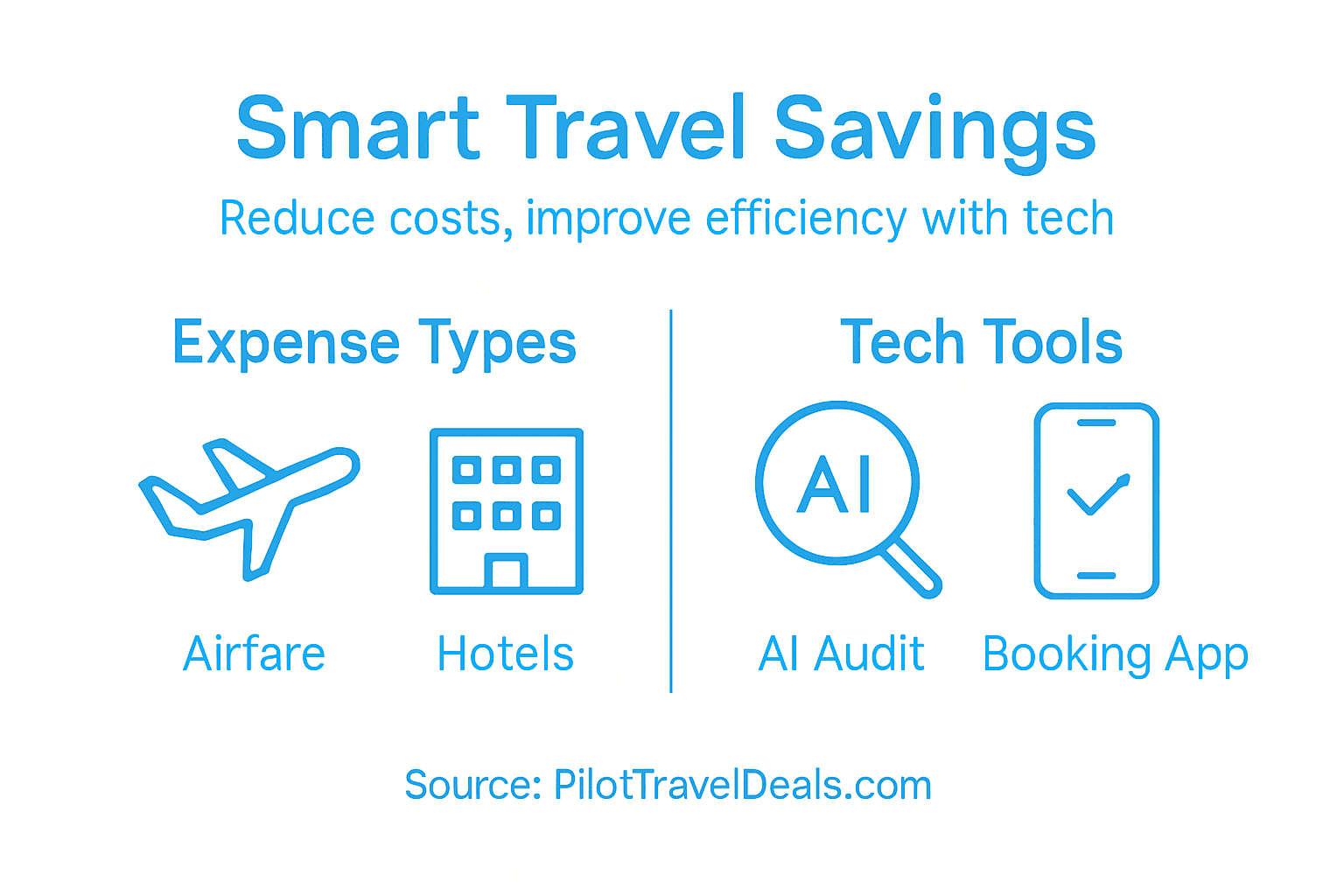
Modern enterprises are integrating sophisticated technologies like blockchain, artificial intelligence, and machine learning to create more intelligent, responsive travel management systems. These innovations allow for personalized travel experiences, enhanced security, and more precise financial forecasting, ultimately delivering substantial cost reductions and operational efficiencies.
Here’s how major technology types impact corporate travel cost control:
| Technology Type | Business Benefit | Example Application |
|---|---|---|
| Artificial Intelligence | Automated expense reduction | Predictive route planning |
| Cloud Platforms | Real-time spending visibility | Centralized expense dashboard |
| Advanced Analytics | Uncover savings opportunities | Vendor spend analysis |
| Blockchain | Enhanced security and tracking | Fraud prevention for bookings |
Pro tip: Conduct a comprehensive technology audit to identify and implement AI-driven tools that can automate and optimize your corporate travel expense management processes.
Influencing Employee Booking Behavior
Effective corporate travel management goes beyond policy creation, requiring a nuanced approach to understanding employee behavior patterns. Organizations must develop strategic frameworks that align employee incentives with corporate travel cost-saving objectives.
Key strategies for influencing employee booking behavior include:
- Incentive Alignment
- Performance-based travel rewards
- Cost-saving bonus programs
- Recognition for budget-conscious choices
- Communication Techniques
- Clear policy explanations
- Transparent cost impact demonstrations
- Regular feedback mechanisms
- Educational Approaches
- Training on cost-effective booking
- Detailed expense management workshops
- Real-world financial impact scenarios
Organizational culture plays a critical role in shaping employee decision-making. Managerial support and motivation strategies can significantly influence travel booking behaviors, encouraging employees to make more financially responsible choices that align with company objectives.
Successful organizations create a comprehensive ecosystem of support, education, and incentives that make cost-conscious travel booking feel like a collaborative effort rather than a restrictive mandate. This approach transforms travel expense management from a top-down directive to a shared organizational goal.
Pro tip: Design a transparent, gamified booking system that rewards employees for making cost-effective travel choices and provides immediate feedback on their financial impact.
Avoiding Common Costly Mistakes
Corporate travel budgets can quickly spiral out of control when organizations fail to recognize and address critical financial pitfalls. Corporate travel mistake prevention requires a strategic and proactive approach to identifying and mitigating potential financial risks.
Common costly mistakes in corporate travel include:
- Booking Errors
- Last-minute flight reservations
- Ignoring advanced booking discounts
- Non-refundable ticket purchases without flexibility
- Policy Non-Compliance
- Bypassing established travel guidelines
- Unauthorized expense submissions
- Inconsistent reporting practices
- Financial Oversights
- Failing to bundle travel services
- Neglecting travel insurance
- Overlooking negotiated corporate rates
Expense management becomes critical when addressing potential financial vulnerabilities. Corporate travel policy strategies demonstrate that clear communication, consistent monitoring, and data-driven decision-making can significantly reduce the risk of expensive travel-related mistakes.
Successful organizations implement comprehensive risk mitigation strategies that combine technological solutions, employee education, and robust policy frameworks. By creating a holistic approach to travel expense management, companies can transform potential financial risks into opportunities for cost optimization and strategic spending.
The table below summarizes common corporate travel pitfalls and the related risks:
| Mistake Category | Cost Impact | Prevention Strategy |
|---|---|---|
| Last-Minute Booking | Higher airfare fees | Enforce advance purchase rules |
| Policy Non-Compliance | Unapproved expenses | Automated policy checks |
| Missed Bundling | Lost discounts | Promote package deals |
| Incomplete Reporting | Reimbursement delays | Use digital reporting tools |
Pro tip: Develop a mandatory pre-travel approval process that requires employees to validate all booking decisions against corporate travel guidelines and cost-saving criteria.
Maximize Your Corporate Travel Savings with Smart Deal Sourcing
Corporate travel managers know how challenging it is to control expenses while ensuring seamless travel for employees. The pain points of managing complex transportation, accommodation, and meal costs require effective strategies like data-driven decision-making and technology integration as outlined in “Corporate Travel Savings: Maximizing Company Budgets.” PilotTravelDeals.com specializes in helping companies overcome these travel budget hurdles by providing easy access to vast discounts and travel options.
Explore our Travel Tips – PilotTravelDeals.com to learn clever ways to reduce costs and enhance booking efficiency. Use our platform at PilotTravelDeals.com to compare flight prices, hotel rates, and more with savings up to 80 percent. Start making smart, cost-conscious travel decisions today to turn corporate travel expenses into strategic savings by visiting our Miscellaneous – PilotTravelDeals.com category for additional insights and deals.
Frequently Asked Questions
How can companies reduce corporate travel expenses effectively?
Companies can reduce corporate travel expenses by establishing clear travel policy guidelines, leveraging technology for expense tracking, negotiating corporate rates, implementing pre-approval processes, and encouraging cost-conscious traveler behaviors.
What are the major categories of corporate travel expenses that should be monitored?
The major categories of corporate travel expenses include transportation costs (like airfare and ground transport), accommodation expenses, meal and per diem allowances, and miscellaneous business expenses (such as communication charges and parking fees).
How can technology help in managing corporate travel costs?
Technology can help manage corporate travel costs through automated expense tracking, predictive pricing analysis, cloud-based management platforms for real-time budget monitoring, and advanced analytics tools that identify spending patterns and cost-saving opportunities.
What mistakes should organizations avoid to control their corporate travel budgets?
Organizations should avoid common mistakes such as last-minute bookings, policy non-compliance, and financial oversights like neglecting to bundle travel services or oversight of negotiated corporate rates. Developing clear policies and utilizing digital tracking tools can help mitigate these risks.
Recommended
- 7 Examples of Corporate Travel Discounts for Business Savings – PilotTravelDeals.com
- Business Travel Budgeting Process: Maximizing Savings – PilotTravelDeals.com
- Importance of Travel Planning for Major Savings – PilotTravelDeals.com
- Group Booking Discounts: Maximizing Family Savings – PilotTravelDeals.com
- 7 Essential Cheapest Cab Service Tips for 2026 – Capital Cars
- 7 Cost-Saving Tech Tips Every Mid-Market Business Needs – BizDev Strategy
- Corporate Car Hire: Enhancing Executive Mobility

