
TL;DR:
- Manual booking of individual flight legs often yields significant savings over bulk transactions.
- Proper preparation, including detailed route planning and verification, prevents costly booking errors.
- Separately booking flights and using carry-on luggage minimize costs and protect against fare increases.
Booking multiple flights sounds simple until you watch the price jump the moment you add a second passenger or a third destination. What started as a manageable budget suddenly balloons by hundreds of dollars, and you’re left wondering where you went wrong. The truth is, most travelers book multi-leg or group itineraries the same way they’d book a single round trip, and that’s the mistake. With the right preparation, a clear strategy, and a few expert tricks, you can cut costs significantly and avoid the headaches that catch most people off guard.
Table of Contents
- Plan your route and gather requirements
- Compare booking strategies for maximum savings
- Step-by-step: How to book multiple flights efficiently
- Verify bookings and avoid common mistakes
- Our take: Why a little extra effort can save a lot
- Get more from your trip with PilotTravelDeals.com
- Frequently asked questions
Key Takeaways
| Point | Details |
|---|---|
| Book one at a time | Purchasing tickets individually can save you money by securing lower fares for each traveler. |
| Use carry-on luggage | Avoid checking bags to sidestep extra fees on each flight booked separately. |
| Compare all booking methods | Check both bundle and separate options, as prices and flexibility differ drastically. |
| Verify reservations | Always double-check booking details and traveler names to prevent costly mistakes. |
| Buy travel insurance | Protect your trip from disruptions, especially when booking unprotected connections. |
Plan your route and gather requirements
With the common pitfalls in mind, the first step to a successful multi-flight itinerary is detailed preparation. Skipping this phase is where most budget travelers lose money before they even open a booking site.
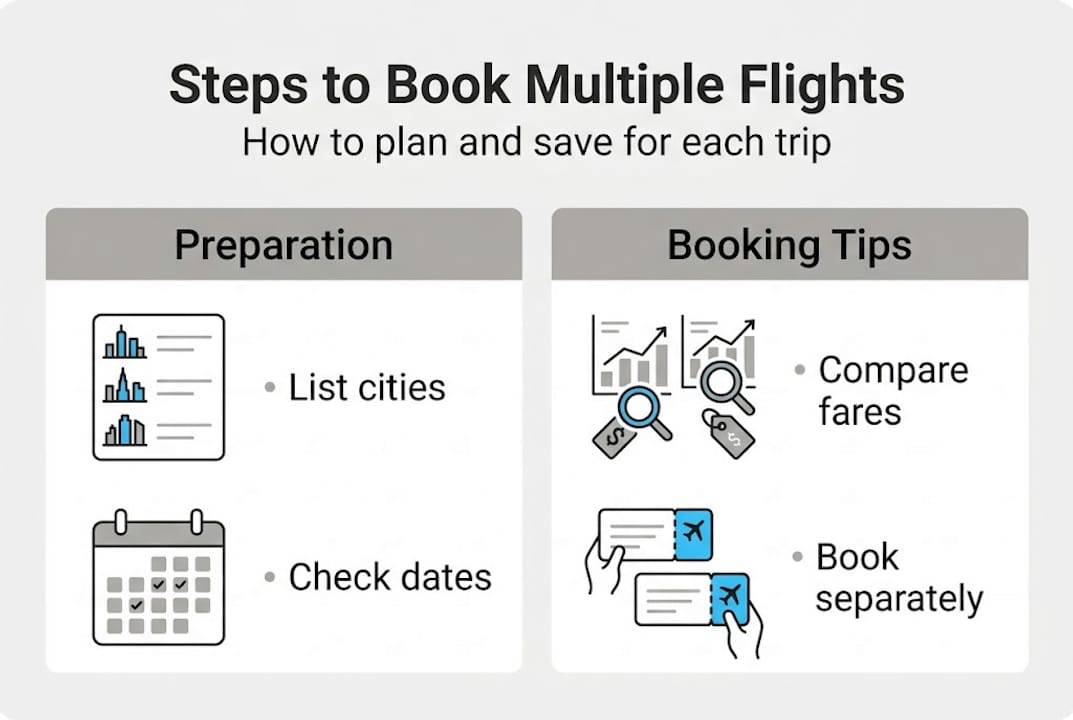
Start by listing every destination in order, including any layovers you’d like to add or must avoid. Write down your group size and collect each traveler’s full legal name, date of birth, passport or ID number, and expiration date. Airlines are strict about name matching, and even a small typo can cost you a rebooking fee. Gather this information before you search for a single fare.
Next, identify your flexible travel dates. Flights can vary by hundreds of dollars depending on the day of the week or the time of day. If your schedule allows even a one or two day shift, you open yourself up to significantly cheaper options. Also note any non-negotiable stops, such as overnight stays between long legs or cities where you need extra time.
For multi-city trip planning, building a simple planning table before you book is one of the most underrated moves you can make. Here’s an example of what that table might look like:
| Leg | Origin | Destination | Preferred dates | Airline options | Estimated fare |
|---|---|---|---|---|---|
| 1 | New York | London | Mar 10-12 | Delta, BA | $420-$510 |
| 2 | London | Rome | Mar 15-17 | Ryanair, easyJet | $60-$110 |
| 3 | Rome | New York | Mar 22-24 | Alitalia, Delta | $390-$480 |
This table keeps you organized and prevents the most common error: forgetting to account for layover time between legs. A good rule of thumb is to allow at least two to three hours between separately booked flights at the same airport, and even more if you’re switching airports.
Here’s a quick checklist of what to gather before you start booking:
- Full legal names for all travelers
- Passport or government ID details and expiration dates
- Flexible date ranges for each leg
- Budget ceiling per leg
- Baggage requirements (checked vs. carry-on)
- Preferred airports if multiple options exist
- Any hotel or overnight stay needs between legs
Taking 30 minutes to build this foundation saves hours of back-and-forth later and protects you from costly surprises.
Compare booking strategies for maximum savings
Once you know your route and requirements, it’s time to choose the right way to book for the biggest savings. Not all booking methods are created equal, and the difference between them can easily run into the hundreds of dollars.
The most common approach is booking everyone in a single transaction. It’s fast and feels organized. The problem is that booking one at a time to secure the lowest fare buckets is actually smarter for groups, because a single transaction forces the airline system to price all seats at the same tier. If only two seats remain at the lowest price, booking four tickets at once bumps every ticket to the next price level.
Here’s a comparison of the three main booking approaches:
| Method | Best for | Cost risk | Flexibility |
|---|---|---|---|
| Single transaction | Solo travelers | Low | Moderate |
| One ticket at a time | Groups of 2 or more | Low to medium | High |
| Multi-city booking engine | Complex routes | Medium | Moderate |
Multi-city booking engines offered by airlines or aggregators can simplify complex itineraries, but they often bundle fares at higher price points to protect their margins. Manual bookings, while more time-consuming, let you cherry-pick the cheapest fare on each leg from any carrier.
For group booking savings, the one-at-a-time method is often the most effective. Book the first ticket, note the price, then open a new browser session or use incognito mode before booking the next. This prevents the site from detecting your search history and inflating prices.
Here’s what to weigh when choosing your method:
- Price: Manual bookings often win on individual legs
- Flexibility: Separate tickets mean separate change policies
- Risk: Unprotected connections require travel insurance
- Time: Multi-city tools are faster but less customizable
Understanding group airfare deals can also open doors to negotiated rates for larger parties, sometimes beating any retail method.
Pro Tip: Take screenshots of pricing at each step as you book. If a price jumps mid-session, you’ll have documentation and can restart the process in a fresh browser window to reset the fare display.
Step-by-step: How to book multiple flights efficiently
You’ve picked your booking strategy. Here’s a practical, step-by-step guide to get the lowest price and avoid typical pitfalls.
- Search each leg individually first. Use flight comparison sites to get a baseline price for every leg before committing to anything. Note the cheapest options across at least two or three airlines.
- Open an incognito browser window. This clears cookies and prevents dynamic pricing from inflating fares based on your search history.
- Book the highest-cost leg first. Prices on major international legs fluctuate more than short regional hops. Lock in the expensive ticket while fares are still favorable.
- Book remaining tickets one at a time. For groups, complete one traveler’s booking before starting the next. Check the price before each ticket to catch any fare tier jumps.
- Verify connection times before confirming. Allow at least two to three hours between separately booked flights. If airlines or airports differ, build in even more buffer time.
- Stick to carry-on luggage when possible. As noted by budget travelers prioritizing carry-on, avoiding checked bags eliminates per-leg baggage fees that can add up fast across a multi-stop trip.
- Purchase travel insurance immediately after booking. Separately booked flights have no built-in protection if you miss a connection. Insurance covers delays, cancellations, and rebooking costs.
For more cheap flight tips that go beyond basic searches, understanding fare calendars and off-peak booking windows can shave another 10 to 20 percent off each leg. And when it comes to minimizing baggage fees, packing smart from the start is one of the highest-return habits any frequent traveler can build.
“For budget travelers, prioritize carry-on only to avoid per-leg bag fees and purchase travel insurance to protect unprotected connections.”
The step-by-step method takes more time than clicking through a single booking flow, but the savings are real and repeatable.
Verify bookings and avoid common mistakes
After booking, it’s essential to verify every reservation and safeguard your trip from common missteps. This stage is where many travelers get complacent and end up paying for it at the airport.

Airline systems have roughly 10 price points per flight, and single-transaction bookings force uniform pricing across all passengers. Understanding this helps you appreciate why verification matters: even a small error in a booking can ripple into a much bigger problem at check-in.
Here’s what to check immediately after every booking:
- Traveler names: Must match passport or ID exactly, including middle names if required
- Travel dates and times: Confirm AM vs. PM and the correct calendar date
- Airport codes: Some cities have multiple airports (London Heathrow vs. Gatwick, for example)
- Connection windows: Make sure no two legs overlap or leave dangerously little transfer time
- Baggage allowances: Each airline has its own rules; check every leg separately
- Email confirmations: Save all confirmation emails in a dedicated folder and cross-check each one against your planning table
Set calendar reminders to check for schedule changes 30 days, 7 days, and 48 hours before each flight. Airlines quietly adjust departure times, and if you’re not watching, a 20-minute shift can turn a comfortable connection into a missed flight.
Using a step-by-step booking guide as a reference during this verification phase helps you catch errors you might otherwise overlook, especially when managing four or more separate bookings at once.
The most common mistakes travelers make with multi-leg bookings are mismatched airports, overlapping departure times, and failing to account for different airline bag policies on each leg. Catching these before departure costs nothing. Fixing them at the airport can cost everything.
Our take: Why a little extra effort can save a lot
Having verified your bookings, let’s reflect on the bigger picture: why the manual approach is worth your time in today’s airline market.
Most travelers reach for the fastest tool available, and that instinct is understandable. But speed in booking often means paying a premium you didn’t need to pay. We’ve seen travelers save $300 or more on a four-person trip simply by booking tickets one at a time instead of all at once. That’s not a trick. That’s just understanding how airline pricing works and using it to your advantage.
Automated flight bundling tools are built for convenience, not for your wallet. They’re optimized to close the transaction quickly, not to find the lowest fare bucket for each individual seat. Manual bookings, while slower, let you access fare tiers that bulk tools skip entirely.
The travelers who consistently find the best deals are the ones who treat booking like a skill, not a chore. They dig into saving money on group travel, learn the quirks of airline pricing, and take personal responsibility for every detail. That mindset is what separates a $900 trip from a $1,400 one.
The best deals are rarely the most visible. They’re earned by those willing to spend an extra 45 minutes doing it right.
Get more from your trip with PilotTravelDeals.com
Ready to put your booking strategy to work? Here’s how you can get even more value on your next adventure.

At PilotTravelDeals.com, we’ve built a platform specifically for travelers who want to stretch every dollar further. Whether you’re hunting for affordable hotels between flight legs or need a reliable travel SIM cards to stay connected across multiple countries, we’ve got curated deals that match the way multi-city travelers actually move. Our flight comparison strategies guide takes everything covered in this article and connects you to live tools that make finding low fares faster and more reliable. Stop leaving money on the table and start booking like someone who knows the system.
Frequently asked questions
Is it cheaper to book flights together or separately for a group?
Booking separately is often cheaper because single-transaction bookings force all passengers into the same, often higher, fare tier. Booking one ticket at a time lets you capture the lowest available price for each seat.
Do I need travel insurance if I book flights separately?
Yes, because unprotected connections in separately booked itineraries leave you with no airline obligation if you miss a flight. Travel insurance covers unexpected delays, cancellations, and rebooking costs.
What’s the safest way to minimize luggage fees when booking multiple flights?
Travel carry-on only whenever possible, since per-leg bag fees add up quickly across a multi-stop itinerary booked with different airlines. Packing light is one of the simplest ways to keep your total trip cost down.
What’s a common mistake to avoid with multi-leg bookings?
Mismatched airport codes and traveler name errors are the most costly mistakes. Always cross-check booking details against your planning table before finalizing any reservation.
Recommended
- Essential Tips for Booking Flights: Save Big Today – PilotTravelDeals.com
- Top Tips for Cheap Plane Tickets: Save on Every Flight – PilotTravelDeals.com
- Best Tips for Cheap Flights: Save More on Airfare – PilotTravelDeals.com
- Proven Tips to Find Cheap Flights and Save Big on Travel – PilotTravelDeals.com
- Kombitickets Disneyland – Mehr Erlebnis und Ersparnis