

TL;DR:
- Timing, flexibility, and booking strategies can significantly reduce travel costs.
- Alternative accommodations like hostels, house shares, and work exchanges offer affordable options.
- Pre-trip planning including visas, insurance, and safety measures helps avoid unexpected expenses.
Budget travel has a reputation problem. Most people assume it means cramped overnight buses, questionable hostels, or eating gas station sandwiches for dinner. That picture is wrong. With the right timing, tools, and a bit of planning, you can travel well and spend far less than you think. This guide walks you through the four biggest cost categories: flights, lodging, pre-trip logistics, and creative savings strategies like work exchanges. Each section includes concrete, actionable steps you can use right now, not vague suggestions that sound good but lead nowhere.
Table of Contents
- Mastering flight and travel timing for savings
- Finding budget-friendly accommodations
- Essential pre-trip logistics to avoid extra costs
- Creative travel savings: Work exchanges and skill swaps
- Budget travel: The reality and how to make it work for you
- Find more budget travel deals and expert guidance
- Frequently asked questions
Key Takeaways
| Point | Details |
|---|---|
| Timing is everything | Booking flights earlier and choosing off-peak travel days can produce substantial savings. |
| Lodging flexibility wins | Alternative and communal accommodation options unlock comfort and cost advantages. |
| Checklists prevent surprises | A thorough pre-trip checklist keeps costs predictable and avoids last-minute disruptions. |
| Creative exchanges add value | Skill swaps and work exchanges are practical ways to cover lodging expenses for adventurous travelers. |
| Tailor your approach | Budget travel can be as comfortable as you want—it’s about balancing savings with your personal preferences. |
Mastering flight and travel timing for savings
With the basics set, let’s jump straight into how you can slash the cost of flights using timing and smart booking strategies.
The single biggest mistake budget travelers make is booking at the wrong time. For domestic flights, the sweet spot is typically one to three months before departure. For international trips, you want to start searching two to eight months out. Booking too early or too late tends to push prices up, and flight booking timing is one of the most reliable levers budget travelers can pull to reduce trip costs.
Day of the week matters more than most people realize. Tuesdays and Wednesdays are consistently cheaper for departures, and Saturdays often beat Sundays by a noticeable margin. Avoiding Monday and Friday departures, when business travelers dominate the market, can shave 10 to 20 percent off your fare. Pair that with off-peak travel periods like shoulder seasons in spring and fall, and you stack savings on top of savings.
Here’s a quick comparison of booking windows and their typical impact:
| Trip type | Best booking window | Potential savings |
|---|---|---|
| Domestic | 1 to 3 months out | 10 to 30% vs. last minute |
| International | 2 to 8 months out | 20 to 50% vs. peak booking |
| Holiday travel | 3 to 5 months out | Varies, but significant |
Fare comparison tools are your best allies here. Use aggregators that track price history so you can see whether a fare is trending up or down. Set price alerts for specific routes and let the algorithm do the watching for you. Our guide on tips to find cheap flights breaks down the best tools and the exact settings that get results.
Key habits to build into every flight search:
- Search in incognito mode to avoid price tracking cookies
- Compare nearby airports, sometimes a 45-minute drive saves $150
- Be flexible on your return date by even one day
- Stack airline rewards with credit card points for free or deeply discounted upgrades
- Consider budget carriers for short routes where baggage needs are minimal
Pro Tip: Combine off-peak departure days with a rewards card sign-up bonus. Many travel cards offer 60,000 to 80,000 points after meeting a spending threshold, which can cover one or two round trips entirely.
Finding budget-friendly accommodations
After locking in affordable airfare, let’s focus on stretching your lodging budget further without sacrificing comfort.
Accommodation is usually the second-largest travel expense after flights, and it’s also one of the most flexible. Communal and alternative lodging options like hostels, house shares, and work exchanges can cut this cost dramatically compared to standard hotels.

Here’s how the most common budget-friendly options compare:
| Option | Average cost per night | Privacy level | Best for |
|---|---|---|---|
| Shared hostel dorm | $15 to $35 | Low | Solo travelers, social stays |
| Private hostel room | $40 to $70 | Medium | Couples, light sleepers |
| House share or sublet | $30 to $60 | Medium to high | Longer stays |
| Hotel loyalty points | Free to low | High | Frequent travelers |
| Work exchange | Free | Varies | Flexible, longer trips |
Safety in communal spaces is a real concern, not something to brush aside. Always check recent reviews specifically mentioning security, read the property’s check-in policies, and look for lockers in dorm rooms. A well-reviewed hostel in a safe neighborhood consistently outperforms a cheap hotel in a sketchy area for both price and peace of mind.
Steps to pick accommodation that’s both affordable and safe:
- Filter by guest rating of 8.0 or above on major booking platforms
- Read the 10 most recent reviews and look for security mentions
- Confirm the neighborhood using a local map and transport check
- Check cancellation policies before you pay anything
- Compare total costs including fees, not just the nightly rate
“Nomadic Matt’s $75 per day travel strategy shows that smart accommodation choices, not income level, determine whether a trip is affordable. Communal stays and timing your hotel bookings outside peak periods can make the biggest dent.”
Use our guide to save on hotels for more detail on loyalty programs and negotiating rates. And if you want a broader money-saving framework, the travel for cheap guide is a useful companion.
Pro Tip: Book hotels on Sunday evenings. Prices often drop as properties clear unsold inventory for the week ahead. Midweek and last-minute weekend stays are two other windows where rates dip predictably.
Essential pre-trip logistics to avoid extra costs
Bookings are just one part. Prepping with the right logistics can keep costs predictable and avoid last-minute hassles.
Here’s an underappreciated truth: most travel budget blowouts aren’t from flights or hotels. They’re from overlooked logistics. A missed visa fee, an expired passport discovered at the airport, or no travel insurance when something goes wrong can cost more than the trip itself.
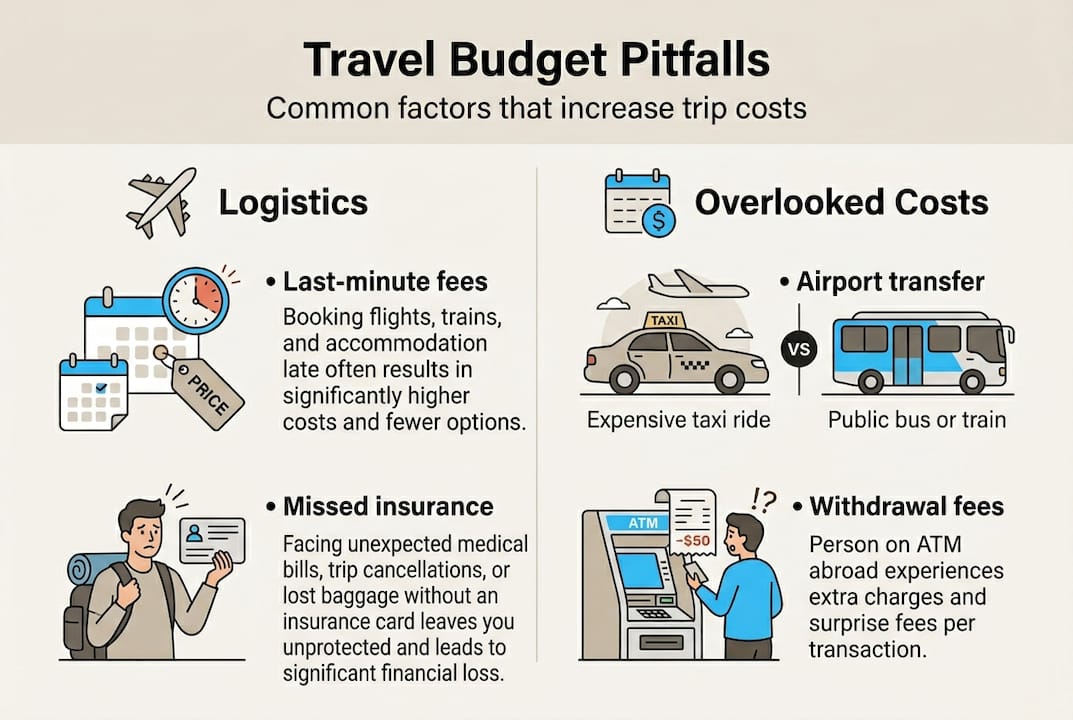
The U.S. State Department’s checklist outlines the official pre-trip preparation items that every international traveler should complete, and skipping any of them can create expensive surprises. Budget travel planning is most effective when it includes these foundational steps from the start.
Overlooked pre-trip tasks that protect your budget:
- Renew your passport at least six months before departure, many countries require this
- Confirm visa requirements for every country on your itinerary, not just your destination
- Purchase travel insurance before you depart, not after a problem starts
- Notify your bank and credit card company of your travel dates
- Download offline maps and key documents to your phone
- Research airport transport options in advance so you’re not stuck with expensive taxis
- Keep a backup emergency cash reserve in a separate location from your wallet
- Save local emergency contacts and embassy phone numbers offline
Our international travel tips guide goes deeper on country-specific entry requirements. For a structured preparation process, the travel planning checklist walks you through each step with clear timelines.
Pro Tip: Build a pre-trip budget buffer of five to ten percent of your total trip cost. Keep it in a separate account or envelope. This isn’t a vacation fund, it’s a contingency for unplanned costs like rebooking fees, medical needs, or lost luggage.
Being proactive about safety logistics matters too. The travel safety tips guide covers what budget travelers in 2026 need to know to stay protected without overspending on unnecessary precautions.
Creative travel savings: Work exchanges and skill swaps
Finally, let’s go beyond conventional strategies and explore creative ways to stretch your budget without cutting out what matters.
Work exchange programs let you trade a few hours of your time for free accommodation, and sometimes meals. You show up at a farm, hostel, language school, or family home, contribute a set number of hours per day, and live there without paying rent. This model can reduce accommodation costs to nearly zero for extended stays.
According to work exchange travel data, most programs require between four and six hours of work per day in exchange for free lodging, with some also covering meals. That’s a meaningful chunk of your day, but for travelers staying weeks or months, the savings can easily reach hundreds or even thousands of dollars.
Skills that hosts commonly look for:
- Language tutoring or English conversation practice
- Childcare and babysitting
- Social media content creation or website help
- Gardening, farming, or permaculture work
- Cooking, cleaning, or hostel front-desk tasks
- Photography or graphic design
The tradeoff is real. You’re giving up flexibility and leisure time during your work hours. Transport, SIM cards, activities, and personal spending are still on your tab. Work exchange isn’t a fit for every traveler, especially those with tight schedules or specific comfort needs.
Pro Tip: Before committing to any work exchange, have a video call with the host, ask for references from past volunteers, and confirm exactly what the schedule looks like day to day. Vague arrangements lead to unpleasant surprises.
For travelers who want maximum savings on lodging without sacrificing all their vacation time, a hybrid approach works well. Spend one or two weeks at a work exchange during a longer trip, then budget accommodation for the rest. You offset the cost without giving up your whole experience.
Budget travel: The reality and how to make it work for you
Here’s something the typical budget travel article won’t say: not every savings strategy is right for every traveler, and that’s completely fine.
A NerdWallet survey found that a meaningful portion of travelers would rather skip a vacation entirely than book a budget trip. That signals something important. Forced discomfort isn’t savings, it’s just misery with a cheap price tag. The goal of budget travel should be to find the savings levers that fit your actual comfort and risk tolerance, not to white-knuckle through an experience you hate.
For some travelers, shared dorms are genuinely fun and social. For others, a private room is non-negotiable for sleep quality and wellbeing. Both are valid. The mistake is assuming you have to go all-in on every cost-cutting measure at once.
Our view at PilotTravelDeals.com is that the best budget travel strategy is one you’ll actually use. Pick two or three tactics from this guide, apply them consistently, and you’ll spend less without feeling like you’re missing out. Start with flight timing and pre-trip logistics since both have high impact and low discomfort. Then decide how far you want to push lodging costs based on your own comfort level. You can always explore budget travel tips to build from there.
Find more budget travel deals and expert guidance
Ready to put these strategies into action? PilotTravelDeals.com brings together the tools, guides, and curated deals you need to plan a smarter trip from start to finish.

Whether you’re hunting for affordable domestic flights or trying to lock in the best rate on a hotel, our comparison platform does the heavy lifting for you. Check out our step-by-step hotel booking deals guide for a walkthrough of how to find and secure the lowest available rates. And before you pack, the holiday travel checklist covers every essential item so nothing gets missed. Savings up to 80% are real when you know where to look.
Frequently asked questions
What is the best time to book flights for maximum savings?
For domestic trips, start searching one to three months in advance. For international routes, two to eight months ahead typically yields the best fares, and booking timing is one of the most reliable ways to reduce trip costs, especially if you avoid peak-day departures.
How can I save on lodging without sacrificing safety?
Choose accommodations with high recent ratings and confirmed security features, and always verify amenity and safety policies before booking. Communal lodging models like hostels with private rooms offer a strong balance between savings and comfort.
What should I include in my pre-trip checklist to avoid surprise costs?
Cover essential documents, visa requirements, travel insurance, backup cash, and airport transport logistics well before departure. The official pre-trip checklist from the U.S. State Department is a reliable starting reference.
Are work exchange programs really free?
Work exchange programs typically cover lodging and sometimes meals, but travel, activities, and personal costs remain your responsibility. Work exchange arrangements usually require four to six hours of daily work in exchange for accommodation.
Can budget travel be comfortable and enjoyable?
Absolutely. The key is matching savings strategies to your actual comfort needs rather than applying every tactic at once. NerdWallet’s findings suggest that personalized approaches to budget travel produce better experiences than a one-size-fits-all method.
Recommended
- 7 Proven Budget Travel Tips 2025 for Smart Savings – PilotTravelDeals.com
- How to Plan Affordable Trips: Smart Strategies for Any Traveler – PilotTravelDeals.com
- 9 Essential Budget Travel Hacks Every Traveler Must Know – PilotTravelDeals.com
- How to Travel on a Budget and Save More on Every Trip – PilotTravelDeals.com
- Budget family ski trips near Baltic airports: top picks • Blog • Go Transfer Peak


