

TL;DR:
- Comparing all-inclusive hotel prices across platforms helps travelers avoid hidden fees and overspending during bookings. Using metasearch engines, direct hotel websites, and tracking price trends enables accurate comparisons and better deals. Always consider total checkout prices, cancellation policies, and timing to maximize hotel savings and travel value.
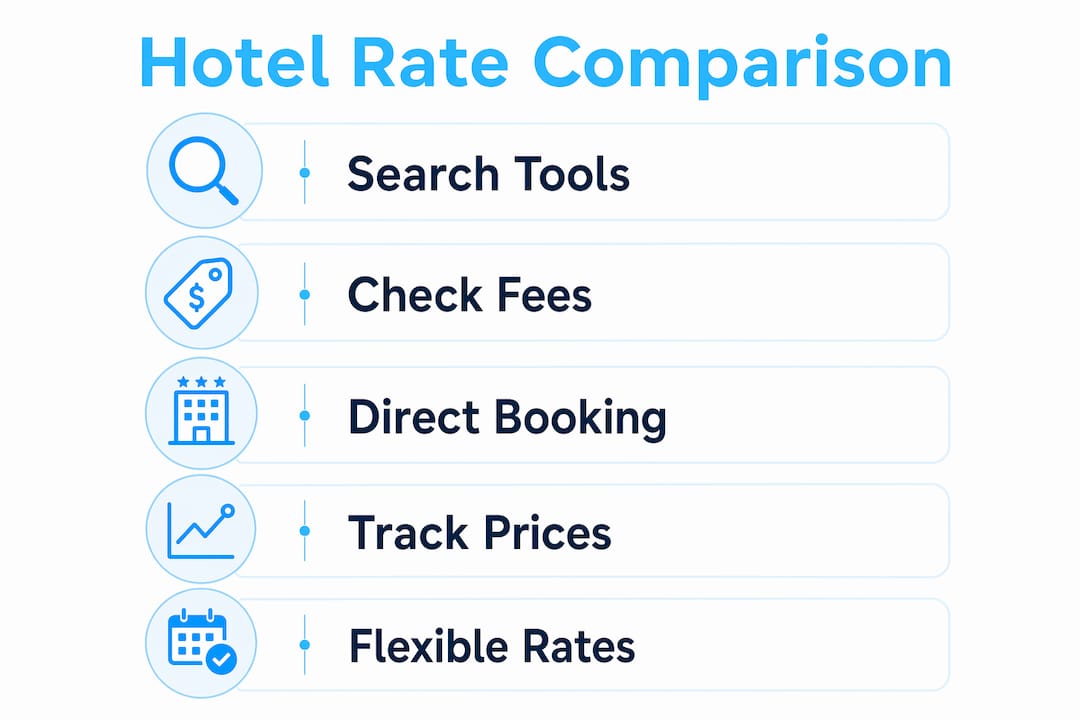
Comparing hotel rates means evaluating final all-inclusive prices across multiple platforms, not just the nightly base rate shown in search results. Travelers who know how to compare hotel rates correctly save significantly more than those who book the first result they see. The difference between a smart booking and an expensive mistake often comes down to three things: the tools you use, the fees you account for, and the timing of your search. This guide covers every step, from choosing the right hotel comparison tools to spotting hidden charges before you pay.
What tools and websites should you use to compare hotel rates?
The most effective approach to hotel rate comparison starts with metasearch engines. Google Hotels, Trivago, and Kayak pull rates from dozens of online travel agencies (OTAs) and display them side by side. That alone saves you from opening 10 browser tabs manually. But these tools are not equal, and knowing their differences changes how you use them.

OTAs apply individual markups on the hotel’s published rate, which is why the same room can cost $189 on one platform and $214 on another. Metasearch engines surface these differences, but they do not always show the cheapest option first. Google Hotels, for example, sorts by ad relevance by default, not by price. Paid placements appear above genuinely cheaper options. Switch the sort order to “Lowest price” immediately after loading results.
Browser extensions like Hotel Ninja go further by comparing exact room types across booking sites in real time. This matters because a “Standard Queen” on Booking.com may not be the same room as a “Standard Queen” on Expedia, and price differences can reflect room quality rather than a true deal. Hotel Ninja eliminates that ambiguity.
Direct hotel websites deserve a spot in every comparison. Booking directly sometimes unlocks perks like complimentary breakfast, room upgrades, or flexible cancellation that OTAs cannot match. Loyalty programs amplify this further. IHG One Rewards, for instance, offers 25 to 30% off Best Flexible Rates during promotional windows, accessible only through direct bookings.
| Tool | Best for | Key limitation |
|---|---|---|
| Google Hotels | Broad rate overview across OTAs | Default sort favors paid ads |
| Kayak | Price trend charts and fare alerts | Fewer direct booking options |
| Trivago | Visual comparison across many sites | Interface can feel cluttered |
| Hotel Ninja | Exact room-type matching | Browser extension only |
| Direct hotel site | Perks, loyalty rates, flexibility | Requires checking each brand separately |
Pro Tip: Always open the hotel’s direct website after finding a competitive rate on a metasearch engine. Even if the price matches, the direct booking often includes perks that make it the better deal.
How to interpret and compare hotel prices accurately
The base rate you see in search results is almost never what you pay. Taxes, resort fees, and service charges routinely add 15 to 30% to the displayed price. Travel commentator Alexander Verbeek highlights that comparing checkout totals rather than nightly rates is the single most important habit for avoiding overspending on hotels.
Google Hotels includes a “Show taxes and fees” toggle in its search interface. Most travelers never enable it, which means they are comparing pre-tax rates that underrepresent true costs by 15 to 30%. Turn this on before you compare anything. Kayak and Trivago have similar settings buried in their filter menus.
Resort fees are the most deceptive line item in hotel pricing. A Las Vegas hotel might advertise $79 per night but charge a $45 daily resort fee at checkout. That $79 rate is not a deal. It is a $124 stay. The only way to catch this is to click through to the final checkout screen on each platform before making any decision.
Here is what to check before treating any rate as a true comparison:
- Total checkout price including all taxes and fees
- Cancellation policy (refundable vs. non-refundable)
- What is included (parking, Wi-Fi, breakfast)
- Whether the rate requires prepayment
- Currency conversion if booking internationally
Pro Tip: Refundable rates are worth paying a small premium for. Book the refundable option first, then monitor prices. If the rate drops, rebook at the lower price and cancel the original.
When should you track hotel price trends to save more?
Hotel prices are not static. They shift daily based on demand, local events, and how far out you are booking. Understanding this pattern turns price comparison from a one-time task into an ongoing strategy.
Google Hotels displays a price trend chart showing whether rates for your dates are currently low, typical, or high relative to historical data. The calendar view uses color codes: green for cheaper dates, red for expensive ones. This is one of the fastest ways to spot whether shifting your arrival by one or two days saves money. Sunday check-ins average 24% cheaper than Friday check-ins for the same hotel, according to Kayak data. That single scheduling shift can save more than any coupon code.
For post-booking monitoring, Google Hotels’ price alerts work at the destination level, not the individual hotel level. If you want hotel-specific price tracking after booking, dedicated tools like Rate Ranger monitor a specific property and notify you when the rate drops. This pairs perfectly with the refundable booking strategy mentioned above.
Seasonal pricing also plays a major role. A beach resort in Miami costs dramatically more in January than in September. Pilottraveldeals has a detailed breakdown of how seasonal price swings affect hotel rates and how to time bookings around them.
- Search your target dates on Google Hotels and enable the price trend chart.
- Check the calendar view for cheaper adjacent dates (especially Sunday arrivals).
- Book a refundable rate if the price looks reasonable but not at its lowest.
- Set a price alert in Google Hotels or use Rate Ranger for hotel-level monitoring.
- Rebook at the lower rate if prices drop before your stay, then cancel the original.
Pro Tip: Local events like conferences, sports finals, and festivals can spike hotel prices by 50% or more overnight. Search local event calendars for your destination before locking in dates.
Common mistakes travelers make when comparing hotel rates
Most overspending on hotels comes from a small set of repeatable errors. Recognizing them before you search is more valuable than any discount code.
Comparing only the nightly rate. This is the most common and costly mistake. Hidden fees can add dozens of dollars per night to what looked like a bargain. Always compare total checkout prices.
Ignoring cancellation policies. A non-refundable rate that is $20 cheaper than a flexible rate is not a deal if your plans might change. The flexibility has real monetary value.
Skipping the direct hotel website. Many travelers assume OTAs always offer the lowest price. They do not. Direct bookings frequently include perks, and loyalty program rates can undercut OTA prices significantly, especially during promotional periods.
Trusting the first search result. Google Hotels and Trivago both surface sponsored listings at the top. These are paid placements, not the cheapest options. Scroll past them and sort by price before drawing any conclusions.
Overlooking location value. A $90 hotel that requires a $30 daily taxi ride to your destination costs more than a $110 hotel within walking distance. Factor in transport costs when comparing rates across neighborhoods.
“The real price of a hotel room is what you pay at checkout, not what you see in the search results. Anything else is just marketing.” — Alexander Verbeek
How to combine hotel comparison with your broader travel strategy
Comparing hotel rates in isolation leaves savings on the table. The most cost-effective trips treat hotel, flight, and transport costs as a single budget to optimize together.
Flight timing directly affects hotel pricing. Flying into a destination on a Tuesday or Wednesday typically costs less than weekend flights, and hotels in most cities are also cheaper midweek. Aligning both saves money on two line items simultaneously. Pilottraveldeals covers cheap airfare strategies that pair well with hotel rate comparison for full-trip savings.
Loyalty programs deserve more attention than most travelers give them. Marriott Bonvoy, Hilton Honors, and IHG One Rewards all offer member-only rates that are not visible on OTAs. Signing up is free, and the discounts activate immediately. Combining a loyalty rate with a promotional window, like the IHG 25 to 30% off deal available through mid-July 2026, produces savings that no third-party platform can match.
Travel passes and bundled packages occasionally beat itemized comparison. If you are booking a hotel for five or more nights, check whether the hotel offers a weekly rate or whether a flight-plus-hotel package from a major OTA undercuts your best standalone hotel price. Packages obscure individual line items, so run the math explicitly before assuming a bundle is cheaper.
For travelers who want a single resource that pulls these strategies together, the hotel booking guide at Pilottraveldeals walks through the full booking process with savings built into each step.
Key takeaways
Comparing hotel rates accurately requires checking all-inclusive checkout prices, using the right tools, and tracking price trends rather than booking on the first search result.
| Point | Details |
|---|---|
| Compare checkout totals | Always enable taxes and fees display; base rates understate true costs by 15 to 30%. |
| Use multiple tools | Combine Google Hotels, Kayak, and direct hotel sites to catch the best rate across all sources. |
| Time your booking strategically | Sunday check-ins average 24% cheaper than Fridays; midweek dates save on both hotels and flights. |
| Book refundable first | Lock in a flexible rate, monitor prices with Rate Ranger, and rebook if costs drop. |
| Leverage loyalty programs | IHG One Rewards and similar programs offer member-only discounts OTAs cannot access. |
Why I stopped trusting metasearch engines alone
I spent years assuming that opening Google Hotels and sorting by price was enough. It is not. The first time I ran a side-by-side comparison between a metasearch result and the hotel’s direct booking page, the direct rate was $18 cheaper per night and included breakfast. That is a $126 difference on a seven-night stay, plus the value of daily breakfast for two people.
What most travelers overlook is that metasearch engines are advertising platforms first and comparison tools second. The business model depends on clicks to OTAs, not on finding you the absolute lowest price. That does not make them useless. It means you use them as a starting point, not a final answer.
The habit that changed my booking results most was enabling taxes and fees on every platform before comparing anything. Rates that looked competitive at $99 per night became $138 after fees, while a $109 rate at the same hotel booked directly came to $121 all-in with Wi-Fi included. The “cheaper” option was not cheaper at all.
Patience matters more than any tool. Prices shift constantly, and a refundable booking combined with a price alert costs nothing extra but can save 20% or more if you catch a rate drop. The travelers who consistently get the cheapest hotel deals are not lucky. They are systematic.
— Asher
Find your next hotel deal with Pilottraveldeals
Pilottraveldeals aggregates hotel deals from across the web so you can compare options without opening a dozen tabs. The hotels deals page pulls together curated offers with savings up to 80%, covering everything from budget stays to premium properties worldwide.

Beyond the deals themselves, Pilottraveldeals publishes guides on smart hotel savings and booking strategies built for real travelers, not just deal hunters. Whether you are planning a weekend city break or a two-week international trip, the platform gives you the comparison tools and editorial guidance to book with confidence. Start your search at Pilottraveldeals and see what you have been overpaying for.
FAQ
What is the best way to compare hotel prices?
Use Google Hotels or Kayak to get a broad rate overview, then check the hotel’s direct website before booking. Always enable the taxes and fees display to compare true checkout totals rather than base rates.
Why do hotel prices differ across booking sites?
Each OTA applies its own markup on top of the hotel’s published rate, which creates price differences for the same room across platforms. Metasearch engines surface these differences, but sorting by lowest price is required to see the cheapest option.
How do I find cheap hotels without overpaying on fees?
Enable the “Show taxes and fees” toggle in Google Hotels before comparing any rates. Pre-tax prices can understate actual costs by 15 to 30%, making a cheap-looking rate more expensive than a higher-listed alternative.
Is it cheaper to book a hotel directly?
Direct bookings sometimes match or beat OTA prices and frequently include perks like breakfast, upgrades, or free cancellation. Loyalty program members can access exclusive rates, such as the IHG One Rewards 25 to 30% discount during promotional periods, that are not available on third-party sites.
When is the cheapest time to book a hotel?
Sunday check-ins average 24% cheaper than Friday check-ins for the same property, according to Kayak data. Midweek stays and off-peak seasonal travel consistently produce the lowest rates across most destinations.


