A business travel per diem is a fixed daily allowance your employer pays to cover lodging, meals, and incidental expenses while you travel for work. Instead of saving every receipt and submitting a line-by-line expense report, you receive a set dollar amount per day and spend it as needed. The U.S. government sets the benchmark rates most private companies reference, with the U.S. General Services Administration (GSA) covering the continental U.S., the Department of Defense (DOD) covering Alaska, Hawaii, and U.S. territories, and the Department of State handling international travel.
Per diem covers three core categories:
- Lodging: The cost of your hotel or other overnight accommodation
- Meals and incidental expenses (M&IE): Food, beverages, tips, and small service fees
- Incidentals: Fees for services like baggage handling and laundry that do not fall under meals
For employees, the appeal is obvious: no chasing receipts, no guessing what qualifies. For managers, it caps daily travel costs at a predictable number, which makes budgeting a lot cleaner.
How per diem rates are set and what the 2025 numbers look like
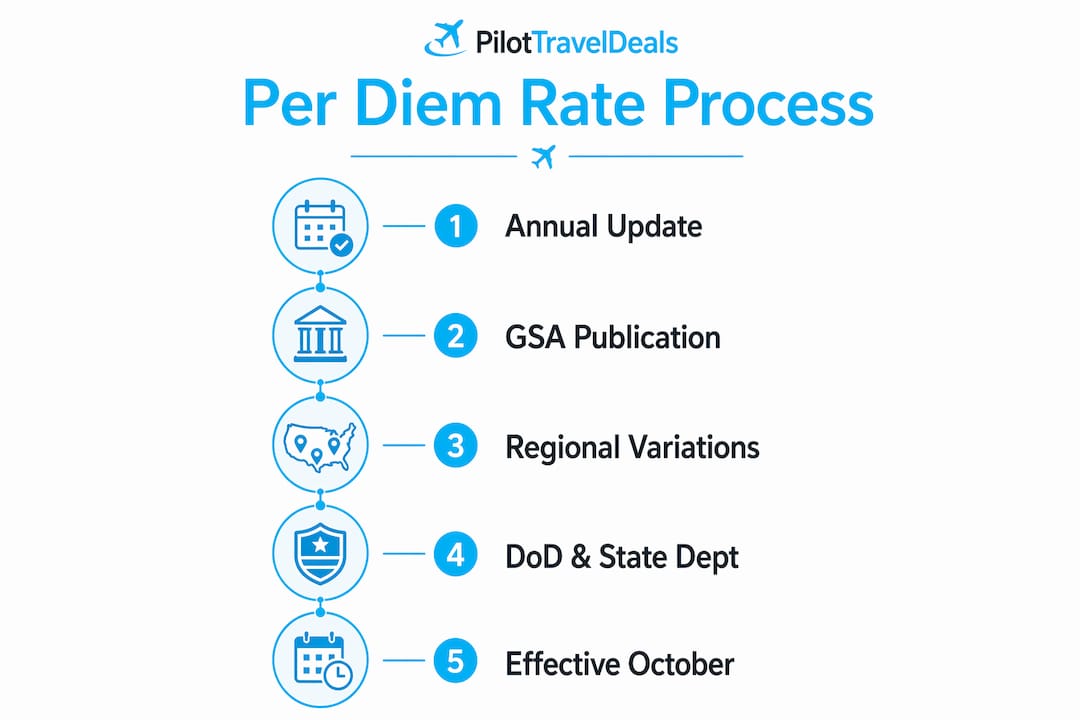
The GSA publishes updated CONUS (continental U.S.) rates every year, effective October 1. For fiscal year 2025, the standard CONUS lodging rate is $110 per night, and the standard M&IE rate is $68 per day. Those two figures combine for a standard daily total of $178 in most of the country.

That standard rate applies to the majority of CONUS destinations. For roughly 300 non-standard areas (NSAs), the GSA sets higher city-specific rates based on local lodging cost data. Think Manhattan, San Francisco, or Washington, D.C., where hotel prices run well above the national baseline. The GSA rate-setting process draws on actual lodging market data to set those NSA figures, which is why a trip to midtown New York carries a very different allowance than a trip to rural Ohio.
| Category | FY 2025 Standard CONUS Rate |
|---|---|
| Lodging | $110 per night |
| M&IE | $68 per day |
| Combined daily total | $178 per day |
| Non-standard areas | Higher city-specific rates (approx. 300 locations) |
| Effective date | October 1 |
Rate spotlight: The standard CONUS M&IE rate covers breakfast, lunch, dinner, and incidentals. Travelers on partial travel days receive only 75% of that figure, not the full amount.
Outside CONUS, the DOD manages rates for Alaska, Hawaii, and U.S. territories, while the Department of State publishes rates for every foreign country. Both agencies follow a similar annual update cycle. If you travel internationally for work, check the State Department’s Office of Allowances before your trip, since rates vary dramatically by country and city.
Tax and legal rules you need to know about per diem
Per diem is a reimbursement for travel costs, not extra pay. That distinction matters more than most travelers realize. A $200 daily per diem allowance is not a bonus or salary supplement. It exists solely to cover legitimate business travel expenses, and treating it otherwise creates real tax problems.

The IRS rule is straightforward: if your employer pays you a per diem at or below the federal GSA rate, the reimbursement is not taxable income, provided you are traveling for a genuine business purpose. If your employer pays above the federal benchmark and you do not return the excess, that overage becomes taxable income for you and a payroll tax liability for the company.
Key tax and legal points every traveler and manager should know:
- Per diem is not salary. It does not count toward retirement contributions, overtime calculations, or benefits.
- Excess payments are taxable. Any amount above the applicable GSA rate must be returned to the employer or reported as wages.
- Documentation still matters. Even under a per diem system, you must record the date, destination, and business purpose of each trip.
- Self-employed travelers can only use per diem for meal costs, not lodging, under IRS rules.
- Per diem pay is different. Some contractors are paid a “per diem rate” meaning a daily wage. That is compensation, not a travel reimbursement, and it is fully taxable.
The last point trips people up constantly. A nurse staffing agency that pays a traveler “$300 per diem” as part of a compensation package is paying wages, not reimbursing expenses. The IRS treats those two things completely differently, and so should your HR and payroll teams.
Pro Tip: Keep a simple travel log with the date, destination, and business purpose for every trip. Even when your company uses a flat per diem, the IRS can still ask for substantiation that the travel was work-related.
Advantages and limitations of using a per diem system
Per diem simplifies expense reporting more than almost any other reimbursement method. Employees spend less time on paperwork, finance teams process fewer receipts, and travel budgets become predictable. Those are real, concrete benefits, especially for companies with frequent travelers.
Advantages:
- Less admin work. No itemized receipts means faster reimbursement and fewer disputes.
- Predictable costs. Finance teams can forecast travel spending with confidence.
- Employee autonomy. Travelers decide how to allocate their daily allowance across meals and incidentals.
- Reduced fraud risk. Fixed amounts eliminate inflated or fabricated receipts.
- Faster reimbursement. Processing a flat daily rate takes far less time than reviewing a stack of receipts.
Limitations:
- Fixed rates can fall short. In expensive cities like New York or San Francisco, even the higher NSA rates may not cover actual hotel costs, leaving travelers out of pocket.
- No flexibility for unusual expenses. A client dinner that costs $200 does not fit neatly into a $68 M&IE allowance.
- Potential for abuse. Employees who spend less than the allowance keep the difference, which can create incentives that do not align with company goals.
- Rate lag. GSA rates update once a year, so a sudden spike in hotel prices mid-year does not get reflected until the next fiscal year.
The honest takeaway: per diem works well for routine travel to mid-tier cities. For high-cost destinations or trips with significant client entertainment, an actual expense reimbursement model often serves travelers better. Many companies run hybrid policies, using per diem for meals and incidentals while reimbursing lodging at actual cost. That approach captures most of the simplicity while reducing the risk of travelers absorbing big hotel bills.
How per diem reimbursement works and what a good policy covers
The math behind per diem reimbursement is simple: daily allowance multiplied by the number of travel days. A three-day trip to a standard CONUS destination at $178 per day yields a $534 total allowance. The wrinkle is the first and last day rule.
Federal guidelines require travelers to use only 75% of the M&IE rate on partial travel days, meaning the day you depart and the day you return. On a standard CONUS trip, that means $51 instead of $68 for M&IE on those two days. Lodging is not affected by this rule since you either stay the night or you do not.
A solid per diem policy covers these elements:
- Rate schedule. Which rates apply, how employees look up city-specific rates, and where to find updates.
- Covered expense categories. Lodging, M&IE, and incidentals clearly defined, with examples of what qualifies.
- Advance payment vs. reimbursement. Whether employees receive funds before the trip or submit for reimbursement afterward.
- First and last day rules. Explicit guidance on the 75% M&IE calculation so travelers are not surprised.
- Overage handling. What happens when actual costs exceed the allowance, and whether exceptions require pre-approval.
- Documentation requirements. Minimum records needed: travel dates, destination, and business purpose.
- Distinction from actual expense reimbursement. When per diem applies and when the company switches to actual receipts.
The difference between per diem and actual expense reimbursement comes down to control and simplicity. Per diem gives employees a fixed budget and lets them manage it. Actual expense reimbursement pays exactly what was spent, but requires receipts and review for every line item. Per diem tends to win on speed; actual expense reimbursement wins on accuracy for high-cost trips. Understanding your company’s business travel budgeting process helps you know which method applies when.
Practical tips for getting the most out of your per diem
For employees:
- Look up the specific rate for your destination before you travel. City rates vary widely, and knowing your allowance in advance helps you book lodging that fits within it.
- Book hotels early. The GSA rate for your city is a ceiling, not a guarantee. Rates at popular business hotels often exceed the allowance, so early booking gives you the best shot at staying within the limit. Checking lodging booking strategies can help you find options that fit your per diem budget.
- Track your travel days carefully, including departure and return times, since the 75% M&IE rule applies any day you do not spend the full day at your destination.
- Do not treat leftover per diem as a windfall. Some companies require unused amounts to be returned; others do not. Know your policy before you spend.
- Keep a record of your business purpose for every trip, even if your company does not require detailed receipts. The IRS can audit travel reimbursements, and a simple log protects you.
For managers:
- Audit per diem claims periodically. Cross-check travel dates against calendar records, project logs, or flight confirmations to catch errors or misuse early.
- Publish a clear rate schedule and update it every october when GSA releases new figures. Employees who do not know the current rates cannot comply with them.
- Set a pre-approval process for trips to high-cost cities where actual lodging costs routinely exceed the GSA allowance. That way, overages are documented and expected rather than discovered after the fact.
- Distinguish per diem travel reimbursements from per diem pay in all HR and payroll documentation. Mixing the two creates compliance risk and confuses employees about their taxable income.
Pro Tip: If your destination falls in a county that straddles two per diem rate zones, the higher applicable rate covers the entire facility or installation. Check the GSA rate tool for your specific location rather than assuming the standard rate applies.
Staying within your per diem while traveling comfortably comes down to planning. Pilottraveldeals makes it easier to find hotels within your budget so your lodging allowance actually covers your stay, whether you are heading to a standard CONUS city or a higher-cost destination.

Key Takeaways
A business travel per diem is a fixed daily reimbursement covering lodging, meals, and incidentals, set by the GSA under the FY 2025 standard CONUS rate, with amounts above federal benchmarks treated as taxable income.
| Point | Details |
|---|---|
| Standard 2025 CONUS rates | GSA sets lodging at $110/night and M&IE at $68/day for most U.S. destinations. |
| Partial day rule | The first and last travel days use only 75% of the M&IE rate, not the full daily amount. |
| Tax threshold | Per diem payments above the federal GSA rate become taxable income unless returned to the employer. |
| Per diem vs. per diem pay | Travel per diem is a reimbursement; per diem pay for contractors is taxable wages. These are legally distinct. |
| Policy clarity reduces risk | Clear written policies on rates, overages, and documentation protect both employees and employers from IRS scrutiny. |
Recommended
- What is travel credit? A 2026 guide for budget travelers – PilotTravelDeals.com
- 7 Smart Ways to Maximize Business Travel Benefits – PilotTravelDeals.com
- Business travel trends to optimize efficiency and costs – PilotTravelDeals.com
- Business Travel Productivity: A 2026 Guide for Executives – PilotTravelDeals.com