
TL;DR:
- Proper overnight flight strategy aligns sleep, seat choice, and arrival plans to reduce fatigue and maximize productivity. It emphasizes pre-flight sleep shifting, choosing the right departure time, and early logistics confirmation for smooth recovery. This approach helps travelers arrive ready to function while saving time and costs associated with hotel stays.
Overnight flight strategy is defined as the practice of timing, planning, and managing a red-eye or long-haul night flight to align sleep with destination time zones, reduce fatigue, and arrive ready to function. The role of overnight flight strategy goes far beyond simply booking a late departure. Done well, it eliminates a hotel night, compresses travel time, and puts you at your destination in the morning with a full day ahead. Done poorly, it leaves you exhausted, disoriented, and wasting your first day recovering. This guide covers every phase: pre-flight sleep preparation, in-flight comfort, and arrival day planning.
How does sleep timing impact the effectiveness of overnight flights?
The goal of overnight flight sleep is circadian alignment, not simply maximizing hours asleep. Your body clock responds to timing cues, not just sleep quantity. Sleeping at the wrong biological time produces poor quality rest even if you technically log six hours in the air.
The most effective jet lag minimization method is shifting your bedtime 1–2 hours toward the destination time zone for 2–3 days before departure. That small shift primes your circadian rhythm before you ever board. Travelers who skip this step often find that even a comfortable business class seat does not prevent a groggy first day.
In-flight sleep timing matters just as much. The ideal overnight flight departure window is between 10 PM and midnight, which aligns with natural biological sleep pressure. Boarding at that hour means your body is already primed to sleep, making the transition far easier than a 7 PM departure that fights your wakefulness cycle.
Meal timing is a powerful but underused tool. Eating at destination meal times during the flight sends a strong signal to your body clock that it is time to shift. Pair that with avoiding alcohol onboard, since alcohol fragments sleep architecture and reduces restorative slow-wave sleep. Caffeine should be cut off at least four hours before your intended sleep window on the flight.
- Shift bedtime 1–2 hours toward destination time for 2–3 days before flying
- Board flights departing between 10 PM and midnight for best sleep alignment
- Eat meals on destination time during the flight, not departure-city time
- Avoid alcohol entirely; cut caffeine at least four hours before sleep onset
- Use light exposure strategically: seek bright light upon arrival to anchor the new time zone
Pro Tip: Set your watch to destination time the moment you board. Order meals and plan your sleep window based on that clock, not your home time zone. This one habit accelerates adaptation faster than any supplement.
What are the practical seat and in-flight comfort strategies for overnight flights?
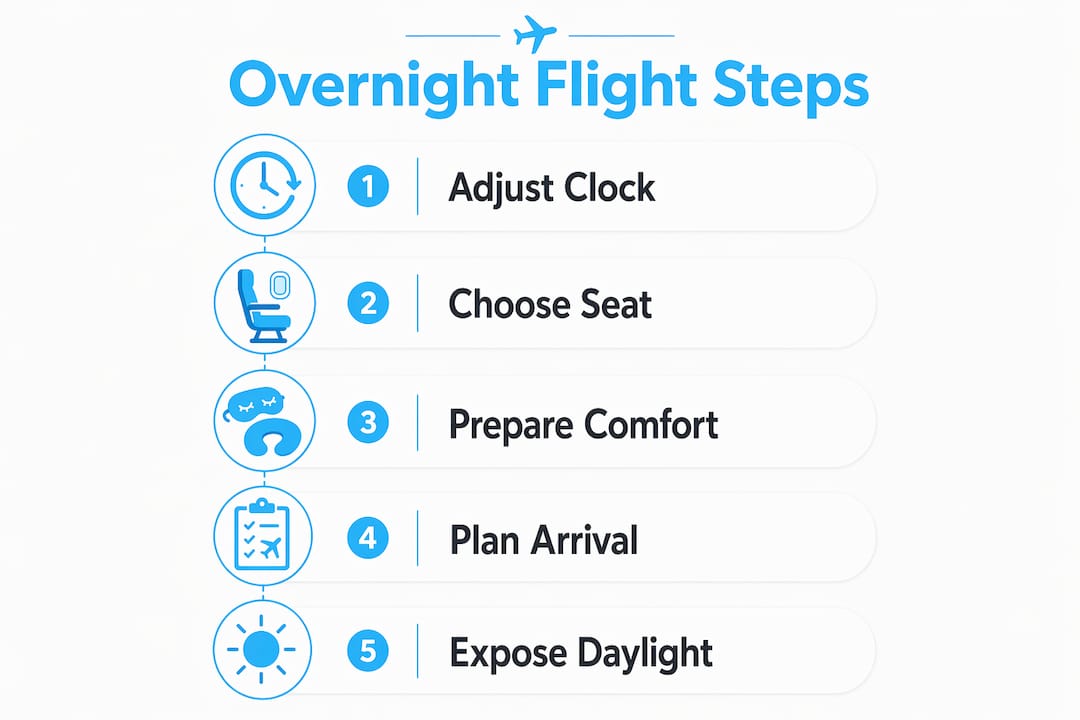
Seat selection is the single biggest variable you control before boarding. Window seats improve sleep continuity by giving you a wall to lean against and removing the need to stand for aisle passengers. That physical support creates what sleep researchers call a “sleep cocoon effect,” reducing micro-awakenings caused by movement around you.
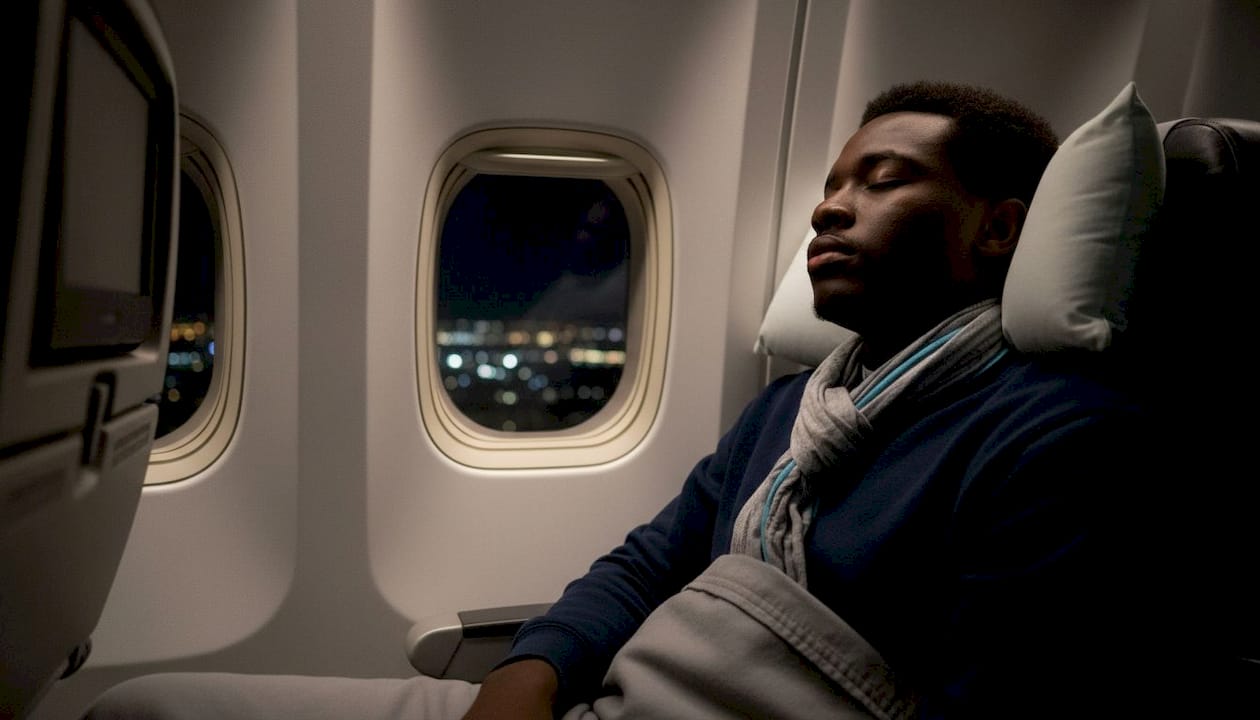
Cabin noise and light are the two most disruptive forces on overnight flights. A quality pair of noise-canceling headphones outperforms foam earplugs by a wide margin. A sleep mask blocks the irregular light from screens, overhead panels, and flight attendant carts. Neither item weighs more than a few ounces, yet both have an outsized effect on sleep depth.
Clothing choice directly affects how well you sleep at altitude. Cabin pressure and recirculated air drop body temperature and cause swelling in the feet and legs. Loose, layered clothing with compression socks addresses both problems. Avoid tight waistbands and synthetic fabrics that trap heat unevenly.
The impact of cabin class on rest quality is significant and worth understanding before you book. Business class lie-flat seats allow genuine horizontal sleep. Economy seats do not. That gap shapes every other decision in your overnight flight plan.
- Book a window seat as early as possible, ideally at the time of purchase
- Pack noise-canceling headphones and a contoured sleep mask in your personal item
- Wear loose, layered clothing and compression socks for the full flight
- Bring a small inflatable neck pillow designed for side sleeping, not the U-shaped variety
- Decline the in-flight meal service if it falls during your intended sleep window
Pro Tip: Request a blanket and pillow from the flight attendant immediately after boarding. They run out fast on full overnight flights, and being without one in a cold cabin at 35,000 feet is a miserable experience.
How can arrival planning improve post-flight recovery and travel efficiency?
Preparing for the first six hours after arrival is the most overlooked part of overnight flight planning. Most travelers focus entirely on the flight itself and arrive with no plan for what happens next. That gap turns a well-executed overnight flight into a wasted morning.
Confirming transport schedules and hotel early check-in before departure is non-negotiable. Arriving at 6 AM with no confirmed way to reach your hotel, and no room ready until 3 PM, eliminates every efficiency gain the overnight flight created. Many hotels offer early check-in for a modest fee. That fee is almost always worth paying.
- Confirm ground transport the day before departure: train, shuttle, or rideshare
- Contact your hotel to request early check-in or at minimum a guaranteed luggage drop
- Schedule only light activities for the first half of arrival day: a walk, a meal, local orientation
- Seek morning daylight immediately after arriving to anchor your circadian rhythm to the new time zone
- Avoid napping longer than 20 minutes on arrival day to protect nighttime sleep
| Arrival phase | Key action |
|---|---|
| Landing to baggage claim | Allow 30–45 minutes; do not rush connecting transport |
| Ground transport | Pre-booked only; confirm the night before departure |
| Hotel check-in | Request early access or guaranteed luggage storage |
| First activity | Light outdoor movement in natural daylight |
| First night | Sleep at local bedtime, not your home time zone |
Daylight exposure after landing is the fastest way to reset your body clock. A 20-minute walk outside in morning sun does more for jet lag recovery than any supplement. Pair that with a proper meal at local breakfast or lunch time and your circadian system gets two strong anchors at once.
When are overnight flights strategically beneficial versus daytime flights?
Business class travelers benefit most from overnight flights because lie-flat seats make genuine sleep possible. Economy passengers, by contrast, often find daytime flights less stressful and more restorative than overnight economy cabins. That distinction matters enormously when choosing your flight.
Directional travel also shapes the calculus. Westbound flights are generally easier for overnight travel because you are extending your day, which aligns with the body’s natural tendency to delay its clock. Eastbound overnight flights fight against that tendency and require more aggressive pre-flight sleep shifting to work well.
| Factor | Overnight flight advantage | Daytime flight advantage |
|---|---|---|
| Cabin class | Business/first class with lie-flat seats | Economy travelers seeking comfort |
| Direction | Westbound long-haul routes | Eastbound short-to-medium haul |
| Trip purpose | Saving a hotel night, arriving ready to work | Leisure trips with flexible first-day plans |
| Traveler profile | Frequent flyers, business travelers | Families, infrequent flyers, light sleepers |
Cost is a real factor too. Overnight flights frequently carry lower fares than peak daytime departures on the same route. For travelers who can sleep in economy, that price difference plus the saved hotel night represents genuine financial value. For travelers who cannot sleep in economy, the math flips entirely. Knowing which type of traveler you are is the foundation of any sound night flight strategy.
Understanding business versus leisure travel needs also shapes the right choice. Business travelers prioritize arriving functional. Leisure travelers prioritize arriving relaxed. Those two goals sometimes point to different flight times.
What are common mistakes in overnight flight strategies and how to avoid them?
The most expensive mistake is overestimating sleep quality in economy. Economy passengers typically achieve only 2–4 hours of actual sleep on overnight flights. Travelers who plan their first day assuming eight hours of rest and arrive with two hours of fragmented sleep make poor decisions and miss commitments.
A second major error is treating the overnight flight as a single event rather than a four-part system. Effective overnight flight planning covers pre-flight preparation, in-flight sleep, morning recovery, and arrival day logistics. Focusing on only one of those four phases, such as buying a neck pillow but ignoring pre-flight sleep shifting, produces mediocre results.
- Overestimating economy sleep: Plan your arrival day around 2–4 hours of rest, not a full night
- Ignoring arrival logistics: Confirm transport and hotel access before you leave home
- Poor pre-flight preparation: Start shifting your sleep schedule 2–3 days before departure
- Failing to adjust promptly: Stay awake until local bedtime on arrival day, no matter how tired you feel
- Drinking alcohol to induce sleep: Alcohol reduces sleep quality and worsens dehydration at altitude
Pro Tip: Write a simple one-page arrival plan before every overnight flight. List your transport, hotel contact, check-in time, and first two activities. Reviewing it the night before departure takes two minutes and prevents the foggy-brain decisions that derail arrival mornings.
Key Takeaways
Overnight flight strategy works when you treat it as a four-part system covering pre-flight sleep alignment, in-flight comfort, arrival logistics, and first-day recovery.
| Point | Details |
|---|---|
| Circadian alignment over sleep hours | Shift your bedtime 1–2 hours toward destination time for 2–3 days before flying. |
| Window seat for sleep continuity | Book a window seat early to reduce disturbances and gain physical support for sleep. |
| Economy sleep is limited | Plan arrival day activities around 2–4 hours of actual rest, not a full night. |
| Arrival logistics are non-negotiable | Confirm transport and early hotel check-in before departure to avoid wasted morning hours. |
| Business class changes the equation | Lie-flat seats make overnight flights genuinely restorative; economy passengers may prefer daytime flights. |
Why I stopped winging overnight flights after one bad trip to Tokyo
I used to treat overnight flights as free hotel nights. Book the red-eye, sleep on the plane, arrive fresh. That theory collapsed on a Tokyo trip where I landed at 6 AM, my hotel room was not ready until 2 PM, and I had nothing confirmed for ground transport. I spent four hours in a coffee shop near Narita, running on two hours of economy sleep, trying to function. I missed my first meeting.
What changed everything was treating the flight as a system, not an event. I now shift my sleep schedule three days before any long-haul overnight. I book window seats without exception. I write out my arrival plan the night before departure, including the hotel’s direct number and a pre-booked train or shuttle. That structure costs maybe 30 minutes of planning and saves an entire day of recovery.
The insight that surprised me most was how little the flight itself matters compared to what happens in the six hours after landing. You can sleep perfectly on the plane and still ruin your arrival day with no plan. You can sleep poorly and still have a productive first day if your logistics are locked in and you get outside in the morning sun.
For booking hotels with early check-in options, I always look for properties that explicitly offer it rather than hoping on arrival. That one habit has paid off more times than I can count. Continual refinement matters too. Airline policies change, your own sleep patterns shift, and what worked on a westbound flight to London may not work eastbound to Singapore. Review your plan after every trip and adjust.
— Asher
Plan your overnight flight from booking to arrival with Pilottraveldeals
A well-planned overnight flight saves money and time. The booking decisions you make before departure, from the right hotel to the right fare, determine how well the whole system works.

Pilottraveldeals brings together hotel deals and early check-in options, flight fare comparisons, and travel essentials like SIM cards for arrival day connectivity in one place. For travelers who want to lock in the logistics that make overnight flights actually work, the platform covers every piece. You can also use the hotel booking guide to find properties that accommodate early arrivals. Pilottraveldeals aggregates deals across providers so you spend less time searching and more time sleeping on the plane.
FAQ
What is the role of overnight flight strategy?
Overnight flight strategy is the practice of aligning sleep timing, seat selection, and arrival logistics to maximize rest and productivity on red-eye or long-haul night flights. Its primary role is to help travelers arrive functional while saving the cost of a hotel night.
How much sleep can you realistically get in economy?
Economy passengers typically achieve only 2–4 hours of actual sleep on overnight flights due to seat recline limits, cabin noise, and light. Plan your arrival day around that reality, not a full night of rest.
What is the best departure time for an overnight flight?
The ideal departure window is between 10 PM and midnight, which aligns with natural biological sleep pressure. Flights departing earlier fight your wakefulness cycle and produce worse sleep outcomes.
Should you take a daytime or overnight flight in economy?
Economy travelers often find daytime flights less stressful and more restorative than overnight economy cabins. Overnight flights in economy make the most sense when the fare savings and eliminated hotel cost outweigh the sleep deficit.
How do you prepare for an overnight flight?
Shift your bedtime 1–2 hours toward the destination time zone for 2–3 days before departure, confirm ground transport and hotel early check-in in advance, and pack noise-canceling headphones and a sleep mask. Those three steps cover the pre-flight, in-flight, and arrival phases of the strategy.
Recommended
- Smart Overseas Flight Tips: Save More and Travel Better – PilotTravelDeals.com
- Smart ways to save money on flights every time – PilotTravelDeals.com
- How to Book Multiple Flights and Save Money on Every Trip – PilotTravelDeals.com
- Business Travel Productivity: A 2026 Guide for Executives – PilotTravelDeals.com

