

Booking a flight only to realize a simple shift in your travel dates could have saved you hundreds is a frustrating experience for any solo traveler. Flexible travel options now offer more control, easier date changes, and less stress—often for just a modest extra fee, not the hefty cost many expect. By understanding flexible travel dates, you can avoid common misconceptions and tap into smarter strategies that stretch your budget much further than rigid bookings ever could.
Table of Contents
- Defining Flexible Travel Dates And Key Misconceptions
- Main Types Of Flexible Date Travel Options
- How Flexible Date Search Tools Operate
- Maximizing Savings: Real-World Cost Benefits
- Additional Perks: Availability, Stress Reduction, And Discovery
Key Takeaways
| Point | Details |
|---|---|
| Flexible Travel Dates Reduce Costs | Adjusting travel dates can lead to significant savings, particularly by avoiding peak times when demand—and prices—are higher. |
| Multiple Flexible Options Available | Options such as Open-jaw Tickets, Date-flexible Fares, Refundable Tickets, and Flexible Time Windows cater to different travel needs and budgets. |
| Improved Search Tools Enhance Booking Experience | Utilizing flexible date search tools allows travelers to discover the best fares across broader date ranges, maximizing potential savings. |
| Increased Availability and Less Stress | Flexible dates improve booking availability and decrease stress, allowing for adjustments as circumstances change without financial penalties. |
Defining Flexible Travel Dates and Key Misconceptions
Flexible travel dates refer to your ability to shift when you depart and return without facing massive penalties or losing your money entirely. Think of it as booking a flight or hotel with built-in wiggle room. Instead of locking yourself into exact dates, you’re getting flexible fare options that allow you to adjust your travel dates, times, or even destinations depending on what life throws at you. This could mean moving your trip forward by a week, pushing it back by a few days, or completely pivoting to a different destination without the typical $200+ change fees most airlines love to charge.
The reality of flexible travel is far simpler than most budget travelers think. You’re not paying for some complex, expensive insurance product. Instead, you’re selecting booking options that include flexibility as part of the package. These come in different flavors. Some plans let you change dates free of charge. Others allow one free change but charge a fee for additional changes. Many options now include refund possibilities or change fee waivers depending on the ticket type. The key misconception most solo travelers hold is that flexibility always costs significantly more upfront. Not true. Sometimes flexible options cost only slightly more than rigid bookings, and the peace of mind they provide often outweighs that small premium.
Another major misconception worth addressing right now is that flexibility makes everything complicated. People assume managing flexible bookings requires juggling multiple apps, dealing with customer service nightmares, or navigating confusing terms. In practice, modern travel platforms have simplified this dramatically. When you book through comparison sites that aggregate offers from multiple providers, you can see exactly what flexibility you’re getting before you commit. No surprises. No hidden restrictions buried in fine print you’d need a lawyer to decode. The complexity your parents encountered when booking travel fifteen years ago simply does not exist anymore.
Here’s what genuinely matters for your wallet. Solo travelers who maintain scheduling flexibility often capture deals that rigid travelers never see. Off-peak dates typically offer discounts ranging from 20% to 60% compared to peak travel times. When you can move your trip to avoid school holidays, summer season, or weekend travel, you’re competing in a completely different pricing tier. That’s not just a savings hack. That’s a fundamental advantage built into how the travel industry prices its products.
Pro tip: _Start tracking prices for your target destination across a 2-3 week date range instead of locking in specific days, then book when you spot the lowest fare. This simple habit alone can save you $150-400 per flight as a solo traveler.
Main Types of Flexible Date Travel Options
Flexible date travel breaks down into several distinct categories, each serving different travel situations and budget constraints. Understanding which option fits your specific needs prevents you from overpaying for features you don’t use or missing out on savings you could grab. The main types range from open-jaw tickets to date-flexible fares, and each operates under different rules about when and how you can change your plans.
Open-jaw tickets are your most extreme flexibility option. These let you fly into one city and depart from a completely different city without paying the typical routing surcharge. Imagine landing in Barcelona and leaving from Madrid two weeks later. Most budget airlines charge premium prices for this setup, but open-jaw tickets handle it cleanly. The catch? They’re less common on budget carriers and typically cost more upfront. However, solo travelers who plan multi-city itineraries often find open-jaw tickets worth the investment because they eliminate backtracking and wasted travel time.
Date-flexible fares represent the most common type you’ll encounter when shopping deals. These allow you to shift your departure and return dates, usually within a specific window like plus or minus three days from your original booking. The beauty here is simplicity. You pay slightly more than the rock-bottom rigid fare, but you gain breathing room if your plans shift. Airlines like Southwest pioneered this model, and it’s now spreading across budget carriers worldwide. Many flexible booking options at comparison sites emphasize date-flexible fares because they balance affordability with practical flexibility.
Refundable tickets sit at the premium end of the flexibility spectrum. Yes, you pay substantially more upfront, often 30-50% extra compared to standard fares. But here’s what you get: genuine money back, not just credit toward future travel. This matters enormously when life happens. A family emergency, a job loss, or even just changing your mind means you recover your cash instead of being stuck with a worthless credit. For solo travelers on tight budgets, refundable tickets make sense only for trips booked far in advance where you have genuine uncertainty about attending.
Flexible time windows work differently than date-flexible fares. Instead of being locked to specific dates with a few days of wiggle room, these tickets give you months to travel. You might buy a ticket valid for an entire year, allowing you to pick exact dates months later when you’ve saved enough money or finalized work schedules. This appeals to budget travelers planning long-term trips. The downside? Prices for these tickets are typically higher because airlines value the certainty of your money now versus later.
Compare these options by your actual constraints. Fixed work schedule? Date-flexible fares solve your problem. Multi-city backpacking route? Open-jaw tickets eliminate logistics headaches. Genuine uncertainty about travel timing? Flexible time windows or refundable tickets become necessary investments, not luxuries.
Pro tip: Most comparison sites let you filter by flexibility level, so set your search to show only date-flexible or refundable options, then sort by price to see exactly how much flexibility costs for your specific route and dates.
Here’s a summary of the main types of flexible date travel options and who benefits most from each:
| Travel Option | Key Benefit | Typical Cost Impact | Best for |
|---|---|---|---|
| Open-jaw Ticket | Enables multi-city trips | Higher upfront cost | Backpackers, explorers |
| Date-flexible Fare | Shift trip dates easily | Slight premium vs. rigid | Solo & casual travelers |
| Refundable Ticket | Recover cash if canceled | 30-50% more expensive | Long-term planners |
| Flexible Time Window | Book up to a year in advance | Highest flexibility cost | Long-term travelers |
How Flexible Date Search Tools Operate
Flexible date search tools work like price detectives on your behalf, systematically scanning multiple dates to find the cheapest options instead of locking you into a single travel window. When you use a traditional flight search, you pick specific dates and get results for only those days. Flexible date tools flip this approach. You input a travel window like “anytime in March” or “plus or minus 5 days from March 15th,” and the tool compares fares across every possible combination. This reveals patterns you’d never spot manually. A flight departing Thursday might cost $340 while the same route on Tuesday costs $210. Most travelers never discover these gaps because they search one date at a time.
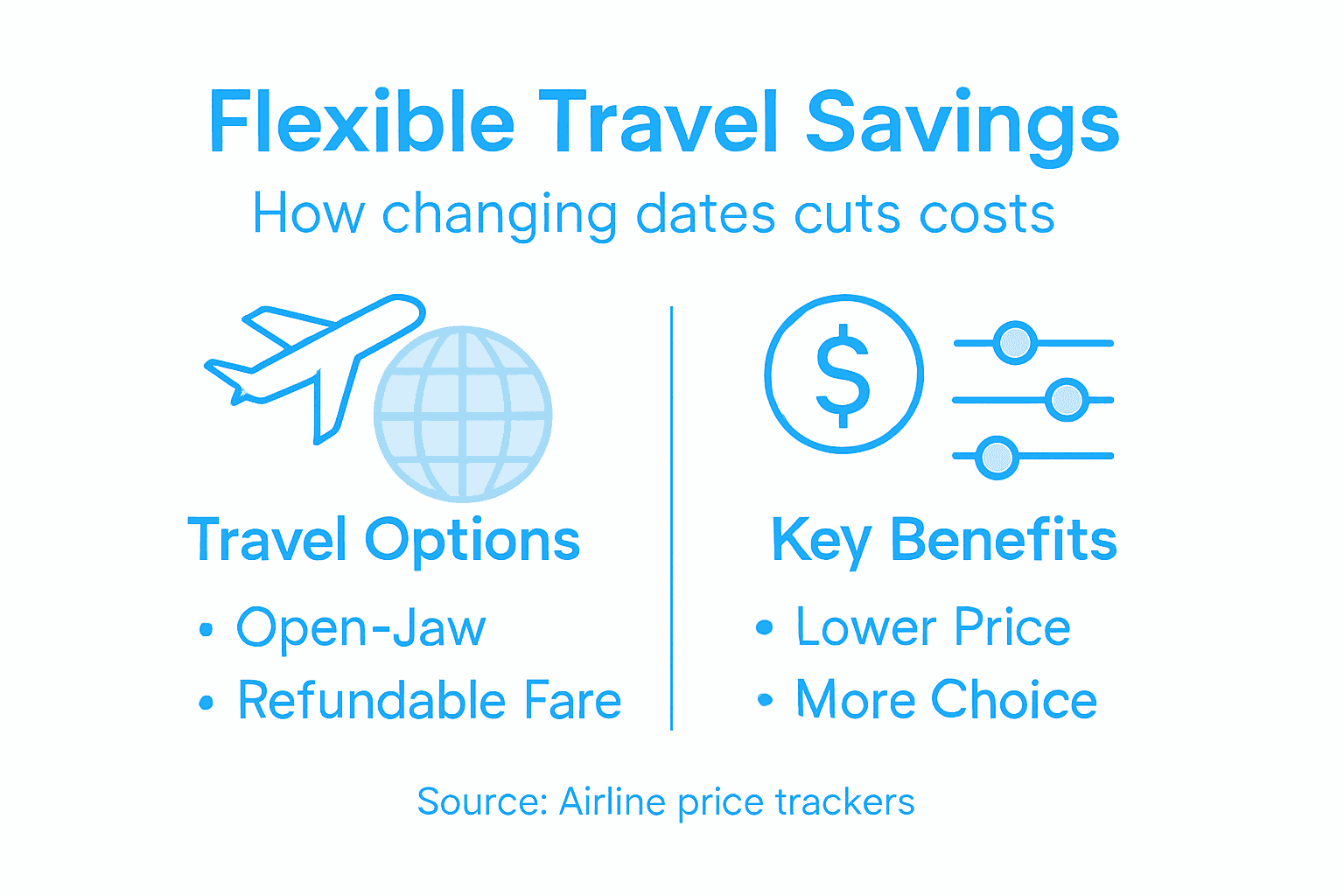
The process starts with inputting your departure city, destination, and flexible date range. You’re not picking exact dates here. Instead, you’re giving the search tool parameters. Something like “departing between March 10-20” or “returning within a 7-day window.” Once you submit, calendar views and fare alerts visualize price fluctuations across your entire date range. You’ll typically see a grid or calendar showing prices for each day combination. Green highlights show cheap days, yellow shows moderate pricing, and red flags expensive options. This visual representation makes patterns instantly obvious. You spot that midweek travel costs 40% less than weekend getaways, or that departing on the 14th instead of the 12th saves $150.
Behind the scenes, these tools pull real-time pricing data from airline systems and aggregator networks. They’re constantly refreshing to catch price fluctuations. Many tools also let you set price alerts that monitor fare changes across your travel window, sending notifications when prices drop below your target threshold. This removes the stress of constantly checking manually. You set an alert for flights under $200 to Barcelona in your available dates, and the tool handles monitoring. When a deal appears, you get notified and can book immediately before prices spike again.
Here’s what makes this powerful for budget solo travelers specifically. Airlines adjust prices based on demand patterns, and those patterns are predictable. School holidays inflate prices. Weekends cost more than Tuesdays. Summer dwarfs winter pricing. Flexible date tools let you exploit these patterns automatically. You’re not guessing. You’re seeing actual data and booking strategically. The key is that these tools compress research time from hours of manual searching into minutes of browsing a single calendar. Most comparison sites like PilotTravelDeals include flexible date functionality built directly into their search interface.
Pro tip: Set your flexible date range to at least 7-10 days wider than your ideal travel window, then book the cheapest date combination even if it’s not your first choice. Solo travelers typically have more scheduling flexibility than families, so use it to your advantage and pocket the savings.
Maximizing Savings: Real-World Cost Benefits
The actual numbers tell a compelling story about why flexible travel dates matter for your wallet. This isn’t theoretical savings. Real travelers booking real trips see measurable reductions in what they pay. Shifting travel days midweek or avoiding holidays can save an average of $90 on domestic flights. That’s on a single domestic flight. For a round-trip booking, you’re looking at $180 in savings. For international routes, the savings multiply. A transatlantic flight that costs $650 on a Friday departure might cost $420 on a Tuesday. That’s a $230 difference for literally the same flight, just three days earlier. Solo travelers who book two or three international trips annually could pocket $500 to $800 just by being flexible about dates.
The mechanics behind these savings are straightforward. Airlines use demand-based pricing, meaning prices spike when lots of people want to travel. Weekends see higher demand than Tuesdays. Holiday weeks crush regular weeks in pricing. Summer outpaces winter by massive margins. When you lock yourself into rigid dates, you’re often booking during peak demand periods whether you realize it or not. Everyone wants to travel Thursday through Sunday. Everyone wants school holidays and summer break. Airlines know this and price accordingly. Your Tuesday departure to the same destination costs less because fewer people want that slot. Mid-week flights and non-peak travel periods often offer considerable discounts, helping to reduce overall trip costs significantly. This principle applies equally to hotels. A Wednesday night hotel room costs 30-50% less than the same room on Saturday. Weekend city breaks command premium pricing. Weekday business travel rates are cheaper.

Here’s where it gets interesting for your broader trip budget. Flights typically represent 30-40% of total trip cost for budget solo travelers. Hotels take another 30-40%. When you find flexibility in both categories simultaneously, the compounding effect becomes substantial. Imagine booking a 7-day trip. Flexible flight dates save you $90-150. Flexible hotel dates save you $40-60 per night, which amounts to $280-420 for a week. Combined, you’ve freed up $370-570 on a moderate budget trip. That money extends your travel week by several extra days, upgrades your accommodation, or funds additional experiences. For travelers planning multiple trips yearly, this flexibility compounds into thousands of dollars in annual savings.
To visualize potential savings, here’s how trip costs compare for flexible vs. fixed travel dates:
| Cost Category | Fixed Dates (Peak) | Flexible Dates (Off-Peak) | Savings Potential |
|---|---|---|---|
| Flight | $650 (International) | $420 (International) | Up to $230 per ticket |
| Hotel (7 nights) | $700 | $420 | $280 per week |
| Total Trip Cost | $1,350 | $840 | $510 saved per trip |
The catch is simple. You actually need scheduling flexibility to access these savings. If your only available vacation week is the third week of July, you cannot access Tuesday pricing. If you travel only during school holidays, you’re stuck paying peak rates. But if you have any wiggle room at all, flexible booking strategies transform pricing. Solo travelers aged 25-40 working flexible jobs or pursuing remote work have enormous advantages here. You’re not locked into school calendars or fixed corporate vacation schedules. You can shift your trip two weeks earlier or later. You can take Mondays off and extend a weekend trip into a full week at lower rates. This flexibility is your secret weapon.
Pro tip: Start tracking prices for your target destination 3-6 months before your ideal travel window, then move your dates to whatever shows the lowest combined flight plus hotel cost, rather than forcing specific dates and paying a premium for rigidity.
Additional Perks: Availability, Stress Reduction, and Discovery
Savings grab the headlines, but flexible travel dates unlock benefits that go far beyond lower prices. The most immediate advantage is availability. When you lock into specific dates, you’re competing with millions of other travelers for the same limited inventory. Popular routes during peak seasons sell out weeks in advance. That dream trip to Barcelona in mid-July? Probably already gone. But shift your dates by two weeks into early July or late August, and suddenly availability explodes. Hotels that showed “fully booked” now have rooms available. Flights that had only expensive premium cabin options suddenly offer economy seats. Flexible travel dates improve availability by opening up more options and avoiding sold-out dates. You’re not just saving money. You’re gaining access to trips that rigid travelers cannot actually book, regardless of budget.
Beyond availability, flexibility dramatically reduces the stress that typically accompanies travel planning. Think about booking a rigid itinerary. You’ve locked in specific dates months ahead. Work gets crazy. A family emergency surfaces. Your coworker’s wedding moves to the same weekend. Now you’re either paying cancellation penalties, losing your deposit, or scrambling to rebook while prices have spiked. The anxiety builds because your trip feels fixed and immovable. Flexible bookings eliminate this mental burden. If circumstances change, you adjust dates without financial punishment. Flexibility eases the risk of cancellation penalties and decreases stress related to rigid itineraries. This psychological benefit matters more than most travelers realize. Solo travelers especially benefit because you’re making all decisions alone without coordinating with family or travel companions. When life changes, you pivot independently and quickly.
Perhaps the most underrated benefit is discovery. Rigid travel planning breeds tunnel vision. You research one destination, book it, and commit. Flexible dates invite exploration. You notice that flights to Lisbon are cheaper than your original Barcelona plan. You discover that a lesser-known destination in Portugal has even lower prices with better weather. You stumble onto a music festival or cultural event happening during your adjusted dates that becomes the highlight of your trip. This serendipitous discovery happens because you’re not locked into a predetermined route. You’re browsing options, noticing patterns, and occasionally pivoting toward something better than your original plan. Solo travelers who keep dates flexible often return home with better stories than those who rigidly followed their initial research.
The combination of these benefits creates a fundamentally different travel experience. You book trips with less stress, access options that others cannot, and often end up somewhere better than you originally planned. Budget constraints still apply, but they become less restrictive because flexibility gives you more ammunition for negotiations with pricing. You’re not desperate to book specific dates at any cost. You’re shopping for the best overall value across a range of options.
Pro tip: When flexible dates reveal an unexpectedly affordable destination or better travel window, trust the signal and book it, even if it differs from your original plan, because flexibility’s superpower is revealing opportunities your fixed research would never have found.
Unlock Smart Savings with Flexible Travel Dates Today
Struggling to find affordable trips that fit your busy schedule? The key to big travel savings lies in flexibility. By embracing concepts like date-flexible fares and open-jaw tickets, you gain control over your travel plans without paying hefty change fees or losing money. Flexible travel dates open doors to discounts often hidden from rigid bookings making it easier to avoid peak prices and packed routes.

Discover how easy and rewarding flexible travel can be by exploring expert insights on our Travel Tips page. Start your journey at PilotTravelDeals.com where you can compare real-time flight and hotel options that fit your ideal flexible date range. Don’t wait for prices to rise. Act now to capture exclusive deals and gain the freedom to adjust your trip with confidence. Your next affordable adventure is just a click away.
Frequently Asked Questions
What are flexible travel dates?
Flexible travel dates allow you to change your departure and return dates without facing hefty fees or penalties. This means you can adjust your travel plans based on different factors such as pricing, availability, or personal circumstances.
How can flexible travel dates save me money?
By shifting your travel dates, especially to off-peak times, you can often find significant discounts. Midweek flights and traveling outside of holiday seasons can result in savings of 20% to 60% compared to rigid travel dates.
What types of flexible travel options are available?
Main types include open-jaw tickets, which allow flying into one city and out of another; date-flexible fares, which let you adjust departure and return dates; refundable tickets, which provide the option to get your money back; and flexible time windows that permit booking within a broader timeframe.
How do flexible date search tools work?
Flexible date search tools compare fares across multiple dates within a specified range instead of a single date. By inputting a date range, you can see price fluctuations and identify the cheapest options quickly, allowing for smarter booking decisions.
