Booking a cheap trip often sounds simple, but the reality hits different when you realize even destinations praised for affordability like Poland hide unexpected expenses in tourist zones. Many travelers assume ‘cheap’ means hostel beds and street food, but true savings come from smart planning and local strategies. This guide breaks down common misconceptions about cheap trips and reveals practical tactics for flights, accommodations, and transit so you maximize every dollar without sacrificing experiences.
Table of Contents
- Cheap Trips Defined And Common Misconceptions
- Key Types: Flights, Stays, And Transit Deals
- Essential Booking Strategies And Saving Tactics
- Risks, Pitfalls, And What To Avoid
- Top Deal Sources And Travel Apps In 2026
Key Takeaways
| Point | Details |
|---|---|
| Strategic Budgeting | Allocate funds to experiences that matter most to enhance overall value, not just save money. |
| Embrace Local Culture | Travel like locals to avoid expensive tourist traps and discover authentic experiences. |
| Research and Compare | Utilize multiple booking platforms and price alerts to find the best deals on flights and accommodations. |
| Plan for Safety and Health | Ensure proper travel insurance and health preparations to prevent costly emergencies during your trip. |
Cheap Trips Defined and Common Misconceptions
A cheap trip isn’t just about booking the lowest fare. It’s a strategic approach to traveling on your budget while experiencing destinations authentically, not cutting corners on what matters to you.
Most budget travelers assume cheap trips mean staying in hostels and eating street food exclusively. That’s one approach, but it misses the bigger picture. Smart savings involve understanding which costs you can reduce and which investments actually save you money long-term.
What Cheap Trips Actually Mean
Cheap trips blend three core elements:
- Strategic spending: Allocating your budget toward experiences you value most
- Smart research: Finding deals before booking, not settling for whatever’s available
- Local knowledge: Traveling like residents to avoid tourist markups and overhyped attractions
The difference between a cheap trip and a miserable one is intentionality. You’re not simply spending less; you’re spending strategically.
A cheap trip maximizes value per dollar, not minimizes dollars spent. These aren’t the same thing.
The Biggest Misconceptions
Budget travel attracts false assumptions that derail real savings. Let’s clear them up:
Misconception 1: All “budget destinations” are equally affordable
Destinations reputed as cheap, like Poland or Southeast Asia, have hidden costs that catch travelers off guard. Public transport and street food might be genuinely inexpensive, but accommodation in tourist areas can surprise you with inflated prices. Research specific neighborhoods and seasons before assuming affordability.
Misconception 2: Sustainable travel is always expensive
Many solo travelers believe eco-friendly options cost more. Nearly half of travelers perceive sustainable choices as expensive, yet budget-conscious and environmentally responsible travel often overlap. Public buses, walking tours, and local guesthouses check both boxes.
Misconception 3: Cheap means low-quality experiences
Spending less doesn’t mean experiencing less. Many free walking tours, community events, and local markets offer richer cultural immersion than paid attractions. Your budget constrains spending, not the quality of memories you create.
Misconception 4: You need to sacrifice health and safety
Budget travel doesn’t mean skipping travel insurance or staying in unsafe areas. Smart allocation means spending on essentials (safety, reliable transit, clean accommodation) while finding savings elsewhere.
Understanding Different Trip Types
Cheap trips vary based on duration, destination type, and travel style. Knowing your trip profile helps set realistic budgets:
- Weekend city escapes: Typically $300-600 including flights from major hubs
- Week-long regional trips: $800-1,500 for mid-range destinations
- Month-long international adventures: $1,200-2,500 depending on region and choices
Your actual costs depend on where you live, where you’re going, and what experiences matter to you. A week in Portugal costs differently than a week in Thailand, even with identical spending discipline.
Pro tip: Start by defining what “cheap” means to you in dollars per day, then research 2-3 specific destinations to see if they match your budget before committing to a location.
Key Types: Flights, Stays, and Transit Deals
Cheap trips break down into three major cost categories. Master these, and you’ll control 70-80% of your total travel spending. The other expenses fade into background noise.
Each category has distinct strategies. Flights demand different tactics than accommodations, which differ completely from getting around once you arrive. Understanding these differences transforms how you search and book.
Here’s a quick comparison of major trip cost categories and their savings potential:
| Expense Type | Typical Share of Budget | Key Ways to Save | Impact on Total Cost |
|---|---|---|---|
| Flights | 30-50% | Flexible booking, alerts | Largest single opportunity |
| Accommodations | 25-40% | Book local, avoid peaks | Big effect over duration |
| Local Transit | 5-15% | Passes, walk, bike | Small but adds up quickly |
| Meals & Activities | 10-20% | Local dining, free events | Highly variable by habits |
Flight Deals: Where the Biggest Savings Hide
Flights represent your largest single expense on most trips. A $200 difference in airfare matters more than finding a $5 cheaper hostel bed.
Flight savings come from three angles:
- Timing: Booking 2-4 weeks ahead typically beats last-minute or months-in-advance purchases
- Flexibility: Flying midweek (Tuesday-Thursday) costs less than weekends
- Route strategy: Connecting flights, alternate airports, and one-way bookings often beat direct routes
Strategic flight booking reveals patterns most travelers miss. You’re not just comparing prices; you’re understanding when airlines discount and why.
Budget carriers and off-peak flights can cut your airfare in half, but only if you know where to look and when to book.
The City Pair Program demonstrates how strategic flight selection yields significant savings across thousands of markets. Government-negotiated fares show what’s possible when you target the right routes and timing.
Accommodation Deals: Beyond the Obvious Choices
Your nightly lodging cost multiplies over a week or month. A $15 daily difference compounds to $105 per week.
Accommodation savings don’t mean suffering in sketchy rooms. Options include:
- Hostels: $20-40 nightly, social atmosphere, kitchen access
- Guesthouses: $25-50 nightly, local ownership, authentic neighborhoods
- Apartment rentals: $30-60 nightly, multiple rooms, kitchen included
- House-sitting: Often free, requires advance planning and responsibility
Location matters more than amenities. A $35 room in a local neighborhood beats a $50 room near tourist zones. You’ll spend less on food and activities when living like residents.

Research stays outside peak tourist districts. The same building standards exist in neighborhood areas, but prices drop dramatically when you’re three blocks from the main plaza instead of on it.
Transit Deals: The Overlooked Savings Opportunity
Getting around drains budgets quietly. Daily transit costs add up faster than you notice.
Public transit options to airports provide affordable ground transportation that beats expensive airport shuttles and ride-shares. Buses and rail services cut typical airport transfer costs by 50-75%.
Once you’re in town, master these transit strategies:
- Transit passes: Multi-day or weekly passes reduce per-journey costs significantly
- Local buses: Always cheaper than taxis or tourist shuttles for same routes
- Walking and biking: Free alternatives for shorter distances within neighborhoods
Many cities offer 3-day or 7-day transit passes at steep discounts. A $25 weekly pass beats $5 per ride across the week. Buy passes immediately upon arrival.
Pro tip: Book flights 3-4 weeks ahead, stay in guesthouses outside tourist cores, and purchase transit passes on day one—these three moves typically save $400-600 per week.
Essential Booking Strategies and Saving Tactics
Booking strategy separates smart travelers from those who waste money. The difference isn’t luck—it’s knowing when to book, where to search, and which tactics actually work.
Most travelers book impulsively or follow outdated advice. You’re going to do neither. These strategies compound across flights, hotels, and transit, multiplying your savings.
Timing Your Bookings for Maximum Impact
When you book matters as much as where you book. Airlines and hotels adjust prices based on demand patterns, seasonality, and competitor activity.
Optimal booking windows vary by trip type:
- Domestic flights: Book 1-3 months ahead for best fares
- International flights: Book 2-4 months before departure
- Hotels: Book 2-3 weeks out for sweet spot pricing
- Last-minute deals: Sometimes appear 3-7 days before travel, but unpredictable
The worst time to book is during peak travel days themselves. Sunday evenings and Friday mornings see highest prices as weekend travelers book hastily.
Airline yield management systems adjust prices hourly based on seat inventory and competitor fares. Booking during off-peak hours (early morning, late night) sometimes yields better prices than midday searches when algorithms are most aggressive.
Leveraging Price Transparency and Comparisons
Comparing platforms reveals opportunities single-site searching misses. Different booking sites show different prices for identical inventory due to negotiated rates and commission structures.
Price transparency mechanisms help travelers spot actual deals versus inflated base prices with high “discounts.” Some platforms show original prices; others hide them, making discounts look bigger than they are.
Effective comparison shopping means:
- Checking at least 3 major booking platforms for each search
- Comparing total costs (base price plus taxes and fees)
- Trusting review scores and guest feedback
- Noting cancellation policies alongside price
The cheapest option on one platform might be the most expensive on another. Always cross-check before booking.
When comparing stays and flights, real-time pricing updates across global inventory ensure you’re seeing current rates, not cached prices from hours earlier. Outdated pricing costs you money.
Strategic Search Patterns That Save Cash
How you search shapes what deals appear. Most booking platforms use algorithms that track your searches and increase prices when you revisit the same query.
Use these tactics:
- Clear your cookies between searches to avoid price increases from tracking
- Search in incognito mode to prevent algorithm-based price manipulation
- Set up price alerts to catch drops without repeated manual searches
- Search flexible dates to identify cheapest travel windows
- Compare one-way flights against round-trip bookings
Flexibility across dates often yields $50-150 savings per flight. A $500 round-trip becomes $350 when you’re willing to fly Tuesday instead of Friday.
Using Loyalty Programs and Flexible Policies
Loyalty programs create real value when used strategically, not when blindly chasing points. The best loyalty play is booking slightly better options when they cost the same.
Flexible cancellation policies cost more upfront but provide insurance against unexpected changes. Budget $10-20 per hotel night for flexible cancellation—worth it if uncertainty exists about your plans.
Pro tip: Search and compare on at least three platforms, book in incognito mode, and set price alerts for your exact dates—then wait 2-3 weeks before confirming unless you find prices already below your target.
Risks, Pitfalls, and What to Avoid
Cheap trips turn expensive fast when you ignore safety and health. A $500 flight savings evaporates instantly with a $3,000 emergency room bill or cancelled plans due to illness.
Budget travel requires smart risk management, not reckless cost-cutting. The goal is saving money without gambling with your wellbeing.
Safety Risks and Destination Assessment
Not all budget destinations are equally safe. Political unrest, crime rates, and infrastructure quality vary dramatically within regions and even neighborhoods.
Before booking any destination, check travel safety advisories issued by the U.S. Department of State. These highlight crime, terrorism, health issues, and political instability affecting travelers.
Destination risk factors to research:
- Current crime rates and tourist-specific incidents
- Political stability and recent unrest
- Natural disaster frequency (earthquakes, hurricanes, flooding)
- Healthcare quality and availability
- Infrastructure reliability (electricity, water, transportation)
A destination with Level 1 or Level 2 advisories is generally safe for tourists. Level 3 (reconsider travel) and Level 4 (do not travel) require serious evaluation before booking.
Saving $200 on flights to an unsafe destination costs you sleep, stress, and potentially everything.
Health Pitfalls That Drain Budgets
Illness and injury abroad become catastrophically expensive without proper preparation. Many budget travelers skip vaccines and travel insurance to save money upfront, then spend thousands on emergency treatment.
Preparation steps that actually prevent costs:
- Get required vaccinations 4-6 weeks before departure
- Purchase travel health insurance covering emergency evacuation and medical care
- Pack a basic health kit with pain relievers, anti-diarrheal medication, and first-aid supplies
- Research local healthcare and locate clinics before you need them
Comprehensive pre-travel health preparation prevents common illnesses like traveler’s diarrhea, malaria, and dengue fever. The CDC’s guidance covers vaccination schedules, medication, and emergency protocols.
Water safety is the biggest culprit. Contaminated water causes illness in travelers who thought they were saving money by skipping bottled water or eating street food from unsanitary sources. One bout of severe dysentery can cost $2,000-5,000 in medical care.
Financial Pitfalls and Hidden Costs
Budget travelers often fall into traps that eliminate savings entirely:
Booking without reading fine print: Cancellation policies, baggage fees, and resort charges add hundreds to quoted prices. A $40 hotel room becomes $65 after taxes and fees you didn’t anticipate.
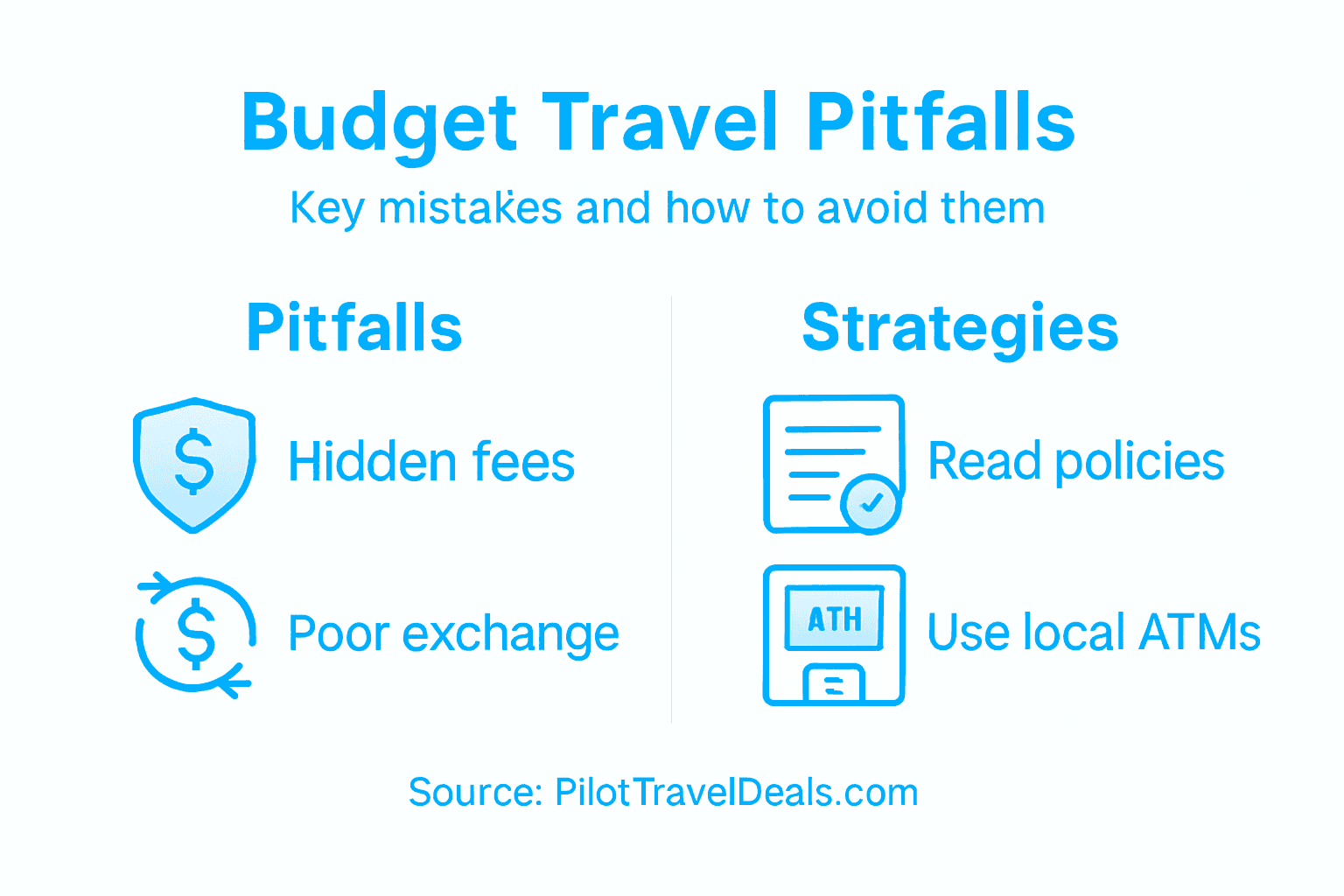
Overpaying for convenience: Airport transfers, restaurant meals in tourist zones, and attraction tickets booked last-minute cost 2-3 times more than researched alternatives.
Currency exchange mistakes: Using airport ATMs or exchanging cash at hotels costs 10-15% in fees. Local ATMs with your home bank’s partnership cut this to 1-2%.
Skipping travel insurance: Medical emergencies, trip cancellations, or lost luggage without insurance means you absorb full costs. Insurance costs $50-200 and protects against $10,000+ losses.
Below is a summary of common travel booking pitfalls and how to counter them:
| Pitfall | Why It Costs Extra | Counter Strategy |
|---|---|---|
| Hidden fees & surcharges | Nearly invisible in search | Read fine print carefully |
| Overpaying for convenience | Higher prices near airports | Research transit alternatives |
| Currency exchange losses | Poor airport/hotel rates | Use local partner ATMs |
| Skipping insurance | Huge medical risks | Always purchase coverage |
Behavioral Pitfalls to Sidestep
Your decisions matter more than external risks. Common mistakes travelers make:
- Booking entire trips before testing one night in a destination
- Committing to tours with non-refundable deposits before verifying quality
- Traveling solo in unsafe areas without local guidance or awareness
- Carrying excessive cash, valuables, or expensive electronics
- Ignoring local customs regarding dress, behavior, or photography
Pro tip: Check travel advisories, get vaccinated, purchase travel insurance, and research healthcare options before booking—these four steps prevent 90% of expensive emergencies while protecting your budget-trip investment.
Top Deal Sources and Travel Apps in 2026
Finding cheap trips requires knowing where to look. The right tools save hours of searching and hundreds of dollars on every booking. In 2026, aggregation platforms and specialized apps dominate the landscape.
Not all deal sources are equal. Some show lower prices but charge hidden fees; others lack real-time updates. Smart travelers use multiple sources simultaneously to verify deals.
Major Deal Aggregation Platforms
Deal aggregators pull inventory from hundreds of providers, comparing prices across airlines, hotels, and transit services simultaneously. This eliminates the need to visit 20 different websites manually.
Top aggregation platforms include:
- Skyscanner: Searches 1.2 million flight combinations, showing budget carriers alongside legacy airlines
- Kayak: Compares flights, hotels, and car rentals with flexible date searches
- Momondo: Specializes in international flights and often finds cheaper options than competitors
- Hopper: Uses price prediction algorithms to suggest optimal booking windows
- Google Flights: Integrates directly with Google’s search ecosystem for seamless comparison
Travel deal aggregation platforms leverage machine learning to identify patterns in pricing across regions and seasons. They update in real-time, ensuring you see current fares rather than cached prices from hours earlier.
Comparing one platform versus many costs 5 extra minutes but saves $200-400 per trip. The math is obvious.
Specialized Apps for Flight Savings
Flight-focused apps target your most expensive trip component. These tools go beyond basic comparison by adding alerts, price tracking, and insider booking tips.
Best flight apps for 2026 include:
- Airfare Alert Apps: Notify you when prices drop below target amounts
- Incognito Flight Searchers: Prevent algorithm-based price increases from tracking
- Mistake Fare Trackers: Alert you to mispriced flights (occasionally under $100 international fares)
- Fuel Surcharge Trackers: Show which airlines add lowest ancillary fees
Set up price alerts for your target destinations 2-3 months before travel. Apps notify you immediately when fares drop, allowing you to book within minutes before prices rebound.
Money-Saving Apps Beyond Travel
Broader budgeting and cashback apps multiply travel savings across your entire trip spending.
Money-saving apps extend savings beyond flights to restaurants, attractions, and shopping. Cashback apps reimburse 1-10% of spending at thousands of merchants.
Relevant categories include:
- Cashback platforms: Earn 2-5% back on dining, attractions, and shopping
- Expense trackers: Monitor daily spending and identify waste
- Coupon aggregators: Stack discounts on activities and meals
- Currency converters: Show actual exchange rates without markup fees
Staying Current With Industry Trends
Travel pricing and app functionality evolve constantly. Industry research and pricing indexes track monthly trends, seasonal patterns, and emerging technologies affecting deal availability.
Subscribe to travel newsletters from major platforms, follow deal-tracking communities on social media, and check industry reports quarterly. Trends shift; strategies that worked last year may not work this year.
The best deals emerge from combining multiple sources, setting up comprehensive alerts, and acting quickly when opportunities appear. Delay costs money.
Pro tip: Set up price alerts on three different platforms simultaneously, check them weekly, and book within 24 hours when prices hit your target—most deals disappear within hours as algorithms adjust.
Unlock the Full Potential of Your Cheap Trip Savings
Navigating the challenges of budget travel requires more than just finding low prices. The article highlights common pitfalls like hidden fees, unsafe destinations, and missing out on smart research tactics that maximize your spending power. If you want to spend strategically and avoid costly mistakes while securing deals on flights, accommodations, and transit, expert resources and real-time tools make all the difference.

Dive deeper into strategic booking and insider tips by exploring our Travel Tips – PilotTravelDeals.com section where we share actionable advice tailored to budget-conscious travelers. Ready to compare hundreds of travel offers instantly to find the best prices? Visit PilotTravelDeals.com now and make sure your next trip blends value with safety and convenience. For travelers seeking unique experiences while saving money, our Miscellaneous – PilotTravelDeals.com page offers curated insights that turn inexpensive trips into unforgettable journeys.
Start planning smarter today and transform your next trip into a truly cheap trip that delivers real value without compromise.
Frequently Asked Questions
What constitutes a cheap trip?
A cheap trip involves strategic spending, smart research, and local knowledge to maximize value per dollar, rather than simply minimizing expenses.
How can I save on flights when planning a cheap trip?
To save on flights, consider booking 2-4 weeks in advance, being flexible with your travel dates, and exploring alternate airports or connecting flights that might offer lower fares.
What are the best strategies for finding affordable accommodations?
Look for lodging options outside tourist areas, consider hostels or local guesthouses, and research apartment rentals. Booking a few weeks in advance can also help secure better rates.
What tips can help me save on local transit during my travels?
Utilize local public transportation instead of taxis, purchase multi-day transit passes, and consider walking or biking for shorter distances to keep costs down.
Recommended
- How to Maximize Travel Savings with Smart Deal Strategies – PilotTravelDeals.com
- 8 Smart Ways to Travel for Cheap and Save Big Money – PilotTravelDeals.com
- 10 Essential Budget Travel Tips for Smart Travelers – PilotTravelDeals.com
- 7 Proven Budget Travel Tips 2025 for Smart Savings – PilotTravelDeals.com
- Ways to Save Money Living Abroad | TEFL Institute
- Minimizing Production Costs: Smart Strategies for Media Teams
- Traveling With Dogs Safely: Achieve Stress-Free Journeys – iPupPee