

Imagine finding the perfect international flight for $450, only to refresh your browser and see the price jump to $620 in minutes. This isn’t a glitch. Flight prices change hundreds of times daily as airlines deploy sophisticated AI models to maximize revenue. For budget travelers, this creates a maze of confusion where the best deal feels impossible to pin down. This guide cuts through the complexity, explaining how airline pricing actually works and giving you proven strategies to compare fares effectively and save real money on your next international trip.
Table of Contents
- Key takeaways
- How airlines use AI and dynamic pricing to set international flight prices
- Recent trends and benchmarks shaping international flight ticket costs
- Choosing the right flight search engines: accuracy, coverage, and risks
- Smart strategies to compare and save on international flight tickets
- Explore more travel savings with PilotTravelDeals
- Frequently asked questions
Key Takeaways
| Point | Details |
|---|---|
| AI driven pricing | Airlines use artificial intelligence to adjust fares hundreds of times per day based on demand, competition, inventory, and timing. |
| Check on Tuesdays and Wednesdays | New inventory and price adjustments often appear on Tuesday evenings and Wednesday mornings, creating a chance to spot discounted seats before rivals react. |
| Fare class differentiation | Pricing is split into fare classes with different rules, so last minute business travelers pay more while early planners access cheaper options. |
| Seasonal price trends | By February 2026 US international airfares rose 7.1 percent year over year, though spring 2026 deals were about 22 percent cheaper than spring 2025. |
How airlines use AI and dynamic pricing to set international flight prices
Airlines abandoned fixed pricing decades ago. Today, they use dynamic pricing systems powered by artificial intelligence that adjust ticket costs in real time based on dozens of variables. These machine learning models like Random Forest and deep learning analyze booking patterns, competitor pricing, fuel costs, seasonal demand, and even weather forecasts to determine optimal fares. The result is a constantly shifting price landscape where the same seat can cost dramatically different amounts within hours.
Several key factors drive these rapid price changes:
- Demand fluctuations: When search volume spikes for a route, algorithms detect increased interest and raise prices
- Competitor monitoring: Airlines track rival fares and adjust their own pricing to stay competitive or capitalize on gaps
- Inventory management: As seats fill up, remaining tickets typically increase in price to maximize revenue
- Time to departure: Prices often rise as the flight date approaches, though last-minute deals occasionally appear for unsold inventory
The complexity goes deeper than simple supply and demand. Airlines segment passengers into different fare classes, each with its own pricing rules and restrictions. Business travelers who book last minute pay premium rates, while leisure travelers who plan ahead access lower buckets. Machine learning models predict which passenger types will book at different price points, then set fares accordingly to capture maximum revenue from each segment.
Pro Tip: Airlines typically release new inventory and adjust prices on Tuesday evenings and Wednesday mornings. Checking fares during these windows can reveal newly discounted seats before algorithms react to increased search activity.
Understanding this AI-driven system reveals an important truth: price volatility creates both risk and opportunity. While fares can spike unexpectedly, they also drop when algorithms predict low demand or when airlines need to fill seats. The key is knowing how to monitor these changes and recognize genuine deals versus temporary fluctuations. Learning about the role of AI in travel booking helps you anticipate pricing patterns rather than reacting to them blindly.
“Airlines use sophisticated revenue management systems that can adjust prices hundreds of times per day based on real-time market conditions and predictive analytics.”
This technological arms race means travelers need equally smart strategies to compete. Simply searching once and booking isn’t enough anymore. You need systematic approaches to track prices, compare across platforms, and identify the optimal purchase moment before algorithms detect your interest and raise rates.
Recent trends and benchmarks shaping international flight ticket costs
The international airfare market has experienced significant shifts recently. By February 2026, US international airfares increased 7.1% year over year, reflecting broader inflation pressures and increased travel demand as pandemic restrictions faded into memory. However, this overall increase masks important seasonal variations that savvy travelers can exploit.
Spring 2026 presented an interesting anomaly. While annual trends showed price increases, international deals for spring travel actually declined by an average 22% compared to spring 2025. This drop reflected airlines overestimating demand and subsequently discounting inventory to fill planes. Such seasonal fluctuations demonstrate why timing matters enormously when booking international flights.
| Season | Average price change | Best booking window |
|---|---|---|
| Winter (Jan-Mar) | +5% vs previous year | 8-10 weeks prior |
| Spring (Apr-Jun) | -22% vs previous year | 6-8 weeks prior |
| Summer (Jul-Sep) | +12% vs previous year | 10-12 weeks prior |
| Fall (Oct-Dec) | +3% vs previous year | 6-8 weeks prior |
Understanding seasonal pricing in travel helps you anticipate when airlines will compete aggressively for passengers versus when demand naturally drives prices higher. Summer remains the most expensive season for international travel, with families and students creating peak demand. Fall and spring shoulder seasons typically offer the best value, though specific routes vary based on destination weather and local events.
Key pricing benchmarks to watch:
- Transatlantic routes: Average $650-850 roundtrip in shoulder seasons, $1,100-1,400 in summer peak
- Asia-Pacific routes: Average $800-1,200 roundtrip depending on season and specific destination
- Latin America routes: Average $400-700 roundtrip with significant variation by country
- Middle East routes: Average $700-1,000 roundtrip with competitive pricing from Gulf carriers
Forecasts for late 2026 suggest moderate pricing stability. Fuel costs have stabilized compared to the volatility of previous years, and airline capacity has largely recovered to pre-pandemic levels. This means fewer dramatic price swings but also less room for exceptional deals as airlines optimize revenue management. The travel deal comparison process becomes even more critical in stable markets where small differences compound into significant savings.
Regional variations matter significantly. European destinations saw smaller price increases than Asian routes, partly due to increased low-cost carrier competition on transatlantic routes. Conversely, Asia-Pacific travel costs rose more sharply as demand recovered faster than airline capacity expansion. Monitoring these regional patterns helps you redirect travel plans toward better-value destinations when flexibility allows.
Choosing the right flight search engines: accuracy, coverage, and risks
Not all flight search engines deliver equal results. The platform you choose dramatically affects the fares you see and whether those prices are actually bookable. Understanding the strengths and weaknesses of major search engines helps you avoid frustration and find genuine deals.

Momondo scans extensively but risks ghost fares, while Google Flights prioritizes speed and accuracy over exhaustive listings. Ghost fares are prices displayed in search results that become unavailable when you attempt to book. They occur when search engines cache outdated pricing or when online travel agencies list fares they can’t actually deliver. This wastes time and creates false hope about savings that don’t exist.
| Search engine | Coverage | Accuracy | Speed | Best for |
|---|---|---|---|---|
| Google Flights | Good | Excellent | Very fast | Quick reliable searches |
| Momondo | Excellent | Moderate | Moderate | Comprehensive fare scanning |
| Skyscanner | Very good | Good | Fast | International routes |
| Kayak | Very good | Good | Fast | Flexible date searches |
| ITA Matrix | Excellent | Excellent | Moderate | Complex routing |
Google Flights has earned reputation for accuracy by limiting results to fares it can verify in real time. The platform connects directly to airline systems and major online travel agencies, reducing ghost fare incidents. However, this accuracy comes at a cost: Google Flights may miss some ultra-low fares from smaller booking sites or unconventional routing options.
Momondo takes the opposite approach, casting the widest possible net across online travel agencies and booking platforms. This comprehensive coverage occasionally surfaces genuinely low fares that other engines miss. The tradeoff is higher ghost fare risk and more time spent verifying prices on booking sites.
Key differences to consider:
- Direct airline connections: Google Flights and Skyscanner maintain stronger direct feeds from major carriers
- OTA coverage: Momondo and Kayak scan more online travel agencies, finding occasional hidden deals
- Interface usability: Google Flights offers the cleanest interface with excellent date flexibility tools
- Mobile experience: Skyscanner and Google Flights provide superior mobile apps for on-the-go searching
Pro Tip: Use Google Flights for your primary search to establish accurate baseline pricing, then cross-check the lowest fares on Momondo to see if any legitimate lower options exist. Always verify final prices directly on airline or booking sites before purchasing.
A controversial strategy worth understanding is hidden-city ticketing, where you book a flight with a connection but exit at the layover city rather than continuing to the final destination. Airlines price some connecting flights lower than direct routes to the connection city. However, hidden-city ticketing faces airline crackdowns in 2026 with carriers canceling frequent flyer accounts and pursuing legal action against violators. The risks now outweigh potential savings for most travelers.
Learning how to use travel comparison sites effectively means understanding these platform differences and developing a systematic search process. Don’t rely on a single engine. Cross-reference results, verify prices before booking, and stay alert for deals that seem too good to be true because they often are.
Smart strategies to compare and save on international flight tickets
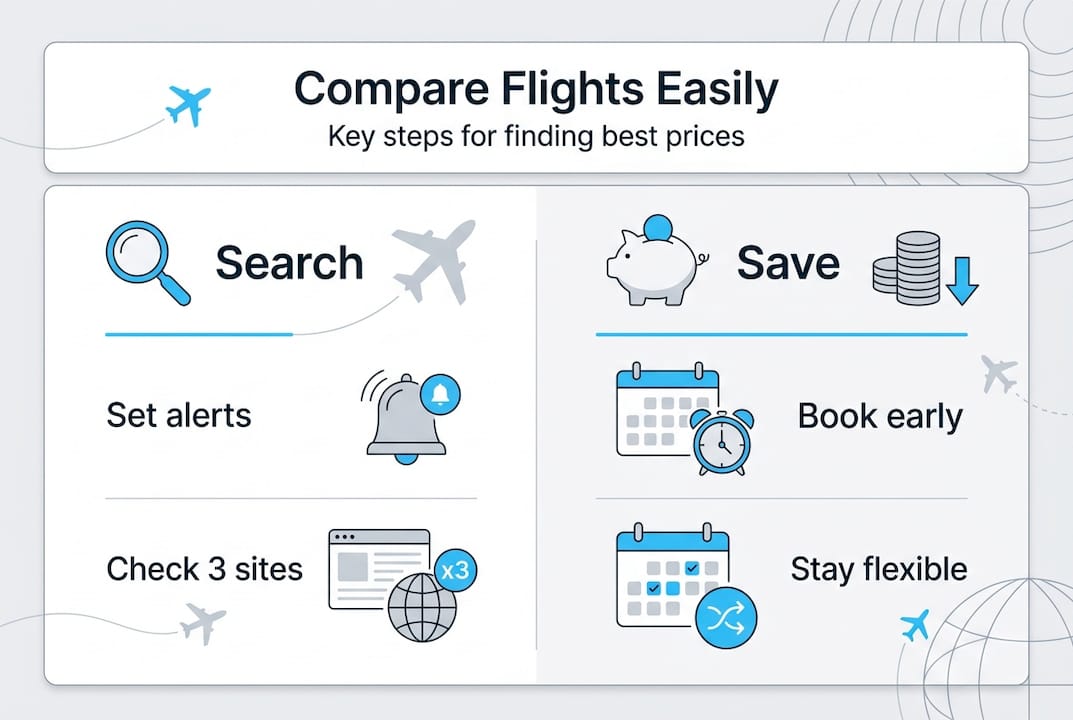
Knowing how pricing works and which tools to use sets the foundation. Now apply that knowledge with proven comparison strategies that consistently uncover the best international flight deals.
-
Set up price alerts on multiple platforms: Don’t manually check fares daily. Configure alerts on Google Flights and at least one other platform for your desired routes. Price alerts and historical graphs help predict optimal purchase moments by showing typical price ranges and flagging unusual drops.
-
Check historical price data before booking: Most search engines display price history graphs showing fare trends over recent months. If current prices sit above the historical average, waiting often pays off unless travel dates are inflexible.
-
Search in incognito mode to avoid price tracking: While evidence is mixed, some travelers report seeing higher prices on repeated searches as cookies track their interest. Searching in private browsing mode eliminates this potential dynamic pricing trigger.
-
Compare different date combinations systematically: Shifting travel dates by even one day can save hundreds of dollars. Use flexible date search tools to view pricing across a week or month, identifying the cheapest departure and return combination.
-
Book international flights 6-8 weeks before departure: Statistical analysis shows this window typically offers the best balance between advance purchase discounts and avoiding last-minute price spikes. Booking earlier rarely saves more, while waiting longer usually costs more.
-
Consider nearby alternative airports: Major cities often have multiple airports. Checking fares from all options within reasonable distance can reveal significant savings, especially when low-cost carriers serve secondary airports.
Timing your search and purchase strategically makes enormous difference:
- Search on Tuesday and Wednesday: Airlines often release deals early in the week, and competitors match prices within 24-48 hours
- Fly on Tuesday, Wednesday, or Saturday: These days see lower demand and correspondingly lower fares than Thursday, Friday, and Sunday
- Avoid peak holiday periods: Traveling a few days before or after major holidays can cut costs by 30-50%
- Book domestic connections separately: Sometimes booking international and domestic segments separately costs less than through-ticketing
Pro Tip: Set alerts for your route 12 weeks before travel, then monitor weekly. If prices drop 15-20% below the historical average shown in price graphs, book immediately rather than gambling on further decreases.
Understanding the flight price prediction guide principles helps you interpret price movements and decide whether to buy now or wait. While no one can perfectly predict pricing, combining historical data, seasonal patterns, and current trends gives you strong probability assessments.
Verify everything before finalizing bookings:
- Check total price including fees: Search results often show base fares before adding taxes, baggage fees, and seat selection charges
- Read cancellation and change policies: Flexible tickets cost more but provide valuable insurance against schedule changes
- Confirm fare rules on airline sites: Ensure the fare class matches your needs for baggage allowance and other amenities
- Use credit cards with travel protection: Many cards offer trip cancellation insurance, baggage delay coverage, and other protections
The tips for cheap flights extend beyond just comparison shopping. Combining smart search strategies with flexible travel planning and strategic booking timing creates a comprehensive approach that consistently delivers savings. Small efforts in research and monitoring compound into hundreds of dollars saved per international trip.
Explore more travel savings with PilotTravelDeals
Mastering flight price comparison is just the beginning of travel savings. Once you’ve secured affordable airfare, your trip budget benefits from finding great hotel deals and understanding how to maximize every aspect of travel planning. PilotTravelDeals specializes in helping budget-conscious travelers like you discover the best deals across all travel categories.

Our platform aggregates deals from multiple providers, giving you the comprehensive comparison power you need to make informed decisions. Whether you’re searching for cheap airfare tips find best deals or exploring hotel deals and bookings that complement your flight savings, we’ve curated resources that save you time and money. Learn advanced techniques for using travel comparison sites to unlock savings up to 80% on your complete travel package. Start planning smarter today and turn travel dreams into affordable reality.
Frequently asked questions
What factors cause international flight prices to change so frequently?
Flight prices fluctuate due to demand shifts detected by airline AI systems, fuel cost changes, competitor pricing moves, and inventory management algorithms. Airlines use machine learning models that update fares multiple times daily, analyzing hundreds of variables to optimize revenue. Dynamic pricing seeks maximum profit by charging different passengers different amounts based on predicted willingness to pay and booking patterns.
How can I avoid ghost fares when searching for international flights?
Use reputable flight search engines like Google Flights that prioritize accuracy over exhaustive coverage. Always confirm the displayed price directly on the airline or booking site before purchasing, as search engines sometimes cache outdated information. Be skeptical of fares that seem dramatically lower than competitors, as these often turn out to be ghost fares that disappear during checkout.
When is the best time to book international flights to get the cheapest tickets?
Booking 6-8 weeks prior to departure typically yields the best international airfare deals according to pricing data analysis. Mid-week departures on Tuesday, Wednesday, or Saturday generally cost less than weekend travel. Set up price alerts 12 weeks before your trip to monitor fare trends and catch sudden drops that signal optimal purchase timing.
Recommended
- Master Flight Comparison Strategies for Big Savings – PilotTravelDeals.com
- How to Search for Cheap International Flights Easily – PilotTravelDeals.com
- How to Book International Flights: A Step-by-Step Guide – PilotTravelDeals.com
- 7 Smart Ways to Find the Cheapest Website to Buy Tickets – PilotTravelDeals.com


