
TL;DR:
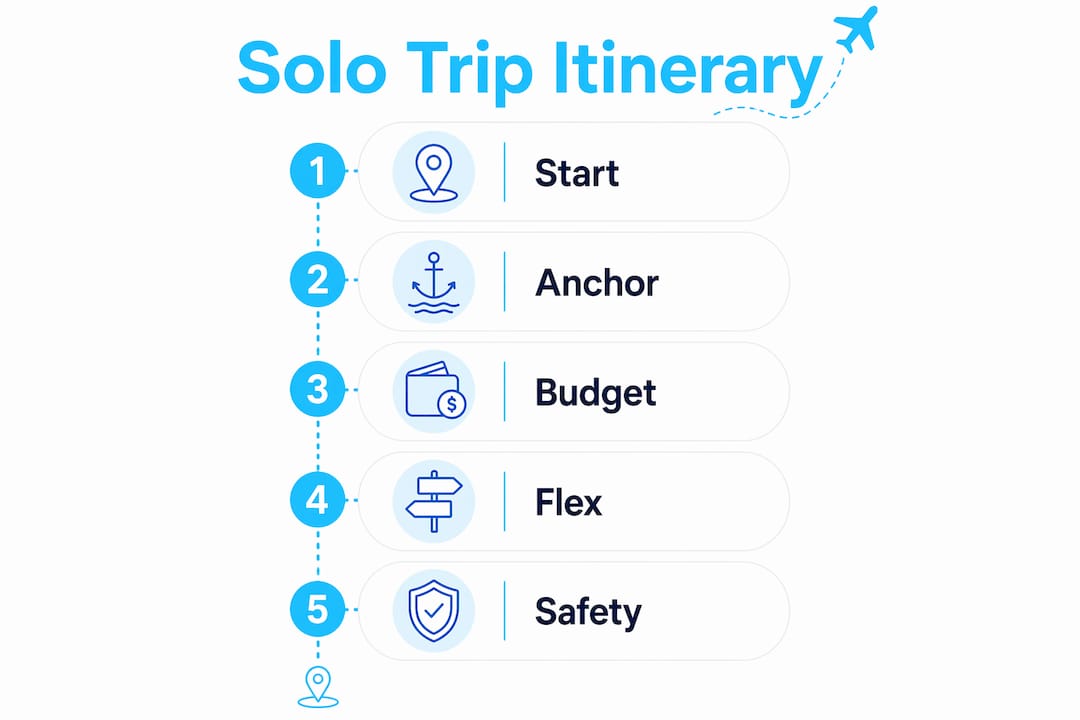
- Solo trip planning involves organizing flexible logistics and activities to ensure safety, budget, and enjoyment. Using anchor-based scheduling and phased preparation minimizes decision fatigue and helps build confidence in navigating new environments. Budget considerations like single supplements and real-time expense tracking are essential for a successful, stress-free solo adventure.
Solo trip itinerary planning is the process of organizing key travel logistics and activities with structured flexibility to protect your budget, safety, and enjoyment. Unlike group travel, going solo means every decision lands on you, which makes a clear framework non-negotiable. Tools like Google Docs, TripIt, and trail-tested budgeting apps give you the infrastructure to plan without obsessing. The goal is not a minute-by-minute schedule. It is a confident skeleton that holds your trip together while leaving room for the unexpected.
How to plan your solo trip itinerary from the start
The first question to answer before booking anything is: why are you traveling alone? Your answer shapes every decision that follows, from destination to daily pace. Someone seeking solitude in nature needs a different itinerary than someone chasing cultural immersion in a foreign city.
Matching your travel pace and destination to your personal comfort level reduces decision fatigue and raises overall trip satisfaction. This is especially true for first-timers, who often underestimate how mentally demanding solo travel can be.
When choosing a destination, ask yourself these questions before committing:
- Do I speak the language, or is English widely understood there? Countries like Portugal, the Netherlands, and Japan score high on navigability even for non-speakers.
- What is the safety profile for solo travelers? Check travel advisories from the U.S. State Department and read recent solo traveler reports on forums like Reddit’s r/solotravel.
- What pace do I actually want? A two-week sprint across five countries sounds exciting until day four.
- Am I ready for full solo travel, or should I start smaller? A weekend trip to a nearby city is a legitimate first solo trip. It builds the muscle memory you need.
Limiting your bases to one to three locations during a two-week trip reduces transit fatigue and lets you go deeper into each place. Spreading yourself across seven cities in fourteen days is a common first-timer mistake. You spend more time in transit than in experience.
Pro Tip: Pick your first solo destination based on infrastructure, not just aesthetics. A city with reliable public transit, walkable neighborhoods, and English-language signage cuts your cognitive load in half.
What does solo travel actually cost?
Solo travel costs more than most people budget for, and the reason is a fee most first-timers never see coming: the single supplement. Single supplement fees can range from $50 per day to 200% of the standard double-occupancy room rate, which can add hundreds of dollars to a trip budget overnight.
Understanding this fee early transforms how you budget. Hostels, solo-friendly hotels, and apartment rentals on platforms like Airbnb sidestep the supplement entirely. Knowing your options before you book is the difference between a comfortable trip and a financially stressful one.
A realistic solo travel budget covers these core categories:
- Flights: Book at least 60 days out for international routes. Use fare alert tools to track price drops.
- Accommodation: Compare hostel dorms, private rooms, and budget hotels. Check affordable stays that cater specifically to solo travelers.
- Food: Budget $30 to $60 per day depending on destination. Street food and local markets cut costs without sacrificing experience.
- Activities: Prioritize two to three paid experiences per week. Many of the best solo travel moments cost nothing.
- Transport: Factor in local transit, airport transfers, and any intercity travel.
- Emergency buffer: A 10 to 15% buffer on your total budget handles transit delays, illness, or a spontaneous opportunity you did not plan for.
Apps like Trail Wallet and TravelSpend let you log expenses in real time so you always know where you stand. Budgeting is not about restriction. It is about making calm decisions instead of panicked ones.
Pro Tip: Build your budget in a spreadsheet with two columns: planned spend and actual spend. Reviewing it each evening takes three minutes and prevents the slow budget bleed that derails most solo trips.
How do you build a flexible solo itinerary?
Anchor-based planning is the most effective framework for solo trip itinerary building. An anchor is any fixed commitment: a hotel check-in, a flight, a museum ticket with a timed entry, or a cooking class you pre-booked. Everything else in the day is open.
Planning only 60% of each day and leaving one fully flexible day per week prevents the burnout that kills solo trips by day five. Rigid hour-by-hour schedules create frustration when reality does not cooperate, and it never does.
Here is how to structure a typical solo travel day using the anchor method:
- Morning anchor: One fixed activity, ideally the most logistically demanding. Museum visits, day tours, or long transit legs work well here when your energy is highest.
- Midday open block: Eat where locals eat. Walk without a destination. Let the neighborhood reveal itself.
- Afternoon exploration: One optional activity from your list. Do it if you feel like it. Skip it without guilt if you do not.
- Evening wind-down: Dinner, a local bar, or simply your accommodation. Solo travel is tiring. Rest is part of the itinerary.
The table below shows how this plays out across a sample three-day solo trip to Lisbon, Portugal:
| Day | Morning anchor | Afternoon option | Evening |
|---|---|---|---|
| Day 1 | Alfama walking tour (pre-booked) | Explore LX Factory market | Dinner in Bairro Alto |
| Day 2 | Day trip to Sintra (train booked) | Pena Palace gardens | Early rest day |
| Day 3 | Fully flexible | Belém Tower or Jerónimos Monastery | Fado show (pre-booked) |
Preparing an offline itinerary dossier with addresses, reservation confirmations, transport details, and backup options reduces cognitive load when you are navigating a new city with limited data. Google Maps offline downloads and a saved PDF in your phone’s files cost nothing and save enormous stress.
What is the 90/60/30 planning timeline?
The 90/60/30 day planning system breaks your preparation into three focused stages, spreading the workload so nothing gets left to the last week. Each stage has a clear job.
- 90 days out: Confirm your destination. Check passport validity and visa requirements for your nationality. Set your total budget and identify your travel dates. Research the safety profile of your destination using the U.S. State Department’s travel advisory database.
- 60 days out: Book your flights and primary accommodation. Purchase travel insurance. For solo travelers, travel insurance should carry a minimum of $100,000 in medical coverage and $500,000 in evacuation coverage, since U.S. health insurance rarely covers care abroad.
- 30 days out: Finalize your daily itinerary anchors. Download offline maps via Google Maps or Maps.me. Book any timed-entry tickets for major attractions. Confirm all reservations.
- 7 days out: Complete online check-ins for flights. Share your full itinerary with a trusted contact at home. Charge and pack all electronics. Review your solo travel packing list one final time.
Batching your planning by stage prevents the scattered, anxious approach where you try to do everything at once. Treat each stage as a single focused session, not an ongoing background worry.
Practical safety tips for solo travelers
Safety for solo travelers is less about avoiding danger and more about reducing exposure to avoidable risk through smart preparation. The two most effective habits are sharing your itinerary and building backup plans.
- Share your itinerary with someone at home. Give a trusted contact your accommodation addresses, flight numbers, and a rough daily schedule. Agree on a check-in routine, such as a daily text, so someone always knows you are okay.
- Choose accommodation with strong solo traveler reviews. Look for properties with 24-hour reception, secure key access, and recent reviews from solo women or solo travelers specifically. The hotel booking tips on Pilottraveldeals cover what to look for in solo-friendly properties.
- Build a backup plan for every major itinerary leg. If your train is canceled, what is the next option? If your accommodation falls through, which area has walkable alternatives? Knowing this in advance costs ten minutes of research and saves hours of panic.
- Trust your instincts without apology. If a situation feels wrong, leave. Solo travel gives you the freedom to make that call without negotiating with anyone else.
“The solo traveler’s greatest asset is not bravery. It is preparation that makes bravery unnecessary.”
Planning lighter rest days after high-activity days is not laziness. It is energy management. Solo travelers carry the full mental load of every decision, and that accumulates faster than most people expect. Build the rest in, or your body will force it.
Key takeaways
Effective solo trip itinerary planning requires three things: anchor-based daily structure, a budget that accounts for solo-specific costs, and a phased preparation timeline that prevents last-minute chaos.
| Point | Details |
|---|---|
| Use anchor-based planning | Fix one key activity per day and leave 40% of the day open for flexibility. |
| Budget for single supplements | Solo fees can add $50 per day or more; compare hostels and apartments to avoid them. |
| Apply the 90/60/30 timeline | Spread planning across three stages to avoid overwhelm and last-minute gaps. |
| Prepare an offline dossier | Save addresses, confirmations, and backups to your phone before you land. |
| Build a 10 to 15% budget buffer | Reserve a financial cushion to handle delays, illness, or spontaneous opportunities. |
Why I think most solo travelers over-plan the wrong things
Most solo travel advice tells you to plan more. My experience points the opposite direction: the problem is not how much you plan, it is what you plan.
I have watched travelers spend hours building color-coded spreadsheets for every meal and attraction, then fall apart on day two when a museum is closed or a restaurant has a two-hour wait. The schedule becomes a source of anxiety instead of a tool for freedom. On the other hand, travelers who show up with no structure at all spend half their mental energy on logistics that could have been resolved in advance.
The sweet spot is planning the things that genuinely cannot be improvised. Flights, accommodation, timed-entry tickets, and major transit connections deserve hard bookings. Everything else deserves a list of options, not a fixed slot. When you land in a new city with your anchors confirmed and your afternoon open, you get the best of both worlds: security and freedom.
The other thing most articles skip is the emotional side of solo travel. Eating alone at a restaurant feels strange the first time. Navigating a foreign transit system with no one to consult is genuinely stressful. These are real experiences, not signs that you are doing it wrong. Build in the buffer time, the rest days, and the low-stakes afternoons. That is where the trip actually happens.
— Asher
Plan your solo trip with Pilottraveldeals
Pilottraveldeals.com is built for travelers who want to spend less time searching and more time experiencing. Whether you are booking your first solo trip or refining a system that already works, the platform compares hotel deals from multiple providers so you can find solo-friendly properties at the best available rates, with savings up to 80% on select stays. For flights, the cheap airfare tips guide walks you through exactly when and how to book to secure the lowest fares. Solo travel does not have to cost more. With the right tools and the right timing, it can cost significantly less.
FAQ
What is solo trip itinerary planning?
Solo trip itinerary planning is the process of organizing travel logistics, daily activities, and budgets with structured flexibility so that a solo traveler can move confidently without rigid over-scheduling. The anchor-based method, fixing one key commitment per day, is the most widely recommended approach.
How far in advance should I plan a solo trip?
The 90/60/30 day timeline is the standard framework: confirm destination and budget at 90 days, book flights and accommodation at 60 days, and finalize your itinerary and offline maps at 30 days out.
What are single supplements and how do they affect my budget?
Single supplements are extra fees charged when one person occupies a room or tour spot priced for two. They can range from $50 per day to 200% of the base rate, making accommodation comparisons a critical step in solo travel budgeting.
How do I stay safe while traveling solo?
Share your full itinerary with a trusted contact at home, establish a daily check-in routine, choose accommodation with strong solo traveler reviews, and build backup plans for every major transit leg. Travel insurance with at least $100,000 in medical coverage is non-negotiable for international trips.
What is the best destination for a first solo trip?
Accessible, welcoming destinations with reliable infrastructure and English-language navigability, such as Portugal, Japan, or the Netherlands, consistently rank as strong choices for first-time solo travelers. Starting with a domestic weekend trip is also a legitimate and confidence-building first step.
Recommended
- 7 Essential Steps for Your Travel Planning Checklist – PilotTravelDeals.com
- Example of a Trip Itinerary: Build Yours Right – PilotTravelDeals.com
- How to Plan Affordable Trips: Smart Strategies for Any Traveler – PilotTravelDeals.com
- Travel Planner Template: Organize Any Trip with Ease – PilotTravelDeals.com