
TL;DR:
- The best flight credit card depends on whether you primarily fly a single airline or compare prices across carriers.
- Mid-tier rewards cards like Chase Sapphire Preferred and Capital One Venture X offer flexibility and travel protections for most travelers.
The best flight credit card is defined by how well it matches your travel habits, not by which card has the highest advertised rewards rate. Travelers who fly a single airline repeatedly get the most value from branded airline cards like the United Explorer Card or the Delta SkyMiles Gold American Express. Travelers who split time across multiple carriers get more from flexible options like the Chase Sapphire Preferred or the American Express Gold Card. The industry term for these flexible options is “general travel rewards cards,” and understanding the difference between them and airline-branded cards is the single most important step in choosing the right one.
What is the best flight credit card for your travel style?
The best choice between airline-branded and general travel cards comes down to one question: do you fly the same airline most of the time, or do you book whoever has the best price? That single factor determines which card structure will actually reward your spending. Most travelers answer “whoever has the best price,” which makes general travel rewards cards the stronger default for the majority.

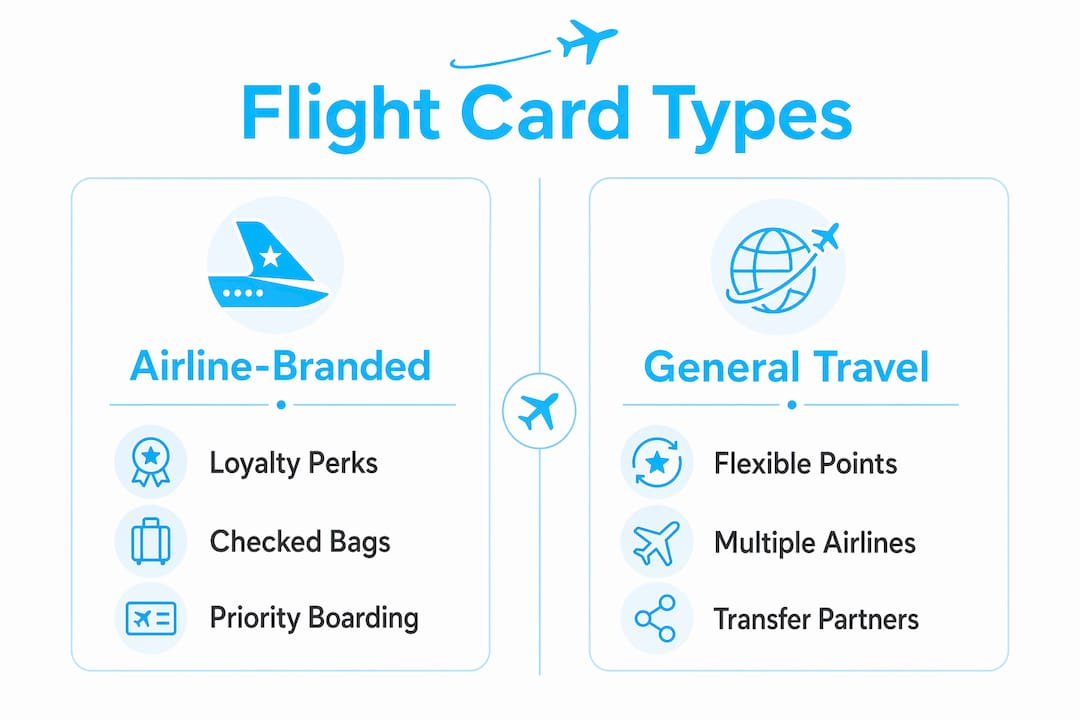
Airline-branded cards are built around loyalty. The United Explorer Card gives you free checked bags, priority boarding, and two United Club one-time passes per year. The Delta SkyMiles Gold American Express offers a free checked bag on Delta flights and a $200 Delta flight credit after spending $10,000 in a year. These perks are genuinely valuable, but only if you fly that specific airline often enough to use them.
General travel rewards cards like Chase Sapphire Preferred and American Express Gold earn points transferable to multiple airline and hotel programs. That flexibility means your points are not locked into one carrier’s award chart. If Delta raises its redemption rates or your preferred route switches to United, your points still hold their value. General-purpose cards are the stronger pick for travelers without a single airline loyalty.
Airline-branded vs. general travel cards: key differences
The structural differences between these two card types affect everything from how you earn points to what happens at the airport gate.
Airline-branded cards typically offer:
- Free checked bags (saving $35 to $40 per bag per flight on most U.S. carriers)
- Priority boarding, which matters most on full flights with limited overhead space
- Companion certificates or discounted companion fares on select cards
- Bonus miles on purchases made directly with that airline
- Occasional lounge day passes, though full lounge access usually requires a premium card
General travel rewards cards typically offer:
- Points transferable to 10 to 20 airline and hotel partners
- Elevated earning on broad categories like dining, groceries, and travel
- Travel protections including trip delay insurance and primary rental car coverage
- No restriction to a single airline’s award inventory
- Annual travel credits that apply across multiple booking platforms
The tradeoff is real. Airline cards give you deeper perks within one ecosystem. General cards give you wider reach. Annual fees also differ significantly. Airline cards like the Southwest Rapid Rewards Priority run around $149 per year. General cards range from $95 for Chase Sapphire Preferred to $795 for Chase Sapphire Reserve. Knowing what you will actually use before paying that fee is the difference between a card that pays for itself and one that quietly drains your wallet.
Comparing top flight credit cards: fees, perks, and rewards
The table below covers the most widely recommended cards across both categories.
| Card | Annual fee | Best for | Key perk |
|---|---|---|---|
| Chase Sapphire Preferred | $95 | Flexible rewards beginners | Points transfer to 14 partners |
| Chase Sapphire Reserve | $795 | Frequent premium travelers | Lounge access + $300 travel credit |
| Capital One Venture X | $395 | Mid-tier flexible rewards | $300 portal credit + 10,000 anniversary miles |
| Delta SkyMiles Gold Amex | $150 | Loyal Delta flyers | Free checked bag + Delta flight credit |
| United Explorer Card | $95 | Loyal United flyers | Free bag + two United Club passes |
| Southwest Rapid Rewards Priority | $149 | Southwest loyalists | 7,500 anniversary points + upgraded boardings |
Chase Sapphire Preferred carries a $95 annual fee and is consistently rated as one of the strongest entry-level travel cards available. Its points transfer to partners including United MileagePlus, Southwest Rapid Rewards, and Hyatt, giving you real flexibility without a steep fee. For most travelers new to the points world, it is the right starting point.
Chase Sapphire Reserve justifies its $795 annual fee through lounge access via Priority Pass, a $300 annual travel credit, and a higher earning rate on travel and dining. Frequent travelers who spend significant time in airports and book travel regularly can offset that fee quickly. Occasional travelers almost certainly cannot.
Capital One Venture X sits between the two. Its $300 annual travel credit applies only to bookings made through the Capital One Travel portal, which is an important restriction. The card also awards 10,000 bonus miles on each account anniversary, effectively reducing the net annual fee to $95 for travelers who use both benefits. That makes it a genuinely competitive mid-tier option.
How to decide which card fits your travel habits
Choosing the right card requires honest answers to a few specific questions, not just a comparison of advertised perks.
-
Count your annual flights and carriers. If you take fewer than six flights per year across multiple airlines, a general travel card almost always delivers better value than an airline-branded card. The perks on airline cards only pay off with consistent use on that specific carrier.
-
Calculate the real value of free bags. A free checked bag on a round trip saves roughly $70 to $80. If you check bags on every flight and fly a single airline at least twice per year, an airline card’s annual fee can pay for itself on bags alone.
-
Decide how much airport comfort matters. Lounge access is a premium perk that genuinely changes the travel experience. If you have long layovers or travel internationally, Chase Sapphire Reserve’s Priority Pass access has concrete value. If you mostly take short domestic hops, it is a luxury you will rarely use.
-
Assess your tolerance for portal restrictions. Cards like Capital One Venture X require you to book through their travel portal to access certain credits. If you prefer booking directly with airlines or through other platforms, that restriction reduces the card’s effective value.
-
Think about where you spend money outside of travel. Chase Sapphire Preferred earns 3x points on dining. American Express Gold earns 4x on dining and 4x at U.S. supermarkets. If most of your spending happens in those categories, a general travel card builds points faster than an airline card that only rewards airline purchases.
Pro Tip: Start with Chase Sapphire Preferred before committing to a premium card. Spend six months learning how points transfers work, which partners offer the best value, and whether you actually use travel protections. That experience makes the decision to upgrade to Chase Sapphire Reserve or a dedicated airline card much clearer.
You can also use multiple cards strategically to capture both worlds. A common approach pairs a general travel card for everyday spending with a no-fee or low-fee airline card for the free bag benefit on your primary carrier. That combination often delivers more total value than any single premium card.
Common mistakes travelers make when picking a flight card
Most card selection mistakes come from comparing advertised features rather than actual usage patterns.
-
Overvaluing the points earning rate. A card that earns 5x miles on airline purchases sounds impressive, but if you only spend $2,000 per year on flights, the difference between 2x and 5x is 6,000 points. That is worth roughly $60 to $90. It does not justify a $200 fee difference.
-
Ignoring portal restrictions on travel credits. The Capital One Venture X credit only applies to bookings through Capital One Travel. Travelers who book directly with airlines or through other platforms cannot access that $300 benefit, which changes the card’s effective annual cost significantly.
-
Underestimating the value of transfer partners. Many travelers focus on earning rates and ignore the transfer partner list entirely. A card with 14 transfer partners gives you access to award pricing across multiple airline programs, which often beats booking directly through a card’s own travel portal.
-
Choosing a card based on the sign-up bonus alone. Sign-up bonuses are one-time events. The ongoing earning rate, annual fee, and perks are what determine long-term value. A 75,000-point bonus is worth roughly $750 to $1,125 depending on redemption. That advantage disappears after year one if the card’s structure does not fit your habits.
Pro Tip: Airline perks only justify fees when they match your actual flight routes and frequency. Before applying, map out your last 12 months of travel and check whether you would have used each advertised benefit at least twice.
Key takeaways
The best flight credit card is the one whose benefits you will actually use, matched to your real travel frequency and airline preferences.
| Point | Details |
|---|---|
| Loyalty vs. flexibility | Airline cards reward single-carrier loyalty; general cards work across multiple airlines and partners. |
| Fee justification | High annual fees only pay off when you consistently use premium credits, lounge access, and travel protections. |
| Start mid-tier | Chase Sapphire Preferred at $95 is the strongest entry point for most travelers before upgrading. |
| Portal restrictions matter | Capital One Venture X’s $300 credit requires booking through their portal, limiting value for some travelers. |
| Multi-card strategy | Pairing a general travel card with a low-fee airline card often beats any single premium card for total value. |
What I’ve learned after years of comparing flight cards
Here is the honest truth most card comparison articles skip: the majority of travelers who apply for premium cards do not use enough of the perks to justify the fee. I have seen it repeatedly. Someone applies for Chase Sapphire Reserve because of the lounge access, uses it twice in the first year, and then quietly downgrades after realizing they take four flights annually, not fourteen.
The cards that deliver the most consistent value are mid-tier flexible cards, specifically Chase Sapphire Preferred and Capital One Venture X for travelers who book through portals. They give you real transfer flexibility, solid travel protections, and manageable fees. You do not need to be a road warrior to get value from them.
Airline-branded cards make sense in one specific scenario: you fly a single carrier at least eight to ten times per year and check bags regularly. In that case, the free bag benefit alone covers the annual fee, and the priority boarding and lounge passes become genuine bonuses. Outside of that scenario, you are paying for perks you will rarely use.
The advice I give most often is this: learn the points transfer system before you spend money on a premium card. Understand how to move Chase Ultimate Rewards points to United MileagePlus or Hyatt. Once you know how to maximize airline rewards, you will know exactly which card structure serves your travel goals. That knowledge is worth more than any sign-up bonus.
— Asher
Find better flights and hotels with Pilottraveldeals
Choosing the right card is only one piece of the savings equation. Pilottraveldeals helps you put those points and credits to work by comparing flight and hotel deals across dozens of providers in one place.

Whether you are redeeming Chase Ultimate Rewards points or Capital One miles, finding the lowest base fare matters as much as the rewards you earn. Pilottraveldeals publishes cheap airfare tips that show you exactly when and where to book for maximum savings. The site also covers hotel deals worth pairing with your travel card credits, so your rewards stretch further on every trip. For travelers who want to combine smart card strategy with real-time deal hunting, Pilottraveldeals is the resource that connects both.
FAQ
What is a travel credit card vs. an airline credit card?
A travel credit card earns flexible points redeemable across multiple airlines and hotels, while an airline credit card earns miles tied to one specific carrier. General travel cards like Chase Sapphire Preferred offer broader redemption options; airline cards like United Explorer Card offer deeper perks within one airline’s ecosystem.
What airline has the best credit card for frequent flyers?
The answer depends on which airline you fly most. Delta SkyMiles Gold American Express suits loyal Delta flyers, United Explorer Card works well for United loyalists, and Southwest Rapid Rewards Priority delivers strong value for Southwest travelers. Frequent flyers on a single carrier benefit most from that carrier’s branded card.
Is Chase Sapphire Preferred worth it for casual travelers?
Yes. Chase Sapphire Preferred’s $95 annual fee is offset by its flexible points transfers, solid travel protections, and 3x earning on dining. Bankrate rates it as one of the best entry-level travel cards for travelers who want real rewards without a steep fee commitment.
How do I know if a premium card’s annual fee is worth it?
Add up the dollar value of benefits you will realistically use in a year, including travel credits, lounge visits, and free bags. If that total exceeds the annual fee, the card pays for itself. If it does not, a mid-tier card like Chase Sapphire Preferred or a no-fee airline card delivers better return on your spending.
Can I use two flight credit cards at the same time?
Yes, and pairing cards is often the smartest strategy. A common combination is a general travel card for everyday spending and a no-fee or low-fee airline card for free bag benefits on your primary carrier. This approach captures flexible rewards and airline-specific perks without paying two high annual fees.
Recommended
- What Airline Has the Best Credit Card in 2026? – PilotTravelDeals.com
- What is travel credit? A 2026 guide for budget travelers – PilotTravelDeals.com
- Flight Comparison Checklist: Secure the Best Airline Deals – PilotTravelDeals.com
- Smart ways to save money on flights every time – PilotTravelDeals.com
