
TL;DR:
- Refundable business tickets help travelers avoid high disruption costs and unrecouped expenses. They are most valuable when the likelihood of change exceeds 10-15%, especially for complex or high-value trips. Effective policies segment trip risks and track savings to optimize booking choices and reduce administrative overhead.
Refundable business tickets are airline fares that let you cancel or change your flight with little to no financial penalty, making them the most practical tool for business travelers with unpredictable schedules. The core case for choosing a flexible fare is financial: disruption costs include airline change fees, fare differences, lodging, transport, missed meetings, and lost time, all of which add up fast. Refundable fares act as a hedge against those costs. Understanding when and why to book refundable business tickets is the difference between a travel budget that holds and one that bleeds.
Why book refundable business tickets: the financial case
Refundable tickets protect you from the full cost of a disrupted trip. When a meeting gets canceled, a deal falls through, or a client reschedules at the last minute, a non-refundable fare turns into a sunk cost. A refundable fare turns it into a recovered asset.

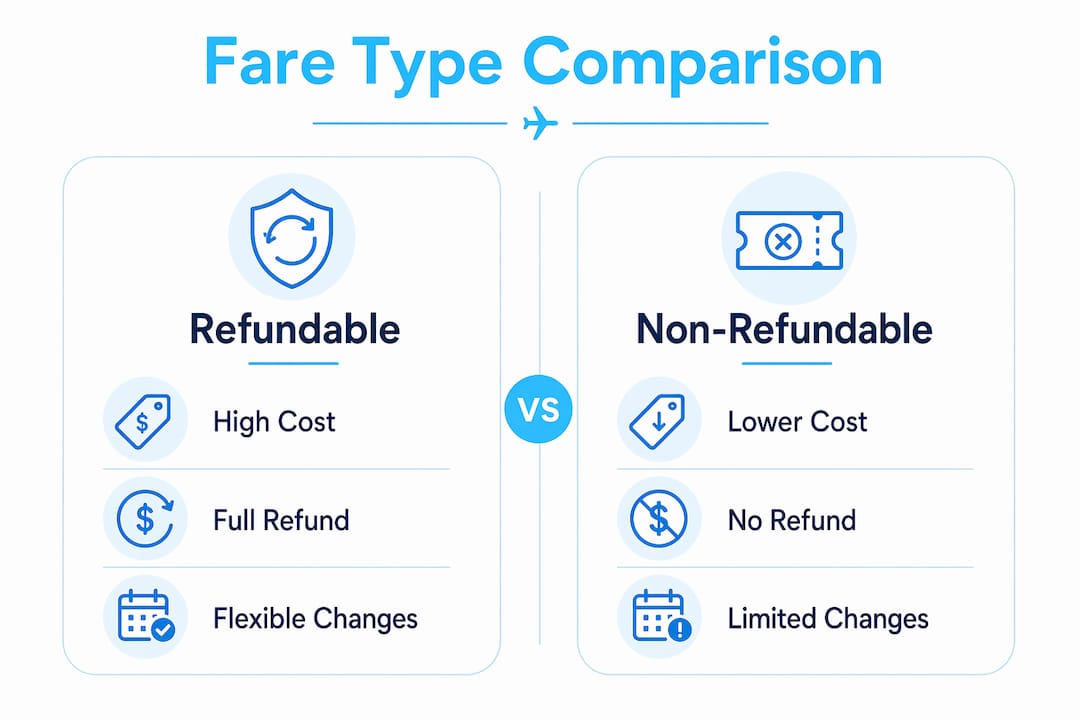
Price premiums vary widely, ranging from a modest markup to as much as three times the cost of a non-refundable ticket, depending on the airline, route, and how far in advance you book. That range matters. On a short domestic hop, the premium may not be worth it. On a long-haul business class fare above $1,500–$2,000, the math shifts decisively in favor of refundable.
The real financial risk is not just the ticket price. Total disruption costs routinely exceed the refundable fare premium when you factor in rebooking fees, last-minute replacement fares, and the downstream costs of missing a critical meeting. That is the number most travelers forget to calculate.
- Change fees and fare differences: Airlines charge both a change fee and the fare difference to the new ticket. On popular routes, that combination can exceed $500 on a single change.
- Cascading itinerary costs: A missed connection on a multi-leg trip triggers rebooking across every subsequent segment, not just one.
- Accommodation and ground transport: Hotels and car rentals booked around a canceled flight rarely refund on short notice.
- Time value: Hours spent on hold with airline customer service have a real cost for a traveling professional.
Pro Tip: Before booking, estimate your personal cancellation probability. If there is a realistic chance you will need to change or cancel, run a quick comparison: refundable fare price minus non-refundable fare price versus the likely total cost of disruption. The math often surprises people.
When to choose refundable over non-refundable tickets
The decision between refundable versus non-refundable tickets is a risk calculation, not a preference. Experts recommend a risk threshold rule: use refundable tickets when your probability of changing or canceling exceeds 10–15% for routine trips, and 25% for trips to volatile regions. Beyond those thresholds, refundable fares financially outperform the savings from cheaper non-refundable options.
The following table shows the most common business travel scenarios and which fare type makes more sense.
| Scenario | Recommended fare type | Reason |
|---|---|---|
| Confirmed client meeting, well-served route | Non-refundable | Low change probability, frequent rebooking options |
| Speculative trip pending deal approval | Refundable | High cancellation risk before trip date |
| Multi-leg international itinerary | Refundable | Single change triggers cascade across all segments |
| Travel to politically volatile region | Refundable | External disruption risk is high and unpredictable |
| Short-notice domestic trip, flexible schedule | Non-refundable | Low premium savings justify the risk |
| High-value executive travel | Refundable | Cost of disruption to senior staff is disproportionate |
Route frequency is a factor that most travelers underestimate. On thin routes with infrequent departures, missing a flight or needing to rebook can cost significantly more than the refundable premium, because replacement options are scarce and expensive. A daily service between two major hubs gives you options. A twice-weekly regional connection does not.
Geopolitical conditions also shift the calculus. Travel to regions with active labor disputes, political instability, or extreme weather seasons carries a higher baseline disruption risk. Refundable fares absorb that risk cleanly.
Common misconceptions about flexible and refundable fares
“Flexible” does not mean “refundable.” This is the most expensive misunderstanding in business travel. A flexible fare may allow you to change your flight date or time without a penalty fee, but it may only issue a credit voucher on cancellation, not a cash refund. Those are two very different outcomes.
The distinction matters most when a trip is canceled entirely. A credit voucher tied to one airline is useful only if you fly that carrier again within the validity window, often 12 months. A cash refund returns money to your account with no strings attached. For corporate travel, cash refunds are almost always preferable because they flow back to the travel budget rather than sitting as airline credit.
Flexible fares vary broadly in what they actually permit. Some allow free date and time changes but impose a cancellation penalty. Others offer partial refunds with a fee deducted. The fine print determines the real value.
Watch for these specific fare rule traps:
- “Refundable” with a cancellation fee: Some fares labeled refundable still deduct a $150–$300 fee before returning the balance.
- Credit-only cancellation: The fare allows changes but cancellation only produces a travel credit, not cash.
- Expiring credits: Vouchers issued on cancellation often expire within 12 months and cannot be transferred to another traveler.
- Blackout periods: Some flexible fares restrict changes during peak travel windows, which is exactly when you might need to change.
Pro Tip: Before completing any booking, search the fare rules for the words “non-refundable,” “credit only,” and “cancellation fee.” Airlines are required to publish these rules, but they are rarely displayed prominently. Spend two minutes reading them before you pay.
How to build refundable tickets into your travel policy
Segmented booking policies outperform blanket rules every time. A policy that mandates refundable tickets for every trip wastes money on low-risk domestic routes. A policy that bans refundable tickets to cut costs exposes the company to large, avoidable losses on complex itineraries.
A practical framework for travel managers and frequent travelers looks like this:
- Classify trips by risk level. Assign each booking to a low, medium, or high disruption-risk category based on route frequency, trip purpose, and destination stability.
- Set fare type rules by category. Low-risk, confirmed trips on well-served routes use non-refundable fares. Medium and high-risk trips default to refundable or fully flexible fares.
- Apply a value threshold. Any itinerary with a total fare above a set amount, such as $1,500, automatically qualifies for refundable booking regardless of risk category.
- Track non-refundable losses as a KPI. Record every dollar lost to non-refundable cancellations and changes. This number, reviewed quarterly, tells you whether your policy is calibrated correctly.
- Review traveler roles. Senior executives and client-facing staff carry a higher cost of disruption. Their bookings should default to refundable regardless of route.
Refundable fares also reduce administrative overhead by cutting the number of change fee disputes, credit tracking tasks, and rebooking calls that travel managers handle. That operational saving is real but rarely appears in a fare comparison spreadsheet.
For a deeper look at structuring cost-effective corporate bookings, the corporate flight booking guide at Pilottraveldeals walks through the full decision framework. Pairing smart fare selection with business travel insurance adds another layer of protection that covers scenarios even refundable fares do not, such as medical emergencies or natural disasters.
When employees in hospitality or client services need to rebook or cancel flights unexpectedly, digital reservation tools can speed up the process and reduce the friction of last-minute changes.
Key Takeaways
Refundable business tickets deliver their greatest value when the total cost of disruption, including fees, rebooking, and lost time, exceeds the fare premium.
| Point | Details |
|---|---|
| Refundable vs. flexible | Flexible fares allow changes but may only issue credits, not cash refunds, on cancellation. |
| Risk threshold rule | Use refundable fares when your cancellation probability exceeds 10–15% for routine trips. |
| Multi-leg protection | Single segment changes on complex itineraries trigger cascading costs that refundable fares prevent. |
| Segmented policy wins | Blanket refundable or non-refundable policies both waste money. Segment by trip risk and value. |
| Track your losses | Monitoring non-refundable cancellation losses as a KPI reveals whether your booking policy needs adjustment. |
The real cost of “saving” on a non-refundable fare
I have watched business travelers make the same calculation error for years. They see a $400 non-refundable fare and a $650 refundable option, and they book the cheaper one without thinking past the checkout screen. Then the meeting gets pushed, the trip gets canceled, and that $400 disappears entirely. The $250 “savings” cost them $400.
The trips where I have seen refundable fares pay off most clearly are not the ones where something dramatic happened. They are the ordinary ones: a client who rescheduled, a project that slipped a week, a connecting flight that made a tight itinerary too risky to lock in. Those situations happen constantly in business travel, and they are exactly what refundable fares are designed for.
My honest advice is this: stop treating the fare premium as a cost and start treating it as a risk management fee. If you would not book a $200,000 business trip without insurance, you should not book a $1,800 flight without asking whether refundability is worth the extra $300. Most of the time, for high-stakes or uncertain trips, it is.
The travelers who get this right are not the ones who always book refundable. They are the ones who ask the right question every time: what is the realistic cost if this trip changes?
— Asher
Pilottraveldeals helps you book smarter every trip
Business travel works best when every part of your booking is coordinated, from the right fare type to the right hotel at the right price.

Pilottraveldeals aggregates deals across flights, hotels, and travel services so you can compare options and book with confidence. Whether you need hotel deals for business trips near your meeting location or want to apply airfare tips that help you identify the best refundable fare windows, the platform puts the right information in front of you before you pay. Business travelers who plan ahead and compare across providers consistently find better value than those who book on the first option they see. Pilottraveldeals makes that comparison fast and straightforward.
FAQ
What does “refundable business ticket” mean?
A refundable business ticket is an airline fare that allows you to cancel or change your booking and receive a full or partial cash refund. Unlike non-refundable fares, the financial loss on cancellation is minimal or zero.
Is a flexible fare the same as a refundable fare?
No. A flexible fare typically allows date and time changes without a penalty but may only issue a travel credit on cancellation, not a cash refund. Always check the fare rules before booking.
When do refundable tickets make financial sense?
Refundable tickets make financial sense when your probability of changing or canceling exceeds 10–15% for routine trips, or when the total cost of disruption, including rebooking fees, replacement fares, and missed meetings, would exceed the refundable fare premium.
Do refundable tickets cost significantly more?
Refundable fares range from a modest premium to up to three times the price of a non-refundable ticket. The gap is widest on long-haul routes and narrowest on short domestic flights with frequent service.
Should every business trip use a refundable ticket?
No. Segmented booking policies outperform blanket rules. Use non-refundable fares for confirmed, low-risk trips on well-served routes, and reserve refundable fares for complex, high-value, or uncertain itineraries.
Recommended
- Understanding the Essentials of Business Travel Booking Guide – PilotTravelDeals.com
- What Is a Ticketed Return Travel Itinerary? – PilotTravelDeals.com
- How to Buy Cheap Business Class Tickets Easily – PilotTravelDeals.com
- How to plan affordable business trips and maximize savings – PilotTravelDeals.com