
TL;DR:
- Booking indirect flights usually saves travelers $200 to $500 per person compared to nonstop options on long-haul routes. While layovers add travel time and some risk, choosing well-designed hubs and proper planning can turn them into enjoyable travel experiences. Booking on a single ticket and allowing sufficient connection time protect travelers from high missed connection costs and ensure a smoother journey.
Booking non-direct routes, the industry term is “connecting flights” or “indirect itineraries,” is the single most reliable way budget travelers cut costs on long-haul international trips. Choosing a flight with one or more layovers saves $200–$500 per person compared to nonstop alternatives on the same route. On high-demand routes during peak seasons, that gap climbs even higher. Airlines price direct flights as premium convenience products, which means every traveler who skips the nonstop option captures real money. This article breaks down why book non-direct routes makes financial sense, what the trade-offs actually look like, and how to turn layovers into a genuine travel advantage.
Why book non-direct routes: the pricing logic behind the savings
The price gap between direct and connecting flights is not accidental. Airlines price nonstop flights higher because the market values speed and convenience, targeting business travelers and time-sensitive passengers who will pay a premium. Connecting flights, by contrast, are priced aggressively to fill seats that would otherwise fly empty through hub airports.
Direct flights carry a 20–30% price premium over connecting itineraries on comparable routes. That premium exists because airlines know their nonstop customers are largely inelastic on price. Budget travelers who accept a stop get the benefit of that competitive pricing.
This pricing gap is stable across seasons. Hub-and-spoke airline networks depend on connecting passengers to fill aircraft on secondary legs. Without those passengers, many routes would not be economically viable. That structural dependency keeps indirect fares consistently lower, not just during off-peak windows.
Key reasons the price gap persists year-round:
- Hub economics: Airlines need connecting passengers to justify operating regional and international hub routes.
- Seat fill targets: Empty seats on connecting legs are a direct revenue loss, so airlines discount them.
- Yield management: Revenue management systems price nonstops at a premium and connecting fares at a discount to maximize total aircraft revenue.
- Traveler segmentation: Connecting itineraries provide consistent savings for travelers prioritizing cost over time, which is a deliberate market segment airlines serve.
Pro Tip: Search the same route with and without a connection filter. The price difference you see is the exact premium you pay for convenience. On routes over eight hours, that number is rarely worth it for leisure travelers.
What are the real trade-offs of choosing non-direct flights?
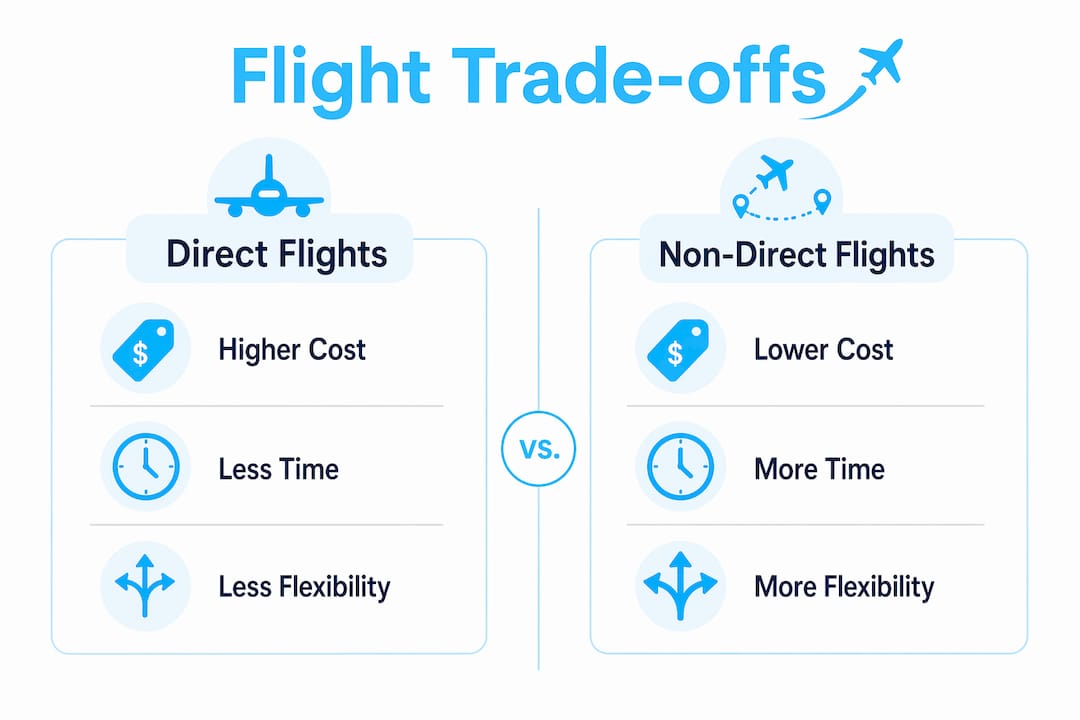
Non-direct flights add time and complexity to any trip. Connecting flights typically add 2–8 hours to total journey time and carry a moderate risk of missed connections compared to the low delay risk of nonstop travel. Baggage handling across two legs also introduces more chances for a bag to be delayed or misrouted.
That said, the trade-offs are manageable with the right approach. Splitting ultra-long routes of 14 hours or more into two segments actually improves comfort. You get to move around, eat a real meal, and decompress before the next leg. Many travelers find a 14-hour nonstop far more exhausting than two 7-hour flights with a 3-hour break in between.
| Factor | Direct flights | Non-direct flights |
|---|---|---|
| Cost | Higher (20–30% premium) | Lower, saves $200–$500+ |
| Journey time | Shortest possible | Adds 2–8 hours |
| Missed connection risk | Very low | Moderate |
| Baggage risk | Low | Slightly higher |
| Comfort on long routes | Demanding on 14+ hour flights | More manageable with a break |
| Routing flexibility | Limited to nonstop pairs | Many more city combinations |
| Best for | Business, time-sensitive travel | Budget and leisure travel |
The comparison above shows that non-direct routes win clearly on cost and flexibility. The trade-off is time, not safety or reliability, as long as you book correctly.
Pro Tip: Always choose a layover of at least 90 minutes at a major hub. Anything shorter leaves no buffer if your first flight runs late. Two hours is the safer standard at large international airports.
How can layovers become the best part of your trip?
Layovers at world-class airports can transform perceived transit time into enjoyable, valuable travel segments. The key is choosing routes that connect through airports designed for traveler comfort and exploration. Singapore Changi, Dubai International, and Istanbul Airport are the three most cited examples, and each offers a genuinely different experience during a long layover.

Singapore Changi has a rooftop pool, a butterfly garden, and a cinema, all accessible to transit passengers. Dubai International offers a sprawling duty-free zone, restaurants representing dozens of cuisines, and quiet rest zones. Istanbul Airport features a Turkish bath and cultural exhibits inside the terminal. These are not just waiting rooms. They are destinations within the trip.
Visa considerations matter here. Many major transit airports allow visa-free transfers for most nationalities, meaning you can stay in the international zone without formal entry. For longer layovers of six hours or more, some countries offer free or low-cost transit visas that let you leave the airport entirely. Turkey, for example, offers a transit visa that allows travelers to explore Istanbul for up to 72 hours.
Practical tips for turning layovers into a positive experience:
- Book layovers of 4–8 hours at top-tier hubs if you want to explore the terminal or nearby city areas.
- Check visa requirements for your nationality at the layover country before booking.
- Use airport lounge access through travel credit cards or day passes to rest, eat, and work comfortably.
- Research airport amenities before you fly. Changi, Dubai, and Istanbul all publish detailed transit guides.
- Pack a small day bag in your carry-on with essentials so you are not dependent on checked luggage during the layover.
Pro Tip: If your layover is 6 hours or more in Istanbul, book a guided half-day city tour through the airport. Several operators run these specifically for transit passengers, and the cost is often under $50 per person.
Combining your layover with smart lodging planning also pays off. Resources like combining lodging and dining during a stopover can stretch your travel budget further while improving the overall experience.
What strategies maximize savings on connecting flights?
The single most important rule for booking connecting flights is to book on one ticket. When your itinerary is on a single booking, the airline is legally responsible for rebooking you free of charge if a delay causes a missed connection. Book two separate tickets and you absorb the full cost of a replacement flight, which can run $300–$800 on short notice.
Here is a practical framework for booking non-direct routes the right way:
- Search for single-ticket itineraries first. Use the multi-stop or connecting flight filter on travel comparison platforms. Confirm that all legs appear under one booking reference.
- Compare total trip cost including layover expenses. A 4-hour layover costs roughly $25–$50 per person for meals and incidentals. Factor that into your savings calculation.
- Use travel credit cards with lounge access. Cards that include Priority Pass or equivalent programs eliminate most layover food and comfort costs. That $25–$50 layover expense drops to near zero.
- Consider a direct outbound and connecting return. If you have a hard arrival deadline, book the direct flight out and save money on the return leg with a connection. This hybrid approach balances time sensitivity with cost savings.
- Check baggage policies across all legs. On a single ticket, your checked bag transfers automatically. Confirm this with the airline before you fly, especially on codeshare itineraries involving two different carriers.
- Set a minimum connection time standard. Ninety minutes at smaller airports, two hours at major international hubs. Never book tighter than that.
Travel credit cards reduce layover costs and improve comfort during longer waits. Cards with annual travel credits, lounge access, and trip delay insurance turn a potential inconvenience into a manageable, even comfortable, experience. For frequent travelers, the card’s annual fee pays for itself on a single long-haul trip with connections.
For a deeper look at booking international itineraries step by step, the international flight booking guide on Pilottraveldeals covers the full process in detail.
Key Takeaways
Booking non-direct routes is the most consistent way budget travelers save $200–$500 or more per person on long-haul flights, with the right booking strategy eliminating most of the associated risks.
| Point | Details |
|---|---|
| Cost savings are substantial | Connecting flights save $200–$500+ per person versus nonstop on long-haul routes. |
| Book on a single ticket | Single-ticket booking protects you from missed connection costs of $300–$800. |
| Layover time is manageable | Adding 2–8 hours is worthwhile when the fare difference funds multiple nights of accommodation. |
| Top hubs add real value | Singapore Changi, Dubai, and Istanbul turn layovers into genuine travel experiences. |
| Layover costs are low | A 4-hour layover costs $25–$50; travel credit cards with lounge access reduce this further. |
The case for indirect flights that most travelers miss
I have booked connecting flights on long-haul routes for years, and the savings have funded entire extra nights at my destination. The math is simple: a $400 saving on airfare covers three nights at a mid-range hotel in Southeast Asia or two nights in Western Europe. That is not a minor convenience trade-off. That is a meaningfully different trip.
What I have noticed is that most travelers reject connecting flights emotionally before they run the numbers. The word “layover” triggers anxiety about delays and missed bags. But the actual risk, when you book on a single ticket with a reasonable connection time, is far lower than people assume. Airlines have strong financial incentives to get you to your final destination. Rebooking a missed connection costs them money too.
The attitude toward layovers is also shifting. Travelers who once saw a 5-hour stop in Dubai as dead time now treat it as a bonus destination. That shift in perspective is worth cultivating. A layover in Istanbul is not a problem to survive. It is a few hours in one of the world’s great cities, at no extra cost.
My honest recommendation: book the connecting flight, pocket the savings, and spend 30 minutes researching what your layover airport actually offers. You will almost always find something worth your time. For travelers who want to go deeper on this approach, the stopover flights guide on Pilottraveldeals is a strong starting point.
— Asher
Pilottraveldeals helps you find the best connecting flight deals
Pilottraveldeals aggregates flight and hotel deals from multiple providers, making it straightforward to compare connecting itineraries against nonstop options on the same route. The cheap airfare tips section covers exactly how to identify the best connecting routes and when the savings justify the extra travel time.

If your connecting itinerary includes a longer layover, Pilottraveldeals also covers hotel options for stopover stays, whether you need a few hours of rest near the airport or a full overnight before your next leg. Budget travelers who plan both the flight and the layover accommodation together consistently get the best overall value on their trips.
FAQ
How much can I save by booking non-direct flights?
Booking connecting flights on long-haul international routes saves $200–$500 per person compared to nonstop alternatives, with savings climbing higher on peak-season routes.
Is it safe to book connecting flights on separate tickets?
Booking on separate tickets is risky. If a delay causes a missed connection, replacement tickets can cost $300–$800, and the airline has no obligation to cover that cost. Always book on a single ticket.
How long should a layover be to avoid missing a connection?
A minimum of 90 minutes at smaller airports and two hours at major international hubs is the standard recommendation. Tighter connections leave no buffer for typical flight delays.
What are the best airports for a long layover?
Singapore Changi, Dubai International, and Istanbul Airport are consistently rated the top layover hubs. Each offers hours of amenities and exploration options for transit passengers.
Do I need a visa for a layover at a foreign airport?
Most major transit airports allow visa-free international zone transfers for most nationalities. For layovers where you want to leave the airport, check the specific transit visa rules for that country before booking.