Searching for flights can feel like playing a frustrating guessing game where prices jump unpredictably every time you check. You might see a great fare one day, only to watch it skyrocket the next, leaving you wondering if you’ll ever catch a deal. The good news is that finding super cheap flights isn’t about luck. It’s about understanding how airlines price tickets, knowing exactly when to book, and using the right tools to spot genuine bargains. This guide reveals proven strategies that budget travelers use to consistently score the lowest fares and turn travel dreams into affordable reality.
Table of Contents
- Understanding Flight Price Fluctuations And Airline Pricing Strategies
- Determining The Best Times To Book: The Goldilocks Window
- Tools And Techniques For Finding Super Cheap Flights
- Common Mistakes To Avoid And Verifying Your Savings
- Get Started On Your Next Cheap Flight With Pilottraveldeals.com
- FAQ
Key takeaways
| Point | Details |
|---|---|
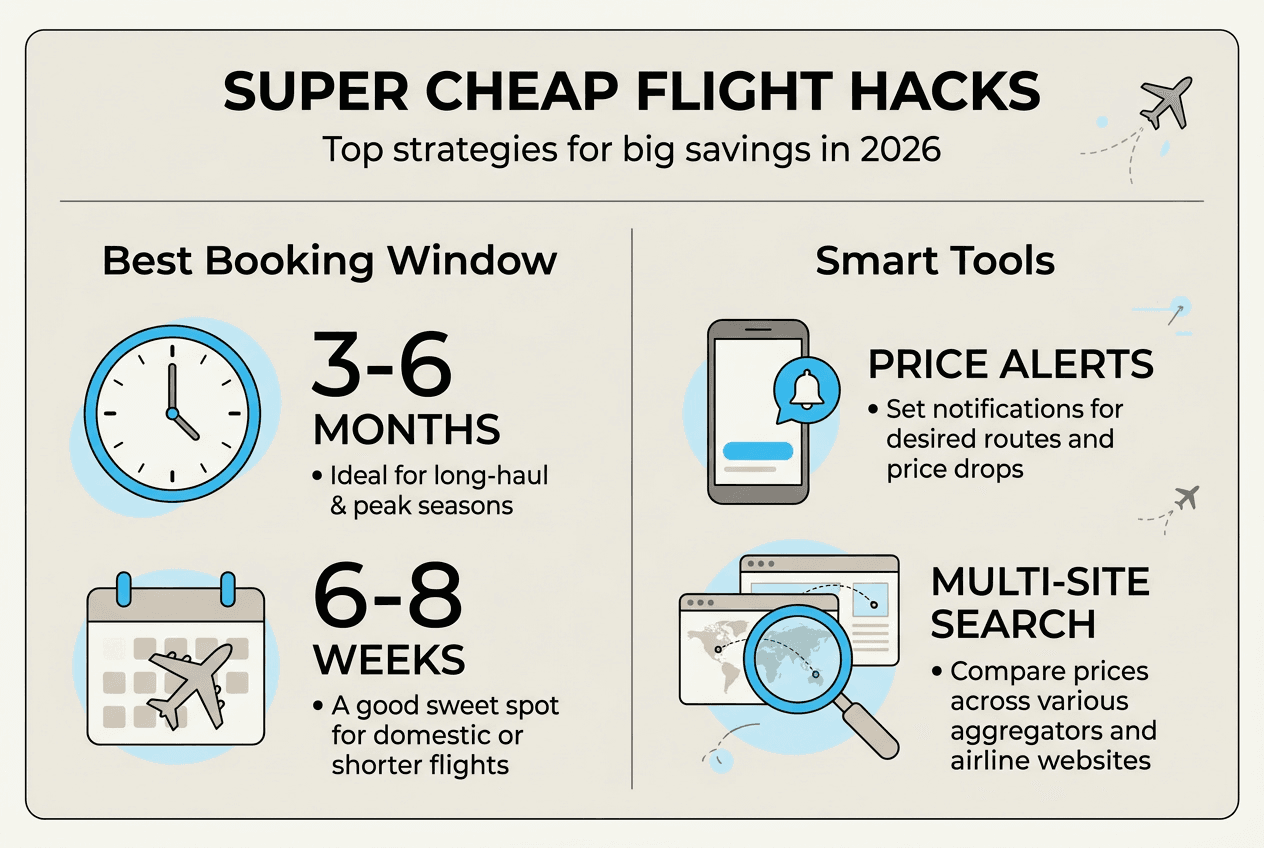
| Booking windows matter | Long-haul flights are cheapest 3-6 months ahead, short-haul international 2-4 months, domestic 6-8 weeks before departure |
| Airlines use dynamic pricing | AI algorithms adjust fares constantly based on demand patterns and competitor prices |
| Flexible dates save money | Searching with flexible date tools reveals significantly cheaper travel days around your preferred dates |
| Multiple comparisons required | Checking at least three platforms uncovers varying prices and hidden deals |
| Price alerts catch drops | Setting notifications tracks fare changes and alerts you when prices fall |
Understanding flight price fluctuations and airline pricing strategies
Airline fares fluctuate constantly due to supply and demand dynamics combined with sophisticated inventory control. Every time you search, you’re seeing a snapshot of a price that could change within hours or even minutes. Airlines don’t set one fixed price for a route. They divide each flight into multiple fare buckets, each with different prices and seat allocations.
Modern carriers rely heavily on artificial intelligence to optimize revenue. United Airlines utilizes dynamic pricing powered by AI algorithms that analyze booking patterns and competitor fares in real time. These systems predict how much travelers are willing to pay for specific routes and adjust prices accordingly. Sometimes prices increase even when seats remain empty, simply because the algorithm anticipates last-minute business travelers will pay premium rates.
Several forces drive these price changes:
- Demand spikes during holidays, weekends, and peak travel seasons push fares higher
- Competitor pricing adjustments trigger automatic fare matching or undercutting
- Fuel cost fluctuations affect operating expenses and base pricing
- Booking velocity signals strong demand, prompting immediate price increases
- Seasonal trends create predictable patterns airlines exploit for maximum revenue
The role of AI in travel booking has fundamentally transformed how airlines manage pricing. Traditional revenue management separated capacity control from price optimization, but newer approaches integrate both functions. This integration improves forecasting accuracy and allows airlines to adjust prices more precisely based on predicted demand patterns.
Understanding these mechanics gives you a critical advantage. When you know that flight prices fluctuate due to demand, competition, fuel costs, and seasonal trends, you can anticipate when prices might drop. You’re not at the mercy of random chance. You’re working with knowledge of the system.
“Airlines continuously adjust fares based on complex algorithms that analyze hundreds of variables simultaneously, creating both challenges and opportunities for savvy travelers who understand the patterns.”
The key takeaway is timing matters enormously. Prices generally rise as departure approaches because airlines know desperate travelers will pay more. But within that general trend, specific windows exist where prices dip due to promotional pushes, competitive pressure, or inventory rebalancing. Your job is finding those windows.
Determining the best times to book: the goldilocks window
Booking at the right time can mean the difference between paying double or snagging a bargain. The optimal booking window varies significantly based on your route type and destination. Best booking windows differ for long-haul international, short-haul international, and domestic flights, each following distinct patterns.

Here’s a clear breakdown of ideal booking timelines:
| Flight Type | Optimal Booking Window | Why This Window Works |
|---|---|---|
| Long-haul international | 3-6 months ahead | Airlines release inventory early and offer promotional fares to fill seats |
| Short-haul international | 2-4 months ahead | Shorter routes have faster booking cycles with sweet spots closer to departure |
| Domestic flights | 6-8 weeks ahead | High competition and frequent flyers create predictable pricing patterns |
Booking too early often backfires. Airlines initially price flights high, then adjust based on booking pace. If you book nine months out, you might pay more than someone who waits for the optimal window. Conversely, waiting until the last minute usually means paying premium prices as inventory shrinks and airlines exploit urgency.
Seasonal variations add another layer. Summer vacation routes and winter holiday destinations see compressed booking windows because demand spikes earlier. For these peak periods, book at the early end of your route’s optimal window. Off-season travel offers more flexibility, and you might find deals even closer to departure.
Pro Tip: Set calendar alerts 6 months, 4 months, and 8 weeks before your planned trip to remind yourself to check fares. This ensures you don’t miss the optimal booking window while juggling other travel planning tasks.
The goldilocks principle applies perfectly here. Too early means overpaying for uncertain inventory. Too late means competing with desperate travelers. Just right means catching airlines during their promotional pushes within the statistically cheapest booking periods. These windows represent when airlines balance filling seats with maximizing revenue, creating opportunities for budget travelers.
Different routes also have different competitive dynamics. Popular routes with multiple carriers often see aggressive pricing competition, creating better deals throughout the booking window. Monopoly routes or less competitive markets might offer fewer deals, making it even more critical to book within the optimal timeframe.
For more strategies on timing your bookings, explore cheap airfare tips to find the best deals that complement these booking windows.
Tools and techniques for finding super cheap flights
Having the right tools transforms flight searching from frustrating guesswork into systematic deal hunting. The most powerful technique is using flexible-date search tools that display prices across multiple days or entire months. Instead of searching only your exact dates, you can instantly spot if flying one day earlier or later saves significant money.
Follow this systematic approach to maximize your chances:
- Start with a flexible-date calendar search on your preferred platform
- Identify the cheapest travel days within your acceptable date range
- Cross-check those specific dates on at least two other flight search sites
- Set price alerts for your top route and date combinations
- Monitor alerts for 1-2 weeks to understand normal price fluctuations
- Book when prices dip below the average you’ve observed
Comparing across multiple platforms is essential because each site has different partnerships, cached data, and fee structures. Setting price alerts and comparing at least three tools maximizes your savings potential. What appears expensive on one site might be a bargain on another due to exclusive deals or promotional codes.
Here’s how popular flight search tools compare:
| Tool | Key Strength | Best For |
|---|---|---|
| Google Flights | Comprehensive flexible-date calendar | Visual price comparison across dates |
| Skyscanner | Worldwide coverage and “everywhere” search | Destination flexibility and exploring options |
| Kayak | Price prediction and tracking | Understanding if prices will rise or fall |
| Momondo | Color-coded price calendars | Quick visual identification of cheap dates |
Pro Tip: Combine flexible-date searches with price alert notifications by setting alerts for multiple date combinations around your preferred travel window, then booking whichever drops lowest.
Additional tactics that consistently uncover savings:
- Search for one-way tickets separately instead of round trips, especially on routes with multiple carriers
- Check flights departing midweek (Tuesday, Wednesday) which typically cost less than weekend departures
- Consider nearby alternative airports that might offer significantly lower fares
- Look for positioning flights or creative routing that costs less than direct options
- Clear your browser cookies or search in private mode to avoid dynamic price increases based on search history
The best websites to find cheap flights each have unique features worth exploring. Some excel at international routes while others dominate domestic searches. Building familiarity with 3-4 platforms lets you quickly cross-reference and spot genuine deals.
For comprehensive strategies beyond basic searching, check out smart ways to find cheap tickets and hacks to get cheaper flights that cover advanced techniques like error fares, positioning flights, and strategic layovers.
The combination of flexible searching, multi-platform comparison, and automated price tracking creates a systematic approach that consistently beats random searching. You’re not hoping to stumble onto a deal. You’re engineering conditions that make finding deals inevitable.
Common mistakes to avoid and verifying your savings
Even experienced travelers make errors that inflate costs or cause them to miss better deals. The most common mistake is searching exclusively on one platform at one time. Airline fares fluctuate constantly, so checking multiple times throughout the day and across different sites reveals true market pricing rather than algorithm-manipulated rates.
Repeated searches on the same device can trigger price increases. Airlines and booking platforms track your search behavior through cookies, interpreting multiple searches for the same route as high purchase intent. This signals their pricing algorithms to raise fares, assuming you’ll pay more out of desperation. Clearing cookies or using private browsing mode helps prevent this manipulation.
Other critical mistakes to avoid:
- Ignoring total trip cost by focusing only on base fare while overlooking baggage fees, seat selection charges, and cancellation penalties
- Booking immediately after finding any decent price without comparing alternatives or waiting for potential drops
- Failing to read cancellation and change policies before purchase, leading to expensive surprises later
- Overlooking alternative airports or routes that might offer substantially lower total costs
- Not factoring in transportation costs to/from distant alternative airports that erase flight savings
Once you think you’ve found a great deal, verify your savings systematically:
- Screenshot or note the price with all fees included from your initial search
- Check the same exact flight on the airline’s direct website to confirm pricing
- Search two additional comparison sites to ensure you’re seeing competitive rates
- Calculate total trip cost including baggage, seats, and ground transportation
- Compare against historical average prices for that route if data is available
- Confirm the booking class and any restrictions match your travel needs
“True savings verification requires looking beyond the advertised base fare to calculate the complete cost of your journey, including all fees, restrictions, and the value of flexibility you’re sacrificing for a lower price.”
Hidden fees deserve special attention. Budget carriers often advertise incredibly low base fares but charge separately for carry-on bags, seat selection, priority boarding, and even printing boarding passes at the airport. A $49 ticket can balloon to $150 after mandatory fees. Always click through to the final booking page to see the complete price before committing.
Cancellation and change policies matter more than many travelers realize. A slightly more expensive ticket with free cancellation might actually save money if your plans change. Conversely, a rock-bottom fare with zero flexibility could cost you the entire ticket price plus rebooking fees if you need to adjust dates.
For additional guidance on avoiding common pitfalls, explore best tips for cheap flights that cover verification strategies and smart booking practices.
The verification process takes an extra 10-15 minutes but can save hundreds of dollars by catching pricing errors, revealing better alternatives, or confirming you truly found the best available deal. This small time investment protects against buyer’s remorse and ensures your budget travel strategy actually delivers savings.
Get started on your next cheap flight with PilotTravelDeals.com
You now understand how airline pricing works, when to book for maximum savings, and which tools reveal the best deals. Putting this knowledge into action starts with having reliable resources that aggregate deals and simplify comparisons. PilotTravelDeals.com specializes in helping budget travelers like you find and book the cheapest flights available.

The platform offers comprehensive cheap airfare tips to find the best deals alongside real-time price comparisons across multiple carriers. Beyond flights, you’ll discover hotels at PilotTravelDeals.com that complement your flight savings, letting you stretch your travel budget further. The site’s comparison tools help you quickly identify the lowest total trip costs.
Learning how to use travel comparison sites effectively amplifies your ability to spot genuine bargains versus marketing gimmicks. Start exploring your 2026 travel options today and turn the strategies from this guide into actual savings on your next adventure.
FAQ
When is the absolute cheapest time to book flights in 2026?
The cheapest booking window depends on your route type. Long-haul international flights are typically cheapest when booked 3-6 months before departure, short-haul international routes offer best prices 2-4 months ahead, and domestic flights hit their sweet spot 6-8 weeks prior. Booking within these goldilocks windows generally secures better fares than booking too early or waiting until the last minute.
How do airline dynamic pricing algorithms impact my chance of finding cheap flights?
AI models predict traveler willingness to pay and adjust prices constantly based on demand signals and booking patterns. This creates price volatility but also opportunities if you understand the patterns. Airlines sometimes increase fares closer to departure even with empty seats, anticipating business travelers will pay premium rates. Using price alerts and booking within optimal windows helps you catch prices during algorithm-driven dips rather than spikes.
What are the best tools to monitor and compare flight prices?
Experts recommend using flexible-date search features and setting price alerts across at least three platforms to maximize your chances of finding cheap flights. Google Flights excels at visual calendar comparisons, Skyscanner offers worldwide coverage, and Kayak provides price predictions. Cross-referencing multiple tools catches exclusive deals and reveals true market pricing. For detailed platform reviews, check the best websites to find cheap flights.
Should I clear my cookies when searching for flights?
Yes, clearing cookies or using private browsing mode can prevent price manipulation. Airlines and booking platforms track your search behavior and may increase displayed prices when they detect repeated searches for the same route, interpreting this as high purchase intent. Searching in incognito mode or clearing cookies between searches helps you see more neutral pricing rather than algorithm-adjusted rates targeting your perceived urgency.
Are budget airlines always the cheapest option?
Not necessarily when you factor in total costs. Budget carriers advertise low base fares but charge separately for baggage, seat selection, and other services that legacy carriers include. A $49 budget airline ticket might cost $150 after fees, while a $120 legacy carrier ticket includes baggage and seat selection. Always calculate the complete trip cost including all fees before deciding which option truly saves money.
How far in advance should I set price alerts?
Set price alerts as soon as you know your travel dates, ideally 6-8 months before departure for international trips and 3-4 months for domestic routes. This gives you time to observe normal price fluctuations and recognize when a genuine deal appears. Monitor alerts for at least 1-2 weeks to understand the baseline pricing, then book when fares dip noticeably below that average.
Recommended
- How to book cheapest domestic flights in 2026: guide – PilotTravelDeals.com
- Tricks to find cheap flights: expert tips for 2026 – PilotTravelDeals.com
- Find cheap business class flights in 2026: proven guide – PilotTravelDeals.com
- Top Tips for Saving on Flights: Travel Smart in 2025 – PilotTravelDeals.com
- 7 praktiske tips til budgetrejser i Danmark for alle – Rejs i Danmark