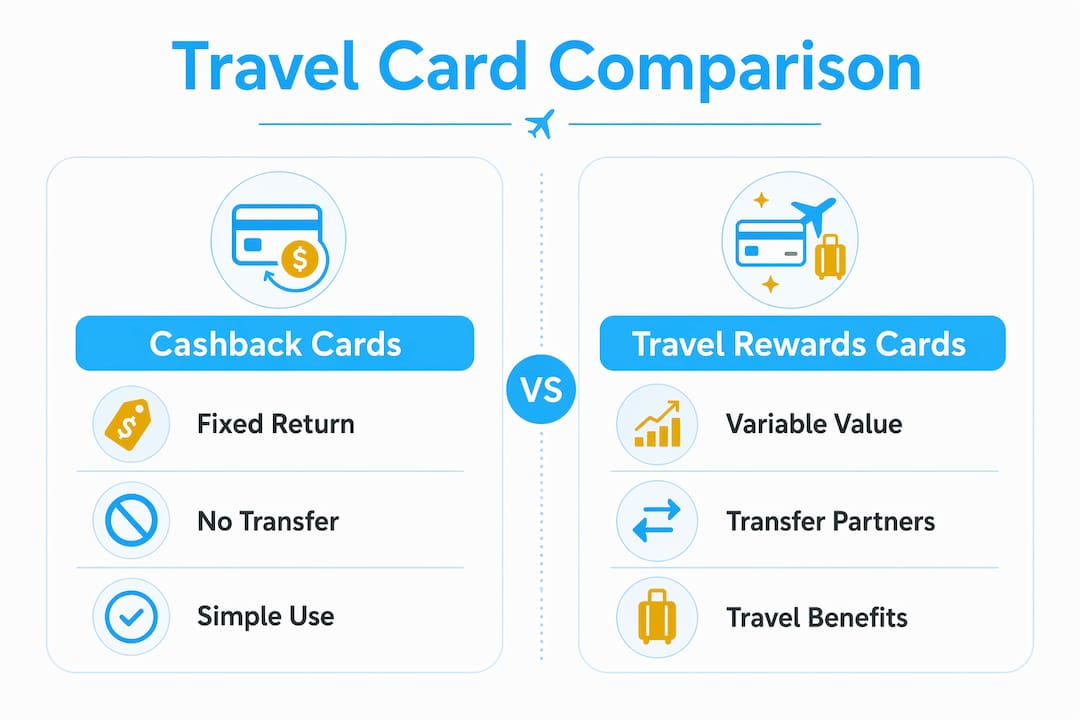
Travel cashback cards do one thing exceptionally well: they turn every purchase into a predictable percentage of money back, with no strategy required. Flat-rate cash back typically runs 1–2% on all spending, redeemable as a statement credit or bank deposit whenever you want it. Travel rewards cards work differently. Instead of cash, you earn points or miles that can be worth 2–3 cents per point or higher using transfer partners for flights and hotels. The ceiling is higher, but so is the complexity.
Here is the practical split between the two card types:
- Travel cashback cards (Citi Double Cash Card, Wells Fargo Active Cash Card, Bank of America Customized Cash Rewards Credit Card): fixed returns, no expiration on active accounts, zero redemption strategy needed, often no annual fee. Best for infrequent travelers who want reliable, liquid rewards.
- Travel rewards cards (Capital One Savor Cash Rewards Credit Card, Chase Freedom Flex): variable point values, premium perks like lounge access and trip insurance, higher sign-up bonuses. Best for frequent travelers willing to learn transfer partners and bonus categories.
- Hybrid users: pair a no-fee cashback card for groceries and gas with a travel rewards card for flights and dining to capture the best of both.
The right card is not the one with the flashiest marketing. It is the one that matches how you actually spend money and how often you actually fly.
What are the real differences between cashback and travel rewards cards?
The comparison comes down to six variables that matter in practice.

| Feature | Cashback cards | Travel rewards cards |
|---|---|---|
| Reward type | Cash (statement credit or deposit) | Points or miles |
| Reward value | Fixed 1–2% per dollar | Variable; 2–3 cents per point or higher with strategic redemptions |
| Annual fees | — | — |
| Foreign transaction fees | Often charged (~3%) | Frequently waived on travel cards |
| Best for spending habits | Everyday categories: groceries, gas, streaming | Travel, dining, and high-bonus categories |
| Travel perks | Minimal | Lounge access, trip insurance, elite status paths |
Cashback card advantages:
- Rewards never expire on active accounts and carry a fixed dollar value, so there is no guessing what they are worth.
- Redemption is instant: apply to your statement, deposit to a bank account, or use for gift cards.
- No annual fee on most cards means every dollar earned is pure gain.
- Rotating bonus categories on cards like Chase Freedom Flex can push returns to 5% in select categories each quarter.
Travel rewards card advantages:
- Sign-up bonuses on travel cards routinely dwarf what cashback cards offer, providing a substantial head start.
- Transfer partner programs let you move points to airline or hotel loyalty programs, where redemption value can reach 2–3 cents per point or higher.
- Built-in travel protections, including trip cancellation coverage and baggage delay insurance, replace standalone policies that can cost hundreds of dollars per year.
- Foreign transaction fees of roughly 3% on standard cards are typically waived, a real saving for international trips.
Key drawbacks to know:
- Cashback cards cap your upside. A 2% flat rate is reliable but will never match a well-executed transfer partner redemption.
- Travel rewards cards punish misuse. Redeeming points for low-value statement credits effectively turns an expensive travel card into a weak cashback card.
- Premium travel cards with $400+ annual fees require deliberate use of perks to justify the cost.
How do you choose the card that actually fits your life?
The honest answer starts with your travel frequency and how to book a weekend stay for the best deal. If you fly fewer than twice a year, a premium travel card’s annual fee and complexity will likely outweigh its perks, making a cashback card the financially smarter default. Frequent travelers who book flights regularly and eat out often will find travel rewards cards pay back far more over time.
Ask yourself these questions before deciding:
- How often do I travel? Once a year or less points strongly toward cashback. Two or more trips annually opens the door to travel rewards value.
- Where do I spend the most? Heavy grocery and gas spending favors cashback cards with category bonuses. Heavy dining and travel spending favors points multipliers on travel cards.
- Am I willing to manage a rewards program? Cashback is earn-and-forget. Travel rewards require tracking transfer partners, booking windows, and bonus categories.
- What is my annual fee tolerance? A $95 travel card can pay for itself quickly with the right perks. A $550 card needs deliberate use of lounge access, travel credits, and insurance to break even.
- Do I carry a balance occasionally? If so, a no-fee cashback card beats any premium travel card. Interest charges erase rewards fast.
- Do I travel internationally? Foreign transaction fees of roughly 3% add up quickly. A travel card that waives them saves real money on every overseas purchase.
A hybrid approach works well for many travelers. Use a no-annual-fee cashback card for everyday spending, groceries, and gas, then reach for a travel rewards card specifically for flights, hotels, and dining. You capture elevated returns in both lanes without overpaying in fees. This hybrid wallet strategy is widely considered the most effective way to maximize overall rewards across different spending categories.

How to get the most out of whichever card you choose
For cashback card holders:
- Activate rotating bonus categories every quarter. Chase Freedom Flex offers 5% back in quarterly categories, but you must opt in each period or you forfeit the elevated rate.
- Stack your cashback earnings with discounted travel deals. Booking through a platform like Pilottraveldeals while earning 2% back on the purchase compounds your savings on the same transaction.
- Use the Bank of America Customized Cash Rewards Credit Card’s category-choice feature to align your 3% bonus with your actual highest-spend category, whether that is dining, online shopping, or travel.
- Pair your card with travel discount strategies to stretch cash rewards further on flights and hotels.
For travel rewards card holders:
- Concentrate spending on bonus categories. A card offering 3x points on dining and travel earns meaningfully more than a flat-rate card when those categories represent a large share of your monthly spend.
- Learn transfer partner optimization. Moving points to an airline or hotel loyalty program can unlock redemption values well above what a travel portal offers, particularly for business class flights and premium hotel stays. Pilottraveldeals’s guide to international airline programs covers how to navigate these partnerships.
- Capture the sign-up bonus. Most travel cards require hitting a spending threshold within the first three months. Plan a large purchase or a trip during that window to lock in the bonus without overspending.
- Never redeem travel points for low-value options like merchandise or statement credits. Reserve them for flights and hotel stays, ideally using transfer partners, to achieve 2–3 cents per point or higher in value.
Pitfalls that cost both card types:
- Paying an annual fee without using the card’s perks is the most common mistake with premium travel cards. Tally the dollar value of lounge visits, travel credits, and insurance before renewing.
- Ignoring the fine print on rotating categories. Chase Freedom Flex caps the 5% bonus at $1,500 in combined spending per quarter. Spending above that threshold earns only 1%.
- Letting points sit idle. Travel rewards points can be devalued by program changes. Redeem them within a reasonable timeframe rather than hoarding for a hypothetical future trip.
Pro Tip: Before applying for any travel rewards card, calculate whether the annual fee is covered by perks you will actually use. Lounge access, travel credits, and trip insurance each carry a real dollar value. If the math does not work for your travel habits, a no-fee cashback card is the better financial choice.
What travel protections do cashback cards actually offer?
This is where travel rewards cards pull ahead in ways that are easy to underestimate. Most premium travel cards include a suite of protections that cashback cards simply do not match.
Travel rewards cards commonly provide trip cancellation and interruption insurance, which reimburses prepaid, non-refundable travel expenses if you cancel due to illness or a covered emergency. Baggage delay insurance covers essential purchases when your luggage is held up. Rental car collision damage waivers can eliminate the need to buy coverage at the rental counter, a saving of $15–$30 per day. Some cards also include emergency medical and evacuation coverage, which standalone travel insurance policies price at several hundred dollars per trip for a family.
Cashback cards offer far less in this area. Most carry standard purchase protection and extended warranty coverage, which apply to items you buy with the card. A few mid-tier cashback cards include basic travel accident insurance, but trip cancellation coverage and rental car waivers are rare at the no-fee tier.
The practical implication: if you travel frequently and currently buy separate travel insurance, a premium travel card’s built-in coverage can easily justify its annual fee before you earn a single point. For infrequent travelers who rarely buy travel insurance, this advantage is less compelling, and a cashback card’s simplicity wins on cost.
Purchase protections are more comparable between the two card types. Both cashback and travel rewards cards at the mid-tier and above typically offer 90-day purchase protection against damage or theft and extended warranty coverage on eligible items. The gap is in travel-specific protections, not everyday purchase coverage.
How Pilottraveldeals makes your rewards go further
Your credit card earns the rewards. Pilottraveldeals helps you spend them wisely. The platform aggregates deals on flights, hotels, bike rentals, and SIM cards from multiple providers, so you can compare options before booking and make sure your cashback or travel points land on the best available price.
Here is how the two work together:
- Lower base prices mean more value per point. When you book a hotel at a discounted rate through Pilottraveldeals and pay with a travel rewards card, your points cover a smaller out-of-pocket cost. That is the same as getting more from each point without changing your redemption strategy.
- Cashback stacks with deal savings. Paying for a discounted flight or hotel with a 2% cashback card earns you cash back on an already-reduced price. Both savings apply simultaneously.
- Destination guides and travel articles on Pilottraveldeals help you plan trips that make the most of your card’s bonus categories, whether that is dining abroad, booking hotels, or renting transportation.
- SIM card deals on the platform can reduce international data costs, which pairs well with a travel card that waives foreign transaction fees.
Pilottraveldeals features:
- Flight and hotel deal comparisons across multiple providers, updated regularly for current pricing.
- Airfare tips and guides to help you find the lowest base fares before applying card rewards.
- Destination-specific travel guides that align trip planning with reward-earning opportunities.
- Transparent deal aggregation with no hidden markups, so the price you see is the price you pay before card rewards apply.
Whether you are maximizing a flat-rate cashback card or chasing transfer partner sweet spots with a travel rewards card, starting with the lowest available price on Pilottraveldeals means your rewards stretch further on every booking.
Key Takeaways
Travel cashback cards provide fixed, reliable returns of 1–2% on all spending, while travel rewards cards offer variable but potentially higher value through points, perks, and transfer partner redemptions.
| Point | Details |
|---|---|
| Cashback rate baseline | Flat-rate cashback cards return 1–2% per dollar, with a fixed and predictable value. |
| Travel rewards upside | Strategic redemptions through transfer partners can yield 2–3 cents per point or higher, outpacing cashback. |
| Annual fee threshold | If you travel fewer than twice a year, cashback cards are typically the smarter financial choice. |
| Foreign transaction fees | Travel cards often waive the ~3% foreign transaction fee, a meaningful saving on international purchases. |
| Hybrid wallet advantage | Pairing a no-fee cashback card for daily spending with a travel rewards card for flights and dining maximizes returns across both categories. |
Recommended
- What is travel credit? A 2026 guide for budget travelers – PilotTravelDeals.com
- What Airline Has the Best Credit Card in 2026? – PilotTravelDeals.com
- What is a travel voucher? A 2026 guide for budget travelers – PilotTravelDeals.com
- Understanding the Role of Travel Discounts for All Travelers – PilotTravelDeals.com