TL;DR:
- Last-minute flight deals are rare and mostly occur on unsold or low-demand routes. Using flexible search methods, nearby airports, and multiple one-way tickets increases chances of finding cheaper options on the day of travel. Proper tool selection and strategic search configurations are essential for securing last-minute bargains.
You can sometimes score a cheap flight the day of travel, but the odds are against you on most routes. Airlines use revenue management systems that push fares higher as seats fill and departure approaches, so day-of prices are usually elevated, not discounted. That said, same-day bargains do exist on routes with unsold inventory, off-peak hours, or schedule changes. The key is knowing exactly where to look and how fast to move.
Three immediate actions to take right now:
- Open Google Flights and switch to the calendar view to scan the next 24–48 hours for price dips across nearby airports
- Pull up Hopper or KAYAK and check the price-prediction signal for your route before committing
- Open the airline’s own app for your target carrier, since some last-minute inventory never appears on third-party sites
Pro Tip: Search for a single passenger first, even if you’re traveling with others. Automated pricing systems sometimes show a higher per-seat price when two or more seats are requested simultaneously, masking cheaper individual fares.
Table of Contents
- How do airlines price last-minute fares?
- What tactics actually work for finding cheaper same-day flights?
- Which tools should you use to find same-day deals?
- What are your options at the airport on the day of travel?
- Why mixing one-ways and checking secondary airports saves more than you expect
- What should you realistically expect from day-of prices?
- What to do right now if you need to fly today
- Emergency travel: insurance, reimbursement, and urgent booking steps
- How to use miles and credit card points for last-minute flights
- Last-minute upgrades and consolidator fares
- Key Takeaways
- The part most guides get wrong about day-of flight deals
- Pilottraveldeals saves you the search time on last-minute fares
- Useful sources and further reading
How do airlines price last-minute fares?
Airline pricing is not random. Carriers divide each flight into fare “buckets,” each with a fixed number of seats at a given price. As cheaper buckets sell out, the system automatically moves remaining seats into higher-priced ones. Demand segmentation matters too: airlines know that business travelers book late and are price-insensitive, so they deliberately hold back seats at premium prices for that window.
The 21-day rule is the clearest heuristic here. Fares are generally cheapest from when bookings open until roughly three weeks before departure. After that, prices tend to climb again at 14 days out and again at 7 days. By the day of travel, you are almost always in the most expensive tier unless something unusual has happened.
What causes occasional day-of drops? A few scenarios:
- Unsold seats on thin routes: On less popular routes, airlines sometimes drop prices to fill the plane rather than fly empty
- Schedule changes or irregular operations: Rebooking situations can briefly open discounted inventory
- Repositioning flights: Carriers occasionally need to move aircraft and offer seats at low cost
- Seasonal low-demand periods: Flying on Christmas Day or New Year’s Eve itself, rather than the days around it, often yields lower fares because most people have already traveled
Statistic callout: KAYAK’s pricing analysis confirms that fares typically rise at the 21-day, 14-day, and 7-day marks before departure, with the cheapest window generally closing around three weeks out.
Understanding this pattern tells you something practical: if you are already at day-of, you have missed the optimal window on most routes. Your best move is to use flexibility, not timing, to find a deal.
What tactics actually work for finding cheaper same-day flights?
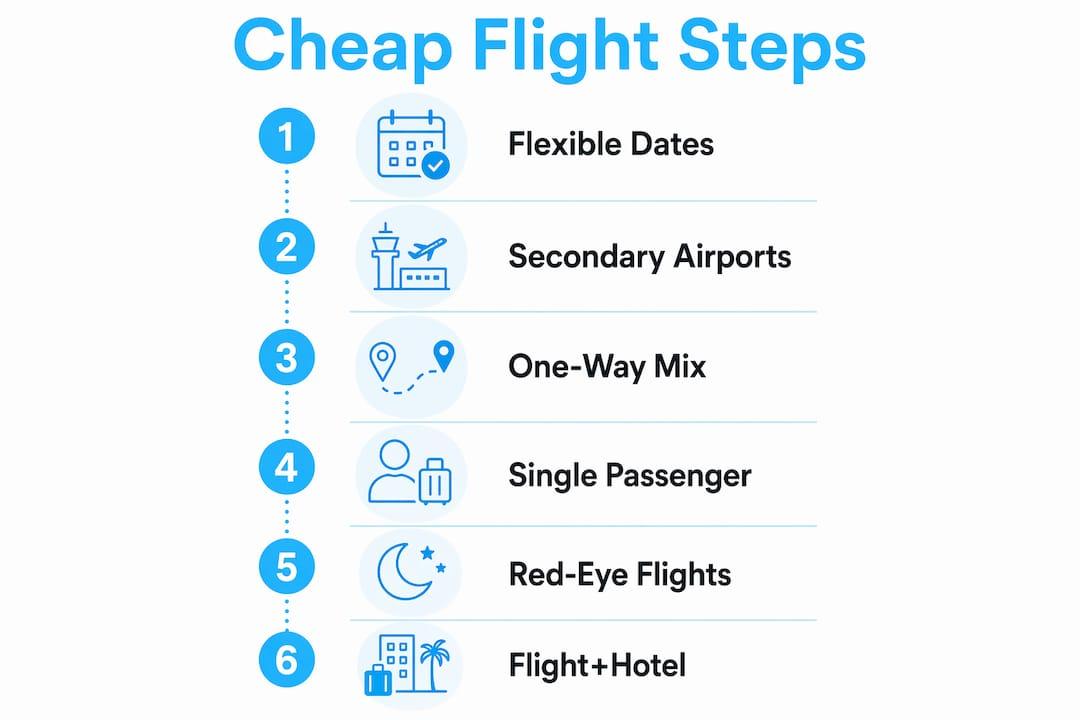
Ranked by expected payoff, these are the moves worth your time right now.
1. Be flexible on timing and dates
Even a one-day shift can mean a significant price difference. Flexible-date searches on Google Flights, KAYAK, and Skyscanner show you a color-coded calendar of prices across a range of days. If you can fly tomorrow instead of today, or tonight instead of this afternoon, you may find a fare that is substantially lower.
2. Check secondary and nearby airports
Flying into or out of a secondary airport is one of the most reliable ways to find cheaper last-minute airfare. Expanding your search to nearby airports can save more than the cost of ground transportation to your destination. In the New York area, that means comparing JFK, LGA, and EWR. In the Los Angeles area, compare LAX with BUR, LGB, ONT, and SNA.

3. Mix two one-way tickets
Instead of searching for a round trip, price each leg separately. Booking two one-ways on different carriers can unlock cheaper individual seats that a combined round-trip search would never surface. This is especially effective for last-minute travel when one carrier has unsold inventory on a specific leg.
4. Search as a single passenger
If you are traveling with a group, search one passenger at a time. Pricing systems sometimes cannot fill multiple seats at the lowest fare bucket and automatically bump the entire group to a higher tier.

5. Target red-eye and off-peak flights
Overnight flights and early-morning departures consistently carry lower fares because demand is lower. A 5:30 AM departure or a midnight red-eye is not glamorous, but it is often the cheapest seat on the board.
6. Check flight-plus-hotel packages
Package deals can undercut standalone airfares because of wholesale pricing that bundles both. If you need a hotel anyway, compare the package price against the standalone flight before booking separately.
How-to micro-checklist for right now:
- Go to Google Flights, enter your route, and open the calendar view
- Toggle to nearby airports on both ends of the trip
- Note the cheapest day within the next 72 hours
- Open a second tab and price the same route as two separate one-ways on different carriers
- If traveling with others, repeat the search for one passenger only
- Check the airline’s own app for any app-exclusive fares
Pro Tip: When traveling with a group, book each ticket individually if the group search returns a higher price. The savings per person can add up quickly, and you can still select adjacent seats after booking.
Which tools should you use to find same-day deals?
Each tool has a specific strength. Using the right one for the right job saves time and surfaces deals others miss.
Google Flights
Google Flights’ calendar and price-graph tools make it the best first stop for scanning price patterns across dates. Use the “Cheapest” tab to sort by price, the calendar view to spot low-fare days at a glance, and the price graph to see where you are in the typical fare cycle. The “Explore” map lets you search with a flexible destination if you are open to going anywhere.
KAYAK
KAYAK’s flexible-date search and color-coded calendar work similarly to Google Flights, but its “Explore” feature and “Price Forecast” box add a useful layer. After you run a search, look for the “Our Advice” box, which tells you whether to book now or wait based on historical pricing data. KAYAK also lets you search multiple nearby airports simultaneously by entering a city and selecting “all airports.”
Skyscanner
Skyscanner’s “Everywhere” search is the best tool when your destination is genuinely flexible. Enter your departure city, type “Everywhere” as the destination, and Skyscanner returns a map of destinations sorted by price. For same-day travel, this is the fastest way to find out where you can fly cheapest right now.
Hopper
Hopper’s price-prediction signal tells you whether fares on your route are likely to rise or fall. For day-of travel, the “buy now” signal is more relevant than the “wait” signal, since you have no time to wait. Hopper also offers a fee-based price-freeze feature that lets you lock a fare for a short window while you confirm plans. Use the prediction as one input, not a guarantee.
Airline apps
Airline apps occasionally surface inventory that never appears on third-party aggregators. Push notifications from your target carrier can alert you to flash sales or last-minute seat releases. It takes two minutes to download the app and enable notifications before you start searching.
| Feature | Google Flights | KAYAK | Skyscanner | Hopper |
|---|---|---|---|---|
| Calendar/price view | Yes | Yes | Yes | Yes |
| Flexible destination (“Explore”) | Yes | Yes | Yes (“Everywhere”) | Limited |
| Price prediction | No | Yes (“Our Advice”) | No | Yes |
| Price freeze | No | No | No | Yes (fee-based) |
| Price alerts | Yes | Yes | Yes | Yes |
| App-only fares | No | No | No | No |
Some larger booking platforms also offer curated deal features that flag fares at least roughly 20% below typical estimates, per Condé Nast Traveler’s reporting. Worth a quick check if the standard search turns up nothing useful.
Pro Tip: Price-prediction tools are helpful but not infallible. Use the signal as one input and run a quick manual calendar check before deciding to wait, especially for day-of travel where the window to act is short.
What are your options at the airport on the day of travel?
Getting to the airport early opens a few options that online searches cannot replicate.
Standby
Standby used to be a reliable way to snag cheap seats, but most U.S. carriers have moved to paid same-day standby or same-day confirmed change fees rather than free standby. Elite frequent flyer status still unlocks complimentary same-day standby on many airlines. Without status, expect to pay a fee, typically in the range of $75 or more depending on the carrier, to move to an earlier flight.
- Paid standby: Available on most major U.S. carriers for a fee; check your airline’s same-day change policy before arriving
- Elite status standby: Complimentary on most carriers for mid-tier and above status holders
- Volunteer programs: If a flight is oversold, airlines ask for volunteers to take a later flight in exchange for travel vouchers. This is not a way to get cheaper seats, but it can fund a future trip.
Gate-counter and walk-up fares
Walk-up fares at the airport are almost always the most expensive option, not the cheapest. The exception is when a flight is severely undersold and an agent has discretion to offer a lower price, which is rare on popular routes. If you are already at the airport and the flight you want is showing high fares online, it is worth a polite conversation with the gate agent, but do not count on a discount.
Customer service and re-accommodation desks
If your travel is connected to a disruption (a canceled or delayed flight), the re-accommodation desk is where you want to be. Agents there can sometimes place you on a different carrier’s flight at no additional cost under interline agreements. This is not a same-day discount tactic, but it is worth knowing if your original flight falls apart.
Pro Tip: Arrive at the gate early and introduce yourself to the gate agent before boarding begins. Agents have more flexibility before the boarding process locks in. A polite, brief ask about standby or upgrade availability costs nothing.
Why mixing one-ways and checking secondary airports saves more than you expect
The most consistently effective tactic for last-minute savings is one that most travelers skip: mixing two one-way tickets and checking secondary airports rather than defaulting to a round-trip search on a single carrier.
Here is why it works. Airline pricing algorithms optimize for round-trip inventory on their own network. When you search for a round trip, the system prices both legs together, often at a higher combined fare. When you price each leg separately, you can mix carriers, tap into different fare buckets, and find single seats that the combined search never surfaces.
Expanding the search radius to secondary airports can often save more than the cost of ground transportation, and mixing one-way fares can unlock cheaper individual seats that a round-trip search misses entirely.
The same logic applies to secondary airports. A flight from Newark instead of JFK, or from Midway instead of O’Hare, can be meaningfully cheaper, and the ground transportation cost to the secondary airport is often less than the fare difference.
A 10-minute test you can run right now:
- Search your route as a round trip on Google Flights and note the total price
- Open a second tab and price the outbound leg only as a one-way, trying at least two different carriers
- Repeat for the return leg
- Add the two one-way prices together and compare to the round-trip total
- Repeat both searches with the nearest secondary airport on each end
Pro Tip: Always factor in ground transportation costs when using a secondary airport. A $40 cheaper fare that requires a $60 Uber ride is not a deal. Check transit options first, since many secondary airports have direct rail or bus connections that cost under $15.
What should you realistically expect from day-of prices?
The honest answer is that day-of fares are usually higher than fares booked weeks in advance, and the gap can be substantial. Community reports and travel forums consistently show mixed results: occasional day-of bargains on thin routes, but frequent last-minute price hikes on popular ones.
Here is how fares typically move from booking open to departure:
- 330–21 days out: Generally the cheapest window; most fare buckets are open
- 21 days out: Prices begin to rise as the first cheap buckets fill
- 14 days out: Another step up in pricing
- 7 days out: Fares rise again; business-traveler pricing dominates
- Day of: Usually the most expensive tier, unless the flight is undersold
For context, KAYAK’s pricing guidance notes that flights booked within seven days of departure are generally considered last-minute, and day-of bookings sit at the extreme end of that window.
| Booking window | Typical fare behavior | Best tactic |
|---|---|---|
| 3–6 weeks out | Cheapest window on most routes | Book now if you have the dates |
| 7–14 days out | Prices rising; some deals remain | Use flexible-date search |
| 2–6 days out | Elevated; secondary airports help | Mix one-ways, check nearby airports |
| Day of | Usually highest; occasional drops | Red-eyes, standby, airline apps |
When to stop searching and book: If the fare you are seeing is less than roughly 30–40% above the lowest price you found earlier in your search session, that is a reasonable day-of price. If it is double or more the historical low, consider whether points, miles, or standby make more sense. There is no magic threshold, but spending more than an hour searching rarely produces a better result.
What to do right now if you need to fly today
Run through this checklist in order. Each step takes under five minutes.
- Open Google Flights and search your route with the calendar view. Check today and tomorrow. Toggle nearby airports on both ends.
- Try two one-ways on separate carriers. Price the outbound and return legs independently and add them up.
- Open KAYAK and check the “Our Advice” price forecast. If it says “buy now,” that is a signal fares are not expected to drop.
- Open Skyscanner and try the “Everywhere” search if your destination is flexible. Sort by price.
- Open the airline’s app for your preferred carrier. Check for app-exclusive fares or push-notification deals.
- Check Hopper for a price-prediction signal on your specific route.
- If you are already at the airport, speak with the gate agent about standby options before boarding begins.
Quick decision rules:
- If the fare is within a reasonable range of what you expected, book it. Waiting rarely helps on day-of travel.
- If fares are extremely high, check whether points or miles can cover the trip (see the section below).
- If the trip is not urgent, consider whether rebooking for a day or two out produces a meaningfully better price.
A note on fees: Always check bag fees and seat fees before comparing prices. A $149 fare with a $45 checked bag fee and a $25 seat selection fee can easily cost more than a $199 fare that includes both. Compare total out-of-pocket cost, not just the base fare.
Emergency travel: insurance, reimbursement, and urgent booking steps
When travel is urgent, the price of the flight may be secondary to getting there. Before you pay a steep last-minute fare out of pocket, check two things.
First, review any travel insurance policy you already hold. If your travel is for a covered reason, such as a medical emergency or a family crisis, some travel insurance plans reimburse necessary last-minute travel costs. Read the policy’s covered-reason definitions carefully, since “emergency” has a specific meaning in most contracts.
Second, check your employer’s travel policy or any corporate travel program you have access to. Some employers cover emergency travel costs directly or through an employee assistance program.
If neither applies, a few practical steps can still reduce the damage:
- Call the airline directly and explain the situation. Bereavement fares still exist on some carriers, though they are less common than they once were.
- Use a travel credit card with trip-interruption or emergency-travel benefits. Cards like the Chase Sapphire Reserve carry provisions that may cover or partially reimburse emergency airfare.
- Check whether a one-way ticket is cheaper than a round trip for an emergency trip where the return date is uncertain.
This article is general information, not professional insurance or legal advice. Confirm your specific coverage terms with your insurer or a qualified professional before relying on any policy for reimbursement.
How to use miles and credit card points for last-minute flights
Points and miles are often the smartest currency for last-minute travel precisely because cash fares are at their highest. Award availability does not always follow the same scarcity rules as cash seats, and some programs release last-minute award space to clear unsold inventory.
Where to look:
- Airline loyalty programs: Check your frequent flyer account directly on the airline’s website. Some carriers, including Delta and United, release saver-level award space within 24–72 hours of departure on undersold flights.
- Transferable points programs: American Express Membership Rewards, Chase Ultimate Rewards, and Capital One Miles transfer to multiple airline partners. If one partner has no award space, another might.
- Credit card travel portals: Cards like Chase Sapphire Preferred and Capital One Venture let you book any available flight through their portal and pay with points at a fixed rate, bypassing award-availability constraints entirely.
The trade-off is that last-minute award bookings sometimes carry close-in booking fees, typically $75 on some programs. Factor that into the comparison. If the cash fare is $400 and the award costs 25,000 miles plus a $75 fee, the math only works if you value those miles at more than about 1.3 cents each.
Pro Tip: Search award availability on the airline’s own website before using a third-party points portal. Direct searches often show space that aggregators miss, and booking direct avoids portal markups.
Last-minute upgrades and consolidator fares
Two underused options for last-minute travelers: upgrade bids and consolidator fares.
Upgrade bids
Many airlines now run auction-style upgrade programs where passengers can bid for a business or premium economy seat before departure. Airlines like United (PlusPoints), American (AAdvantage upgrades), and Delta (upgrade waitlists) all have mechanisms for this. The bid window often closes 24–48 hours before departure, so day-of travelers may be too late for a formal bid, but it is worth checking the airline’s app for any available upgrade offers at check-in.
Consolidator fares
Consolidators are wholesalers that buy blocks of seats from airlines at negotiated rates and resell them, sometimes at prices below what the airline publishes directly. These fares are more common on international routes than domestic ones. Travel agents with consolidator access can sometimes find international last-minute fares that do not appear on any consumer-facing search tool. If you are booking an international emergency trip and the published fares are extreme, a call to a consolidator-connected travel agent is worth the five minutes it takes.
The catch: consolidator tickets often come with restrictions. Change and cancellation fees can be steep, and some tickets are non-refundable. Read the fare rules before booking.
Key Takeaways
Day-of cheap flights are possible but situational: flexibility on airports, timing, and search method matters far more than luck.
| Point | Details |
|---|---|
| Day-of fares usually run high | Airlines price remaining seats at business-traveler rates; bargains exist mainly on thin or undersold routes. |
| The 21-day rule is real | Fares typically rise at 21, 14, and 7 days before departure, making day-of the most expensive window on most routes. |
| Mix one-ways and check secondary airports | Pricing two one-way tickets separately and comparing nearby airports consistently surfaces cheaper options than a standard round-trip search. |
| Use the right tool for the job | Google Flights for calendar scanning, Hopper for price prediction, Skyscanner for flexible-destination searches, and airline apps for unpublished inventory. |
| Pilottraveldeals aggregates last-minute deals | Pilottraveldeals compares offers across multiple providers, helping budget travelers find last-minute flight deals without searching every site individually. |
The part most guides get wrong about day-of flight deals
Most articles frame last-minute flight hunting as a patience game: keep checking, wait for the drop, and eventually the airline will blink. That framing is mostly wrong for day-of travel, and following it will cost you money.
Airlines are not waiting to discount your seat. Their revenue management systems are designed to extract the highest possible fare from late bookers, who are statistically more likely to be business travelers with less price sensitivity. The system is not broken or slow. It is working exactly as intended, and it is working against you.
The travelers who actually find day-of deals are not the ones who wait longest. They are the ones who search differently: secondary airports, single-passenger queries, two one-ways instead of a round trip, and red-eye departures that most people skip. The deal is not hiding in the same search everyone else is running. It is in the search configuration almost nobody tries.
There is also a real case for knowing when to stop. Spending three hours hunting a $50 savings on a $400 fare is a bad trade. Set a mental threshold before you start, and if the fare is within a reasonable range of that number after 30–45 minutes of searching, book it. The opportunity cost of the time you spend searching is real, even if it does not show up on your credit card statement.
Pilottraveldeals saves you the search time on last-minute fares
Searching six tools, comparing one-ways across three carriers, and checking secondary airports is effective, but it takes time most travelers do not have when they need to fly today. Pilottraveldeals aggregates flight deals, hotel offers, and travel packages from multiple providers in one place, so you can see cheap airfare options without opening a dozen tabs.

The site claims savings up to 20% on flights and hotels, pulling from a wide pool of providers to surface deals that a single-platform search would miss. For last-minute travelers who want curated options fast, that aggregation is the practical advantage. Check the current deals at Pilottraveldeals.com and see what is available for your route right now.
Useful sources and further reading
- Google Flights — Calendar view and price graph for scanning cheapest days and nearby airports
- KAYAK — Flexible-date search, multi-airport comparison, and “Our Advice” price forecast
- Skyscanner — “Everywhere” destination search and same-day flight guide
- Hopper — Price prediction and fee-based price-freeze feature
- NerdWallet: How to Find Cheaper Last-Minute Flights — Research-backed tactics including the one-way mix and secondary airport strategy
- KAYAK: How to Get Cheap Last-Minute Flights — 21-day rule explanation and tool-specific tips
- Pilottraveldeals: Last-Minute Travel Tips — Combined flight and hotel last-minute strategies
- Pilottraveldeals: How to Find Random Cheap Flights — Exploratory search techniques for flexible travelers
- Pilottraveldeals: Cheap Airfare Tips — Broad airfare-hunting guide with deal alerts