
The fastest way to lower a multi-city airfare is to combine flexible-date searches with split-ticketing and budget regional legs, then protect yourself with smart connection buffers. Here are the five tactics that actually move the needle:
- Use multi-city mode with flexible dates. Open Google Flights in multi-city mode and check the date grid for the cheapest three-day window around each leg.
- Compare multi-city vs. separate one-ways. Price each leg independently first, then run the full multi-city search and subtract. Whichever total is lower wins.
- Split-ticket with buffer days. Book long-haul on one ticket and short regional hops separately, but add at least one overnight between them to absorb delays.
- Use budget/regional carriers for short legs. Intra-Europe or intra-Asia hops on regional carriers often run low fares per leg, slashing the total when combined with a transatlantic base fare.
- Set price alerts and track key segments. Monitor the most expensive leg separately so you catch a drop before it disappears.
Pro Tip: Run what frequent deal-hunters call a “meta-meta” search: get a baseline from a fast aggregator, then check secondary tools and budget carrier direct sites. The gap between those two numbers tells you exactly where to book each leg.
Table of Contents
- What should you do in the first 30–60 minutes?
- What is a multi-city flight, and is it cheaper than separate tickets?
- Step-by-step: how to search, compare, and book the cheapest itinerary
- Which search tools find the best multi-city fares?
- What booking pitfalls can erase your savings?
- A worked example: single multi-city ticket vs. split tickets
- Common mistakes, red flags, and the truth about skiplagging
- Key Takeaways
- The search sequence that actually works
- Pilottraveldeals makes multi-city flight planning faster
- Useful sources and further reading
What should you do in the first 30–60 minutes?
Speed matters. Fares on popular multi-city routes can shift within hours, so a structured first session beats an open-ended browse.
First 30 minutes: build your baseline
- Search each leg as a standalone one-way on Google Flights. Write down the cheapest fare and the best date for each segment.
- Open a multi-city search (Google Flights, Skyscanner, or a multi-stop aggregator) and enter all legs at once. Compare the bundled total to your one-way sum.
- Run a flexible-date check: shift each leg by ±3 days and note any price drops. Shifting dates by two or three days, or swapping to a nearby airport, can reduce a multi-city itinerary substantially in competitive corridors.
- Check one nearby alternative airport for your departure and for any leg where the savings could be significant (e.g., Newark vs. JFK, or Milan Malpensa vs. Bergamo Orio al Serio).
Next 30 minutes: set up tracking and make a decision
- Set a price alert on the most expensive leg using Google Flights or a dedicated tracker.
- Check baggage policies for every carrier in your shortlist. A $30 fare with a $60 checked-bag fee is not a bargain.
- Verify visa and onward-proof requirements for each destination, especially if you are mixing tickets.
- Decision rule: if the split-ticket total is more than $75 below the single multi-city fare AND you have at least one overnight buffer between self-connected legs, book the split. If the gap is smaller, take the single ticket for the protection it provides.
Pro Tip: Use Skyscanner’s “Everywhere” search if your second or third destination is flexible. It surfaces cheaper arrival cities you might not have considered, sometimes cutting hundreds off the total.
What is a multi-city flight, and is it cheaper than separate tickets?
A multi-city flight (also called a multi-stop itinerary) is a single booking that strings together three or more city pairs under one ticket. You fly A → B → C → home, and the airline or booking platform treats it as one reservation.
Three related terms come up constantly:
- Open-jaw: You fly into one city and out of a different one (e.g., fly into Paris, depart from Rome). No backtracking required.
- Stopover vs. layover: A layover is a connection under 24 hours. A stopover is an intentional pause of 24 hours or more, often at a hub city, and some airlines allow free or low-cost stopovers on long-haul routes.
- Virtual interlining: Two separate tickets from different airlines stitched together by a third-party platform. No airline protection if one leg is delayed.
On pricing: airlines set multi-city fares based on route competition, hub economics, and how much of the itinerary runs on their own metal. In competitive corridors, open-jaw routing plus independent regional legs often reduces backtracking and saves money compared to a single multi-city ticket. The savings are most pronounced when one leg is a short intra-regional hop that a budget carrier flies for a fraction of what a legacy airline charges.
Multi-city fares are not automatically cheaper than round-trips. They tend to win when your route avoids backtracking, when one leg is served by a low-cost carrier, or when the airline prices the combined routing below the sum of its parts to fill seats on thinner routes.
Pro Tip: Airline alliances (Star Alliance, Oneworld, SkyTeam) sometimes offer round-the-world or multi-continent fares that undercut the sum of individual tickets. Check alliance websites directly if your trip spans more than two continents.
Step-by-step: how to search, compare, and book the cheapest itinerary
This workflow takes 60–90 minutes the first time. After that, it becomes fast.
Step 1: Baseline each leg as a one-way
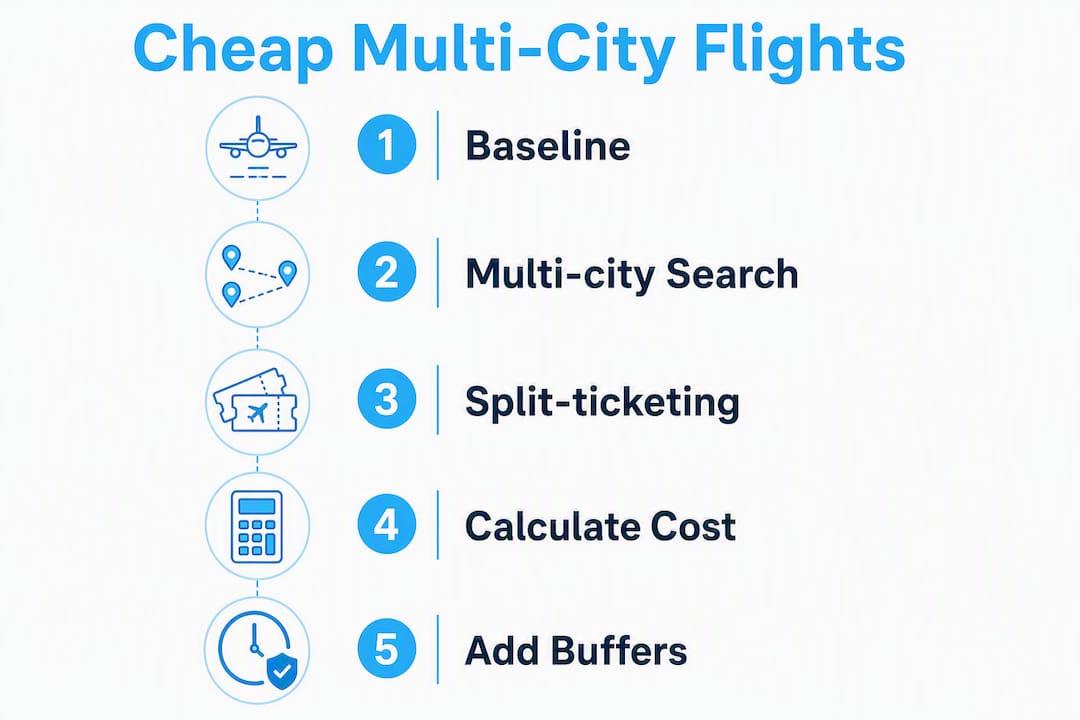
Search every segment independently as a one-way fare. Use Google Flights for speed: its date grid shows the cheapest day in a 30-day window at a glance. Record the lowest fare and the optimal date for each leg. This baseline is your benchmark; every subsequent search gets compared to this number.

Step 2: Run the multi-city search with flexible dates and nearby airports
Enter all legs into a multi-city search simultaneously. Try ±3 days on each leg and at least one alternative airport per city. The date flexibility alone can drop fares significantly in competitive regions. Compare the bundled multi-city total to your baseline sum. If the multi-city ticket is cheaper, note the margin.
Step 3: Test split-ticketing with regional carriers
For any leg under three hours, check the budget carrier that dominates that region directly. In Europe, that means carriers like Ryanair or Wizz Air; in Southeast Asia, AirAsia or Scoot. Regional legs often run low fares, so replacing a legacy-carrier short hop with a budget alternative can save significant amounts on that segment alone.
Decision rule: if the split-ticket total (long-haul ticket + regional tickets + any transfer costs) is more than $75–$100 below the single multi-city fare, split-ticketing wins financially. Below that threshold, the single ticket’s protection against missed connections is usually worth the premium.
Step 4: Calculate total landed cost
Fare price is not the final number. Add:
- Checked baggage fees for each carrier (budget carriers charge per leg)
- Seat selection fees if relevant
- Airport-to-airport transfer costs when legs use different terminals or airports
- Travel insurance for any self-connected legs
A fare with added bag fees and airport transfer costs can significantly increase the effective cost of a leg.
Step 5: Add buffers and book

For self-connected legs (separate tickets), allow ample buffer time between flights at the same airport, or book an overnight if the airports differ. Purchase travel insurance that covers missed connections for any itinerary where you hold separate tickets. For a single multi-city ticket, the airline’s standard rebooking protection applies, so a 90-minute connection is usually acceptable.
Pro Tip: When booking split tickets, put each leg on a credit card that includes trip delay or interruption coverage (Chase Sapphire Preferred and Capital One Venture X both include this). It costs nothing extra and covers the gap that travel insurance sometimes misses.
For a deeper look at the full booking process, Pilottraveldeals has a practical multi-city booking guide that walks through the same workflow with additional examples.
Which search tools find the best multi-city fares?
No single tool wins every search. The trick is knowing what each type does well.
| Use case | Best tool type | What to watch for |
|---|---|---|
| Initial multi-city routing and date grid | Meta-search with multi-city mode (e.g., Google Flights) | Doesn’t always show budget carriers; check direct sites too |
| Comparing aggregator results quickly | Secondary meta-search tools | Results can lag by hours; verify price on booking site |
| Finding flexible or open-jaw routes | Route planners and “Everywhere” search | Best when destination is partly flexible |
| Short intra-regional legs | Budget carrier direct sites | Fees not always shown upfront; check baggage rules |
| Alliance or partner fares | Airline alliance booking tools | Useful for multi-continent trips; requires loyalty number |
| AI-assisted route optimization | AI trip planners (e.g., Planytera) | Good for sequencing cities; verify fares independently |
The meta-meta approach works like this: get a baseline on a fast aggregator, then cross-check on a second aggregator and on budget carrier direct sites. The gap between those results tells you exactly where to book each leg. It adds 15 minutes but regularly surfaces savings the first search misses.
For a curated list of the tools Pilottraveldeals recommends, the best flight search websites guide covers the current top options with notes on what each does best.
Loyalty points and frequent flyer programs deserve a mention here. If you hold miles with a Star Alliance, Oneworld, or SkyTeam carrier, check award availability on partner airlines before paying cash. Multi-city award bookings often require fewer miles than two separate round-trip awards, and some programs let you add a stopover for free. The math only works if your miles are worth more than the cash fare, so compare both before committing.
Stopovers as free destinations are an underused tactic. Icelandair, Turkish Airlines, and Singapore Airlines have historically allowed free or low-cost stopovers at their hubs (Reykjavik, Istanbul, Singapore) on long-haul itineraries. That turns a two-city trip into three cities for the price of two.
Price tracking is worth setting up before you book. Google Flights sends email alerts when a tracked route drops. For more granular tracking across multiple legs, dedicated tools let you monitor each segment independently and alert you when any leg hits a target price.
What booking pitfalls can erase your savings?
Savings on paper disappear fast when hidden costs and connection risks aren’t accounted for. These are the traps that catch travelers most often.
- Baggage fees on budget carriers. A low-cost carrier fare often covers a personal item only. A checked bag can cost significant fees each way per leg, turning a “cheap” ticket into an expensive one. Always price the full baggage cost before comparing fares.
- Seat selection fees. Some carriers charge seat selection fees per leg. On a multi-leg itinerary, these can add up before you’ve left the ground.
- Airport-to-airport transfers. Budget carriers often use secondary airports (London Stansted instead of Heathrow, Paris Beauvais instead of CDG). A taxi or bus between airports can incur notable costs and take time you need to budget.
- Tight self-connections. A 90-minute self-connection between separate tickets at a large international airport is a gamble. If the first flight is delayed 45 minutes, you miss the second with no airline obligation to rebook you.
- Visa and onward-proof requirements. Some countries require proof of an onward ticket at immigration. If your legs are on separate bookings, you may need to show each one individually.
Self-transfer risk and how to manage it:
When you hold separate tickets, you are responsible for your own connection. A safe buffer at the same airport for international legs is recommended, with longer buffers or overnight stays needed if different airports are used. Travel insurance that explicitly covers missed connections is worth the cost on any split itinerary.
Decision rule: if split-ticketing saves less than $75 on a short trip or less than $150 on a long-haul itinerary, the single multi-city ticket’s built-in protection is the better value. The savings threshold rises with the complexity of the connection.
Pro Tip: Screenshot your full itinerary, all booking confirmations, and baggage allowances for every carrier before you travel. Store them offline. If a carrier’s app goes down or a connection is missed, you need those details without relying on Wi-Fi.
A worked example: single multi-city ticket vs. split tickets
Route: New York (JFK) → London (LHR) → Rome (FCO) → New York (JFK)
Assumptions: One checked bag, economy class, travel in shoulder season, 2-night stay in London before continuing to Rome.
| Option | JFK–LHR | LHR–FCO | FCO–JFK | Baggage extras | Total |
|---|---|---|---|---|---|
| Single multi-city ticket | Included | Included | Included | — | ~$980 |
| Split: long-haul + budget regional | ~$620 (JFK–LHR) | ~$45 (LHR–FCO, budget carrier) | — | $60 (budget carrier bag fee) | — |
In this example, the single multi-city ticket wins by roughly $325. Why? The transatlantic legs are priced competitively on the multi-city ticket, and the budget regional leg’s savings ($45 vs. the ~$200 it would cost on a legacy carrier) don’t offset the higher separate transatlantic fares plus the added baggage fee.
The decision rule that applies here: when the long-haul legs are already priced tightly on a single multi-city ticket, splitting rarely saves money. Split-ticketing wins most clearly when the multi-city ticket forces you onto an expensive connecting carrier for a short leg that a budget airline serves for a fraction of the price, AND the long-haul fares are comparable whether booked separately or together.
This is exactly the kind of comparison Pilottraveldeals runs before publishing a deal: baseline each leg, check the bundled fare, account for fees, and let the math decide.
Common mistakes, red flags, and the truth about skiplagging
Mistakes that erase savings
- Booking the tightest legal connection on separate tickets. A 60-minute connection that works on a single ticket (where the airline is responsible) is a missed flight on separate tickets if anything goes wrong.
- Ignoring baggage rules across carriers. Each airline on a split itinerary has its own baggage policy. A bag that’s free on your transatlantic carrier may cost $60 on the regional leg.
- Treating budget carrier fares as full-service. No free meals, no free seat selection, often no free rebooking. Factor that into the comparison.
- Failing to check airport pairs. “London to Rome” can mean six different airport combinations. Make sure your connection city and airport match across all legs.
Red flags that signal a risky itinerary
- Virtual interlining with an overnight connection at an airport with limited hotel options or poor transit links.
- A “cheap” fare that requires a 5 AM departure from a secondary airport 90 minutes from your hotel.
- A budget carrier leg with a 45-minute connection to an international flight on a separate ticket.
- Unusually low fares on a route with only one carrier, which often indicates a fare error that may be canceled.
Skiplagging: what it is and why to avoid it
Skiplagging (also called hidden-city ticketing) is buying a connecting itinerary with the intention of getting off at the layover city and skipping the final leg. Airlines may penalize this practice, including canceling your return ticket, voiding your frequent flyer account, or pursuing legal action in some cases. It also only works with carry-on luggage, since checked bags go to the final destination. The short version: understand the consequences before attempting it, and for most travelers, the risk outweighs the savings.
Key Takeaways
The single most effective approach to finding cheap multi-city flights is to baseline each leg as a one-way, run the bundled multi-city search, and let the math tell you whether to split or book together.
| Point | Details |
|---|---|
| Baseline before bundling | Price each leg as a standalone one-way first, then compare to the multi-city total. |
| Flexible dates cut costs | Shifting departure dates by ±3 days can reduce fares substantially in competitive corridors. |
| Split-ticket threshold | Split tickets when savings exceed $75–$100 AND you have at least one overnight buffer between self-connected legs. |
| Total landed cost matters | Add baggage fees, seat fees, and transfer costs before declaring a fare “cheap.” |
| Pilottraveldeals as your starting point | Use Pilottraveldeals’ cheap airfare tips and planning guides to compare options and set price alerts before booking. |
The search sequence that actually works
Most articles tell you to “compare multiple sites.” That’s true but incomplete. The part they leave out is the order.
The baseline-first approach changes how you read every subsequent search result. When you know that JFK to London costs $620 as a standalone one-way, a multi-city quote of $980 for three legs looks different than it does with no reference point. Without the baseline, $980 feels arbitrary. With it, you know immediately whether the bundled fare is a deal or a markup.
The other thing most guides underweight is the regional leg. Travelers fixate on the transatlantic or transpacific fare because it’s the biggest number. But that leg is also the most competitive, which means the pricing is often tighter. The real savings on a multi-city trip frequently live in the short hop between two cities in the same region, where a budget carrier charges $40 and a legacy airline charges $250 on the same route. That $210 gap is where the trip gets cheap.
The worked example above shows a case where the single multi-city ticket won. That happens. But it happens because the transatlantic fares were already priced tightly, not because multi-city tickets are inherently better. The method stays the same regardless of which option wins: baseline, compare, account for fees, decide.
One habit worth building: check the multi-city planning resources at Pilottraveldeals before you start any search. Having a clear itinerary sequence before you open a search tool saves 20 minutes and prevents the most common mistake, which is searching in the wrong order and missing cheaper routing options.
Pilottraveldeals makes multi-city flight planning faster
Searching for cheap multi-city flights across four or five tools, tracking prices on three separate legs, and cross-checking baggage rules for two different carriers takes time most travelers don’t have. Pilottraveldeals pulls that work into one place: curated flight deals, price alert guidance, and practical how-to guides built specifically for multi-city and multi-stop itineraries.

The cheap airfare tips page is the best starting point: it covers the search tools, the decision rules, and the alert setup in one place. If you’re adding hotel nights between legs (which you should, for buffer days), the hotel deals section shows options near major layover airports. For travelers who want itinerary sequencing help before they start searching, the AI planning tools at Planytera pair well with Pilottraveldeals’ fare guides.
Start with the airfare tips page, set alerts on your two most expensive legs, and check back when the price drops. That’s the workflow.
Useful sources and further reading
- Multi-City Flights, Compare Best Multi-Stop Sites | FlightsFinder — Good overview of how multi-stop aggregators work and why comparing across tools matters.
- How to Find Cheap Multi-City Flights Using Google Flights and AI Tools — Practical walkthrough of the Google Flights date grid, flexible-date tactics, and regional carrier pricing.
- How to Book Multi-City Flights for Less — Covers open-jaw routing and the mechanics of mixing airlines for savings.
- Skyscanner “Everywhere” Search — Explains how to use destination-flexible search to surface cheaper arrival cities.
- What Is Skiplagging? What to Know | Travel + Leisure — Clear explanation of hidden-city ticketing, airline policies, and the risks involved.
- Google Flights — The fastest tool for building a baseline and checking flexible dates across a 30-day window.
- How to Book Multi-City Trips for Cheap and Easy Travel | Pilottraveldeals — Pilottraveldeals’ own step-by-step guide with checklists and planning tools for multi-city itineraries.