
You can reliably cut hundreds of dollars from a holiday by staying flexible on dates, airports, and accommodation. That single principle outperforms every coupon hunt, loyalty hack, or flash-sale alert combined. Here is how to book a cheap holiday right now, starting with the three moves that pay off fastest.
Three fastest actions to take today:
- Open Google Flights, enter your nearest airport, and switch the destination to “Everywhere” to see a price map of where you can fly cheapest.
- Set a price alert on Google Flights or Skyscanner for your target route so you catch drops automatically.
- Pull up any hotel you are considering on your phone’s browser. Mobile-only rates can run significantly lower than the desktop price on the same night.
Pro Tip: Before you book anything, spend five minutes checking two or three nearby airports. Driving an extra hour to a regional hub has saved families hundreds on a single booking — sometimes over £1,000 on a family trip.
Table of Contents
- 1. Why flexibility is your biggest lever for cheap travel
- 2. When to book: timing rules that actually work for U.S. travelers
- 3. How to find cheap flights: a workflow that lowers airfare
- 4. How to book cheap hotels and alternative stays
- 5. Which destinations and package deals give you the best value?
- 6. Smart booking hacks that save hidden money
- 7. How to book a cheap holiday in 9 steps
- Key Takeaways
- The flexibility gap most travelers never close
- Pilottraveldeals puts these tactics in one place
- Useful sources and tools to follow up with
1. Why flexibility is your biggest lever for cheap travel
Flexibility is not a vague suggestion. It is the single mechanism that changes the price ceiling on a trip. Industry experts confirm that switching departure airports and shifting travel dates can save families hundreds on a single booking. No discount code comes close to that.
The practical version of flexibility has three dimensions: dates, airports, and destination. Most travelers lock in all three before they search, which means they are shopping at retail price. Unlock even one of them and the math changes.
How to run a genuinely flexible search:
Start with Google Flights. Enter your departure city, leave the destination blank or type “Everywhere,” and switch to the price map view to discover the cheapest available fares from your airport on any given week. From there, click the “Flexible dates” toggle and use the monthly price grid to compare fare levels across a full calendar month. The cheapest week usually stands out immediately.
On Skyscanner, the same logic applies. Select “Everywhere” as the destination and choose “Whole month” as the date. The results rank destinations by total price, giving you a shortlist of genuinely affordable options rather than a single route you already had in mind.
Pro Tip: Search from multiple nearby airports in separate tabs and compare. A 90-minute drive to a different hub can unlock fares that are dramatically cheaper, especially on transatlantic or Caribbean routes where hub competition is fierce.

2. When to book: timing rules that actually work for U.S. travelers
Timing is where most travelers leave money on the table. The rules differ by trip type, so applying the wrong window to the wrong booking costs you.
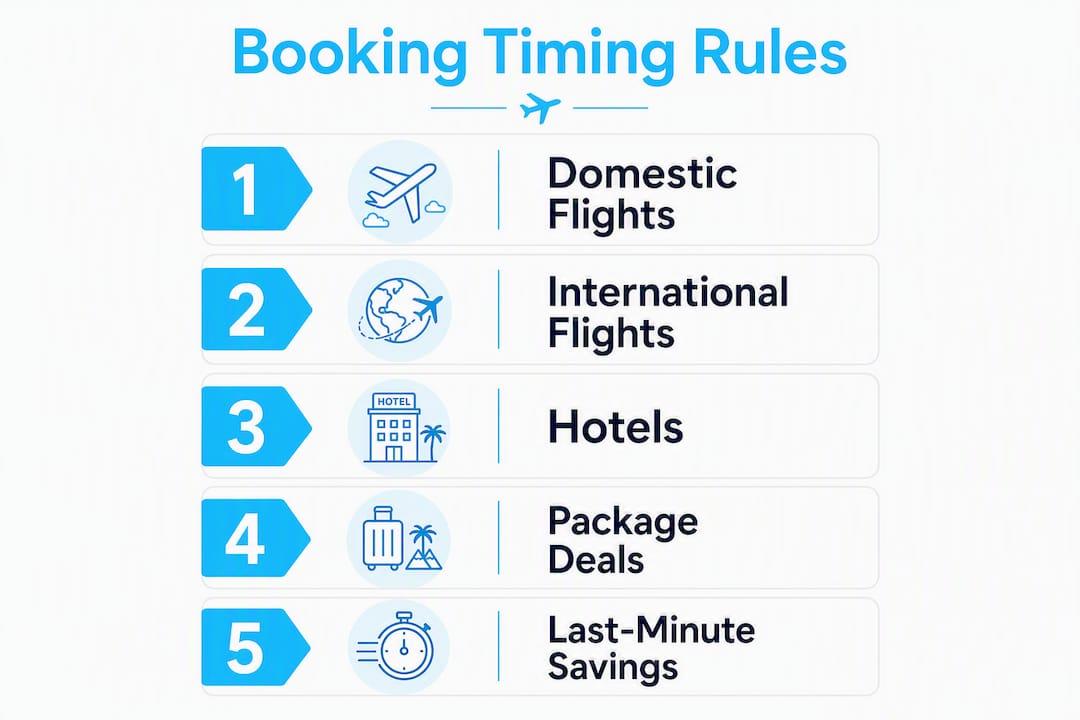
For flights: Domestic U.S. routes tend to hit their price floor roughly 1–3 months before departure. International flights to Europe or the Caribbean usually price best in the 2–6 month window. Booking too early (more than 9 months out) often means paying a premium before airlines have filled their load forecasts. Booking too late (under 3 weeks) on popular routes almost always means paying more.
For hotels: The calculus flips. Hotels often drop rates closer to the date to fill empty rooms, so booking 2–4 weeks out on a flexible trip can yield genuine savings. The exception is peak season or major events, where early booking is non-negotiable.
For package deals: Which? tracked 24,000 short-haul package holidays and found that most destinations were cheaper when booked in advance, though some had last-minute bargains. The safe default is to book packages early and watch for late-deal windows only if your dates are genuinely flexible.
Best days and times to search: Midweek searches (Tuesday and Wednesday) often surface lower fares because airlines adjust pricing after weekend demand spikes. Flying on a Tuesday or Wednesday rather than a Friday or Sunday typically costs less on the same route.
Book now vs. wait checklist:
- Is your destination in peak season? Book now.
- Are you flying a popular route with limited seats? Book now.
- Is your hotel a large chain property with flexible cancellation? Wait and watch.
- Is your trip more than 6 months out for a domestic flight? Wait until the 1–3 month window.
- Is it a package deal to a beach resort? Book early.
3. How to find cheap flights: a workflow that lowers airfare
The mistake most travelers make is treating one search as the answer. A reliable flight-search workflow uses multiple tools in sequence, not a single aggregator.
Step-by-step flight search workflow:
- Baseline check: Search Google Flights for your route. Use the calendar view to identify the cheapest travel days in your window.
- Cross-check Skyscanner: Run the same route on Skyscanner. Prices sometimes differ by $20–$50 on the same flight.
- Check low-cost carriers directly: Some budget carriers are not fully indexed by aggregators, so go to their sites directly after your aggregator search. Spirit, Frontier, and Allegiant in the U.S. frequently have fares that do not appear on Google Flights.
- Set a price alert: If you are not ready to book, set alerts on both Google Flights and Skyscanner. You will get an email when the price drops.
- Decide: If the fare is within 10–15% of the lowest price you have seen in the calendar view, book it. Waiting for the absolute floor is a gamble that usually does not pay off.
Evaluating trade-offs: A connecting flight that saves $80 but adds a 5-hour layover in a hub airport is often worth it for a long international trip. For a 2-hour domestic hop, it rarely is. The math is simple: divide the savings by the extra hours and decide if your time is worth that rate.
Pro Tip: Budget airline base fares often mask baggage fees that can double the effective ticket cost. Before you celebrate a $59 fare, add the bag fee. A carry-on fee of $35–$50 each way on a budget carrier can make a legacy airline’s $130 fare the actual cheaper option. Check the full baggage cost breakdown before you commit.

| Fare Type | Base Fare | Bag Fee (est.) | Effective Cost |
|---|---|---|---|
| Budget carrier with checked bag | $59 | $35–$50 each way | — |
| Legacy carrier with 1 free bag | $130 | — | $130 |
| Budget carrier, carry-on only | $59 | — | $59 |
The carry-on-only strategy wins every time it is possible. Packing light and sticking to cabin-bag-only travel is one of the highest-return habits in budget travel.
4. How to book cheap hotels and alternative stays
The price you see on a hotel listing is rarely the lowest available price. Three checks, run in sequence, will almost always find a better rate or a better deal for the same money.
Price-check workflow:
- Search a comparison site (Booking.com, Hotels.com, or Expedia) to establish a baseline rate.
- Switch to your phone and check the same property on the same platform. Which? testing found mobile-only discounts on Booking.com, Expedia, and Hotels.com that in some cases reach up to 40% on selected listings.
- Call the hotel directly. Hotels sometimes offer better packages or add-ons when contacted directly, even when comparison sites show similar rates. Ask for a rate match, free breakfast, or a room upgrade.
For deeper guidance on this workflow, Pilottraveldeals has a full breakdown on how to book budget hotels that covers filters, negotiation scripts, and loyalty stacking.
When self-catering beats a hotel: For trips of 5 nights or more, a vacation rental with a kitchen almost always wins on a per-person, per-day basis. Cooking two meals a day in a rental can save $30–$60 per person daily compared to eating out three times. Combine a breakfast-included hotel filter for short trips with a self-catering rental for longer stays and the savings compound quickly.
Pro Tip: Book a refundable rate first, then keep watching prices. If the rate drops before your cancellation window closes, cancel and rebook at the lower price. Many travelers leave this money on the table by treating the first booking as final.
| Accommodation Type | Best For | Typical Saving vs. Standard Hotel |
|---|---|---|
| Hostel (private room) | Solo travelers, short stays | 40–60% |
| Vacation rental (self-catering) | Groups, stays 5+ nights | 20–40% per person |
| Hotel (mobile rate) | 1–3 night stays | Up to 40% on select listings |
| Direct booking (phone) | Any stay, especially boutique | Rate match + perks |
For a weekend break specifically, this partner guide on booking a weekend stay covers the short-break angle in detail.
5. Which destinations and package deals give you the best value?
Destination choice is a fixed-cost decision. Once you pick a region, your food, transport, and activity costs are largely set by local price levels. Choosing a high-value destination is worth more than any discount code you will find once you arrive.
High-value regions for U.S. budget travelers in 2026:
- Southeast Asia (Thailand, Vietnam, Indonesia): Strong dollar, low daily costs, direct flights from West Coast hubs.
- Eastern Europe (Poland, Czech Republic, Hungary): Significantly cheaper than Western Europe, with strong infrastructure and culture.
- Central America (Guatemala, Nicaragua, Belize): Short flights from the U.S., low accommodation costs, and strong adventure travel value.
- Southern Spain and Portugal: Budget breakdowns for European routes show return flights plus 7 nights can fall into a £300–£570 range for specific routes with low-cost airlines and budget accommodation (UK market data, for reference).
When a package deal beats DIY:
Package deals win when you are heading to a popular beach resort where the operator has bulk-rate hotel contracts you cannot match. They lose when you want flexibility, unusual accommodation, or a multi-city itinerary.
Use this checklist to decide:
- Is the destination a standard sun-and-beach resort? Package likely wins.
- Do you want to move between cities or regions? DIY wins.
- Is the trip under 7 nights to a popular European or Caribbean destination? Check packages first.
- Are you traveling as a family of four or more? Package deals often have the best per-person rates.
Sample budget breakdown (illustrative, based on published European route data):
| Component | Budget Option | Mid-Range Option |
|---|---|---|
| Daily food budget | $30–$60 per person daily | $60–$90/day |
6. Smart booking hacks that save hidden money
These are the moves that do not show up in a standard search but consistently reduce the final cost.
Mobile-only discounts: Pull up any hotel on your phone after checking on desktop. The price difference is not always there, but when it is, it can be substantial. Which? testing found mobile-only discounts reaching up to 40% on selected listings on Booking.com, Expedia, and Hotels.com. Takes 60 seconds to check.
Avoid dynamic currency conversion (DCC): When a payment terminal abroad asks if you want to pay in dollars instead of the local currency, always choose the local currency. BBC reporting confirms that choosing DCC hands the merchant the right to set the exchange rate, which is almost always worse than your card’s rate. This applies to ATMs, hotel checkouts, and restaurant card readers.
Cashback and travel cards: A no-foreign-transaction-fee card (Chase Sapphire, Capital One Venture, or similar) eliminates the 2–3% fee most standard cards charge on every international purchase. On a $3,000 trip, that is $60–$90 saved with zero effort. Pair it with a cashback portal like Rakuten or TopCashback for hotel bookings and you can stack an additional 2–5% back on top.
Pro Tip: Carry a pocket luggage scale. Budget carriers charge gate fees for bags that exceed the weight limit, and those fees are always higher than pre-purchased baggage. A $10 scale pays for itself on the first trip.
| Hack | Effort | Typical Saving |
|---|---|---|
| Mobile hotel check | 60 seconds | Up to 40% on select listings |
| Local currency payment | 5 seconds | 2–5% per transaction |
| No-FX-fee travel card | One-time setup | 2–3% on all foreign spend |
| Carry-on only (no checked bag) | Packing discipline | — |
| Cashback portal for hotels | 2 minutes | 2–5% back on booking total |
For a deeper look at how hidden fees in transport bookings can catch travelers off guard, that partner resource covers the non-air side of the equation.
7. How to book a cheap holiday in 9 steps
Follow this in order. The whole process takes 2–4 hours spread across a few days, not weeks of research.
- Define your trip parameters (15 min): Set a budget ceiling, a rough date window (flexible by 2–3 weeks if possible), and a list of 2–3 destination options.
- Run a flexible destination search (20 min): Use Google Flights “Everywhere” and Skyscanner “Any Destination” to see what is cheapest from your airport in your window.
- Benchmark flight prices (30 min): Use the calendar/price-graph view on Google Flights to identify the cheapest travel days. Note the lowest fare you see.
- Check low-cost carriers directly (15 min): Visit Spirit, Frontier, Allegiant, or Southwest directly for domestic routes. For international, check the relevant budget carrier’s site.
- Set price alerts (5 min): If you are not booking today, set alerts on Google Flights and Skyscanner. Check cheap ticket-finding strategies for alert setup tips.
- Search accommodation on desktop, then mobile (20 min): Run your hotel search on a comparison site, then immediately check the same property on your phone for mobile-only rates.
- Call the hotel directly (10 min): If the property looks right, call and ask for a rate match or added perks. Takes 10 minutes and often yields something.
- Check the total cost including fees (10 min): Add baggage fees, resort fees, and any booking platform fees before comparing options. The cheapest headline price is rarely the cheapest total.
- Book and set a calendar reminder to recheck (5 min): If you booked a refundable rate, set a reminder to recheck prices 2 weeks before the cancellation deadline.
Pro Tip: Use the Pilottraveldeals cheap travel checklist as a companion to this workflow. It covers the pre-trip checks that most travelers skip and that consistently prevent last-minute cost surprises.
Key Takeaways
Flexibility on dates, airports, and destination is the single highest-impact lever for booking a cheap holiday, consistently outperforming discount codes and last-minute deal hunting.
| Point | Details |
|---|---|
| Flexibility beats everything | Shifting airports or dates can save hundreds; run “Everywhere” searches before locking in a destination. |
| Timing windows matter | Book flights 1–3 months out for domestic U.S. routes and 2–6 months out for international destinations; hotels can often be booked 2–4 weeks before travel for lower rates outside peak season. |
| Mobile hotel checks are fast wins | Mobile-only discounts can reach up to 40% on select listings — takes 60 seconds to verify. |
| Avoid DCC and add-on fees | Always pay in local currency; factor in baggage fees before comparing fares. |
| Pilottraveldeals as your workflow hub | Use Pilottraveldeals to compare flight and hotel deals, set alerts, and access budget travel guides in one place. |
The flexibility gap most travelers never close
The conventional wisdom on cheap travel focuses on timing: book early, fly midweek, avoid school holidays. That advice is not wrong, but it addresses the second-order problem. The first-order problem is that most travelers define their trip before they search for prices, which means they are always shopping for a specific product at whatever price it happens to be.
The travelers who consistently pay less do the opposite. They start with a budget and a rough window, then let the price data tell them where and when to go. That sounds obvious, but it requires a real shift in how you approach planning. Most people find a destination first because that is the exciting part. The price search feels like a chore that comes after.
What actually works is treating the flexible search as the exciting part. The “Everywhere” map on Google Flights is genuinely one of the most useful tools in travel, and most people have never used it. Running that search first, before you have committed emotionally to a destination, is the single habit change that separates budget travelers who consistently pay less from those who occasionally get lucky.
The 9-step workflow in this guide is designed around that principle. Notice that destination confirmation comes after the flexible search, not before. That sequence is the point.
Pilottraveldeals puts these tactics in one place
Searching five tabs, calling hotels, and cross-checking carrier sites is the right approach, but it is time-consuming when you are doing it from scratch. Pilottraveldeals aggregates flight deals, hotel comparisons, and airfare-saving tips in one place, with discounts on select listings reaching up to 80%.

The practical workflow: start your hotel search on the Pilottraveldeals hotels page to compare rates across providers, then use the site’s travel guides to cross-check the destination and timing tactics covered in this article. The site covers flights, hotels, bike rentals, and SIM cards, so you can handle most of the trip’s variable costs in a single session rather than across a dozen browser tabs. Check current deals at pilottraveldeals.com and see what your target dates are actually worth.
Useful sources and tools to follow up with
The research and tools behind this guide, organized by what each one is best for:
Flight search and price alerts:
Research and expert guidance:
- Which? — 30 ways to save money on holiday — covers mobile discounts, direct hotel booking, and package timing data
- The Independent — cheap family holiday planning — flexibility and airport-switching savings evidence
Foreign travel safety and entry requirements:
Pilottraveldeals resources to bookmark:
- Budget travel tips guide — the core principles in checklist form
- Travel booking hacks — testable hacks with step-by-step instructions
- How to use travel comparison sites — aggregator workflow and direct-check guidance
This article provides general travel planning information. Entry requirements, fees, and travel conditions change frequently. Confirm current rules with the relevant government travel authority or a qualified travel professional before booking.
Recommended
- How to Plan Affordable Trips: Smart Strategies for Any Traveler – PilotTravelDeals.com
- Budget travel guide: Proven strategies to save on every trip – PilotTravelDeals.com
- Cheap Vacation Deals: Your 2026 Budget Travel Guide – PilotTravelDeals.com
- 7 Essential Tips for a Cheap Family Travel Guide – PilotTravelDeals.com
