
Booking a hotel for your next adventure can feel like a balancing act between cost and flexibility. For budget-conscious solo travelers from North America, understanding the truth about hotel booking lead time is essential if you want to secure better deals. Myths about when to book often lead to overspending or missed opportunities. This guide clarifies what lead time really means, reveals common misconceptions, and helps you use timing strategies proven by research to maximize your savings.
Table of Contents
- Defining Hotel Booking Lead Time And Myths
- Lead Time Types: Advance, Last-Minute, Flexible
- How Timing Impacts Hotel Prices And Deals
- Best Strategies For Maximizing Hotel Savings
- Mistakes To Avoid When Choosing Booking Lead Time
Key Takeaways
| Point | Details |
|---|---|
| Understanding Lead Time | Hotel booking lead time is the period between reserving a room and checking in, impacting pricing and availability. |
| Myths about Booking | Common myths include the belief that earlier is always cheaper and that last-minute deals are always the best. |
| Types of Bookings | Advance, last-minute, and flexible bookings each have distinct characteristics, risk levels, and are suited for different travel styles. |
| Maximizing Savings | Track prices, compare multiple platforms, and set alerts to find the best deals, ensuring you book at the right time for significant savings. |
Defining Hotel Booking Lead Time And Myths
Hotel booking lead time is straightforward: it’s the gap between when you reserve a room and when you actually check in. This interval shapes everything from pricing strategies to room availability.
What exactly is lead time?
Booking lead time reflects the period between your reservation and arrival, affecting how hotels forecast demand and manage revenue. Think of it as the hotel’s planning window. They’re calculating occupancy rates, staffing needs, and pricing based partly on how far out you booked.
For context, booking lead times average between 20-60 days across various markets. International travelers typically book 50-90 days ahead, while domestic solo travelers often book 15-35 days out.
The myths holding you back
Countless budget travelers believe certain “rules” about lead time that simply don’t hold up.
-
Earlier is always cheaper. Wrong. Hotels adjust prices constantly based on demand, competitor rates, and occupancy levels. Sometimes booking 45 days early gets you a premium price because demand is high.
-
Last-minute deals are always the best. Partially true, but risky. Yes, hotels drop prices to fill empty rooms. But availability shrinks, and you might end up in a mediocre property just to save $10.
-
There’s one “perfect” booking window. Nope. The sweet spot varies by destination, season, day of week, and hotel type. A downtown business hotel behaves differently than a beach resort.
-
Booking early guarantees your preferred room. Hotels don’t work that way. Early bookers secure better rates, not necessarily premium rooms. Room selection often happens at check-in.
The real advantage of booking early is locking in lower rates when demand is light, not accessing secret inventory or superior rooms.
How lead time actually influences pricing
Hotels use dynamic pricing, meaning rates shift based on demand patterns. When booking 60 days ahead, you’re often hitting a lower-demand period where hotels want to secure revenue. As your arrival date approaches, demand increases and prices typically follow.
But here’s the catch: this doesn’t apply universally. Peak season booking 45 days out might be more expensive than booking 20 days out, depending on competing supply.
Why psychology matters
Booking decisions aren’t purely rational. The peace of mind from reserving early appeals to many travelers. You lock in a rate, eliminate uncertainty, and can plan your budget. Last-minute bookers accept risk for potential savings. Both approaches have merit depending on your situation.
Pro tip: Track prices for your desired hotel starting 90 days before travel. Most hotel booking platforms show price history—use this data to identify when rates typically drop for your destination, rather than guessing at a universal “best time.”
Lead Time Types: Advance, Last-Minute, Flexible
Not all bookings are created equal. Your booking style—how far ahead you reserve—shapes your pricing options, flexibility, and peace of mind. Understanding the three main lead time categories helps you choose the strategy that fits your budget and travel style.
Advance Bookings: The Early Bird Strategy
Advance bookings happen 30+ days before your arrival, typically ranging from 60-90 days out. You’re booking when demand is often lighter and hotels want to lock in revenue.
Why go this route?
- Lower base rates during off-peak demand periods
- Better room selection at some properties
- Time to compare multiple options without pressure
- Psychological peace of mind—your trip is secured
Advanced booking enables maximizing travel savings by locking in rates before they potentially rise. The trade-off? You’re committing money upfront and may face cancellation fees if plans change.
Advance bookers typically get the best rates during shoulder seasons (spring and fall) and definitely during low season. Peak season advance bookings don’t always beat last-minute deals—hotels often hold inventory for last-minute price increases during busy periods.

Last-Minute Bookings: The Risk-Taker’s Play
Different booking lead time types affect consumer choices and hotel revenue strategies, and last-minute bookings represent the highest-risk, highest-reward category. You’re booking days before arrival—sometimes just 3-7 days out.
The appeal?
- Hotels desperate to fill empty rooms drop prices significantly
- You maintain maximum flexibility for life changes
- No money tied up weeks in advance
The reality:
- Limited room options, often lower-quality inventory
- Hotels might be fully booked, forcing you elsewhere
- Stress from uncertainty right before travel
- Less time to arrange transportation or activities
Last-minute bookings work best during low-demand periods when hotels have excess inventory they need to fill quickly.
Post-pandemic booking behaviors show a rise in last-minute reservations, driven partly by flexible cancellation policies and travel uncertainty. But don’t assume last-minute always means cheaper—during peak season, hotels rarely discount because they know rooms will sell at full price.
Flexible Bookings: The Smart Middle Ground
Flexible bookings bridge advance and last-minute approaches. You book 14-30 days ahead while maintaining cancellation flexibility, typically through free cancellation up to 7-14 days before arrival.
This strategy offers:
- Reasonable rates without extreme advance commitment
- Ability to cancel if better deals emerge
- Lower stress than pure last-minute booking
- Some room selection, though less than advance bookings
Flexible booking works best when you have confidence about your travel dates but want to monitor prices. If a rate drops significantly in your cancellation window, you can rebook at the better price.
Flexible bookings let you capture some of last-minute’s savings potential while maintaining advance booking’s security and reasonable pricing.
Which type matches your travel style?
Advance works if you prefer certainty and can commit early. Last-minute suits risk-tolerant travelers with flexible schedules. Flexible bridges both approaches—solid for solo travelers who value both savings and adaptability.
Here’s a concise comparison of hotel booking lead time types to help travelers match booking strategies to their needs:
| Booking Type | Typical Lead Time | Risk Level | Best For |
|---|---|---|---|
| Advance | 30-90 days before | Low to moderate | Travelers needing certainty |
| Flexible | 14-30 days before | Moderate | Budget-conscious solo travelers |
| Last-Minute | 3-7 days before | High | Flexible, risk-tolerant travelers |
Each approach impacts pricing, flexibility, and room options differently.
Pro tip: Set price alerts 45 days before your trip using hotel booking platforms, then decide your lead time strategy based on actual market trends for your specific destination rather than following a fixed rule.
How Timing Impacts Hotel Prices And Deals
Timing isn’t just about picking a convenient date. When you book relative to your arrival date directly influences what you pay. Hotels use sophisticated pricing strategies that shift rates based on demand patterns, occupancy forecasts, and how far away your stay is.
The Lead Time-Price Relationship
Timing of booking markedly affects hotel prices and booking intentions across different traveler types. Budget solo travelers show more price sensitivity when booking further in advance, meaning you’re more likely to shop around and compare options when you have time.
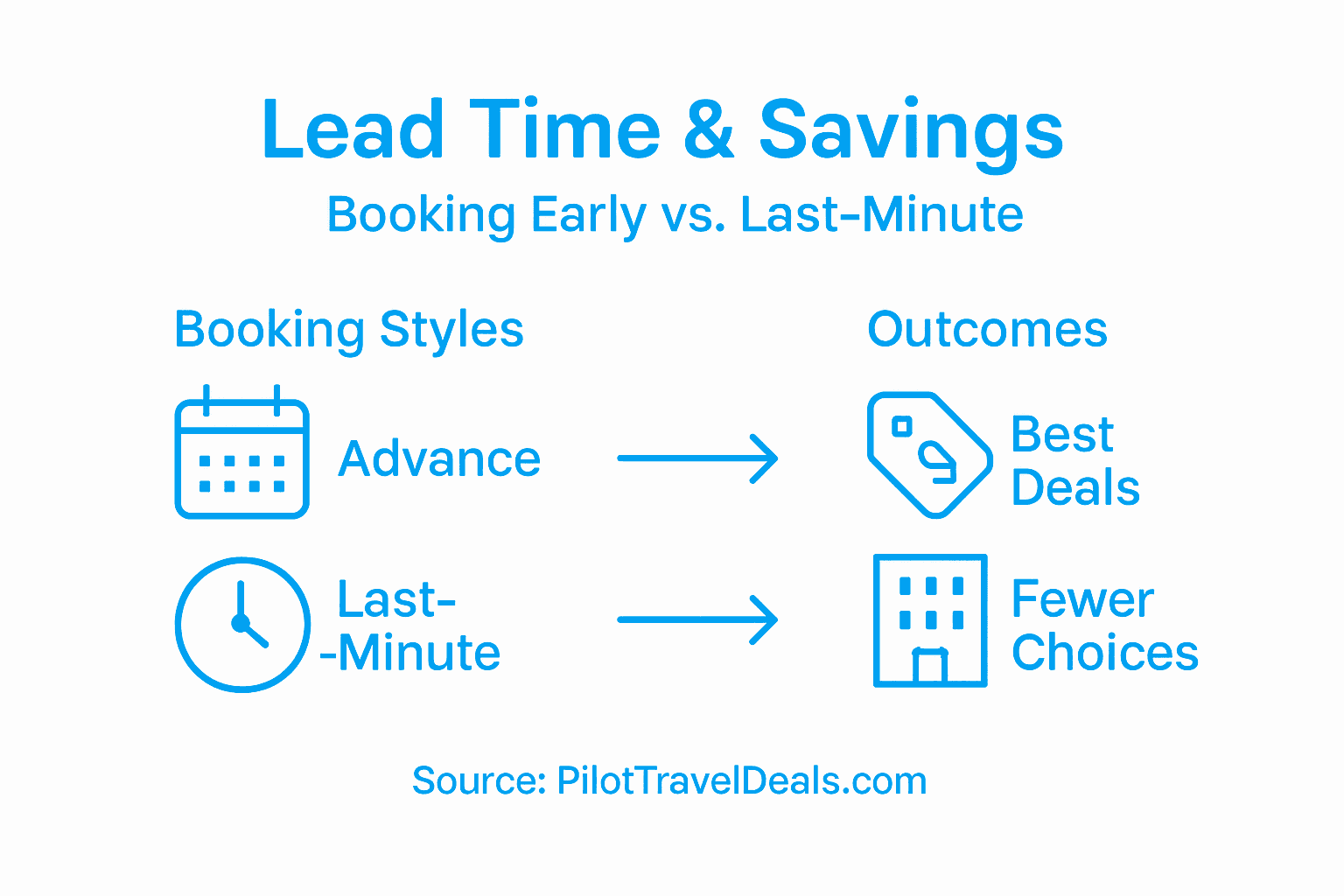
Hotels leverage this psychology. They know that travelers booking 60 days ahead want deals more desperately than someone booking 3 days before arrival. This shapes how aggressively they discount.
When Hotels Drop Prices
Hotels don’t drop prices randomly. They follow patterns based on several factors:
- Occupancy forecasts: If bookings lag behind projections, rates fall dramatically
- Competitive rates: When nearby hotels cut prices, others follow to stay competitive
- Day of week: Weekday rates often drop for business hotels; weekend rates rise
- Season: Peak season pricing holds firm; shoulder and low seasons see more discounting
- Length of stay: Booking 3 nights might cost more per night than booking 5 nights
The key insight: hotels adjust pricing dynamically to fill rooms and optimize revenue. If they’re tracking toward low occupancy, they’ll slash prices days before arrival. If they’re tracking toward full occupancy, they maintain premium pricing.
For quick reference, here are major factors affecting hotel price drops based on booking timing:
| Factor | Influence on Price | When Most Impactful |
|---|---|---|
| Occupancy Forecast | Drives deep discounts | Low or lagging occupancy |
| Competitive Rates | Causes matching price cuts | When nearby hotels discount |
| Season | Sets limits on discounts | Off-peak or shoulder seasons |
| Day of Week | Adjusts price direction | Weekdays vs. weekends |
Awareness of these triggers improves timing decisions for hotel savings.
Psychological Pricing and Booking Distance
Temporal distance moderates consumer price perceptions differently depending on when you book. Booking months ahead? You think in terms of the total trip cost and compare options rationally. Booking days before arrival? You’re more emotional, less price-sensitive, and more willing to pay premium rates for convenience.
Hotels know this. They price accordingly:
- Early bookings (60+ days): Lower base rates to lock in demand
- Mid-range bookings (14-30 days): Moderate rates, slight increases if demand rises
- Last-minute bookings (3-7 days): Volatile pricing—either steep discounts or premium rates
Your willingness to pay changes based on how much time remains before arrival, and hotels price precisely to capture that difference.
Corporate vs. Leisure Pricing
Corporate travelers show less price sensitivity regardless of booking timing. A business traveler booking a hotel for Tuesday night doesn’t shop obsessively like a budget solo traveler does. Hotels know this and price corporate rates differently.
As a leisure traveler, you have an advantage: your flexibility and price sensitivity give you leverage if you book strategically.
The Best Pricing Windows
For solo travelers maximizing savings, target these windows:
- Low season, 30-60 days out: Lowest absolute rates
- Shoulder season, 45-75 days out: Strong discounts before peak approaches
- Peak season, 2-3 days before: Gamble for last-minute cuts (risky)
- Weekday stays year-round: Consistently cheaper than weekends
Pro tip: Monitor the same hotel’s price for your exact dates starting 90 days before arrival, then identify the pattern for that specific property—some drop prices 45 days out, others hold steady until 10 days before. Use that property’s historical pattern, not generic advice.
Best Strategies For Maximizing Hotel Savings
Maximizing hotel savings isn’t about luck—it’s about executing a deliberate strategy that tracks prices, compares options, and responds to market changes. Budget-conscious solo travelers can save hundreds annually by combining timing with systematic shopping.
Track Prices Like a Hawk
The foundation of savings is data. Continuous data monitoring bridges the gap between negotiated rates and booked prices, revealing opportunities you’d miss by booking casually.
Here’s what tracking looks like:
- Monitor your target hotel daily starting 90 days before arrival
- Note the price, room type offered, and cancellation policy each day
- Watch for patterns: Does it drop Tuesdays? Jump weekends? Rise when occupancy increases?
- Compare the same hotel across multiple booking platforms—rates vary significantly
Most hotel booking sites show price history. Use it. You’ll spot when rates typically bottom out for that specific property during your travel window.
Compare Across Multiple Platforms
Comparing hotel prices helps maximize travel savings by revealing rate discrepancies across booking platforms. The same room might cost $89 on one site and $102 on another—a 15% difference that adds up across trips.
Always check:
- Major OTAs (online travel agencies)
- The hotel’s direct website
- Discount booking sites
- Loyalty program booking portals if applicable
The cheapest rate often appears on unexpected platforms; checking three sources takes five minutes and typically saves $10-40 per night.
Redirect Choices Toward Better Rates
If a hotel offers multiple room types, lower-category rooms cost significantly less. A standard room versus a deluxe room at the same hotel might differ by $20-30 nightly. You’re sleeping, not living there—prioritize savings over amenities.
Similarly, consider alternative properties. Two blocks away costs 40% less? Walk it. Nearby neighborhoods beat downtown prices dramatically. Solo travelers gain flexibility competitors lack.
Automate Price Alerts
Manual tracking works, but automation saves time. Set price alerts on your target hotel through booking platforms. When prices drop 10-15%, you receive notifications instantly. This catches flash discounts and market shifts you’d otherwise miss.
Mobile apps often send alerts faster than email. Use both for redundancy.
Lock In at the Right Moment
You’ve tracked prices for weeks. You’ve identified the pattern. Now act decisively when your data suggests rates hit bottom. Don’t wait for another $3 decrease—that hesitation costs $30 when prices rebound.
The best rate often appears 30-45 days before arrival for leisure travel. Don’t overthink it. Book when your research suggests prices are favorable, then stop monitoring.
Combine Strategies for Maximum Impact
Single strategies help. Combined approaches transform savings:
- Track prices 90+ days out
- Compare across platforms daily
- Identify the hotel’s price pattern
- Set price alerts
- Consider alternative room types and neighborhoods
- Book when data suggests optimal timing
- Maintain free cancellation until you’re certain
This systematic approach typically saves 20-35% versus casual booking, translating to $300-400 annually for regular solo travelers.
Pro tip: Use a simple spreadsheet to track prices for three competing hotels in your desired neighborhood, updated weekly—this reveals which property offers the best value trajectory and whether prices are trending up or down, removing guesswork from your decision.
Mistakes To Avoid When Choosing Booking Lead Time
Choosing the wrong booking lead time costs money, flexibility, or both. Understanding common pitfalls helps you avoid expensive decisions and select timing that actually matches your situation.
Mistake 1: Betting Everything on Last-Minute Deals
The biggest error solo travelers make is assuming last-minute always delivers bargains. You skip booking at reasonable rates early, betting prices will plummet days before arrival. Sometimes they do. Often they don’t.
Reality check: Relying on short booking windows creates forecast challenges with high cancellation rates, making hotel availability unpredictable at the last moment. You might find nothing available in your budget range.
Last-minute deals work during low-demand periods when hotels have excess inventory. Peak season? Forget it. Hotels know demand is strong and rarely discount.
Mistake 2: Ignoring External Factors Affecting Your Destination
Booking lead time doesn’t exist in a vacuum. Errors include ignoring consumer psychology and external factors influencing booking behavior, causing poor timing decisions.
Consider these external influences:
- Local events (concerts, conferences, festivals) spike demand and prices
- School holidays create waves of family travelers
- Weather patterns—hurricane season, ski season, spring break
- Economic news affecting travel demand
- Competitor hotel openings affecting local rates
You can’t ignore these forces. If a major event hits your destination 30 days after your arrival, it won’t affect your rates. But if it coincides with your stay, book earlier when demand hasn’t spiked yet.
Mistake 3: Over-Weighting Early Booking Discounts
Yes, early bookings often get lower rates. But obsessing over early booking discounts while ignoring last-minute potential is backward. This strategy made sense decades ago. Modern hotels use sophisticated pricing that captures value at every stage.
You might book 90 days early at $85 per night, only to watch rates drop to $72 at day 14. You’re locked in at premium pricing while others snag discounts you ignored.
Balance early booking security with awareness that prices continue shifting until arrival; free cancellation lets you capture better rates if they emerge.
Mistake 4: Forgetting About Cancellation Flexibility
Booking early seems smart—until your plans change. If you book 75 days ahead without free cancellation, life surprises leave you paying for a trip you can’t take.
Always maintain cancellation flexibility by booking refundable rates, at least until 30 days before arrival. This costs slightly more upfront but protects against changes.
Mistake 5: Treating All Destinations Identically
Booking a beach resort requires different timing than a city hotel. Seasonal destinations have compressed peak windows where rates spike dramatically. Business hotels behave completely differently from leisure properties.
Stop applying generic “book 45 days ahead” advice to every trip. Research your specific property and destination.
Pro tip: Before booking, search your target hotel for dates 90, 60, 45, 30, 14, and 7 days before arrival to see the actual price trajectory for that property during your travel window, then book when your data shows prices are favorable, not based on general timing rules.
Take Control of Your Hotel Booking Lead Time and Maximize Savings Today
Understanding hotel booking lead time is key to unlocking the best prices and avoiding costly mistakes. If you are tired of guessing the right moment to book or missing out on deals because of unpredictable pricing patterns, you are not alone. The challenge is clear: finding a strategy that balances early booking discounts with last-minute flexibility, while navigating dynamic pricing and varying demand. With terms like “advance bookings,” “flexible bookings,” and “last-minute deals” shaping your travel decisions, it helps to have a trusted guide and tool at your side.

PilotTravelDeals.com specializes in simplifying this complexity by aggregating the best hotel offers and price trends from multiple providers all in one place. Take advantage of powerful price tracking, compare flexible options, and lock in deals during your ideal booking window. Whether you are a budget-conscious solo traveler or someone who values both savings and peace of mind, start your journey by exploring tailored deals and expert insights on PilotTravelDeals. Don’t wait for prices to jump. Act now to find your best booking lead time and save up to 80% on hotels, flights, and more.
Frequently Asked Questions
What is hotel booking lead time?
Hotel booking lead time is the period between when you make a reservation and when you check in. It influences pricing strategies, availability, and hotel revenue management.
How does lead time affect hotel prices?
Lead time impacts hotel prices through dynamic pricing models. Rates tend to be lower when booked well in advance during off-peak periods, but can rise as demand increases closer to the check-in date.
Are last-minute hotel deals always cheaper?
Not necessarily. While hotels may drop prices last minute to fill empty rooms, this strategy is risky as it can limit availability and lead to suboptimal accommodations, especially during peak seasons.
What are the benefits of advance booking?
Advance booking typically allows travelers to secure lower rates, better room selection, and the peace of mind of confirming their trip without last-minute stress.
Recommended
- Role of Advanced Booking: Maximizing Travel Savings – PilotTravelDeals.com
- Why Book Early for Travel Deals: Maximize Savings – PilotTravelDeals.com
- Last-Minute Booking: How It Changes Travel Planning – PilotTravelDeals.com
- Step by Step Hotel Booking: Secure the Best Deals Easily – PilotTravelDeals.com
- Booking Received – Bali Dive Cove

