
TL;DR:
- Booking a multi-city flight with one ticket covers multiple legs under a single reservation, offering disruption protection and potential savings. It often costs less than separate tickets, especially when adding layovers instead of nonstop flights, and provides greater flexibility to visit multiple destinations efficiently. Proper planning, including checking baggage policies and transit visas, allows travelers to maximize the benefits of multi-city bookings for complex, multi-destination trips.
Most travelers assume booking a multi-city trip means juggling multiple separate tickets, multiple confirmation numbers, and multiple chances for things to go wrong. That assumption costs people real money and genuine peace of mind. Understanding what is multi city flight booking actually means reveals a smarter, often cheaper way to see several destinations on one trip. Multi-destination travel grew 35% year-on-year during the April 2026 Labour Day period, with over 30% of international trips including multiple destinations. There is clearly something here worth understanding.
Table of Contents
- Key takeaways
- What a multi-city flight actually is
- The real benefits of booking multi-city
- How to plan and book multi-city flights step by step
- One-way, round-trip, and multi-city compared
- Practical tips to get more from multi-city bookings
- My honest take on multi-city flying
- Plan your next multi-city trip with Pilottraveldeals
- FAQ
Key takeaways
| Point | Details |
|---|---|
| One ticket, multiple stops | A multi-city booking covers all your flight segments under a single reservation with one ticket number. |
| Built-in disruption protection | If any leg gets canceled, the airline must rebook your entire itinerary at no extra cost to you. |
| Real cost savings exist | Choosing layovers over nonstop and booking 3–6 months ahead can cut costs by around 22%. |
| Not as complex as it looks | Airlines and travel sites offer dedicated multi-city search tools that make building itineraries straightforward. |
| Flexibility is the real win | You can fly into one city and out of another, mixing air and overland travel in a single booking. |
What a multi-city flight actually is
A multi-city flight is a single booking that covers three or more flight segments connecting different cities, all under one ticket number and one reservation record. That last part matters more than most people realize.
Unlike booking three separate one-way tickets, a single ticket record creates a contractual obligation between you and the airline covering your entire trip. If one leg is delayed or canceled, the airline is responsible for rebooking every subsequent segment. With separate tickets, a missed connection on ticket one has zero bearing on ticket two. You are stranded and on your own.
Multi-city flights also include what travel planners call “open-jaw” itineraries. This means you can fly into one city and out of another, combining air travel with a train, bus, or road trip in between. A classic example: New York to London, then London to Paris, then Paris to Barcelona, then Barcelona back to New York, all on one ticket with through-checked baggage.
Here is what typically characterizes a multi-city booking:
- Three or more distinct flight segments with different origin and destination cities
- One ticket number covering the entire itinerary
- Baggage checked through to your final destination on most itineraries
- Disruption protection across all legs, not just the one that went wrong
- Pricing calculated segment by segment, which often undercuts the cost of piecing things together yourself
Pro Tip: When searching for multi-city options, check whether your itinerary qualifies for through-baggage checking before you book. Some airline partnerships do not automatically connect bags, especially when budget carriers are involved.
Airlines price multi-city flights by evaluating each segment individually and then applying any applicable combination fares. This is why the total cost can surprise you. Sometimes it comes out lower than a standard round trip because the airline prices dead-leg segments (routes with lower demand) at a discount to fill seats.
The real benefits of booking multi-city
The most obvious multi-city travel benefit is convenience. One booking, one customer service number if things go wrong, and one place to manage everything. But the financial case is equally strong, and most travelers never fully explore it.

Multi-city flights often cost less than booking the same route as multiple one-way tickets. Beyond the base fare, you also avoid paying per-segment booking fees that accumulate when you use multiple platforms or airlines separately.
Choosing a routing with layovers instead of nonstop flights adds another layer of savings. Flights with layovers save roughly 22% compared to nonstop equivalents on the same routes. Stack that against a multi-city itinerary and the savings compound quickly.
Here is a breakdown of the key advantages:
- Cost efficiency: A multi-city ticket connecting New York, Tokyo, and Bangkok often runs cheaper than two separate one-way fares for the same route.
- Disruption protection: The airline carries full responsibility for your entire itinerary when everything is under one reservation record.
- Loyalty point accrual: Longer, more complex itineraries booked under one frequent flyer number tend to accumulate more miles than fragmented separate bookings.
- Flexibility of entry and exit: You are not locked into returning to the city you started from, which opens up overland travel options between stops.
- Streamlined baggage: Most major airlines check your bags through to the final destination, saving you the hassle of reclaiming and re-checking at every stop.
Multi-city bookings are also growing at twice the pace of single-destination bookings, which has pushed airlines to improve their multi-city tools significantly. Competition for this segment of travelers works in your favor.
How to plan and book multi-city flights step by step
The process is more approachable than it looks. Most major airlines and travel comparison platforms have dedicated multi-city search functions that walk you through building your itinerary segment by segment. United, Delta, and American all offer multi-city booking tools supporting four to five segments each.
Here is how to approach it:
- Start with your destinations. Write out every city you want to visit in rough order, then consider whether the sequence makes geographic sense. Flying backward across a continent wastes money.
- Choose your booking platform. Airline websites offer the most reliable through-baggage and disruption protection. Third-party search tools give you more pricing flexibility and cross-airline comparisons.
- Search segment by segment. Use the “multi-city” or “multi-destination” tab on your chosen platform. Enter each origin and destination pair with your preferred dates.
- Check segment availability. Multi-city bookings typically allow 4 to 7 segments, but specific combinations may not be available. If a segment throws an error, adjust your dates or try a nearby alternate airport.
- Compare the total fare against alternatives. Run the same route as separate one-way tickets and as a round-trip with a stopover. The cheapest option is not always obvious.
- Book the full itinerary in one transaction. This is what creates the single ticket number and the protection that comes with it.
- Confirm baggage policy for each segment. Check whether bags are checked through, especially when your itinerary includes flights on partner airlines rather than the primary carrier.
Pro Tip: For international multi-city trips, book 3 to 6 months in advance. For domestic segments, 1 to 2 months out tends to hit the pricing sweet spot. Historically, Tuesday is often the cheapest day to purchase flights.
If you hit dead ends with a specific routing, iterative searching and adjusting airports often resolves the issue. Try the nearest major hub instead of a smaller regional airport. Shifting one segment by a day or two can also unlock combinations that would not show up otherwise. For a deeper look at saving on every segment, Pilottraveldeals has a dedicated guide worth reading before you book.
One-way, round-trip, and multi-city compared
Understanding when to use each booking type saves you money and frustration. None of them is universally better. The right choice depends entirely on your trip.
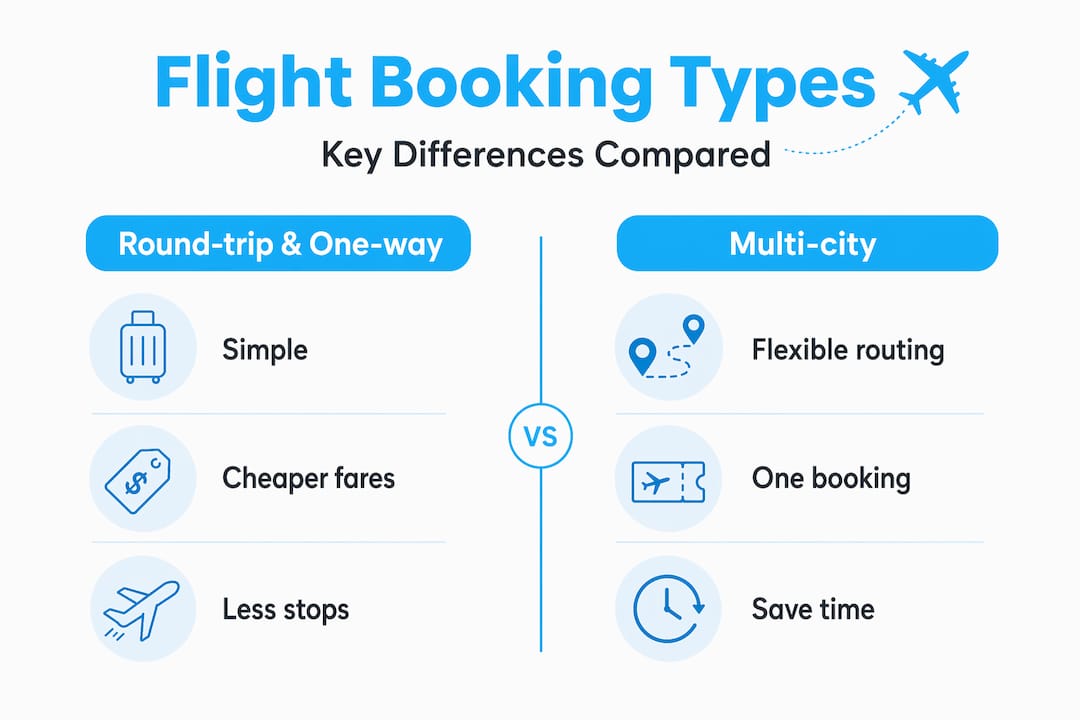
One-way flights make sense when your plans are genuinely open-ended, or when you want maximum flexibility to mix carriers. The trade-off is that one-way fares on major carriers often run disproportionately expensive, and you lose all disruption protection if something goes wrong on a connected itinerary.
Round-trip flights remain the default for most travelers for good reason. They are simple, often cheaper than two one-way fares, and airlines price them competitively. But they lock you into returning to your departure city, which limits how you can structure a trip involving multiple destinations.
Multi-city flights sit in a category of their own. They give you the pricing advantages of a single booking while removing the geographic restriction of a round trip.
| Booking type | Flexibility | Cost potential | Disruption protection | Best for |
|---|---|---|---|---|
| One-way | High | Often higher cost | None between segments | Open-ended travel |
| Round-trip | Low | Usually lowest cost | Partial, on one carrier | Simple A to B to A trips |
| Multi-city | High | Often competitive | Full itinerary covered | Multi-destination trips |
The scenario where multi-city clearly wins is any trip where you want to visit three or more cities without backtracking. Trying to see Rome, Athens, and Istanbul in one trip as a round-trip from New York is structurally awkward and often more expensive than a multi-city ticket connecting all four cities cleanly.
Practical tips to get more from multi-city bookings
Getting the mechanics right is one thing. Getting the most out of your trip is another. These tips come from travelers who have run complex itineraries and learned the hard way what actually matters.
- Order your destinations geographically. Flying east to west and then back east wastes fare dollars on unnecessary routing. Map your cities before you search.
- Check alternate nearby airports. Flying into a secondary airport 40 miles from your main destination can cut one segment’s cost significantly, especially in Europe where regional airports serve budget carriers.
- Balance layover length realistically. A 90-minute connection looks fine on paper but creates genuine risk if your first flight runs 20 minutes late. For international connections, give yourself at least two to three hours.
- Know your visa requirements before you book. A multi-city itinerary that passes through a country requiring a transit visa you did not account for will cost you more in stress than in money. Check every transit point, not just your overnight stops.
- Use budget carriers for regional legs strategically. Flying regional segments on low-cost carriers within Southeast Asia or Europe can undercut the same leg on a major airline’s connecting ticket. Just know that those segments will not carry the same disruption protection.
- Plan your accommodation in the same sequence. Hotel costs vary dramatically by city. Getting your flight routing right first means your hotel budget can follow the geographic logic you have already established.
Pro Tip: If your multi-city trip involves multiple countries, buy a local SIM card for each destination before you arrive. Staying connected between segments is far cheaper with a local data plan than roaming charges. You can compare travel SIM options at Pilottraveldeals before you leave home.
For multi-city travelers managing accommodation across several stops, the hotel savings guide at Pilottraveldeals covers strategies that pair well with a smart flight itinerary.
My honest take on multi-city flying
I’ve watched travelers skip multi-city bookings for years because they assume it is too complicated or too expensive. In my experience, both assumptions are wrong. And the cost of holding onto those assumptions is real.
The first time I booked a multi-city itinerary, I was genuinely surprised at how close the total fare came to a straight round trip covering only two of the same cities. Adding a third destination for what amounted to a small premium felt like the system was making an error. It was not.
What I’ve found is that the disruption protection is actually the underrated part. Most people focus on the cost angle. But knowing that a canceled leg in Istanbul does not strand you with an unusable ticket for your onward flight to Dubai is worth a lot. I’ve seen that exact situation save a fellow traveler hundreds of dollars and a very bad night.
The mistake I made early on was not checking visa requirements at transit points. I once routed through a country that required an airport transit visa I had not secured. The rebooking fee was a painful and entirely avoidable lesson.
My recommendation is to try a multi-city booking on your next trip even if it is just adding one extra city to an existing route. The tools are better than they were five years ago, the pricing is genuinely competitive, and the protection is real. Don’t let complexity that does not actually exist keep you from traveling smarter.
— Asher
Plan your next multi-city trip with Pilottraveldeals
Ready to put this into practice? Pilottraveldeals is built for exactly this kind of travel planning. Whether you are comparing multi-city flight deals or looking for hotel options across multiple destinations, the platform aggregates offers from dozens of providers so you can see your real options in one place.

From flight discounts to hotel bookings and travel SIM cards, Pilottraveldeals covers the full picture of multi-destination travel. The flight discounts guide for 2025 is a strong starting point if you want to cut costs before you even begin building your itinerary. Savings of up to 80% are on the table when you compare across providers instead of booking on the first site you find.
FAQ
What is a multi-city flight exactly?
A multi-city flight is a single booking covering three or more flight segments between different cities, all under one ticket number. It differs from separate one-way tickets because it provides disruption protection across your entire itinerary.
Is a multi-city flight cheaper than booking separately?
Multi-city flights often cost less than equivalent separate one-way tickets, and choosing layover routings instead of nonstop can save around 22% more. Booking 3 to 6 months in advance for international trips locks in the best pricing.
How do you book multiple flights as a multi-city itinerary?
Use the “multi-city” tab on an airline website or travel comparison platform, enter each origin and destination pair with dates, then complete the booking in a single transaction to get one ticket number and full disruption protection.
How many destinations can I include in one multi-city booking?
Most airlines support 4 to 7 segments in a single multi-city booking, with some carriers permitting up to 6 destination cities. If a specific combination is unavailable, adjusting dates or trying alternate nearby airports usually resolves the issue.
Do multi-city flights include baggage check-through?
Most major airline multi-city bookings include through-checked baggage to your final destination, but this depends on whether all segments are operated by the same carrier or its partners. Always confirm the baggage policy before booking when budget carriers are part of your itinerary.
Recommended
- Multi-city flight booking: save money and travel smarter – PilotTravelDeals.com
- How to Book Multi-City Trips for Cheap and Easy Travel – PilotTravelDeals.com
- How to Book Multiple Flights and Save Money on Every Trip – PilotTravelDeals.com
- How to Book International Flights: A Step-by-Step Guide – PilotTravelDeals.com