
TL;DR:
- Booking 15-90 days before departure usually saves around 190 dollars.
- Flying on Fridays in July offers the best chances for cheaper international flights.
- Using total cost comparison, budget airlines may be more expensive than legacy carriers after fees.
Most travelers assume international flights are expensive by nature, but booking 15-90 days ahead can cut your average fare by about $190 compared to last-minute purchases. The real problem is not the price of flights itself; it is that most people book based on habit, guesswork, or outdated myths. This guide cuts through the noise. You will find proven, field-tested strategies covering when to book, which airline to choose, how to navigate airports like a pro, and how to keep more money in your pocket from departure to landing.
Table of Contents
- How to find the best international flight deals
- Budget airlines vs. legacy carriers: What really saves you money?
- Airport and transit hacks for a smoother international journey
- Smart packing and onboard essentials for flying internationally
- Money matters abroad: Cards, cash, and avoiding fees
- Why most travelers miss out on the best flight deals
- Find even more savings for your next international trip
- Frequently asked questions
Key Takeaways
| Point | Details |
|---|---|
| Book at the right time | Booking international flights 15-90 days ahead can save you around $190 on average. |
| Compare total costs | Measure travel time, baggage fees, and ground transit when weighing airline options, not just the ticket price. |
| Maximize airport efficiency | Pre-check-in, light packing, and offline maps simplify even the most hectic travel days. |
| Avoid currency fees abroad | Always pay in local currency to dodge dynamic currency conversion and save money. |
| Use tech and rules to your advantage | Leverage refund windows and AI fare tracking apps for smarter, safer booking. |
How to find the best international flight deals
Getting a cheap international ticket is not about luck. It is about knowing the rules of the game and following them consistently. A few small changes to your booking habits can easily save you hundreds of dollars per trip.
The single biggest lever is timing. Booking internationally between 15 and 90 days before departure hits the sweet spot where airlines are still filling seats without panic pricing. Book too early and airlines have not released sale fares yet. Book too late and scarcity pricing kicks in hard. That $190 average saving is real, and it compounds even more if you fly during lower-demand periods.
Day of the week also matters more than most people realize. Fridays are now the cheapest booking day in 2026, and July is statistically the best month to lock in fares, with savings averaging 13% compared to other months. These are not arbitrary rules. They reflect when airlines adjust pricing algorithms to stimulate demand.
| Booking strategy | Estimated savings | Best for |
|---|---|---|
| Book 15-90 days out | Up to $190 avg | Most international routes |
| Book on a Friday | Up to 13% off | All destinations |
| Book in July | 13% savings | Peak travel seasons |
| Use AI price alerts | Avg $550 intl savings | Deal hunters |
| Use 24-hour refund rule | Risk-free price lock | Uncertain planners |
“The travelers who save the most aren’t the ones who search the most. They’re the ones who act decisively when the right price appears.”
Here is a step-by-step approach we recommend when searching for cheap international flights:
- Set up price alerts immediately using apps like Google Flights or Going (formerly Scott’s Cheap Flights). The Going app has been shown to deliver average savings of $550 on international fares through AI-powered fare predictions.
- Search flexible dates by using the calendar view or “cheapest month” tools. Shifting your departure by even two or three days can cut prices by 20-30%.
- Book when you see a good price and use the 24-hour refund rule. In the U.S., airlines must allow you to cancel within 24 hours of booking for a full refund. This means you can lock in a great fare the moment it appears, then keep searching. If something better shows up, cancel and rebook risk-free.
- Check nearby airports as an alternative. Flying into a city 60-90 miles from your destination sometimes costs $150-300 less, especially in Europe.
- Clear your browser cookies or use incognito mode before searching. Some fare comparison tools use cookies to track repeated searches and may raise prices accordingly.
Pro Tip: Sign up for multiple fare alert services at once. Different platforms access different data sets, so having alerts from Google Flights, Hopper, and Going simultaneously increases your chance of catching a mistake fare or flash sale before it disappears.
Finding the best day to find flights is just one piece of the puzzle, but it is one that takes almost no effort once you understand it.
Budget airlines vs. legacy carriers: What really saves you money?
The choice between a budget carrier and a full-service airline is rarely as simple as comparing base ticket prices. This is where many travelers get burned. They see a $199 fare on a budget airline and celebrate, only to find they are spending an extra $140 in baggage fees, $30 in seat selection, and then another $40 in a taxi because the budget airline lands at a remote secondary airport 45 miles from the city center.

Budget airlines use low base fares as a marketing hook, but the total cost when you add ground transportation, checked bags, and in-flight purchases often rivals or exceeds legacy carrier prices. That does not mean budget airlines are never worth it. It means you need to calculate the total trip cost, not just the ticket price.
| Cost factor | Budget airline | Legacy carrier |
|---|---|---|
| Base fare | Very low | Moderate to high |
| Carry-on bag | Sometimes charged | Usually free |
| Checked bag | $30-$60+ each way | Often included |
| Seat selection | $10-$50 | Often free |
| Airport location | Often remote | Usually central |
| Ground transport extra cost | $20-$80 | Usually minimal |
| Meals and drinks | Purchased onboard | Often included |
When budget airlines make clear sense:
- You are traveling carry-on only and know all the baggage rules in advance
- The budget airline flies into a primary airport, not a remote one
- The route is short (under 4-5 hours) where comfort is less critical
- You are booking a last-minute fare and the budget carrier is significantly cheaper even after all add-ons
When legacy carriers offer better value:
- Your trip involves complex routing or connections where delays could cause missed flights
- You need checked luggage and the legacy carrier includes bags in the fare
- You have airline status or miles that deliver meaningful perks
- Your time is valuable enough that an extra $80 is worth the reliability and proximity to the city center
Pro Tip: Before booking any budget airline ticket internationally, Google the specific airport it uses and calculate your ground transportation cost both ways. Add that to the ticket price and every single fee the carrier charges. Then compare to a legacy carrier fare on the same route. You will sometimes find the legacy carrier is actually cheaper in total.
When booking international flights, always run this total cost calculation before deciding.
Airport and transit hacks for a smoother international journey
International airports can feel chaotic, especially when you are unfamiliar with the layout, language, or transit systems. A few preparation habits make a massive difference between a smooth connection and a stressful, expensive scramble.
Here are the most effective airport hacks we have seen work consistently:
- Check in online 24 hours before departure. This locks in your seat, skips lines, and sometimes grants access to priority boarding lanes even in economy.
- Pack documents in one accessible spot. Keep your passport, boarding pass, and travel insurance in the same exterior pocket so you are not rummaging through your bag at every checkpoint.
- Download offline maps before you fly. Google Maps allows you to download city maps for offline use. Do it at home before you lose reliable Wi-Fi. This alone can save you from expensive roaming data or getting lost without a signal.
- Use airport lounges for long layovers. Many credit cards offer lounge access. Even without a card perk, day passes often cost $30-$50 and include food, drinks, showers, and quiet seating. For a six-hour layover, it is almost always worth it.
- Know your terminal before arrival. Large international hubs like London Heathrow or Dubai International have multiple terminals that require inter-terminal transport. Missing a connection because you were in the wrong terminal is a real and avoidable catastrophe.
“The travelers who breeze through international airports are not lucky. They have simply done the reading before they arrived.”
One of the most overlooked and costly airport mistakes involves currency. When you use an ATM abroad or pay at a card terminal, the machine may ask you whether you want to be charged in your home currency or the local currency. Always choose local currency. This is called dynamic currency conversion (DCC), and avoiding DCC can save you 3-7% on every single transaction. That adds up fast over a two-week trip.
Following cheap airfare tips is great, but protecting your money once you land is equally important.
Smart packing and onboard essentials for flying internationally
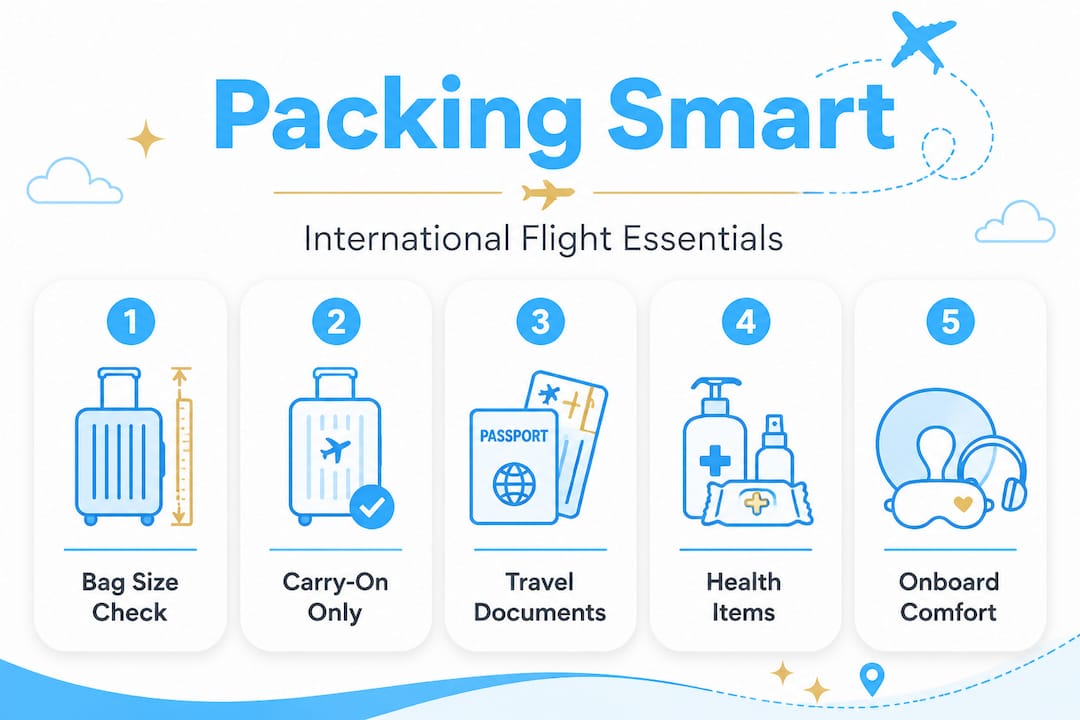
Overpacking is one of the most common and expensive travel mistakes. Checked baggage fees on international routes can reach $60-$100 each way on budget carriers, meaning a round trip for one bag costs as much as a cheap domestic flight. Strategic packing eliminates this cost entirely for most trips under two weeks.
Here is what we recommend for a well-prepared international carry-on:
- One week of clothes using the capsule wardrobe method. Pack neutrals that mix and match. Four tops, two bottoms, one layer, and one pair of versatile shoes cover almost every scenario.
- Universal power adapter. Outlets vary wildly by country. A multi-region adapter costs $15-$25 and prevents the nightmare of arriving with dead devices.
- Travel-size hygiene kit in a clear zip bag. Keep it pre-packed so you never scramble before departure. Replace items as needed after each trip.
- An empty reusable water bottle. Fill it after security to avoid $5-$8 airport water purchases on long flights.
- Healthy snacks. Almonds, protein bars, and dried fruit avoid the $10-$15 airport meal trap and keep your energy stable during long-haul flights.
- Printed copies of critical documents. Keep a copy of your passport photo page, travel insurance, and hotel confirmation in a separate spot from the originals.
- Layers and a change of clothes. Airplane cabins run cold and unpredictably. Your first outfit upon landing matters too, especially if your connection is a short one.
Pro Tip: Budget airlines often charge for carry-on bags above a strict size limit. Before packing, check the specific dimensions for your airline and own a soft-sided bag that can compress if needed to pass the gate check.
Smart ways to save on flights extend beyond the booking process and into how you show up at the airport.
Money matters abroad: Cards, cash, and avoiding fees
Managing money intelligently abroad is one of the highest-return habits a budget traveler can develop. Small mistakes here cost real money at scale.
The most important rule, mentioned earlier but worth repeating, is to always pay in local currency. Avoid DCC every single time a terminal or ATM asks. The convenience offered is not free; it is a fee disguised as a favor.
Beyond that, here is how to manage money abroad effectively:
- Notify your bank before you leave. Without advance notice, many banks freeze cards the moment they detect foreign transactions. A five-minute phone call or app notification before departure eliminates this headache.
- Carry a backup card from a different bank. If one card is blocked or lost, the second ensures you are never stranded without funds.
- Use a fee-free travel card. Cards like the Charles Schwab debit card or Wise travel card eliminate foreign transaction fees (typically 1-3%) and reimburse ATM fees. Over a two-week international trip, these fees add up to $30-$80 in savings.
- Withdraw larger amounts less often. ATM fees are often flat-rate, so withdrawing $200 at once costs less per dollar than four withdrawals of $50.
- Carry a small amount of local cash always. Street food, local buses, small shops, and tips often require cash. Having $20-$40 in local currency at all times prevents awkward moments.
- Learn local tipping customs before arrival. Tipping norms vary enormously. In Japan, tipping is considered rude. In the U.S., 18-22% is expected. In many European countries, rounding up the bill is sufficient. Knowing this in advance prevents overpaying or unintentionally offending.
Pro Tip: Exchange a small amount of foreign currency at your home bank before departure. Airport exchange booths often charge 8-12% margins. Getting $50-$100 in local currency at a better rate at home means you never have to use an airport exchange booth out of desperation.
Why most travelers miss out on the best flight deals
Here is an uncomfortable truth: the information about saving money on international flights has been publicly available for years. And yet, the majority of travelers still overpay. The problem is not access to advice. It is behavior.
Most people book flights emotionally. They decide on a destination, feel excited, and search immediately with a fixed date in mind. They are not looking for the best deal; they are looking for confirmation that their chosen dates are available. That mindset makes strategic saving almost impossible.
The second barrier is inaction on alerts. Travelers set up price alerts and then hesitate when a deal appears because the timing feels inconvenient or the price drop is not as dramatic as they hoped. AI predictors average $550 in international savings per trip, but only for travelers who actually click “book” when the alert fires.
The third issue is clinging to flight myths. Many people believe Tuesday is the cheapest day to book, that flying on Christmas Day is always cheap, or that last-minute deals are common on international routes. These myths were partially true a decade ago. In 2026, airline pricing algorithms are far more sophisticated and data shows Friday booking windows and 15-90 day advance purchase windows are the real opportunity for finding cheaper flights in 2026.
Discipline matters more than any single tip. Act fast when prices drop. Be flexible on dates by at least a few days in either direction. Use the 24-hour refund window as your safety net, not as an excuse to delay acting. The travelers who consistently fly internationally for less are not smarter than everyone else. They simply removed emotion from the equation and replaced it with a repeatable system.
Find even more savings for your next international trip
You now have the framework to book smarter, pack better, and spend less abroad. The next step is putting these strategies into action with the right tools.

At PilotTravelDeals.com, we have gathered everything you need in one place. Whether you want step-by-step booking tips to navigate your next purchase, tools to help you find cheap flights anywhere in the world, or affordable international SIM cards so you stay connected without roaming shocks, we have curated the best deals and guides to simplify your planning. Savings of up to 80% are on the table. All you need is the right starting point.
Frequently asked questions
Is it cheaper to book international flights far in advance or last minute?
Booking 15-90 days in advance is consistently the cheapest window, with average savings around $190 compared to last-minute fares on international routes.
What’s the best day to book international flights in 2026?
Friday is now the cheapest booking day in 2026, outperforming the outdated Tuesday myth that circulated in previous years.
Are budget airlines really the least expensive choice for international travel?
Budget airlines often appear cheaper but total costs can rise sharply once you factor in baggage fees, remote airport locations, and added ground transportation expenses.
How can I avoid extra fees when spending abroad?
Always pay in local currency at ATMs and card terminals to avoid DCC charges, which can add 3-7% to every transaction you make abroad.
What’s the advantage of the 24-hour flight refund rule?
The 24-hour refund rule lets you book instantly when a great price appears and cancel risk-free within 24 hours if a better deal shows up before your window closes.
Recommended
- Smart Overseas Flight Tips: Save More and Travel Better – PilotTravelDeals.com
- Top Tips for Saving on Flights: Travel Smart in 2025 – PilotTravelDeals.com
- Essential Tips for Booking Flights: Save Big Today – PilotTravelDeals.com
- Budget travel guide: Proven strategies to save on every trip – PilotTravelDeals.com
- Seasoned Travelers Know This Secret: How I Fly Home for the Holidays W – BOLSTIE TRAVEL PILLOW