
TL;DR:
- A multicity flight allows travelers to visit multiple destinations under a single ticket, often saving money and providing better connection protection. It involves flying into one city and out of another or incorporating stopovers, making complex itineraries more convenient and cost-effective. Booking requires comparing airline websites, comparison platforms, and considering alliances to maximize savings and simplify travel planning.
Most travelers book round-trips without thinking twice. But what is a multicity flight, and could it be the smarter option for your next trip? A multicity flight, also called a multi-city itinerary in the airline industry, lets you fly into one city and out of another, or visit several destinations under a single ticket. It’s not a niche product for frequent flyers only. Anyone planning a trip to more than one destination can benefit from understanding how this booking structure works, what it costs, and when it beats the alternatives.
Key Takeaways
| Point | Details |
|---|---|
| Multicity = single ticket, multiple stops | You fly through two or more destinations without needing separate bookings or tickets. |
| Often cheaper than separate one-ways | Booking legs together frequently beats the combined cost of individual one-way fares. |
| Protection for missed connections | A single ticket means the airline is responsible for rebooking you if something goes wrong. |
| Open-jaw trips count as multicity | Arriving in one city and departing from another is a common and practical multicity format. |
| Always compare booking configurations | Sometimes separate tickets are cheaper, so testing both options before purchasing is smart. |
What is a multicity flight, exactly
A multicity flight is an airline itinerary that connects three or more city pairs under one ticket, or uses what the industry calls an “open-jaw” structure, where you fly into one city and return home from a different one. Think of it as the opposite of a standard round-trip, which locks you into arriving and leaving from the same airport.
The core components of a typical multi-city itinerary include:
- Origin city: Where you start your journey
- Intermediate stops: One or more cities you visit along the way, each with its own flight segment
- Final destination: The city where your trip ends, which may or may not match your origin
- Connecting segments: Flights that link all the above under a single booking record
It helps to understand the difference between a layover, a stopover, and a multicity stop. A layover is a connection of less than 24 hours, typically just time to change planes. A stopover is a deliberate pause of more than 24 hours (or 4 hours on domestic routes) where you actually spend time in a city. A multicity stop is intentional. You planned to be there, explore it, and depart to your next destination on a separately ticketed segment within the same booking.
Open-jaw routing lets you arrive in one city and depart from another without backtracking, which is one of the most useful features of this format. A classic example: fly from New York to Rome, travel overland to Barcelona, then fly back to New York from Barcelona. That entire trip can be priced close to a Rome round-trip fare, making it one of the best-value configurations in travel.

Pricing for multi-city itineraries doesn’t work the way most people assume. It isn’t simply the sum of each one-way fare. Airlines use complex fare construction rules including maximum permitted mileage, routing constraints, and alliance agreements to calculate the final price.
Benefits and drawbacks worth knowing
Multi-city bookings offer real advantages, but they come with trade-offs. Here’s an honest look at both sides.
The main benefits:
- Single ticket convenience means all your flights live in one booking. One confirmation number. One check-in process for through-bags in many cases.
- Missed connection protection. When you book separate one-way tickets, the second airline owes you nothing if your first flight is late. With a multicity ticket, the airline is responsible for getting you to your destination.
- Cost efficiency. You often save money versus booking each leg separately, especially for international routes where one-way fares are priced higher than their share of a round-trip.
- No backtracking. You move forward geographically instead of retracing your steps, saving both time and sometimes money.
- Extended stopovers can add an entirely new city to your trip at little or no extra cost. Some airlines actively promote free stopovers as an incentive to book through them.
The challenges:
- Booking can be more complex than a standard round-trip, especially if you’re mixing airlines or working across multiple time zones.
- Fare rules for multicity tickets are sometimes more restrictive around changes and cancellations.
- Baggage rules may differ by carrier if your itinerary crosses airline partners, requiring you to recheck luggage at connection points.
- If one segment is disrupted, the knock-on effect across a complex itinerary can be stressful.
Pro Tip: When your itinerary crosses multiple airline alliances, look into Star Alliance, Oneworld, or SkyTeam Round-the-World fares. Alliance round-the-world tickets allow multiple segments at a fixed price, making extended multi-continent travel surprisingly affordable.
For trips involving multiple countries and connections, getting travel insurance is a straightforward way to cover trip interruption, baggage delays, and unexpected rebooking costs across all your destinations.
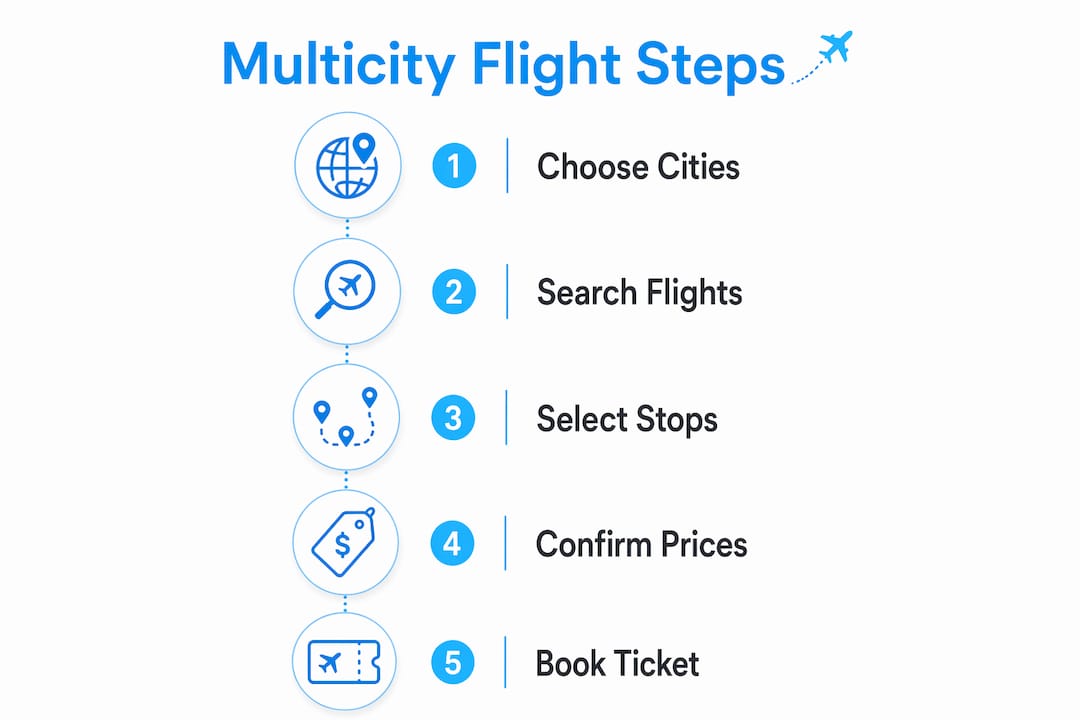
How to book multiple flights on one itinerary
The good news: booking a multi-city flight is easier than it sounds once you know where to look.
-
Go directly to airline websites first. Major U.S. carriers like United, Delta, and American all offer multi-city search tools that handle up to four or five segments. These tools generate valid tickets with consolidated itineraries and often with through-check baggage.
-
Use a flight comparison platform. Sites that aggregate fares across multiple airlines let you compare multicity configurations side by side. Pilottraveldeals has a breakdown of multicity booking strategies that walks through how to use these tools to your advantage.
-
Test separate tickets against the combined fare. This is the step most people skip. Sometimes booking each leg independently is cheaper, sometimes the multicity fare wins. Testing various booking scenarios is the only reliable way to identify the best price and experience combination.
-
Try flexible dates and nearby airports. If your schedule allows a day or two of flexibility, pricing can shift dramatically. A multicity trip from Chicago might cost less if you depart from Milwaukee or Midway instead of O’Hare.
-
Check alliance-based options for international multicity. If your itinerary crosses continents, booking within a single alliance can unlock fares that wouldn’t appear on standard search tools. Understanding fare construction and routing constraints is key to maximizing value here.
-
Consider a travel agent for complex itineraries. If you’re building a four-city international trip with mixed carriers, a travel agent with GDS access (the back-end reservation system airlines use) can often price tickets that consumer-facing tools can’t construct.
Pro Tip: If you’re new to booking multicity trips, start with a simple open-jaw route. It’s the easiest format and often the most immediate way to save money versus booking two separate one-ways. Check out the multi-city booking guide at Pilottraveldeals for step-by-step instructions.
Real-world multicity scenarios that show why it matters
The concept clicks faster with concrete examples. Here are four practical scenarios where a multicity structure outperforms standard booking:
Open-jaw for a European road trip. You fly from Los Angeles to Paris, travel by train through Switzerland and Italy, then fly home from Rome. Instead of paying for a separate one-way back to Paris, an open-jaw ticket prices the LA-Paris and Rome-LA legs together as a single fare. You save money and skip the backtrack.
Stopover sightseeing without extra cost. A flight from New York to Tokyo with a planned 48-hour stopover in Seoul is a classic multicity structure. You spend two days exploring Seoul before continuing to your final destination. The total fare is often comparable to a direct New York to Tokyo round-trip, and you get two countries for the price of one.
Business travel across multiple cities. A sales team traveling from Atlanta to Chicago, then Chicago to Denver, then Denver back to Atlanta books all three legs as a single multicity ticket. The fare is lower than three separate one-ways, and a single booking record simplifies expensing and changes.
Family vacation with varied interests. A family flying into Orlando for theme parks, then catching a short hop to Miami for beach days before flying home doesn’t need two separate round-trips. One multicity ticket handles the entire routing cleanly.
Here’s a quick comparison to put the structure in context:
| Trip type | Structure | Best for |
|---|---|---|
| Round-trip | Same origin and destination | Simple there-and-back travel |
| Open-jaw | Different return city | Road trips, regional exploration |
| Multicity | Three or more city segments | Multi-destination tours, business travel |
| Round-the-world | Alliance-priced multi-continent | Extended global travel |
What all these scenarios share is the core advantage: you move in a logical direction, spend less time backtracking, and often pay less than you would piecing things together one flight at a time.
My honest take on multicity flights
I’ve seen travelers leave real money on the table by defaulting to round-trips simply because that’s what the search form defaults to. What strikes me most about multicity booking is how underused it is given how often the math works in the traveler’s favor.
Here’s what most people overlook: the fare construction system airlines use wasn’t designed with consumer convenience in mind. It was built for agents who understood routing logic and mileage allowances. That means there are legitimate pricing advantages buried in how multicity fares are calculated, and most travelers never find them because they stop at the first round-trip result they see.
My experience with complex itineraries has taught me one consistent lesson: the open-jaw format is almost always worth testing before booking. Flying into Rome and out of Barcelona, or into Bangkok and out of Bali, rarely costs more than a round-trip to one of those cities. Sometimes it actually costs less, because the fare engine is routing you along a logical geographic path.
I’d also push back on the assumption that multicity bookings are inherently risky or complicated. With a single carrier or within one alliance, the booking process takes maybe five extra minutes compared to a round-trip. The booking multiple flights guide at Pilottraveldeals lays out a practical framework that removes most of the guesswork.
My advice: treat the round-trip as your fallback, not your default. Test a multicity configuration every time you plan a trip involving more than one destination. You might be surprised how often it wins.
— Asher
Find your next multicity deal with Pilottraveldeals
Planning a multi-destination trip is a lot less stressful when you have the right tools. Pilottraveldeals brings together flight comparison resources, booking guides, and deal alerts specifically built for travelers who want to get the most out of every itinerary.

Whether you’re figuring out how to search for cheap flights anywhere or looking for affordable domestic flights to build out individual legs of your multicity trip, Pilottraveldeals has the resources to help you compare options and book with confidence. The site covers everything from booking cheap flights step by step to destination-specific deal guides, with savings of up to 80% on select routes and packages. Start exploring your options and build the multi-destination trip you’ve been putting off.
FAQ
What is a multi-city flight in simple terms?
A multi-city flight is a single airline ticket that connects three or more city pairs, or uses an open-jaw structure where you fly into one city and return from a different one. It’s the most flexible way to book a trip with multiple destinations.
Is a multicity flight cheaper than booking separate tickets?
It depends on the route, but multicity fares are often cheaper than combining separate one-way tickets, especially for international travel. Always compare both configurations before booking.
How do you book multiple flights as one itinerary?
Most major airline websites and flight comparison platforms include a “multi-city” search option where you enter each city pair and travel date as a separate row. Booking platforms that aggregate fares can also compare multicity configurations across carriers.
What is the difference between a stopover and a multicity stop?
A stopover is a planned break of more than 24 hours at an intermediate city, while a layover is a connection under 24 hours. A multicity stop is a deliberate destination within your itinerary, often with its own hotel stay and sightseeing plans, all on one ticket.
Can multicity flights include different airlines?
Yes. Through airline alliances like Star Alliance, Oneworld, and SkyTeam, multi-carrier itineraries can be priced and ticketed as a single fare. This opens up routing options that a single airline alone couldn’t provide.
Recommended
- What Is a Multi City Flight and How to Book One – PilotTravelDeals.com
- Multi-city flight booking: save money and travel smarter – PilotTravelDeals.com
- Connecting Flights Explained: Complete Travel Guide – PilotTravelDeals.com
- How to Book Multiple Flights and Save Money on Every Trip – PilotTravelDeals.com