TL;DR:
- Traveling midweek often leads to lower airfare, hotel rates, and fewer crowds, making trips smoother and more affordable.
- Major holidays and events can negate these benefits, so checking local calendars is essential before changing plans.
Yes, traveling midweek genuinely matters. Tuesday and Wednesday departures often cost less than weekend peak fares on many routes, and the savings don’t stop at airfare. Hotels run lower occupancy, lines shrink, and the whole trip runs smoother. The main caveat: major holidays, local festivals, and school-break weeks can erase these advantages, so always check the event calendar for your destination before shifting dates.
Stat to know: Tuesday and Wednesday flights often cost less than Friday and Sunday departures on comparable routes.
Table of Contents
- Why travel mid-week matters: the core benefits at a glance
- How much can you actually save by going midweek?
- How to plan a midweek leisure trip without the guesswork
- When midweek travel isn’t the better choice
- How midweek travel changes the local experience
- What midweek travel does to your dining options
- Midweek vs. weekend travel: energy and how you actually feel
- Key Takeaways
- The case for midweek travel most people overlook
- Midweek deals are easier to find than you think
- Useful sources and next steps
Why travel mid-week matters: the core benefits at a glance
The advantages stack up fast once you start looking at them together.
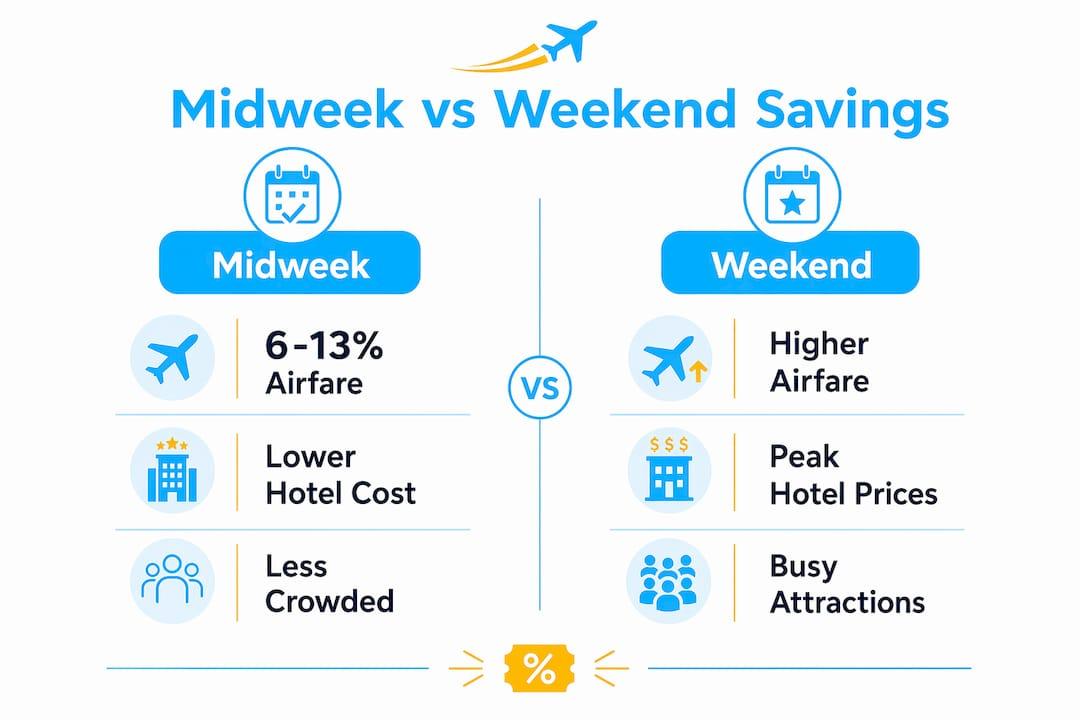
- Cheaper flights. Tuesday and Wednesday seats cost less because business demand drops and airlines haven’t filled planes with weekend leisure traffic yet.
- Lower hotel rates. Properties drop nightly rates midweek to fill rooms; some run specific promos, like 30% off the first night for select midweek arrivals.
- Shorter attraction lines. Theme parks, museums, and popular landmarks see a fraction of weekend foot traffic on Tuesday and Wednesday.
- Less road traffic. Driving to a trailhead or city center on a Wednesday morning is a different experience than fighting Saturday gridlock.
- Easier parking and transfers. Airport parking lots and rental car counters are less picked over; shuttle waits are shorter.
- Better upgrade odds. Lower hotel occupancy means front-desk staff have more flexibility. Hoteliers confirm that complimentary upgrades, early check-in, and late checkout happen more often when the property isn’t packed.
- Calmer airports. TSA volume data consistently ranks Sunday, Friday, and Monday as the busiest travel days. Midweek sits at the quiet end of that spectrum.
- Easier last-minute booking. Small boutique inns and vacation rentals often relax minimum-stay rules for midweek arrivals that they enforce on weekends.
- Fewer flight delays. Airline schedules are less compressed midweek, which means a single disruption is less likely to cascade and rebooking onto a same-day alternative is more realistic.
Pro Tip: Arrive Tuesday evening and use Wednesday as your first full sightseeing day. You get the midweek pricing without burning a weekend, and you’re already settled before the Thursday-to-Sunday crowd arrives.
| Factor | Midweek (Tue–Wed) | Weekend (Fri–Sun) |
|---|---|---|
| Airfare | Lower on most routes | Higher demand pricing |
| Hotel rates | Reduced nightly rates | Peak occupancy pricing |
| Attraction crowds | Light to moderate | Heavy |
| Airport congestion | Low | High |
| Upgrade likelihood | Higher | Lower |
| Flight reliability | Better on-time odds | More delay exposure |
How much can you actually save by going midweek?
The airfare savings on midweek travel is a useful baseline, but the real savings picture is wider. On a round-trip domestic flight priced at $350 on a Friday, shifting to Tuesday could save a modest amount on the ticket alone. Multiply that across two travelers and you’re already covering a nice dinner.
Hotels add another layer, and learning how to book a weekend stay and get the best deal can apply equally well to midweek reservations. Some properties advertise midweek promotions explicitly — a 30% discount on the first night for midweek arrivals is a real example from the hospitality industry, not a hypothetical. On a typical room rate, that can translate to a noticeable discount on the first night. A three-night midweek stay at a mid-range property can cost noticeably less than the same dates over a weekend.
Attractions pile on too. Some theme parks and museums offer weekday-specific ticket pricing that doesn’t apply on Saturday or Sunday. Add airport parking savings during off-peak times, and the aggregate savings on a three-night trip for two can become quite substantial without extensive deal-hunting.
Where savings compound most: shoulder season travel (spring and fall), routes with heavy Friday/Sunday business traffic, and trips that include at least two midweek nights rather than just one.
Pro Tip: Check alternate airports when running flexible-date searches. A Tuesday departure from a secondary airport combined with a midweek hotel rate can double the savings compared to a single-variable change.
| Savings category | Typical midweek advantage |
|---|---|
| Airfare (per ticket) | 6–13% below weekend peak |
| Hotel first night | Up to 30% off at some properties |
| Attraction tickets | Weekday-only pricing at select parks |
| Airport parking | Lower daily rates at off-peak times |
How to plan a midweek leisure trip without the guesswork
Getting the benefits requires a few deliberate choices at booking time. Here’s a practical sequence:
- Pick your target days. Tuesday and Wednesday departures offer the strongest combination of price and reliability. Aim to return Thursday or Friday to keep the trip compact.
- Run a flexible-date search. Use the calendar view on flight search tools to compare Tuesday/Wednesday fares against the surrounding days. The price difference is often visible immediately.
- Check alternate airports. A secondary airport 30–60 miles away can amplify midweek savings, especially on routes where the main hub is dominated by business travelers.
- Set price alerts. Configure alerts for your target dates so you catch drops without monitoring manually. Pilottraveldeals’s flexible-date comparison tools make this straightforward.
- Search weekly hotel rates. Many properties offer a lower per-night rate when you book three or more consecutive weeknights. Ask directly when calling to confirm — front-desk staff can often apply a rate the booking engine doesn’t surface.
- Ask for midweek perks at check-in. Lower occupancy gives staff room to offer early check-in, late checkout, or a room upgrade. A polite ask at the desk costs nothing. These hotel stay tactics work more often than most travelers realize.
- Check attraction schedules before you book. Some museums close on Mondays or Tuesdays; verify hours for your specific destination so you don’t arrive on a closure day.
- Calculate PTO efficiency. Leaving Tuesday evening and returning Friday morning uses two PTO days but gives you three full days at the destination. That’s a better ratio than a long weekend that costs no PTO but delivers two rushed days.
- Boutique inns and vacation rentals often drop minimum-stay requirements for midweek arrivals, opening inventory that’s blocked on weekends.
- Booking a midweek hotel stay through a step-by-step hotel booking guide helps you catch rate structures that aren’t obvious on standard search pages.
When midweek travel isn’t the better choice
Midweek pricing and calm don’t apply everywhere, all the time. Know the exceptions before you rearrange your schedule.
- Major festivals and conventions. A city hosting a large conference or music festival on a Wednesday will be as crowded and expensive as any Saturday. Check the local events calendar.
- School holiday weeks. Spring break, Thanksgiving week, and winter break compress the midweek advantage significantly because leisure demand spikes across all days.
- Theme park peak seasons. Summer midweek at the most popular parks is still busy. Weekday pricing helps, but it won’t replicate the quiet of an off-season Tuesday.
- Weekend-only services. Some ferry routes, scenic train lines, and rural shuttle services run reduced or no service midweek. Verify transport options before committing to dates.
- Attraction closures. Many museums and smaller cultural sites close on Monday or Tuesday. A Wednesday arrival can still work, but confirm hours for every venue on your list.
- Family schedule constraints. If school-age kids are involved, midweek travel during the academic year isn’t realistic for most families. For those travelers, a weekend getaway strategy is the more practical path.
One environmental note: spreading travel across midweek days modestly reduces per-trip congestion at airports and on roads, which is a small but real benefit beyond the personal savings.
How midweek travel changes the local experience
Traveling midweek puts you in a city when it belongs to the people who live there. Restaurants fill with regulars rather than tour groups. Museum galleries are quiet enough to actually read the placards. A neighborhood coffee shop on a Tuesday morning feels nothing like the same spot on a Saturday afternoon.

Travelers consistently report that midweek trips feel calmer and less performative. You’re not competing for the same Instagram backdrop with fifty other visitors. That shift in atmosphere is harder to quantify than a price difference, but it’s one of the most common reasons experienced travelers actively prefer midweek dates. Travel experts increasingly frame midweek travel as a lifestyle choice for flexible workers seeking an authentic experience, not just a budget tactic.
What midweek travel does to your dining options
The dining picture midweek is genuinely mixed, and worth thinking through before you go.
On the upside, popular restaurants that are booked solid on Friday and Saturday often have open tables on Tuesday or Wednesday. You can walk into places that would otherwise require a reservation made weeks in advance. Service tends to be more attentive when the kitchen isn’t overwhelmed.
The downside: some restaurants, particularly in tourist-heavy areas, close one or two days midweek to give staff a break. Monday and Tuesday closures are common in the restaurant industry. A quick check of hours on Google Maps or the restaurant’s own site before you travel prevents the frustration of arriving at a locked door. In smaller towns, the selection of open restaurants on a Wednesday night can be noticeably thinner than on a weekend.
Midweek vs. weekend travel: energy and how you actually feel
Weekend travel carries a particular kind of pressure. You have two days, the clock is running, and the crowds are everywhere. That combination produces a specific type of exhaustion that has nothing to do with how far you traveled.
Midweek trips tend to run at a different pace. Airports are calmer, check-in is faster, and you’re not racing to squeeze everything into 48 hours. A midweek break can also serve as a buffer between the workweek and your return, especially if you come back Thursday or Friday and use the weekend to decompress rather than recover from travel itself. Many travelers find they return from a three-night midweek trip feeling more rested than after a two-night weekend trip that covered the same distance.

Key Takeaways
Traveling midweek consistently delivers lower costs, shorter lines, and a calmer experience — Tuesday and Wednesday are the strongest days to target for most leisure trips.
| Point | Details |
|---|---|
| Best days to fly | Tuesday and Wednesday average 6–13% lower airfares than weekend peak days. |
| Hotel savings | Some properties offer up to 30% off the first night for midweek arrivals. |
| Upgrade odds | Lower occupancy midweek means hotels are more likely to offer upgrades and flexible check-in. |
| Know the exceptions | Festivals, school holidays, and attraction closures can erase midweek advantages. |
| Find midweek deals | Pilottraveldeals’s hotel search and flexible-date tools make it easy to compare midweek vs. weekend pricing side by side. |
The case for midweek travel most people overlook
The conversation about midweek travel almost always centers on price, and price matters. But the argument I find more compelling is what you actually get for the money you do spend.
A weekend trip is often a race. You land, you rush, you try to see everything, and you leave tired. A midweek trip at the same destination can feel like a completely different place. The restaurant has a table. The museum isn’t a crowd-management exercise. The hotel staff has time to talk to you. Those aren’t soft benefits. They’re the difference between a trip you remember and one you just survived.
The savings are real and worth capturing. But the quality-of-experience gap between a packed Saturday and a quiet Wednesday at the same destination is the reason I keep choosing midweek whenever my schedule allows it. The price is lower and the trip is better. That combination doesn’t come along often in travel.
Midweek deals are easier to find than you think
Shifting your dates is only half the equation. You also need a fast way to see whether Tuesday actually beats Friday on your specific route and hotel.

Pilottraveldeals aggregates flight and hotel deals across multiple providers so you can run a flexible-date comparison in one place rather than toggling between a dozen tabs. Filter by weekday check-in, set a price alert for your target dates, and let the platform surface the gap. For travelers ready to book, the home page is the fastest starting point for a midweek search across flights, hotels, and more.
Useful sources and next steps
Use these to dig deeper or set up alerts before you book:
- TSA travel volume data — see which days are statistically busiest and plan around them
- Condé Nast Traveller: best day to fly data — airfare and reliability breakdown by departure day
- Fox Business: midweek travel reasons — hotel perks and attraction pricing examples
- HI USA: midweek travel guide — booking flexibility and lifestyle framing
- Pilottraveldeals hotel search — filter midweek hotel rates and promotions
- Pilottraveldeals flexible-date comparison — set price alerts and compare Tuesday/Wednesday fares against weekend pricing
- Budget travel hacks guide — broader savings tactics that pair well with midweek timing
Pro Tip: When setting fare alerts, include the two airports nearest your destination, not just the main hub. A midweek departure into a secondary airport can cut the total trip cost more than any single deal you’ll find on a weekend.
Recommended
- Unlocking Affordable Adventures: Tips for Cheaper Travel Without Sacrificing Fun – PilotTravelDeals.com
- Why Travel Off Peak Season: Save More, See More – PilotTravelDeals.com
- Seasonal Pricing in Travel Explained: Smart Savings Strategies – PilotTravelDeals.com
- Weekend Getaways: Maximizing Value and Adventure – PilotTravelDeals.com