TL;DR:
- Prioritizing total trip costs, including hidden fees and transportation, leads to smarter hotel choices than just selecting the lowest headline rate.
- Booking during midweek or late Saturday hours can save travelers 5-8%, especially when monitoring flexible rates and rebooking when prices drop.
Most travelers assume that clicking the lowest hotel rate is the smartest move. It isn’t. The cheapest headline price often hides a pile of extra costs, and it rarely accounts for how you’ll actually feel after a night in a noisy, inconveniently located room. Prioritizing total cost over headline price, including taxes, fees, parking, breakfast, and transit time, is the foundation of genuinely smart hotel booking. This guide gives you evidence-backed strategies to maximize both comfort and value at every stage of planning your stay.
Table of Contents
- Rethinking value: Beyond the lowest price
- Save more: Smart booking timing and strategies
- Comfort upgrades that don’t break the bank
- Alternative stays: Stretch your travel dollar further
- What most hotel guides miss about real value
- Plan your next trip for maximum value
- Frequently asked questions
Key Takeaways
| Point | Details |
|---|---|
| Total cost matters | Focus on the combined cost of rates, fees, and perks instead of just base price. |
| Book smart for savings | Use dynamic pricing and timing to grab the best hotel rates. |
| Prioritize true comfort | Choose hotels with comfort perks like soundproofing and free breakfast for better rest. |
| Alternative stays work | Explore options like home swaps and micro-hotels for affordable, unique experiences. |
| Flexibility beats rigidity | Be ready to rebook or try new approaches for even more value from each trip. |
Rethinking value: Beyond the lowest price
With the groundwork set, let’s break down what value really means for smart hotel stays.
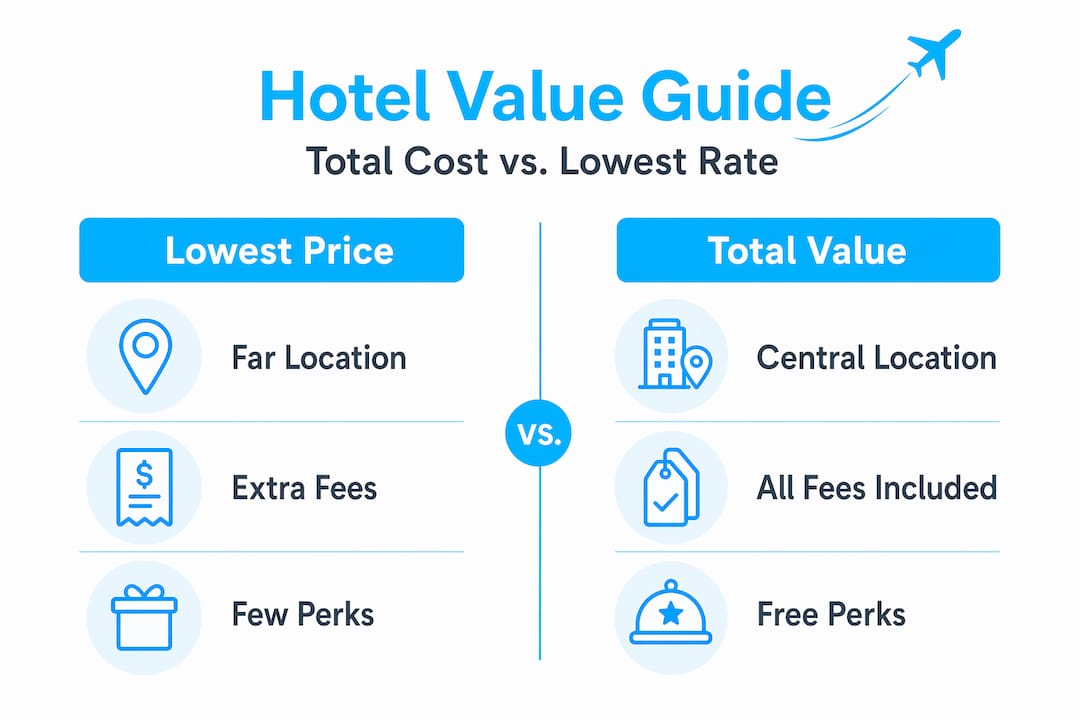
The moment you stop treating price as the only metric, better trips start to happen. A $79 hotel that sits 45 minutes from your destination by taxi, charges $25 for parking, and doesn’t include breakfast can easily cost you $160 a day in real money. A $110 property in a walkable neighborhood with free breakfast included might actually be the better deal.
The hidden cost problem is real. Resort fees alone average around $35 to $45 per night at many American properties, often added at checkout rather than shown upfront. Mandatory valet fees, baggage storage charges, and Wi-Fi add-ons quietly inflate your total. Smart hotel booking tips always start with a full cost audit before committing to a rate.
Here’s a simple comparison of what two hotels might actually cost you:
| Cost item | Budget hotel ($79 rate) | Mid-range hotel ($110 rate) |
|---|---|---|
| Base room rate (3 nights) | $237 | $330 |
| Resort/facility fees | $105 | $0 |
| Parking (3 nights) | $75 | $0 (free) |
| Daily breakfast x 2 people | $90 | $0 (included) |
| Transit to center (daily) | $60 | $0 (walkable) |
| Total real cost | $567 | $330 |
The numbers speak for themselves. The so-called budget hotel costs nearly $240 more over three nights.
What true value actually includes:
- A central location that cuts transportation costs and saves you hours
- Free or included breakfast that removes a daily expense
- Flexible cancellation so you’re not locked in if plans shift
- Free Wi-Fi without throttling or daily caps
- Parking included if you’re traveling by car
Pro Tip: Before booking anything, build a quick checklist. Write down the base rate, then add taxes, resort fees, parking, estimated daily transit costs, and meal costs. Compare that number across at least three properties. The winner often surprises you.
Save more: Smart booking timing and strategies
Once you know what value to look for, maximizing your savings is all about how and when you book.
Hotel pricing is not static. It moves constantly based on demand, occupancy forecasts, and competitor rates. Understanding this dynamic is one of the simplest ways to pay less for the same room.
Research consistently shows that booking on Tuesdays or midnight Saturday can yield savings of 5 to 8% compared to booking on weekend afternoons, when demand spikes. Hotels frequently adjust their inventory pricing algorithms midweek when they process the previous weekend’s bookings and recalibrate for future occupancy gaps. Understanding how dynamic rates work lets you time your booking to hit those recalibration windows.
Here’s how booking timing compares across a typical week:
| Day/time | Average savings vs. Friday | Best for |
|---|---|---|
| Tuesday (any time) | 5-8% | Planned trips 2-4 weeks out |
| Wednesday | 3-5% | Shoulder season travel |
| Saturday midnight | 5-8% | Weekend last-minute deals |
| Sunday afternoon | 0-2% | Minimal benefit |
| Friday or Saturday daytime | Baseline (highest) | Avoid if possible |
Steps to monitor and rebook for maximum savings:
- Book a flexible rate as soon as you have confirmed travel dates. Lock in availability while the market is less volatile.
- Set a weekly calendar reminder to check the same property’s current rate.
- If the rate drops by more than 8-10%, cancel the original booking and rebook at the lower price. Most flexible rates allow same-day cancellation.
- Check the hotel’s direct website alongside comparison platforms. Hotels sometimes offer exclusive direct-booking discounts to avoid third-party commission fees.
- If points bookings apply, rebook those too. One traveler saved $31 and 7,000 points by simply rebooking the same award reservation when prices adjusted downward.
“The most overlooked hotel savings strategy isn’t a discount code. It’s the willingness to check back and rebook what you’ve already reserved.” — frequent traveler insight shared widely among points and miles communities
Non-refundable rates deserve a mention. They typically save around 10% compared to flexible rates, but they create risk. They work well when your travel dates are absolutely locked in and the destination has minimal weather or disruption risk. For everything else, the flexibility of a refundable rate is worth the small premium. Explore the benefits of last-minute booking versus early locking to decide which strategy fits your trip type.
Pro Tip: If you’re booking more than 21 days out, lock in a flexible rate now and use the rebooking strategy above. If you’re within 7 days of arrival, last-minute deals can run 15 to 25% below standard rates as hotels try to fill unsold inventory.
Comfort upgrades that don’t break the bank
Now that you can reliably get value and savings, let’s dial in the comfort factor for a restful and restorative stay.

Comfort in a hotel room isn’t about marble countertops or turndown service. For budget travelers, the features that actually improve sleep quality and reduce stress are far more practical. According to research on hotel comfort priorities, soundproofing, adjustable climate control, and free breakfast consistently outweigh luxury aesthetics for travelers focused on rest and recovery.
The comfort features worth prioritizing when you book:
- Blackout curtains: These matter enormously for sleep quality, especially in urban hotels where street lights and signage bleed through standard curtains. Check recent guest photos in reviews, not just the hotel’s professional shots.
- Noise control: Look for rooms away from elevators, ice machines, and street-facing walls. When you check in, simply ask the front desk for a quiet room or one on an upper floor.
- Climate flexibility: A room where you control the thermostat independently (not a shared hallway unit) makes a significant difference, especially in summer or if you travel with a partner who runs warmer or cooler than you.
- Free breakfast: Even a modest continental spread saves $15 to $25 per person per morning. Over a week, that’s real money back in your pocket.
Quick habits that improve any hotel stay:
- Unpack your toiletries and essentials immediately. Living out of a suitcase increases mental clutter and makes you feel like a temporary guest rather than settled in.
- Bring resistance bands or a light workout accessory if fitness matters to you. Hotel gyms vary wildly in quality; having your own equipment gives you a consistent routine.
- Book any on-site spa or wellness service on arrival rather than waiting. Budget hotels that do offer massage or spa options fill quickly, especially on weekends.
- Use stress-free hotel habits to build a simple arrival routine that signals your body to relax into the space.
“The budget traveler who sleeps eight quality hours in a quiet, temperature-controlled room starts each day ahead of the luxury traveler who slept poorly in a beautiful suite with street noise at 2 a.m.” — a simple truth about comfort over aesthetics
Pro Tip: When checking in, ask quietly and politely for a room on a higher floor, away from the elevator, and not directly above the hotel bar or kitchen. Front desk staff can almost always accommodate this at no extra cost. It takes less than 30 seconds and pays off every night of your stay.
Alternative stays: Stretch your travel dollar further
Good comfort and savings aren’t just about hotels. Sometimes, thinking outside the box lands you the top deal.
The lodging landscape has expanded dramatically over the past decade, and budget-conscious travelers who ignore non-hotel options are leaving genuine value on the table. Alternatives like pet sitting, home swaps, and micro hotels provide budget lodging with real comfort, local immersion, and sometimes zero nightly cost.
Home swaps are one of the most underrated options available. You offer your home to another traveler while staying in theirs. The arrangement is coordinated through vetted platforms with review systems. You get a full kitchen (massive savings on meals), a living room, laundry access, and the feeling of actually living in a city rather than passing through it. For families or travelers staying longer than five nights, home swaps often beat any hotel rate outright.
Pet sitting for locals is another category worth knowing. Several platforms connect homeowners who need someone to care for their pets with travelers who want free or heavily discounted accommodation in exchange for looking after animals. If you like animals and can commit to a pet-friendly schedule, this option provides free stays in private homes in neighborhoods you’d never have access to otherwise. The experience often adds a dimension to travel that no hotel can replicate.
Micro hotels have grown substantially in major cities across North America, Europe, and Asia. These properties offer compact but thoughtfully designed rooms (often 150 to 200 square feet) with excellent soundproofing, premium mattresses, and central urban locations. They typically cost 20 to 35% less than standard hotel rooms in the same neighborhood while delivering comparable or superior sleep quality.
Comparing non-hotel alternatives at a glance:
- Home swaps: Best for stays of 5+ nights, families, and travelers who cook
- Pet sitting stays: Best for flexible itineraries and animal lovers
- Micro hotels: Best for city-centric trips where location is everything
- Hostels with private rooms: Best for solo travelers who want social energy without dorm costs
Pro Tip: Use platforms with verified reviews and identity checks for home swaps and pet sitting arrangements. The review system is your safety net, so look for hosts with at least 10 confirmed reviews and recent activity before committing.
What most hotel guides miss about real value
After covering practical strategies, let’s step back for some honest perspective on what truly matters most.
Most hotel guides optimize for one thing: the lowest number. They’ll tell you to compare rates, stack discount codes, and chase flash sales. That’s useful, but it misses something important that experienced budget travelers understand deeply.
Rigidly chasing the cheapest rate often costs more than it saves. When you book a non-refundable rate to save 10% and your meeting runs a day late, you’ve lost the entire booking. When you pick the cheapest property in a distant neighborhood to save $30, you spend that $30 (and two hours) on transportation every day. The math of “cheapest rate wins” breaks down fast in the real world.
Seasoned travelers value flexibility not as a luxury but as a strategic tool. Paying an extra $10 to $15 for a refundable booking is, in essence, purchasing travel insurance at a fraction of the cost. The peace of mind that comes from knowing you can adjust your plans without penalty is a genuine form of value that never shows up in a price comparison table.
Location is another area where experienced travelers refuse to compromise, even on tight budgets. Being within walking distance of your main activities doesn’t just save on transit. It reduces decision fatigue, gives you the option to return to your room between activities, and makes the whole experience feel more connected. That connection to a place is what you remember about a trip, not whether you saved $18 on a room.
The most honest framing of hotel value we’ve found is this: value isn’t a number. It’s how you feel when you travel. A stay that costs $20 more but leaves you rested, unstressed, and genuinely immersed in your destination has delivered more value than the cheapest option that left you tired, frustrated, and disconnected.
Plan your next trip for maximum value
Ready to put these practical strategies into action? Here’s how you can plan with ease.
Everything covered in this guide becomes faster and simpler when you have the right tools in one place. At PilotTravelDeals.com, you can compare top budget hotels side by side, filtering for the features that actually matter like location, breakfast inclusion, and cancellation flexibility. No more manually adding up hidden fees across five different tabs.

Stay connected throughout your trip with affordable travel SIM cards that keep data costs predictable so you can navigate, rebook, and stay in touch without surprise charges on your bill. And if you want to keep building your savings toolkit, check out more hotel savings tips that go even deeper on rate tracking, loyalty programs, and off-peak strategies. Smart travel planning takes less than an hour when you know where to look.
Frequently asked questions
What is the best day and time to book a hotel for the lowest price?
Tuesdays and non-peak hours like midnight Saturday tend to produce the lowest rates due to dynamic pricing cycles, saving you 5 to 8% compared to weekend bookings.
How do I monitor and rebook hotel rooms to save money?
Check your booking weekly, and if the rate drops significantly, cancel your flexible reservation and rebook at the lower price. One documented case shows a traveler who saved $31 and 7,000 points simply by rebooking the same reservation.
What comfort features matter most in budget hotels?
Soundproofing, adjustable climate control, and free breakfast deliver the greatest day-to-day comfort benefits for budget travelers, far outweighing decorative or luxury finishes.
Are non-refundable hotel rates always cheaper?
Non-refundable rates save roughly 10% on short, low-risk stays, but they become costly if your plans change. Always weigh the savings against the cancellation risk before locking in.
What are some alternatives to traditional hotels for budget travelers?
Home swaps, pet sitting, and micro hotels offer budget-friendly, comfortable stays with local character that standard hotels simply can’t replicate at comparable price points.