TL;DR:
- Corporate flight booking is a structured, policy-driven process that controls costs, ensures compliance, and supports travelers. It involves tools such as online booking platforms and travel management companies to enforce policies and maintain centralized records, unlike unmanaged, leisure-style bookings. Implementing best practices and governance can significantly reduce hidden costs, improve efficiency, and provide better overall trip outcomes for organizations.
Most people assume corporate flight booking is just buying airline tickets in bulk. It isn’t. The real process is a structured, policy-driven system designed to control costs, ensure compliance, support travelers, and create an auditable record of every trip. For travel managers and business professionals, understanding this distinction isn’t just useful — it’s the foundation of a well-run travel program. This guide covers everything: what corporate booking actually means, how the tools work, how it compares to unmanaged booking, and how to apply these insights inside your organization starting today.
Table of Contents
- What is corporate booking in flight?
- How corporate booking tools and platforms work
- Corporate flight booking vs. unmanaged leisure booking: Key differences
- Governance, compliance, and exceptions: Beyond the basics
- Making corporate flight booking work for your organization
- The truth most companies overlook about corporate flight booking
- Ready to level up your corporate flight booking?
- Frequently asked questions
Key Takeaways
| Point | Details |
|---|---|
| Managed booking defined | Corporate flight booking is an organized, policy-driven process for arranging employee air travel, not just bulk ticket buying. |
| Tools ensure compliance | Online booking tools and travel management companies automate oversight, policy enforcement, and reporting. |
| Biggest gains beyond price | Effective corporate booking programs deliver visibility, control, and duty-of-care rather than simply pursuing lower fares. |
| Unmanaged booking risks | Booking outside company systems can increase hidden costs, reduce compliance, and compromise duty-of-care. |
| Continuous program improvement | Best results come from regular policy reviews and adapting booking workflows to company needs and trends. |
What is corporate booking in flight?
Corporate flight booking is the company-managed process of arranging employee air travel, covering planning, purchasing, and controlling itineraries under a corporate travel policy rather than through individual, unmanaged leisure-style booking. That definition matters because it draws a hard line between an employee searching for a personal trip and a structured system that governs every step a company’s traveler takes.
In practice, corporate booking involves several interconnected elements working together:
- Travel policies that define which fare classes are approved, which airlines are preferred, how far in advance bookings must be made, and what spend thresholds require extra approval
- Expense controls that connect booking data directly to company finance systems so every ticket is tracked and attributed to a budget or cost center
- Itinerary management that coordinates multi-leg trips, hotel stays, and ground transport under a single, visible record
- Supplier negotiations that secure discounted rates from airlines based on committed volume, reducing per-ticket costs well below what an individual would pay
The workflow follows a consistent pattern: an employee submits a travel request, an approver reviews it against policy, a booking is made through an approved channel, and the trip is later audited against both the travel policy and the expense report.
“Corporate travel management includes approving or rejecting travel plans, arranging itineraries, purchasing tickets, and auditing expense reports.” — Investopedia
Different people own different parts of this process. Travel managers set and enforce the policy. Employees search and select within the approved framework. Executive approvers sign off on high-cost or exception requests. Finance teams audit outcomes. Each role is distinct, and when they work together through a clear flight booking workflow guide, the entire program becomes faster and more cost-effective.
How corporate booking tools and platforms work
With the definition clear, it’s essential to understand how technology and service providers actually operationalize corporate booking. There are two primary channels most companies use, and knowing how each works helps travel managers pick the right fit.
An Online Booking Tool (OBT) is software that gives employees a self-service interface to search and book flights, but within guardrails set by the company. An OBT doesn’t just display flight options — it filters, ranks, and sometimes blocks options based on the policies your team has configured. A Travel Management Company (TMC) is a full-service provider that handles bookings on behalf of the company, often combining technology with human agents who manage complex itineraries or disruptions.
Corporate booking platforms are used so bookings are tracked, policy-enforced, and aligned with negotiated supplier content. That’s the core value proposition. Here’s how the process typically unfolds step by step:
- An employee logs into the OBT and enters their travel dates, origin, and destination
- The platform displays only approved options, hiding or flagging fares that fall outside policy
- The system applies negotiated rates from preferred airline contracts automatically
- If the selected option exceeds a cost threshold, an approval request routes to the travel manager or executive approver
- Once approved, the booking is confirmed and automatically logged in the expense and reporting system
- Post-trip, the data feeds into dashboards that show spend by department, route, or traveler
| Feature | Online Booking Tool (OBT) | Travel Management Company (TMC) |
|---|---|---|
| Self-service | Yes | No (agent-assisted) |
| Policy enforcement | Automated | Human-reviewed |
| Best for | High-volume, routine trips | Complex or high-value itineraries |
| Cost | Lower per-transaction | Higher, but includes support |
| Reporting | Real-time dashboards | Comprehensive management reports |
Pro Tip: Integrate your OBT with your expense management system from day one. When booking data flows automatically into expense reports, you eliminate manual entry, reduce errors, and close the compliance loop without adding work for travelers.
Reviewing the available business travel booking platforms side by side will help you identify which tool matches your company’s size, travel volume, and policy complexity. For teams that need premium seats without premium prices, looking at purpose-built business class ticket tools is also worth the time.
Corporate flight booking vs. unmanaged leisure booking: Key differences
The tools make the differences stark, so let’s break down how company-managed booking diverges from ad hoc methods in concrete terms.
When an employee books their own flight on a consumer site without any company oversight, that’s an unmanaged booking. It might look cheaper at first glance. But the hidden costs pile up fast: no negotiated rates, no centralized record, no duty-of-care tracking, and no ability to audit whether that person followed any policy at all.

Structured corporate booking focuses on balancing cost control and traveler requirements by matching preferences to policy and using preferred vendors and corporate portals. That balance is exactly what unmanaged booking fails to deliver.
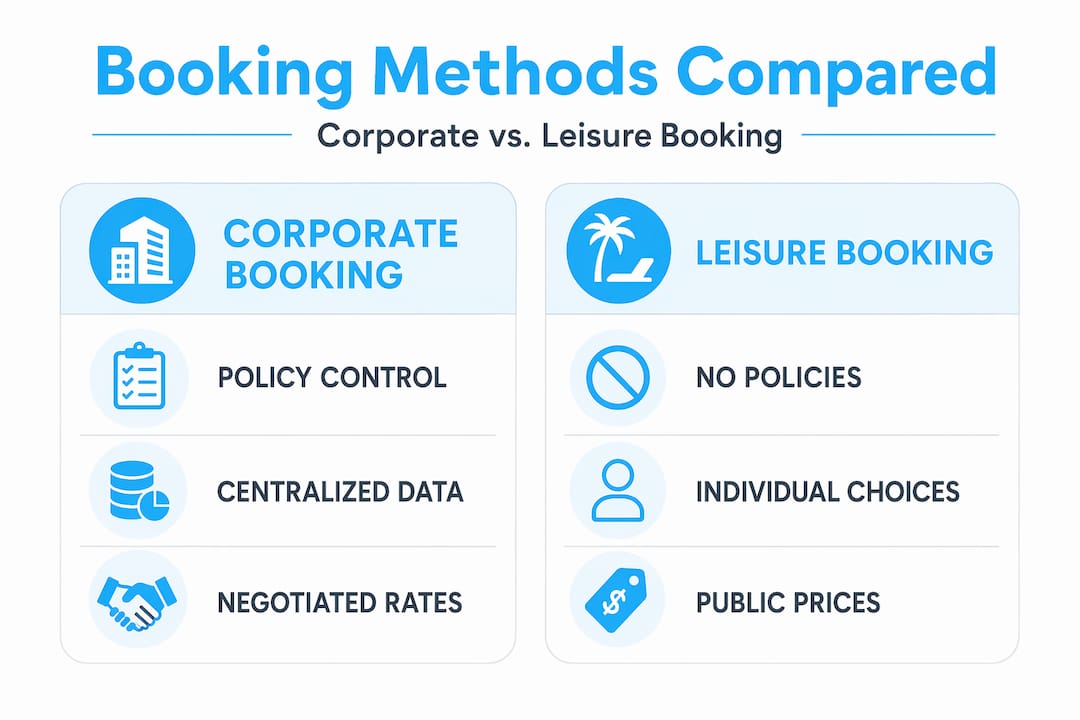
| Dimension | Corporate booking | Unmanaged booking |
|---|---|---|
| Cost control | Negotiated rates, budget caps | Market rate, no guardrails |
| Visibility | Centralized, real-time reporting | Scattered, manual reconciliation |
| Policy compliance | Built into the booking flow | Entirely dependent on the employee |
| Traveler support | 24/7 agent access via TMC | Employee handles disruptions alone |
| Vendor negotiation | Company-level contracts | No leverage |
| Audit trail | Automatic | Non-existent unless expense report filed |
The practical advantages of a managed program are significant:
- Cost savings through preferred airline contracts and fare class restrictions that eliminate unnecessary upgrades
- Duty of care (the company’s legal and ethical obligation to keep traveling employees safe) is fulfilled because the company always knows where its people are
- Simplified reimbursement when bookings are made through approved channels and auto-populated in expense systems
- Stronger reporting that gives travel managers the data they need to renegotiate supplier contracts at renewal time
- Reduced policy leakage (the percentage of trips booked outside approved channels), which is one of the biggest hidden cost drivers in corporate travel programs
Hidden costs in unmanaged programs are a bigger problem than most finance teams realize. Productivity losses from poor routing, missed connections, lack of support during disruptions, and hours spent on manual expense reconciliation can easily outweigh any fare savings a traveler finds on their own. Understanding this distinction is at the heart of booking workflow optimization.
Governance, compliance, and exceptions: Beyond the basics
A company-managed framework is only as good as its real-world enforcement, so let’s look at the governance and exception handling that are crucial to program success.
Even the best-designed travel policy will face pressure from reality. Last-minute meetings get called. Airlines cancel flights. Travelers get stranded in cities their booking tool never accounted for. This is why governance — the systems and processes that enforce policy and handle exceptions — deserves as much attention as the booking tools themselves.
Corporate booking is also about governance and exceptions. Companies must handle approvals, out-of-policy leakage, and disruption management, not just finding the cheapest fare. The governance layer typically includes:
- Real-time policy rules embedded in OBTs that prevent non-compliant selections at the point of booking, before money changes hands
- Pre-approval workflows for trips above certain cost thresholds, ensuring senior review before commitment
- Expense monitoring that flags discrepancies between what was booked and what was expensed
- Duty-of-care tools that provide real-time location data during travel disruptions or emergencies
Common exceptions that every program needs to account for include urgent business meetings that require same-day or next-day travel at premium fares, changes to approved itineraries due to client requests, flight disruptions that require rebooking outside the original fare class, and travelers in time zones where the OBT may not reflect the most current availability.
Governance strategies that minimize policy leakage include clear, written policies that explain not just the rules but the reasoning behind them, making employees far more likely to comply voluntarily. Regular communication about why preferred vendors are preferred (cost savings that fund department budgets, for example) builds buy-in. Tracking and reporting leakage percentages by team creates healthy accountability without punitive culture.
Pro Tip: Schedule a quarterly audit of out-of-policy bookings. Review the reasons, identify patterns, and update your policy or your platform settings to address recurring exceptions. This feedback loop is how programs improve continuously without requiring a full redesign.
Staying current on business travel trends also matters here. Flexible work arrangements, sustainability mandates, and evolving airline pricing models all affect how policies should be written and enforced in 2026.
Making corporate flight booking work for your organization
Now that you see the mechanisms and challenges, here’s how to put the best practices into action for your organization, whether you’re building a program from scratch or improving an existing one.
The practical goal of corporate flight booking is not only to purchase tickets — it is to enforce a repeatable, auditable workflow that supports policy compliance, cost control, visibility, and duty-of-care. Keeping that goal front and center guides every decision below.
- Audit your current state. Before selecting tools or rewriting policies, document how travel is being booked today. Identify leakage rates, average ticket costs, and how much time finance spends reconciling travel expenses. This baseline makes ROI measurement possible later.
- Write a clear travel policy. Define approved fare classes, preferred airlines, advance booking windows, per-trip cost limits, and the exception request process. Keep it short enough that travelers actually read it.
- Select your OBT and/or TMC. Match the platform to your volume and complexity. High-volume programs with mostly routine domestic trips may do well with an OBT alone. Programs that include international travel, complex itineraries, or executive travel often need TMC support as well.
- Configure policy rules inside the platform. Don’t rely on travelers to self-enforce. Build the guardrails directly into the booking tool so compliant options surface first and non-compliant ones trigger an alert or require approval.
- Connect your systems. Link the booking platform to your expense management software and HR data so traveler profiles, cost centers, and approval hierarchies stay current automatically.
- Train your travelers. A great platform with poor adoption delivers poor results. Run short onboarding sessions and keep a quick-reference guide available inside the tool itself.
- Report, review, and revise. Pull monthly spend reports by route, traveler, and department. Use that data to negotiate better rates at your next airline contract review. Share high-level summaries with department heads to build program awareness.
Exploring proven corporate travel savings strategies and understanding available corporate travel discounts from airlines, hotels, and ground transport providers can significantly accelerate results once the foundational program is in place.
Pro Tip: Revisit your travel policy at minimum once a year, ideally using the previous year’s booking data to guide revisions. Policies written without data become outdated quickly and create the leakage they were meant to prevent.
The truth most companies overlook about corporate flight booking
Here’s a perspective that most corporate travel guides won’t tell you: the obsession with finding the cheapest fare is one of the most expensive mistakes a travel program can make.
It sounds counterintuitive. But chasing the lowest headline price routinely leads to longer layovers, inconvenient routing, reduced flexibility when disruptions occur, and travelers arriving exhausted and unproductive at meetings that cost tens of thousands of dollars to arrange. A $200 fare difference is irrelevant when a missed connection kills a deal.
The hidden costs of poorly planned journeys — productivity loss, time waste, stress, and compliance failures — can exceed the fare savings they were supposed to generate. Process-focused travel programs that emphasize cost control, preferred suppliers, centralized reservations, and policy compliance consistently outperform fare-chasing programs over a 12-month period. The data is clear on this when you actually measure total program cost rather than average ticket price.
The smarter metric is total trip cost, which includes fare, productivity impact, change fees, time in transit, and the administrative cost of managing the booking. When you measure that, structured programs with strong governance and preferred supplier agreements win every time.
This shift in mindset also changes how you evaluate business travel trends. The most progressive travel managers in 2026 are moving away from cost-per-ticket dashboards and toward cost-per-outcome thinking: what did the trip produce, and what did it actually cost the business in total? That’s the question a mature corporate booking program is designed to answer.
Ready to level up your corporate flight booking?
You now have a strong grasp of what corporate flight booking actually involves, from policy design to governance to the tools that make it run. The next step is putting that knowledge to work with the right resources in your corner.
At PilotTravelDeals.com, we’ve built a library of resources specifically for travel managers and business professionals who want to move from reactive booking to a strategic travel program. Whether you’re looking for a clear breakdown of the advantages of flight comparison tools, a deep look at available corporate travel discounts your company may not be capturing, or a broader overview of the types of travel discounts available across airlines and booking channels, you’ll find actionable, practical guides designed for how business travel actually works. Savings of up to 80% are real when the right structure is in place.
Frequently asked questions
Is corporate flight booking more expensive than booking individually?
Corporate booking typically reduces total costs through negotiated rates and centralized management, even when individual headline fares appear slightly higher, because hidden costs in unmanaged programs frequently outweigh any savings.
How do travel managers enforce flight booking policies?
They configure OBT policy rules that surface only compliant options and automatically route non-compliant requests through an approval workflow before any booking is confirmed.
Can employees choose their own flights in a corporate system?
Yes, but within guidelines — the booking platform filters results so choices align with approved fare classes, preferred vendors, and budget thresholds set by the company.
What happens if a flight is booked outside of policy?
Out-of-policy bookings are flagged or blocked by the booking tool, and those that proceed require additional management approval plus documentation explaining the exception.
Who benefits the most from managed corporate flight booking?
Companies with significant travel volume, strict compliance requirements, or duty-of-care obligations gain the most measurable value from a structured, managed corporate booking program.
Recommended
- How to Book Multiple Flights and Save Money on Every Trip – PilotTravelDeals.com
- 7 Examples of Corporate Travel Discounts for Business Savings – PilotTravelDeals.com
- Corporate Travel Savings: Maximizing Company Budgets – PilotTravelDeals.com
- Flight Booking Workflow: Complete Step-by-Step Guide – PilotTravelDeals.com