
TL;DR:
- An open jaw airline ticket allows travelers to fly into one city and depart from another within a single booking, covering two flight legs with an unprotected open gap in between. This structure is ideal for multi-destination trips, regional explorations, and unique journeys like cruises or overland travel, but requires careful planning for ground transportation and buffers. Booking involves selecting the multi-city option to bundle flights, comparing against separate one-way fares, and preparing for potential ground delays in the open gap.
An open jaw airline ticket is a flight itinerary where you fly into one city and depart home from a completely different city, all within a single booking. The Cambridge Dictionary defines open jaw tickets as flying into one city and out of another, making them ideal for travelers who want to cover more ground without retracing their steps. Think of flying into Paris, spending two weeks traveling south through France and into Italy, then flying home from Rome. That is an open jaw ticket in action. For anyone planning a multi-destination trip, this structure removes the biggest inefficiency in travel: the pointless return leg to a city you have already left.
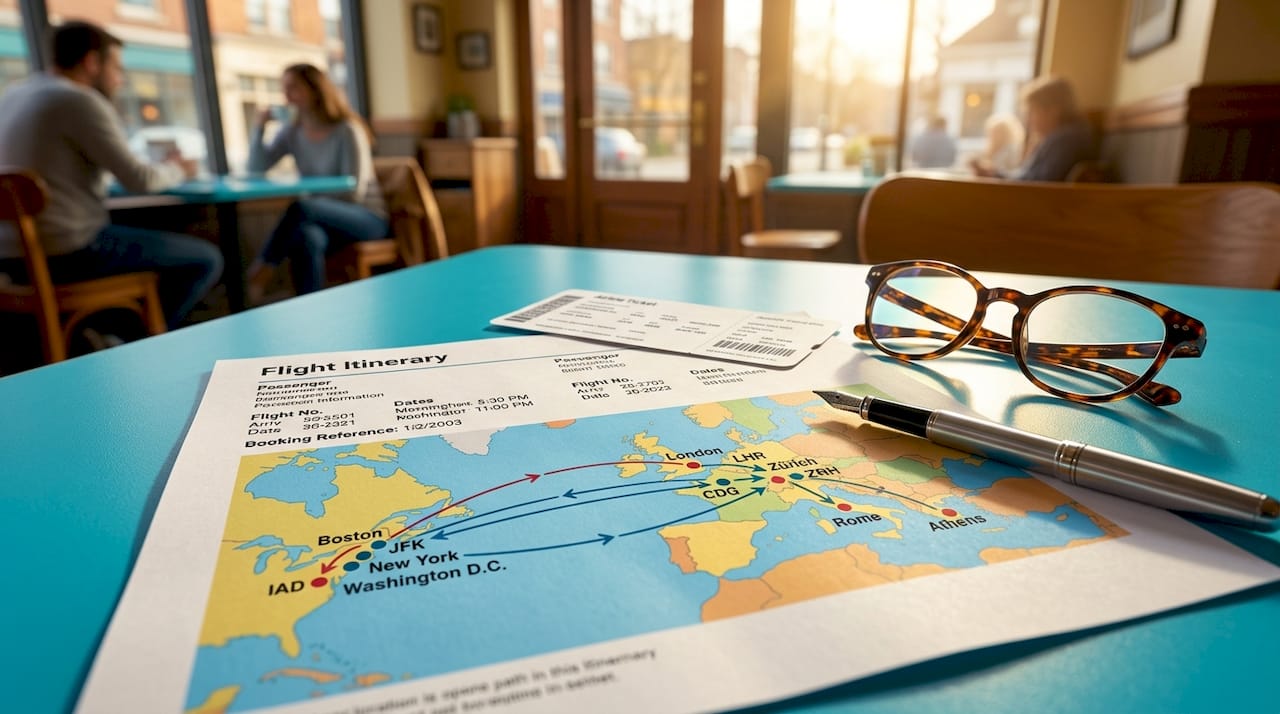
What is an open jaw airline ticket and how does it work?
An open jaw ticket covers two flight legs. The first leg takes you from your home city to your destination. The second leg returns you home from a different city entirely. The gap between your arrival city and your departure city is the “open jaw,” and you are responsible for getting yourself across it.
Airalo explains open jaw flights as two or more planned flights with an open section in between, where the traveler arranges separate transport. That gap is yours to fill with a train, a rental car, a bus, or even a short domestic flight. The airline covers only the international or long-haul legs it sold you.
Here is a concrete example of how the structure looks in practice:
- Leg 1: New York (JFK) to Paris (CDG)
- Open gap: Paris to Rome by train or budget carrier
- Leg 2: Rome (FCO) to New York (JFK)
Booking this structure requires using the multi-city booking option on an airline’s website or a third-party platform. Standard round-trip search tools will not produce this result. You need to select “multi-city” or “add a flight” and manually enter each leg.
Pro Tip: When booking, price your open jaw itinerary against two separate one-way tickets on the same routes. Open jaw fares are often cheaper because airlines bundle the legs, but this is not always the case on budget carriers.
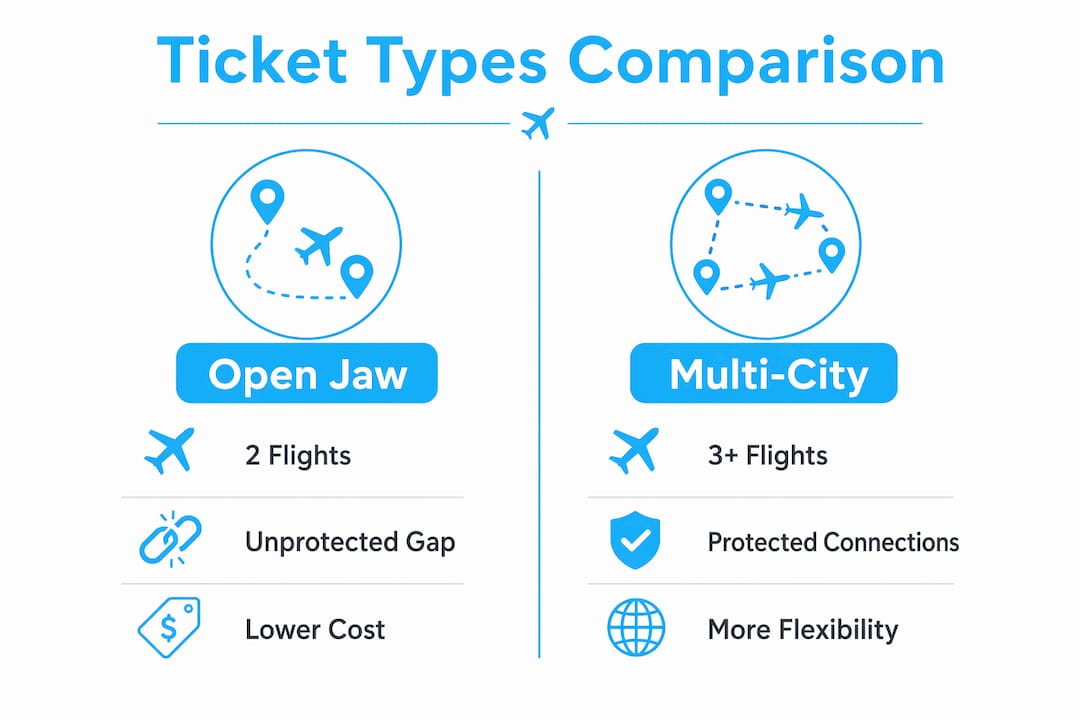
The open gap is what separates this ticket type from a standard round trip or a layover. A layover is a brief stop the airline controls. An open jaw gap is a stretch of travel you plan and pay for independently.
Open jaw vs. multi-city vs. one-way: which ticket wins?
Open jaw tickets are not the only flexible option. Multi-city tickets and one-way tickets each serve different travel goals, and the right choice depends on your itinerary shape.
Open jaw tickets can save money compared to booking separate one-way tickets by bundling flights into a single itinerary. That bundling also simplifies your booking record and can make rebooking easier if a flight is disrupted.
| Ticket type | Cost | Flexibility | Ground transport needed |
|---|---|---|---|
| Open jaw | Often lower than two one-ways | High: visit two cities, depart from second | Yes, for the open gap |
| Multi-city | Moderate to high | Very high: three or more cities | Depends on itinerary |
| One-way (separate) | Can be expensive | Maximum: change anything | No airline coordination |
| Round trip | Usually lowest | Low: return to origin city | No |
The key distinction between an open jaw and a true multi-city ticket is the number of flight legs. A multi-city ticket typically includes three or more booked flight segments. An open jaw ticket has exactly two airline-covered legs with one unprotected gap. For a traveler visiting two regions, open jaw is cleaner and often cheaper. For a traveler hitting four cities across two continents, multi-city is the better structure.
The main limitation of open jaw travel is the unprotected gap. If your train from Paris to Rome is delayed, the airline operating your Rome departure has no obligation to rebook you. You carry that risk entirely. This is not a reason to avoid open jaw tickets. It is a reason to plan the gap carefully.
Who benefits most from open jaw flights?
Open jaw tickets suit tourists, business travelers, and others who need to visit multiple cities without backtracking. The traveler profiles that get the most value from this structure include:
- Regional explorers: Travelers touring a geographic region, such as Southeast Asia or Western Europe, who want to enter at one end and exit at the other without retracing their route.
- Business travelers: Professionals with meetings in two cities who need to fly into the first and out of the second without wasting a day returning to their origin.
- Cruise passengers: Travelers who fly into a port city, board a cruise, and disembark at a different port before flying home. The open jaw structure is purpose-built for this scenario.
- Train and road trip travelers: Anyone planning a point-to-point overland journey, such as a cross-country train trip or a road trip through national parks, benefits from open jaw because the ground journey is the trip itself.
- Group and destination event travelers: Groups attending weddings or events in destination cities often use open jaw structures to combine the event with broader regional travel. Platforms covering destination wedding group bookings note that coordinating arrival and departure cities is a common planning consideration for travel groups.
The common thread across all these profiles is directional travel. If your journey naturally moves from point A to point B rather than looping back, an open jaw ticket matches that shape exactly.
How to book open jaw tickets and maximize your savings
Booking an open jaw ticket is straightforward once you know where to look. The process differs slightly depending on whether you book directly with an airline or through a third-party platform.
- Go to the multi-city search tool. On most airline websites and booking platforms, select “multi-city” rather than “round trip.” Enter your outbound flight as Leg 1 and your return flight as Leg 2, using different origin and destination cities for each leg.
- Search both legs together. Pricing the two legs as a bundle often produces a lower fare than two separate one-way searches. Airlines price open jaw itineraries as a unit, which can work in your favor.
- Plan your open gap before you book. Research train schedules, bus routes, or short domestic flights between your arrival city and your departure city. Know the travel time and cost before you commit to your flight dates.
- Build buffer time into your gap. Airlines only protect the flight legs in an open jaw itinerary. Ground transportation between cities is outside airline responsibility, so a missed train or a delayed bus is your problem. Give yourself at least one full day of buffer before your return flight.
- Compare against one-way combinations. Run a parallel search for two separate one-way tickets on the same routes. Sometimes budget carriers offer one-way fares that beat the bundled open jaw price, especially on popular European or Asian routes.
- Stack hotel deals on your gap cities. Combining open jaw flights with lodging discounts is one of the most effective ways to reduce total trip cost. The cities in your open gap are often the ones where you spend the most nights, so discounted hotel rates there have an outsized impact on your budget.
Pro Tip: Set fare alerts for both legs of your open jaw itinerary separately. If one leg drops significantly in price, you may be able to rebook that leg alone and keep the other, depending on your fare class and airline policy.
The most common mistake travelers make with open jaw tickets is underestimating the open gap. A four-hour train journey sounds manageable until you factor in station transfers, luggage, and the possibility of delays. Treat the gap as a mini-itinerary with its own contingency plan, not as a footnote to your main booking.
Key takeaways
Open jaw airline tickets are the most efficient structure for directional, multi-destination travel because they eliminate the wasted return leg while keeping costs lower than two separate one-way tickets.
| Point | Details |
|---|---|
| Open jaw definition | You fly into one city and depart from a different city within a single itinerary. |
| Booking method | Use the multi-city search option on airline sites or third-party platforms to build the itinerary. |
| The open gap is your responsibility | Airlines cover only the booked flight legs; ground transport between cities is unprotected. |
| Cost advantage | Bundled open jaw fares are often cheaper than two separate one-way tickets on the same routes. |
| Best use cases | Regional tours, cruises, business multi-city trips, and point-to-point road or rail journeys. |
Why open jaw tickets changed how I plan every long trip
I booked my first open jaw ticket by accident. I was trying to visit both Lisbon and Barcelona on the same trip and could not stomach the idea of flying back to Lisbon just to catch my transatlantic home flight. A travel agent suggested I fly into Lisbon and out of Barcelona, take the overnight train between the two cities, and book the whole thing as a multi-city itinerary. The fare came in lower than a round trip to either city alone.
What I learned from that trip is that the open gap is not a problem to solve. It is the trip. The train from Lisbon to Barcelona was one of the best travel days I have had. The open jaw structure forced me to slow down and actually move through the geography rather than teleporting between airports.
The planning discipline it requires is real. I now treat every open jaw gap as a separate booking task with its own checklist: transport booked, buffer day confirmed, accommodation at the gap city sorted before I finalize the flights. That discipline has never failed me, and it has saved me from the one scenario that ruins open jaw trips, which is arriving at your departure city with no margin for error.
My honest advice: if your trip moves in one direction across a region, an open jaw ticket is almost always the right structure. The multi-city booking strategies that work for complex itineraries apply here too. Start with the geography, then find the flights that match it.
— Asher
Find your next open jaw flight deal with Pilottraveldeals
Planning an open jaw itinerary means juggling flights, hotels, and ground transport across multiple cities. Pilottraveldeals makes that process faster by aggregating deals from multiple providers in one place, so you can compare open jaw and multi-city flight options without switching between a dozen tabs.

Whether you are looking for cheap airfare tips to cut costs on both legs of your open jaw ticket or searching for hotel deals in the cities along your route, Pilottraveldeals has the tools to help you build a smarter trip. Savings of up to 80% on travel bookings mean your open jaw gap cities do not have to blow your budget. Visit pilottraveldeals.com to start comparing deals today.
FAQ
What is an open jaw airline ticket in simple terms?
An open jaw airline ticket is a booking where you fly into one city and return home from a different city, with the gap between those two cities covered by your own ground transport. The Cambridge Dictionary defines this as a ticket that avoids the traveler having to return to the original arrival city.
How do open jaw flights differ from multi-city tickets?
An open jaw ticket has exactly two airline-covered flight legs with one unprotected gap between cities. A multi-city ticket typically covers three or more booked flight segments across several destinations, making it better suited for longer, more complex itineraries.
Are open jaw tickets cheaper than round trips?
Open jaw tickets are often cheaper than booking two separate one-way tickets, and they can be comparable to or cheaper than round trips depending on the route. The savings depend on the specific airlines, routes, and travel dates involved.
How do I book an open jaw ticket?
Select the multi-city option on an airline website or booking platform, then enter your outbound flight as Leg 1 and your return flight as Leg 2 with different origin and destination cities. Airalo confirms that travelers must use multi-city tools rather than standard round-trip search to create open jaw itineraries.
What happens if I miss my connection during the open jaw gap?
The airline has no obligation to rebook you if you miss your return flight due to a delay in the unprotected ground segment. Plan buffer time of at least one full day between your arrival in the gap city and your scheduled departure flight to protect against this risk.
Recommended
- Unlock cheaper airfare: insider strategies for saving – PilotTravelDeals.com
- What is travel credit? A 2026 guide for budget travelers – PilotTravelDeals.com
- How to book cheapest domestic flights in 2026: guide – PilotTravelDeals.com
- What is a travel voucher? A 2026 guide for budget travelers – PilotTravelDeals.com