Most travelers believe there’s one magic day to buy the cheapest plane ticket. Book on a Tuesday, the myth goes, and you’ll always score a deal. The truth is more interesting. Airfare prices shift constantly based on algorithms, seat inventory, and demand patterns that have nothing to do with the day of the week you open your laptop. Cheapest domestic days to fly include Friday, Tuesday, and Wednesday, with Friday running up to 14% less than Sunday. But timing is just one piece of a much bigger puzzle. This article breaks down how airfare is actually priced, when to buy, and the real strategies that save you money.
Table of Contents
- How airlines set airfare: The science behind the price
- When to buy tickets: Is there really a best time?
- Why flexibility is your biggest weapon for cheap airfare
- Smart booking tactics: Tools, alerts, and common pitfalls
- What’s changing: AI, personalization, and the future of airfare
- Connect your knowledge: Let PilotTravelDeals supercharge your savings
- Frequently asked questions
Key Takeaways
| Point | Details |
|---|---|
| Dynamic pricing explained | Airfare constantly shifts based on demand, inventory, and competitive factors. |
| Flexibility yields savings | Travelers with flexible dates or airports can routinely score better deals. |
| Smart tools matter | Using alerts, comparison sites, and direct booking helps bypass common traps. |
| No magic day to book | Rely on trends and flexibility over myths about the ‘cheapest day’ to buy. |
How airlines set airfare: The science behind the price
Airline pricing feels random, but it follows a precise logic. Every seat on every flight is managed by a revenue management system (RMS), a software platform that adjusts fares in real time. These systems use dynamic pricing algorithms that factor in demand forecasting, competitor prices, booking pace, and time to departure. The goal is simple: squeeze maximum revenue from every single flight.
Here’s where it gets interesting. Airlines divide their seats into fare buckets, each with a set price and a limited number of seats. Think of it like a movie theater that sells a handful of early-bird tickets at half price, then switches to full price once those run out. As lower fare buckets sell out, the price jumps to the next tier, even if the plane is still half empty. The airline prioritizes revenue per seat, not filling every seat.
| Fare bucket | Typical availability | Price level |
|---|---|---|
| Lowest (Y, B, M) | First few seats | Cheapest |
| Mid-tier (H, K, Q) | Moderate availability | Mid-range |
| Full fare (J, C, F) | Always available | Most expensive |
| Last-minute | Rare discounts | Varies |
This is why checking a flight on Monday and again on Wednesday can show wildly different prices. The RMS is constantly recalculating. AI and travel booking tools are now starting to help travelers track these shifts automatically, giving you a real edge.
“Airlines use revenue management systems with dynamic pricing algorithms that adjust fares in real-time based on demand forecasting, seat inventory in fare buckets, booking pace, competitor prices, and time to departure to maximize revenue per flight.” — Drey Travel
When to buy tickets: Is there really a best time?
Once you understand how airlines set prices, the next question is when to actually hit purchase. The short answer: there is no single best day to buy, but there are clear patterns worth knowing.
Cheapest days to fly domestically are Friday, Tuesday, and Wednesday. Flying on a Sunday is typically the most expensive option, running up to 14% more than a Friday flight. For months, August, September, and January tend to offer the lowest average fares because demand drops after summer peaks and holiday travel.

| Day to fly | Relative cost |
|---|---|
| Friday | Cheapest (up to 14% less than Sunday) |
| Tuesday/Wednesday | Low cost |
| Monday/Thursday | Mid-range |
| Sunday | Most expensive |
Here’s the catch: contrasting expert views exist on whether Sunday or Friday is actually the best day to buy a ticket. Some analysts say Sunday shopping surfaces better deals because airlines load new fares over the weekend. Others say it doesn’t matter. The disagreement itself tells you something important: rigid rules don’t work.
What actually works is monitoring prices over time rather than trying to guess the perfect moment. Here’s what the data supports:
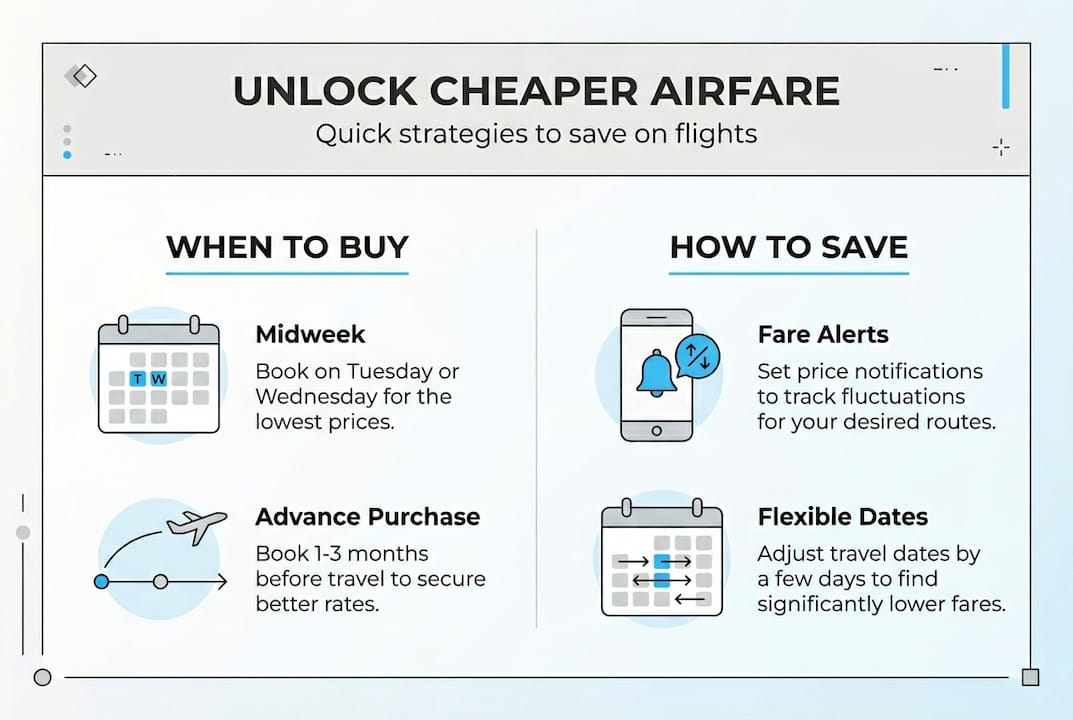
- Domestic flights: book 1 to 3 months in advance
- International flights: book 2 to 6 months ahead
- Holiday travel: book as early as possible, often 4 to 6 months out
- Last-minute deals: rare and unreliable for most routes
Pro Tip: Instead of checking prices manually every day, set fare alerts on Google Flights or Hopper. You’ll get notified the moment a price drops, so you can act fast without obsessing over the calendar.
Using flexible travel dates tools lets you see a full month of prices at once, which is far more useful than picking one date and hoping for the best. Understanding why date flexibility matters can shift your entire approach to booking.
Why flexibility is your biggest weapon for cheap airfare
While timing your purchase helps, flexibility is often the true key to finding the lowest fares. Travelers who can move their trip by even one or two days consistently pay less than those locked into specific dates.
Here are the most effective ways to use flexibility to your advantage:
- Use fare calendars. Google Flights and Kayak both offer calendar views that show the cheapest days in a given month. Scan the whole month before committing to a date.
- Check nearby airports. Flying into or out of a secondary airport can save hundreds. If you’re heading to New York, compare JFK, LaGuardia, and Newark. The price difference can be significant.
- Fly at off-peak times. Early morning and late-night flights are less popular and often cheaper. Red-eye flights, in particular, tend to price lower because demand is thin.
- Consider low-cost carriers (LCCs). Budget airlines like Spirit, Frontier, and Ryanair often undercut major carriers by a wide margin. Just check all fees before booking, since baggage and seat selection costs can erase your savings.
- Be open on destination. If you’re flexible on where you go, use the “Explore” feature on Google Flights to see the cheapest destinations from your home airport on your chosen dates.
Pro Tip: When setting fare alerts, use a wide search window of plus or minus three days around your ideal travel dates. This dramatically increases your chances of catching a price drop.
Understanding how flexibility saves you money is one of the most practical skills a budget traveler can develop. Pair it with solid research on how to travel for cheap and you’ll consistently outperform travelers who rely on luck alone. Some destinations even offer flexible holiday deals that bundle accommodation with open travel dates for extra savings.
Smart booking tactics: Tools, alerts, and common pitfalls
Having mastered flexibility, let’s talk about which tools and habits give you a real edge every time you book.
Best tools for tracking airfare:
- Google Flights: Best overall for price tracking, calendar views, and route exploration
- Hopper: Predicts whether prices will rise or fall and recommends when to buy
- Kayak: Strong for multi-city searches and fare alerts
- Skyscanner: Excellent for international routes and “everywhere” searches
- Airfarewatchdog: Curated deals sent directly to your inbox
Here’s a step-by-step process for setting price drop alerts:
- Search your route on Google Flights
- Toggle on the “Track prices” button
- Set your preferred price threshold if the tool allows it
- Wait for email notifications when the price changes
- Book directly with the airline or through a trusted platform once the price hits your target
Pro Tip: Book directly with LCCs rather than through third-party sites like Expedia. If your flight is canceled or changed, dealing with the airline directly is far easier than going through a middleman.
Common pitfalls to avoid:
- Ignoring baggage fees: A $49 base fare with $60 in fees is not a deal
- Booking too late: Prices almost always rise within two weeks of departure
- Assuming the cheapest site is always cheapest: Compare at least three sources before buying
- Skipping travel insurance: One canceled trip can cost more than years of premiums
For more strategies, check out these cheap flight tricks and proven cheap flight tips that go deeper on each tactic. You’ll also find a solid breakdown of more airfare savings methods worth bookmarking.
What’s changing: AI, personalization, and the future of airfare
Looking forward, airfare pricing is getting even smarter. Airlines and booking platforms are investing heavily in artificial intelligence to make pricing more precise and, in some cases, more personalized.
Here’s what’s already happening and what’s coming:
- Personalized offers: Airlines are beginning to tailor fare bundles based on your loyalty status, past bookings, and browsing behavior on their own sites
- Predictive pricing: AI tools like Hopper already predict fare movements with reasonable accuracy, giving travelers a data-backed recommendation on when to buy
- Dynamic ancillary pricing: Fees for bags, seats, and upgrades are increasingly set by algorithms, not fixed price lists
- Real-time competitor matching: Airlines adjust fares within minutes of a competitor dropping prices on the same route
“AI personalization is emerging, but there is no confirmed individual search tracking across sites. Revenue management systems still favor early bookers for leisure travel.” — Drey Travel
The good news: AI personalization has not yet reached the point where airlines are tracking your individual searches across the web and raising prices just for you. That’s a persistent myth. What does matter is booking early for leisure trips, since RMS systems are designed to reward advance purchases with lower fares.
Stay informed about how AI in airfare booking is evolving. The travelers who understand these systems will always have an advantage over those who don’t.
Connect your knowledge: Let PilotTravelDeals supercharge your savings
Now that you understand how the system works, it’s time to put that knowledge into action. Knowing the theory is one thing. Having the right tools in front of you is another.

At PilotTravelDeals.com, we’ve built a set of resources specifically for travelers who want to stop guessing and start saving. Start with our guide on how to search for cheap flights to build your search strategy from scratch. Then walk through our booking flight tips for a step-by-step process that covers everything from setting alerts to comparing carriers. Before you finalize any booking, run through our flight comparison checklist to make sure you’re getting the best deal available. We compare deals from dozens of providers so you don’t have to.
Frequently asked questions
Does searching for flights in incognito mode really give better prices?
Airfare sites do not confirm individual search tracking, and no confirmed tracking across browsers has been verified. Prices change based on demand and fare bucket availability, not your browsing history.
Is it better to book flights last minute for cheaper deals?
Waiting is risky. Last-minute prices typically rise as departure nears because airlines know remaining seats are in high demand, especially from business travelers.
What’s the true best day of the week to fly for savings?
Data shows Friday, Tuesday, and Wednesday are the cheapest days for domestic flights, with Friday running up to 14% less than Sunday. That said, flexibility across multiple days beats any single rule.
How far in advance should I book for the lowest airfare?
Dynamic pricing rewards early leisure bookers, so aim for 1 to 3 months ahead for domestic and 2 to 6 months for international. Setting alerts and watching price trends over time is the smartest overall approach.
Recommended
- Best Tips for Cheap Flights: Save More on Airfare – PilotTravelDeals.com
- Top Tips for Cheap Plane Tickets: Save on Every Flight – PilotTravelDeals.com
- Tricks to find cheap flights: expert tips for 2026 – PilotTravelDeals.com
- Cheap Airfare Tips to Find the Best Deals Easily – PilotTravelDeals.com
- How to budget Morocco family vacation: save 25% on lodging – Top Morocco Travel
- Bargain hunting strategies to save more online | PriceLix