TL;DR:
- Planning a multi-city trip involves strategic route sequencing, realistic pacing, and early booking to optimize travel efficiency. Group nearby destinations, choose the most suitable route type, and allocate days based on city size to avoid exhaustion. Using spreadsheets and travel tools helps organize logistics, while building buffer days ensures flexibility and minimizes risk.
A multi-city trip is a travel itinerary that connects three or more destinations in a single journey, using a combination of flights, trains, and ground transport to move between them. Knowing how to plan multi-city trips correctly means mastering three things: route sequencing, pacing between cities, and booking strategy. Get all three right and you save hundreds of dollars, avoid exhausting backtracking, and arrive at each destination with energy to spare. This guide covers every step, from plotting your first map to locking in the best transport deals.
How to plan multi-city trips with smart route logic
The single most important decision in any multi-destination trip is the order of your cities. Cluster-based trip design groups nearby cities into geographic zones and moves linearly between them. This approach reduces travel fatigue and improves budget efficiency compared to treating all cities as standalone points.

Start by plotting every city you want to visit on Google Maps. Look for natural clusters: cities within a 2–3 hour travel range of each other. A trip through Western Europe, for example, might cluster Paris, Brussels, and Amsterdam together before jumping to a second cluster of Berlin, Prague, and Vienna.
Once you see your clusters, choose a route type:
- Linear route: Move in one direction from start to finish. This is the most efficient pattern and eliminates backtracking entirely. A Tokyo to Osaka to Hiroshima to Fukuoka route is a textbook linear sequence.
- Loop route: Start and end in the same city. Useful when your international flights both use the same hub airport.
- Hub-and-spoke: Base yourself in one city and take day trips to nearby destinations. This works well in regions with strong rail networks, like Switzerland or the Netherlands.
Backtracking wastes travel days. If you find yourself drawing lines that cross on your map, that is a signal to drop or reorder a city. No destination is worth a full day of reverse travel.
Pro Tip: Before booking anything, screenshot your Google Maps route and share it with a travel companion or post it in a travel forum. A fresh set of eyes catches routing errors you will miss after staring at the same map for an hour.
What is the right pacing for each city?
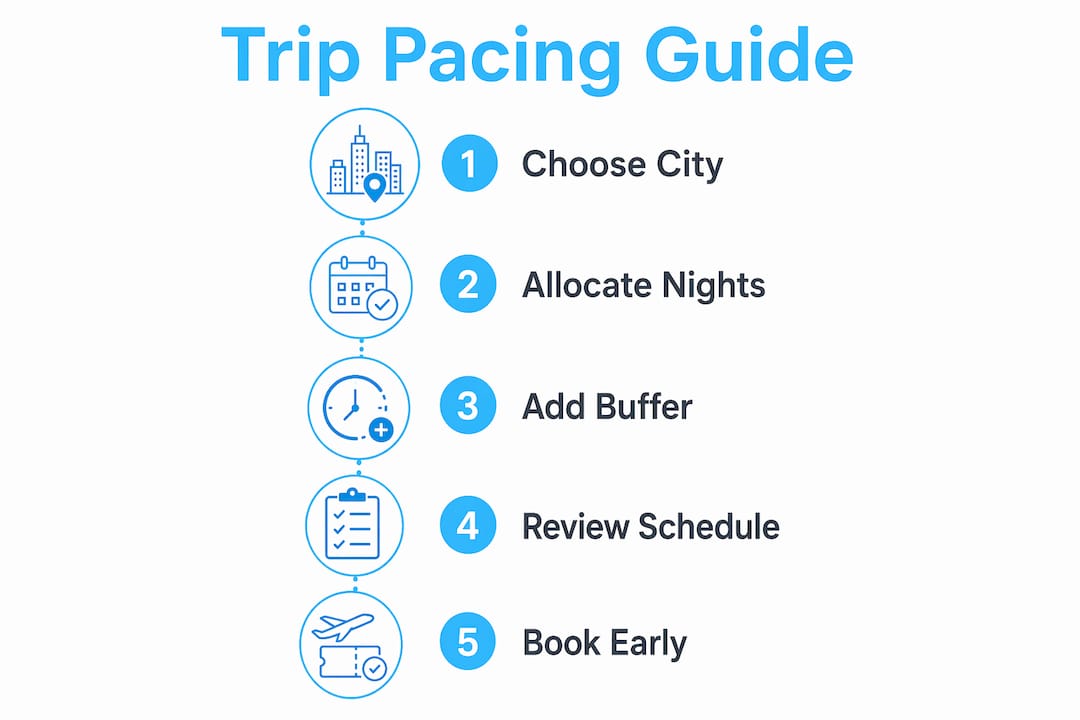
Pacing is the number of nights you allocate per city, and it is the difference between a trip that feels rich and one that feels like a sprint. Optimal pacing for multi-city trips is 3–5 nights for major capitals and 2–3 nights for secondary cities. Small towns and day-trip stops need only 1–2 nights.
| City Type | Examples | Recommended Nights |
|---|---|---|
| Major capital | Tokyo, Rome, New York City | 3–5 nights |
| Secondary city | Lyon, Porto, Kyoto | 2–3 nights |
| Small town or village | Cinque Terre, Hallstatt | 1–2 nights |
| Day trip only | Versailles, Bruges | 0 nights |
These numbers serve a real purpose. Three nights in Rome gives you one day to recover from jet lag, one full sightseeing day, and one flexible day for a side trip or a slower morning. Two nights in a secondary city like Porto gives you one full day of exploration without the cost of an extra hotel night.
Buffer days are non-negotiable on longer trips. One buffer day per week of travel handles delays, fatigue, and the unexpected restaurant or museum that pulls you off schedule. A 21-day trip should have at least three buffer days built in.
Pro Tip: Assign buffer days to the city you are most excited about, not to transit days. That way, if nothing goes wrong, you get bonus time in your favorite place instead of a blank day at an airport.
How do you book flights and transport for multiple cities?
Multi-city flight booking, also called a multi-stop or open-jaw ticket, is a single reservation that covers three or more flight segments under one booking reference. This is the industry standard term for what most travelers loosely call “booking multiple flights at once.”
Open-jaw flights save travelers $200–$500 compared to booking individual one-way tickets. They also simplify baggage check-in because your luggage moves through the booking as a single itinerary. Most major booking platforms, including Google Flights and Skyscanner, have a dedicated multi-city search mode.
When to choose rail over air
The 500-mile rule is a practical threshold: for city pairs under 500 miles apart, trains almost always beat planes on total travel time. Door-to-door travel time is more relevant than advertised flight duration. The Shinkansen from Tokyo to Kyoto takes 2 hours and 15 minutes city center to city center. Flying the same route takes 3.5 hours door to door once you factor in airport transfers and security.
Rail tickets reward early bookers heavily. A Paris to Amsterdam Thalys ticket costs €35 booked 60–90 days in advance versus €180 on the day of travel. That price gap alone justifies locking in your inter-city rail legs before you finalize hotel bookings.
Here is a quick decision framework for transport mode selection:
- Under 500 miles: Default to train unless rail infrastructure is poor.
- 500–1,000 miles: Compare door-to-door times and total costs including airport transfers.
- Over 1,000 miles: Fly. Budget carriers like Ryanair or easyJet in Europe and AirAsia in Southeast Asia cover these routes cheaply.
- Overnight options: Night trains and overnight buses save a hotel night and preserve daytime hours.
Book inter-city rail and flights 45–90 days before departure for the best combination of availability and price. Waiting until the last two weeks almost always costs more.
What tools help you organize a multi-city itinerary?
The biggest planning mistake is replicating single-city trip density across every stop. Each added city multiplies logistics complexity. You need a system that holds all your information in one place and lets you revise quickly.
Here is a proven workflow for organizing a multi-destination trip:
- Map your route first. Use Google Maps to build a custom map with each city pinned. Add your transport legs as routes. This visual layer catches routing errors before you spend money.
- Build a master itinerary document. A Google Sheet or Notion page works well. Include columns for city, dates, accommodation name, confirmation number, transport mode, and departure time.
- Use a trip management app. TripIt, Wanderlog, and TripCase all aggregate confirmation emails into a single timeline. Forward your booking confirmations and the app builds your day-by-day schedule automatically.
- Separate your bookings by city. Create a folder in your email or cloud storage for each destination. Drop all related confirmations, maps, and notes into the relevant folder.
- Review the full itinerary monthly. Revisiting your itinerary on a monthly basis leading up to departure lets you catch flight schedule changes, sold-out accommodations, and better pricing windows before they become problems.
Pro Tip: Add a “transit buffer” row between each city in your itinerary document. Note the check-out time, transport departure time, and check-in time at the next city. Seeing those three times side by side instantly reveals whether your schedule is realistic or dangerously tight.
Which mistakes derail multi-city trips most often?
Most multi-city trips go wrong in predictable ways. Knowing the failure points in advance lets you design around them.
- Evenly splitting nights across all cities. Giving every city the same number of nights ignores the reality that a major capital like Barcelona has five times more to see than a small coastal town. Match nights to content, not to a sense of fairness.
- Ignoring transfer time. A flight listed as one hour still requires two hours at the airport before departure and 45 minutes of ground transport on arrival. Budget 4–5 hours of dead time for any flight leg, regardless of distance.
- Booking non-refundable hotels before confirming transport. Lock in your flights and trains first. Hotel cancellation policies are far more flexible than airline change fees.
- Adding one city too many. A 14-day trip covering eight cities is a logistics exercise, not a vacation. Cut the weakest city and use those days to go deeper in the ones that matter most.
“Treat your multi-city trip as a series of clustered sub-journeys, not a single marathon. Each cluster gets its own rhythm, its own pace, and its own focus.” This mental shift, supported by expert planners, is what separates travelers who return energized from those who return exhausted.
The fix for most of these mistakes is the same: build your itinerary in a spreadsheet before booking anything. Seeing all your cities, nights, and transit legs in a single view makes bad decisions obvious.
Key takeaways
Successful multi-city trips depend on route logic, realistic pacing, and early booking, not on visiting as many places as possible.
| Point | Details |
|---|---|
| Cluster your destinations | Group cities within 2–3 hours of each other and move linearly to cut backtracking. |
| Match nights to city size | Allocate 3–5 nights for major capitals, 2–3 for secondary cities, and 1–2 for small towns. |
| Book open-jaw tickets | Multi-city flight bookings save $200–$500 versus individual one-way tickets. |
| Use the 500-mile rail rule | Choose trains over planes for city pairs under 500 miles to save total travel time. |
| Build buffer days in | Add one buffer day per week of travel to absorb delays without derailing your schedule. |
Why i think most multi-city itineraries are built backwards
After planning dozens of complex itineraries, I have noticed that most travelers start with a wish list of cities and then try to force a route around it. That is backwards. The route should come first.
The travelers I have seen get the most out of multi-city trips are the ones who treat geography as a constraint, not an afterthought. They drop a city they love the idea of visiting because it sits in the wrong direction. That discipline pays off every time. You arrive at each stop with energy instead of arriving already worn down from a pointless detour.
The other thing most guides understate is how much door-to-door transit time matters. A 45-minute flight between two European cities sounds efficient. Add two hours of airport time on each end, plus 30 minutes of ground transport, and you have burned half a day. The Shinkansen comparison is not an edge case. It is the norm for short-haul routes across Europe and Asia.
My honest recommendation: build your itinerary in a spreadsheet before you open a single booking site. Write out every city, every transit leg, and every night. If the document looks chaotic, the trip will feel chaotic. Fix it on paper first.
— Asher
Plan your next multi-city trip with Pilottraveldeals
Pilottraveldeals brings together flight deals, hotel rates, and travel tools in one place so you can stop switching between tabs and start booking with confidence.

Whether you need affordable airfare for a three-city European loop or want to compare hotel rates across multiple cities before committing to a route, Pilottraveldeals has you covered. The platform aggregates offers from multiple providers, with savings up to 80% on select deals. You can also pick up a traveler SIM card to stay connected across borders without paying roaming fees. For a full breakdown of how to book multi-city trips cheaply, the Pilottraveldeals resource library is a strong starting point.
FAQ
What is multi-city flight booking?
Multi-city flight booking is a single ticket that covers three or more flight segments under one reservation. It typically costs $200–$500 less than booking the same segments as individual one-way flights.
How far in advance should you book inter-city transport?
Book rail tickets and flights 45–90 days before departure. A Paris to Amsterdam Thalys ticket, for example, costs €35 booked early versus €180 on the day of travel.
How many nights should you spend in each city?
Major capitals like Tokyo or Rome need 3–5 nights. Secondary cities need 2–3 nights. Small towns and villages need 1–2 nights. Adjust based on your personal interests and the city’s size.
What is the best route type for a multi-city trip?
A linear route is the most efficient because it eliminates backtracking. Move in one direction from your first city to your last, grouping nearby destinations into geographic clusters along the way.
How do you avoid burnout on a long multi-city itinerary?
Add one buffer day per week of travel to your schedule. Assign buffer days to your favorite destination so that if nothing goes wrong, you gain bonus time there instead of sitting idle at a transit hub.
Recommended
- How to Book Multi-City Trips for Cheap and Easy Travel – PilotTravelDeals.com
- Multi-city flight booking: save money and travel smarter – PilotTravelDeals.com
- What Is a Multi City Flight and How to Book One – PilotTravelDeals.com
- Tips for International Flights: Your 2026 Travel Guide – PilotTravelDeals.com