
TL;DR:
- A business class upgrade bid is an online offer, in cash or points, to move from economy to business class on unsold seats. Success depends on fare eligibility, timing, and bid amount, not elite status, with most accepted bids being non-refundable. Long-haul international routes offer better opportunities, and strategic bidding combined with low fares maximizes upgrade chances.
A business class upgrade bid is a cash or points offer you submit online to move from economy to business class when an airline has unsold premium seats. The industry term for this practice is a “bid upgrade” or “upgrade auction,” and airlines use it as a yield-management tool to fill seats that would otherwise fly empty. Understanding how this system works gives you a real shot at a flat bed and lounge access at a fraction of the full fare.
What is a business class upgrade bid?
A business class upgrade bid is an offer submitted online to pay to move from economy to business class when the airline has unsold seats. You book your economy ticket first, then receive an invitation to bid through the airline’s portal or a partner platform. If your bid is accepted, your card is charged and your ticket is reissued in business class. If it is declined, you pay nothing and fly in your original seat.
Airlines run these auctions primarily to monetize unsold premium inventory rather than guarantee discounted upgrades. That distinction matters. You are not buying a discounted business class ticket. You are competing in a demand-driven auction where the airline decides whether your offer meets its revenue threshold. Accepted upgrade bids often include business class perks such as lounge access, extra baggage allowance, and in-flight amenities, though the exact benefits vary by airline and route.
How does the business class upgrade bid process work?
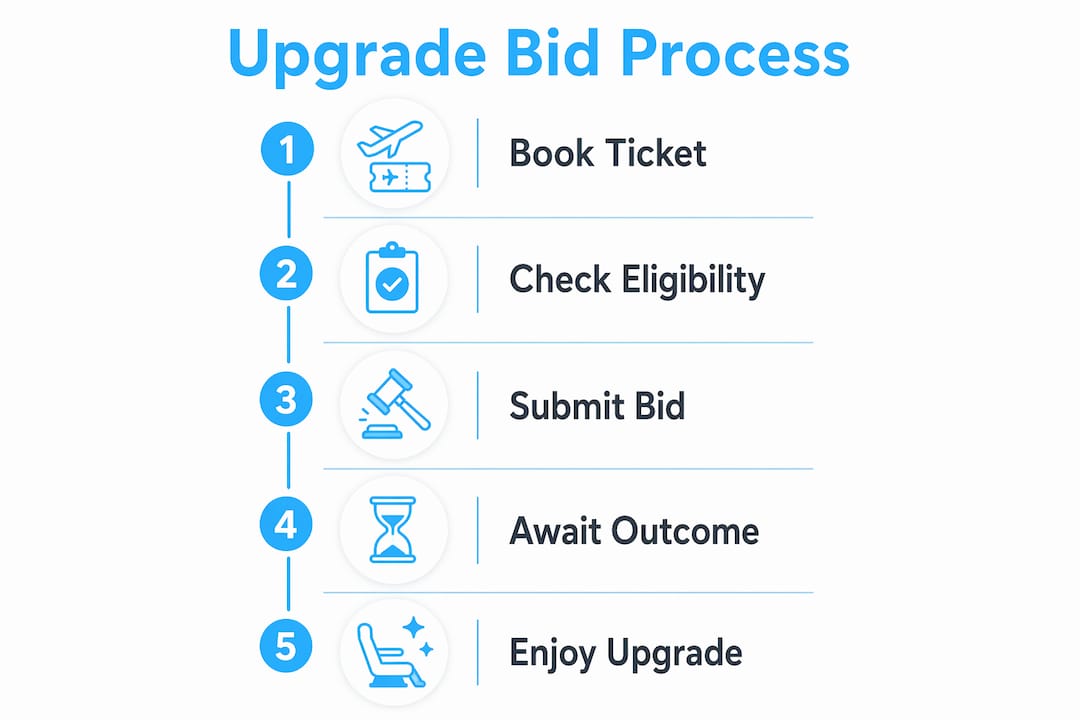
The business class upgrade process follows a clear sequence from booking to boarding. Here is how it works step by step:
- Book your economy ticket. You must hold a confirmed economy reservation before you can access any bidding portal. Most airlines send a bid invitation by email within 24–72 hours of booking.
- Confirm eligibility. The airline checks your fare class and seat availability. Not every ticket qualifies. Lowest economy fares are frequently excluded from the upgrade bid process.
- Access the bidding portal. Airlines like Air Canada, Lufthansa, and Aer Lingus use either their own portals or third-party platforms such as Plusgrade or SeatBoost to manage bids.
- Enter your bid amount. Bids require minimum and maximum amounts, entered per passenger and per flight segment. You cannot submit a token offer below the floor the airline sets.
- Submit payment details. Your card is stored but not charged at this stage. Payment only processes if your bid is accepted.
- Wait for the decision. Airlines typically notify travelers 24–72 hours before departure. Some programs notify as early as a few days out; others send results just hours before the flight.
- Receive ticket reissue. If accepted, your boarding pass is updated to reflect the business class cabin. If declined, nothing changes and no charge appears.
Pro Tip: Set a calendar reminder for the bid cut-off time. Many portals allow you to revise your bid upward before the deadline, and that last-minute adjustment can be the difference between a flat bed and a middle seat.
What eligibility criteria affect who can place upgrade bids?
Eligibility for upgrade bidding in airline travel is not universal. Several factors determine whether you can participate:
- Fare class restrictions. Lowest economy fares generally cannot participate in bid upgrades due to airline restrictions. Basic economy and heavily discounted promotional fares are the most common exclusions.
- Seat availability. If the business class cabin is already full or nearly full, the airline may not open bidding at all. Availability fluctuates up to departure.
- Route and cabin type. Bid upgrade programs are far more common on long-haul international routes than on short domestic segments. A transatlantic flight on Lufthansa is a strong candidate; a 90-minute domestic hop typically is not.
- Per-passenger, per-segment bidding. If you are traveling with a companion or on a multi-leg itinerary, you must submit separate bids for each passenger and each segment. One accepted bid does not cover the whole party or the whole trip.
- Ticket ownership. Award tickets, tickets purchased through certain corporate travel programs, and tickets booked on a codeshare partner may be ineligible depending on the operating carrier’s rules.
Airlines impose these restrictions because bid upgrades are a revenue tool, not a loyalty reward. The goal is to fill seats at a price that beats leaving them empty, not to reward every traveler equally.
Pro Tip: Before booking your economy ticket, check the airline’s upgrade bid policy page. Some carriers list eligible fare classes explicitly. Booking one fare bucket higher can unlock bidding access and more than pay for itself if you win.
How should you strategize your upgrade bids?
Winning upgrade bids depends more on following eligibility, timing, and bidding range guidance than on elite frequent flyer status. That is the single most important strategic insight in this entire article. Here is how to apply it:
- Read the bid range as a probability signal. The minimum and maximum amounts the airline sets tell you what the market looks like. A wide range on a low-demand route means a modest bid may succeed. A narrow range on a popular route signals you need to bid near the top to compete.
- Adjust for perceived demand. A Friday evening departure on a popular business route will attract more bidders than a Tuesday midday flight. Lower-demand departures reward conservative bids.
- Use the offer strength meter. Bid range slider meters act as probability hints; incremental bid adjustment before the deadline is a tactical best practice. Move the slider into the upper third of the range if you genuinely want the seat.
- Weigh cash versus points. Some programs allow bidding with cash or loyalty points via slider controls. Calculate the cents-per-point value before choosing. Points bids often look cheaper but may represent poor redemption value compared to using those points for a full award ticket.
- Do not rely on elite status. Elite tier status does not guarantee an upgrade in bid auctions unless explicitly combined with cash bids. Willingness to pay drives upgrade success in these auctions, not your frequent flyer tier.
The bid auction is not a loyalty program. It is a revenue program. The traveler who bids the right amount at the right time wins, regardless of how many miles they have accumulated.
Set a firm maximum before you open the portal. It is easy to keep nudging the slider upward in the moment. Decide your ceiling in advance and stick to it.
Which airlines and platforms run upgrade bid programs?

Airlines offering bid upgrade services include Air Canada, Lufthansa, and Aer Lingus, among others. Most programs integrate third-party platforms like Plusgrade or SeatBoost to manage the auction mechanics. The table below compares key program features across major carriers.
| Airline | Platform | Bid Currency | Notification Timing | Notable Feature |
|---|---|---|---|---|
| Air Canada | Plusgrade | Cash or Aeroplan points | 24–48 hours before departure | Points bidding available |
| Lufthansa | Proprietary portal | Cash (EUR) | 5 days to 24 hours before departure | Applies to Business and Premium Economy |
| Aer Lingus | Plusgrade | Cash | 3–5 days before departure | Covers transatlantic routes primarily |
| Multiple carriers | SeatBoost | Cash | Varies by airline | White-label solution for smaller carriers |
International routes consistently offer more upgrade bid opportunities than domestic ones. A long-haul flight from Chicago to Frankfurt on Lufthansa is far more likely to have an active bidding window than a short regional hop. The premium cabin on a widebody aircraft holds more unsold seats, which gives the airline more inventory to auction and gives you better odds of winning.
Understanding the differences between cabin classes on a given aircraft also helps you assess what you are actually bidding for. Business class on a narrowbody regional jet is a very different product from a lie-flat suite on a widebody transatlantic flight.
Practical tips for business class bidding most travelers miss
Most travelers focus entirely on the bid amount and ignore the factors that actually determine success. These are the details that separate informed bidders from frustrated ones:
- Research fare class eligibility before you book. Choosing a slightly higher economy fare class at booking can unlock bid access. The price difference is often $30–$80, which is trivial if you plan to bid.
- Check the portal early. Bid invitations sometimes expire or close earlier than expected. Logging in within 24 hours of receiving the invitation gives you the most time to monitor and adjust.
- Set a hard budget ceiling. Accepted bids are often non-refundable except in case of flight cancellation. If the flight operates as scheduled, you cannot reverse the charge even if circumstances change.
- Monitor bid status actively. Some portals show whether your bid is currently “likely” or “unlikely” to succeed. Check back in the 48 hours before departure and revise upward if the meter suggests you are below the competitive threshold.
- Know when to buy outright instead. If the minimum bid is already close to a discounted business class fare, skip the auction. Pilottraveldeals recommends checking cheap business class options before committing to a bid, especially on routes where business class fares drop significantly close to departure.
- Use points strategically. If your loyalty points are worth more than 1.5 cents each on a given program, a cash bid often delivers better value. Reserve points for full award redemptions on routes where cash prices are prohibitive.
Pro Tip: Long-haul flights with a departure more than 10 days away tend to have more flexible bid windows. Submit early, then revise upward in the final 48 hours if the offer strength meter indicates your bid is underperforming.
Key takeaways
A business class upgrade bid succeeds when you combine fare class eligibility, a competitive bid amount, and smart timing, not elite status alone.
| Point | Details |
|---|---|
| Core definition | A bid upgrade is a cash or points offer to move from economy to business class on unsold seats. |
| Eligibility matters | Lowest economy fares are typically excluded; check fare class rules before booking. |
| Bid range signals odds | The minimum-to-maximum range tells you how competitive the auction is on that route. |
| Non-refundable risk | Accepted bids are usually non-refundable, so set a firm budget ceiling before bidding. |
| Status does not win auctions | Willingness to pay, not frequent flyer tier, determines upgrade bid success. |
What i have learned after years of watching upgrade bids
The most common mistake I see travelers make is treating the upgrade bid as a lottery ticket. They submit the minimum amount, forget about it, and then act surprised when they lose. That is not how these auctions work.
The bid range meter is the most underused tool in the entire process. I have watched travelers leave the slider at the minimum and then complain the system is rigged. The meter is telling you something real. When it shows your bid as “weak,” it means other passengers are outbidding you. Adjust accordingly.
My other observation: long-haul flights on off-peak travel days are where upgrade bids deliver the most value. A Tuesday departure from New York to Frankfurt on Lufthansa will have fewer competing bidders than a Friday evening flight. The airline still wants to fill those seats. A mid-range bid on a low-demand departure wins far more often than a high bid on a packed Friday flight.
One caution I give every traveler: never bid more than you are willing to lose. The non-refundable nature of accepted bids catches people off guard. Decide your maximum before you open the portal, not while you are staring at the slider. The psychology of the moment will push you higher than your budget allows.
For frequent flyers who want to maximize business travel benefits, upgrade bidding is worth building into your pre-trip routine. Check eligibility when you book, set a reminder for the bid window, and treat it as a calculated bet rather than a guaranteed upgrade.
— Asher
Find the best deals to pair with your upgrade strategy
Winning a business class bid is only part of a smart travel strategy. The real savings come from combining a well-placed upgrade bid with low base fares and competitive hotel rates.
Pilottraveldeals aggregates flight and hotel deals from multiple providers so you can find the lowest economy base fare before you even open a bidding portal. A cheaper starting ticket means your upgrade bid costs less in total, even if the bid amount stays the same. Explore cheap airfare tips to lock in the best economy fare before you bid, and browse hotel deals to complete your trip without overspending on accommodations. Smart travelers win on both ends of the booking.
FAQ
What is a business class upgrade bid?
A business class upgrade bid is an online offer, submitted in cash or loyalty points, to move from economy to business class when the airline has unsold premium seats. If accepted, your card is charged and your ticket is reissued; if declined, no charge applies.
How do i bid for a business class upgrade?
Book your economy ticket first, then access the airline’s bidding portal or a third-party platform like Plusgrade or SeatBoost. Enter a bid amount within the airline’s set minimum and maximum range, submit your payment details, and wait for a decision typically 24–72 hours before departure.
Does elite status help with upgrade bids?
Elite status does not guarantee success in bid upgrade auctions. Willingness to pay drives outcomes in these auctions, not frequent flyer tier, so a competitive cash bid from a non-elite traveler can beat a low bid from a top-tier member.
Are accepted upgrade bids refundable?
Accepted upgrade bids are generally non-refundable unless the airline cancels the flight. Set a firm budget ceiling before bidding, since you cannot reverse the charge once the bid is accepted and the flight operates as scheduled.
Which airlines offer upgrade bid programs?
Air Canada, Lufthansa, and Aer Lingus are among the carriers with active upgrade bid programs. Many use third-party platforms like Plusgrade or SeatBoost to run the auctions, and availability varies by route, fare class, and seat inventory.
Recommended
- Find cheap business class flights in 2026: proven guide – PilotTravelDeals.com
- How to get business class for cheap: proven 2026 strategies – PilotTravelDeals.com
- How to Find Cheapest Business Class Tickets Step-by-Step – PilotTravelDeals.com
- How to Buy Cheap Business Class Tickets Easily – PilotTravelDeals.com