
TL;DR:
- Setting a travel spending limit helps you control costs and avoid post-trip debt by establishing a financial guardrail.
- Calculating it as 5–10% of your annual after-tax income and allocating funds across categories ensures a realistic and manageable budget.
A travel spending limit is the predetermined maximum amount a traveler sets for all trip expenses before booking a single flight or hotel room. Think of it as your financial guardrail: it keeps you from returning home to a credit card bill that wrecks the memory of a great trip. Financial guidance consistently places a sustainable travel budget at 5–10% of annual after-tax income, meaning a household earning $75,000 post-tax should plan for $3,750–$7,500 per year in travel costs. Setting this ceiling before you start planning is the single most effective way to protect both your wallet and your enjoyment.
What is a travel spending limit and why does it matter?
A travel spending limit is defined as the total dollar amount a traveler commits not to exceed across all trip expenses, from airfare to souvenirs. The industry term for this practice is “travel budget planning,” and it covers everything from the big fixed costs to the small daily purchases that quietly add up. Setting a firm ceiling before you book forces you to make deliberate choices rather than reactive ones.
The psychological benefit is real. A spending limit aligns expectations among travel companions and prevents the budget-related stress and arguments that can ruin a trip. When everyone in your group knows the number, spending decisions become conversations instead of conflicts. That clarity alone is worth the 30 minutes it takes to build a budget.
Travel expense limits also improve financial predictability. You know exactly how much to save before departure, which means no scrambling for cash mid-trip and no post-vacation debt hangover. The limit is not a punishment. It is a plan.
How do you determine a realistic travel spending limit?
Start with your income. A sustainable travel budget sits at 5–10% of your household’s annual after-tax income. For a $75,000 post-tax income, that range is $3,750–$7,500 per year. If you take two trips annually, split that figure between them based on the scale of each trip.
Next, factor in trip length and destination cost. A seven-night trip to Southeast Asia costs far less than seven nights in Scandinavia, even at the same daily spending rate. Use a simple formula to build your number:
- Flights: Research actual round-trip prices for your target dates.
- Lodging: Multiply your nightly rate by the number of nights.
- Daily spending: Estimate a per-day amount for food, local transport, and activities, then multiply by trip length.
- Buffer: Add 15% on top of the total for unexpected costs.
A practical example: a $450 flight, $120 per night for seven nights, and $90 per day in daily spending produces a base cost of $1,740. Add the 15% buffer for incidentals and your total spending limit lands around $1,965. That number becomes your ceiling.
Pro Tip: Set your travel spending limit before you start browsing destinations. Falling in love with a $5,000 trip when your budget is $2,000 creates frustration. Know your number first, then find the best destination that fits it.

What spending categories should your travel budget include?
Travel experts recommend a four-category budget system: Transportation, Accommodation, Food and Drink, and Activities/Miscellaneous. Each category gets a percentage of your total limit. This structure prevents you from overspending on flights and realizing too late that you cannot afford dinner.
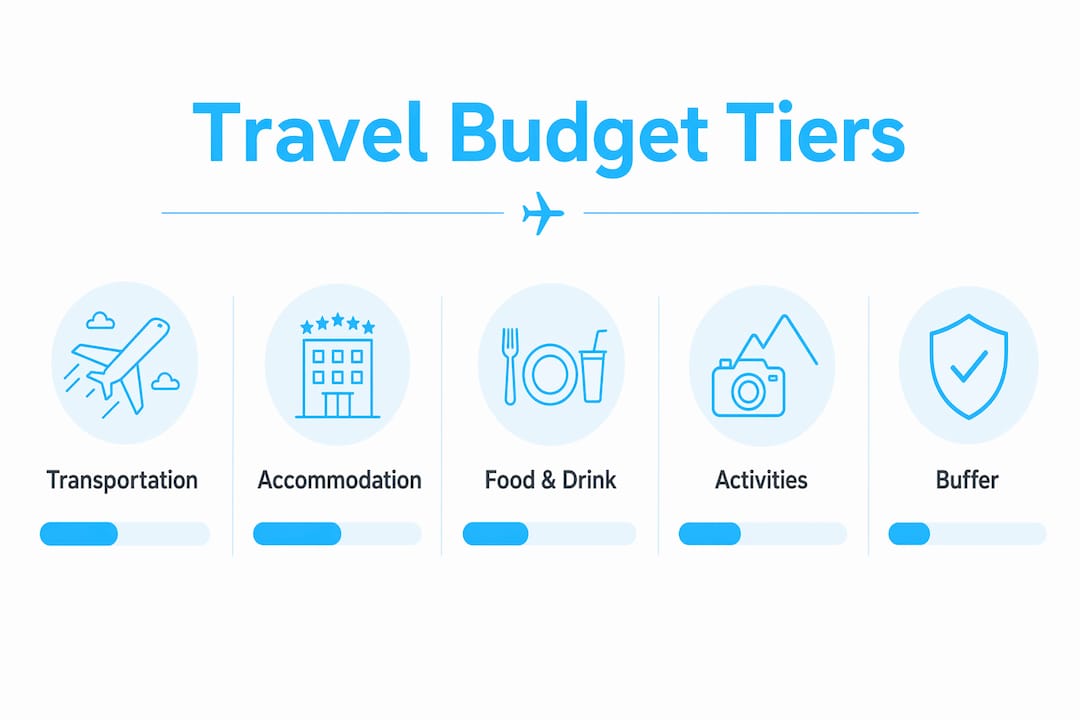
The standard allocation ranges look like this:
| Category | Recommended allocation | What it covers |
|---|---|---|
| Transportation | 30–40% | Flights, trains, car rentals, airport transfers |
| Accommodation | 30–35% | Hotels, hostels, vacation rentals |
| Food and drink | 20–25% | Restaurants, groceries, coffee, alcohol |
| Activities/Misc | 10–15% | Tours, entry fees, souvenirs, tips |
| Buffer | +15% | Baggage fees, tourist taxes, surprises |
Lodging consumes 30–35% of most trip budgets, making it the category where smart choices have the biggest impact. Booking early, choosing shoulder-season dates, or opting for a well-reviewed budget property can free up hundreds of dollars for experiences. For practical guidance on keeping accommodation costs low, Pilottraveldeals covers hotel budgeting strategies that apply to most trip types.
Pro Tip: Allocate your buffer as a separate line item, not a vague mental note. Put that 15% figure in writing. Travelers who skip this step are the ones who end up paying tourist taxes and baggage fees on a credit card they planned to leave at home.
For travelers who want to combine lodging and dining into a single planned experience, the 2026 guide on lodging and gastronomy offers a useful framework for budgeting both categories together.
How do you set and manage daily spending limits?
Once you have your overall travel spending limit, divide the discretionary portion (everything except fixed prepaid costs like flights and lodging) by the number of trip days. That figure is your daily spending limit. It is the number you check against each evening to stay on track.
Independent travelers typically work within three daily spending tiers:
- Budget tier ($75–$150 per day): Hostels or budget hotels, street food and local markets, free or low-cost activities.
- Mid-range tier ($150–$300 per day): Three-star hotels, sit-down restaurants, paid tours and museum entry.
- Comfort tier ($300–$500+ per day): Four to five-star hotels, fine dining, private guides and premium experiences.
The key is separating fixed costs from daily expenses before you calculate your daily limit. If your flights and hotel are already paid, those dollars are gone from the budget. Your daily limit only covers what you spend on the ground each day.
Flexible daily limits work better than rigid tracking for most travelers. Overspend on a big activity day, then eat street food the next day to compensate. This approach keeps the overall limit intact without making every purchase feel like a math test.
Practical tips for managing daily spending on the road:
- Review your spending each evening, not each purchase.
- Designate one “splurge day” per week and plan frugal days around it.
- Use a simple notes app or spreadsheet to log daily totals.
- Pay in local currency to avoid dynamic currency conversion fees that silently add 3–5% to every card transaction.
- Keep a small cash reserve for markets, tips, and vendors who do not accept cards.
What mistakes do travelers make when setting a spending limit?
The most common error is budgeting to the exact dollar. Trying to account for every coffee and bus ticket creates a false sense of precision and collapses the moment reality diverges from the spreadsheet. The better approach is to define your non-negotiables first, then trim discretionary spending around them. Book the flight and the hotel. Everything else is adjustable.
Underestimating incidentals is the second most common mistake. ATM fees, local transit charges, tipping, and small entry fees add up fast. Industry standard practice is to add 10–20% to daily estimates specifically for these overlooked costs. Failing to account for them is a primary cause of budget failure.
Ignoring seasonality is a costly oversight. Traveling in shoulder season can reduce lodging and flight costs by 15–30% compared to peak travel periods. That savings can mean the difference between a comfortable mid-range trip and a budget trip with the same overall spending limit. Pilottraveldeals explains how seasonal pricing affects travel costs in detail, which is worth reading before you lock in dates.
Pro Tip: Talk to your travel companions about the spending limit before you book anything. Mismatched expectations about daily spending are one of the top sources of travel conflict. A five-minute conversation upfront prevents a week of awkward negotiations at restaurants.
Additional mistakes to avoid:
- Forgetting visa fees, travel insurance, and airport parking in the pre-trip budget.
- Using your home currency on payment terminals abroad (always choose local currency).
- Setting a limit based on a best-case scenario rather than realistic prices.
Key Takeaways
A travel spending limit is the most effective tool for protecting your finances and your enjoyment on any trip, and it works best when built from income benchmarks, category allocations, and a deliberate daily limit before you book.
| Point | Details |
|---|---|
| Start with income benchmarks | Set your annual travel budget at 5–10% of after-tax income, then divide by trips planned. |
| Use four spending categories | Allocate across Transportation, Accommodation, Food/Drink, and Activities, then add a 15% buffer. |
| Set a daily spending limit | Divide discretionary funds by trip days and use flexible guardrails, not rigid per-purchase tracking. |
| Avoid precision traps | Define non-negotiables first, then trim discretionary spending rather than budgeting every dollar. |
| Travel in shoulder season | Booking outside peak periods can cut lodging and flight costs by 15–30%, stretching your limit further. |
The number that changed how I travel
I spent years treating travel budgets as rough guesses. I would estimate a number, ignore it by day three, and spend the flight home calculating the damage. The shift happened when I started treating the spending limit as a design constraint rather than a restriction.
The most useful thing I do now is separate fixed costs from daily spending before I leave. Once flights and lodging are paid, I know exactly what I have left per day. That number is surprisingly freeing. I am not tracking every purchase. I am just checking in each evening to see where I stand.
The psychological benefit surprised me most. Traveling with a clear limit means I spend less mental energy on money and more on the trip itself. I also stopped having the uncomfortable “how much did that cost?” conversations with travel companions. We agree on the daily range before we go, and the trip runs smoother for it.
My honest advice: do not try to build a perfect budget. Build a realistic one with a buffer, set a daily limit you can actually live with, and give yourself one guilt-free splurge day. That structure handles 90% of the situations you will encounter on the road.
— Asher
How Pilottraveldeals helps you stay within your travel budget
Pilottraveldeals is built for travelers who take their spending limits seriously. The platform aggregates deals on flights, hotels, and travel services, with savings that can reach up to 80% off standard rates. That kind of discount directly expands what your spending limit can cover.
If accommodation is your biggest budget line, the hotel deals on Pilottraveldeals are a practical starting point. The platform also covers affordable airfare options for travelers who want to keep transportation costs within the 30–40% allocation range. For a broader look at how to put a travel budget together from the ground up, the travel budgeting guide on Pilottraveldeals covers the full process in one place.
FAQ
What is a travel spending limit?
A travel spending limit is the maximum dollar amount a traveler sets for all trip expenses before departure. It covers flights, lodging, food, activities, and a buffer for unexpected costs.
How much should I budget for a trip?
A sustainable travel budget is 5–10% of annual after-tax income. For a $75,000 post-tax income, that means $3,750–$7,500 per year across all trips.
What is a reasonable daily travel spending limit?
Daily spending tiers run from $75–$150 for budget travel, $150–$300 for mid-range, and $300–$500 or more for comfort travel, per person, excluding prepaid lodging and flights.
Should I track every purchase while traveling?
Tracking every purchase creates unnecessary stress. Review your total daily spending each evening and balance overspend days with lighter spending the next day.
How do I avoid going over my travel budget?
Add a 10–20% buffer to daily estimates for incidentals, always pay in local currency to avoid conversion fees, and book during shoulder season to cut lodging and flight costs by up to 30%.

