TL;DR:
- Booking international flights 31 to 45 days before travel can save around $190 compared to booking six months early. Traveling on Tuesdays or midweek days lowers fares, while booking 3 to 7 months ahead benefits long-haul routes with the most savings. Using automated alerts and comparing total costs across fare classes helps travelers consistently find cheaper options.
International travel flight booking is the process of strategically purchasing airline tickets to secure the best prices and routes for global travel. Timing, departure day selection, fare class awareness, and the right booking tools all determine how much you pay. Travelers who apply these principles consistently pay far less than those who book on impulse. This guide covers the exact windows, methods, and steps that produce real savings on cheap international flights in 2026, with data to back every claim.
What are the best times to book international flights?
The single most important variable in international airfare pricing is when you buy, not where you search. Booking 31–45 days before travel saves an average of $190 compared to purchasing six months in advance. That finding flips the common advice to “book as early as possible” on its head.
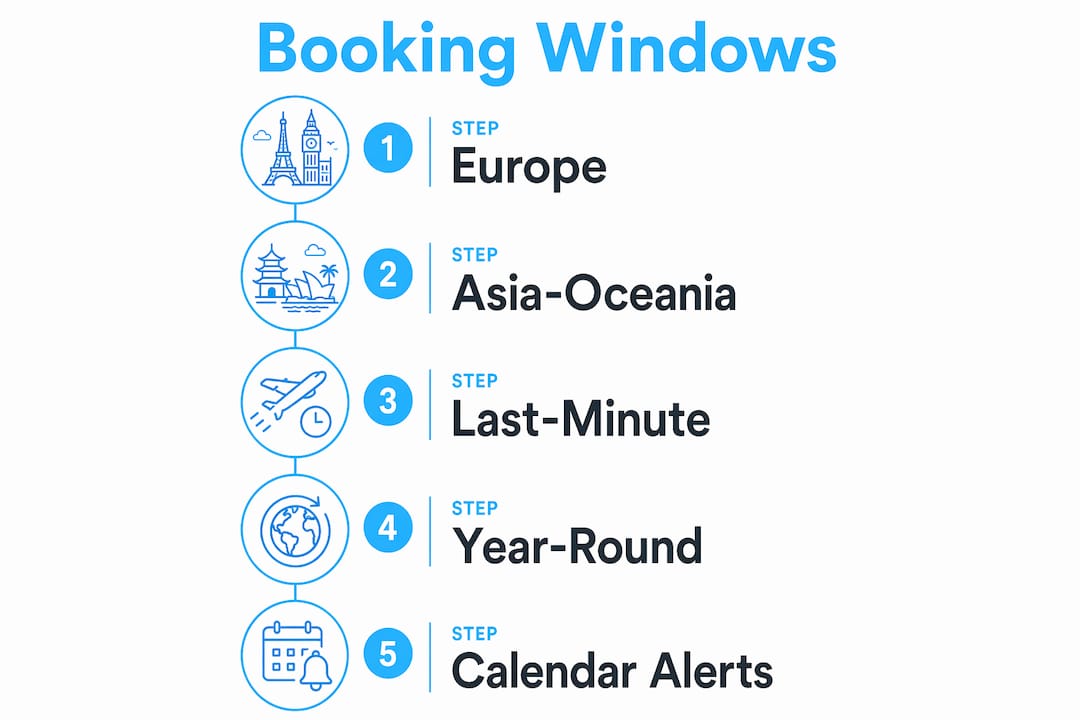
Experts recommend a destination-specific approach for longer planning horizons. For Europe, book 3–5 months ahead; for Asia and Oceania, push that window to 5–7 months. Those regions fill up faster and price spikes hit earlier. The concept industry analysts call the “Goldilocks Window” captures this idea: there is a period for each route where demand is low enough that airlines discount seats, but not so close to departure that inventory is gone.
Seasonality matters just as much as the booking window. Flying in august instead of december cuts airfare by about 29%, saving roughly $120 per ticket. Understanding seasonal pricing patterns before you commit to dates is one of the highest-return moves a traveler can make.
| Region | Recommended booking window | Potential savings |
|---|---|---|
| Europe | 3–5 months ahead | Significant vs. last-minute |
| Asia and Oceania | 5–7 months ahead | Highest savings potential |
| Any region, off-peak month | Flexible timing | ~29% vs. peak months |
| Any region, 31–45 days out | Short-term window | ~$190 vs. 6 months ahead |
Pro Tip: Set a calendar reminder for your target booking window by destination. Treating it like a deadline prevents the “I’ll check tomorrow” drift that pushes you into peak pricing.
How do departure days and flight timing affect airfare?
Departure day is a lever most travelers ignore, and airlines count on that. Tuesday departures average 14% less than Sunday departures on international routes. That gap can translate to hundreds of dollars on a transatlantic or transpacific ticket.

The logic is demand-driven. Business travelers and weekend vacationers flood Friday and Sunday flights. Airlines respond by raising prices on those days because they can. Midweek flights carry lower demand, so fares drop to fill seats. The pattern is consistent enough to build a booking strategy around.
Here is how departure days rank for international routes:
- Tuesday: Cheapest day to depart. Roughly 14% below Sunday prices.
- Wednesday: Close second. Low demand, good availability.
- Thursday: Slightly higher than midweek but still well below weekend rates.
- Friday: Demand rises sharply. Prices follow.
- Saturday: Mixed. Sometimes cheaper than Friday for leisure routes.
- Sunday: Most expensive day to depart internationally.
- Monday: Elevated due to business travel demand on transatlantic routes.
Return flights follow the same pattern in reverse. Sunday returns are the most expensive. Flying back on a Tuesday or Wednesday cuts costs noticeably.
Pro Tip: If your schedule allows even one day of flexibility on departure or return, run a price comparison across the full week. A single-day shift on a long-haul route can save more than a discount code ever will.
Which booking methods give you the best results?
The right tool depends on what stage of the process you are in. Aggregator platforms like Google Flights work best for broad route exploration and price calendars. They surface options across dozens of airlines quickly and let you visualize price changes over a date range. Start every search there.
Once you identify a flight, check the airline’s website directly. Prices are often identical, but booking direct gives you a cleaner relationship with the carrier. If your flight gets canceled or changed, dealing with the airline directly is far simpler than going through a third-party agency. Online travel agencies (OTAs) add a layer of complexity to rebooking and refunds that can cost you time and money during disruptions.
Fare class is the detail most travelers miss. Most search engines display basic economy fares first. Basic economy often excludes carry-on baggage, seat selection, and changes. A $50 difference between basic economy and main cabin can disappear fast once you add a bag fee and a seat assignment fee. Always calculate the full trip cost before clicking “book.”
| Booking method | Best use case | Key limitation |
|---|---|---|
| Aggregator platforms | Broad search, date flexibility, price calendars | May not show all airline fees |
| Airline website | Direct booking, customer service, loyalty points | Fewer route comparisons |
| Online travel agency | Package deals, bundled pricing | Complicates changes and refunds |
What are the step-by-step strategies to book cheap international flights?
A repeatable process beats luck every time. Follow these steps to apply everything above to your next booking.
- Lock in your travel window. Identify a two-to-three-week range of acceptable departure dates. Flexibility here is your biggest asset.
- Search with a price calendar. Use an aggregator platform’s calendar view to see the cheapest days within your window. Midweek departures almost always show lower prices.
- Set price alerts immediately. Automated alerts on specific routes outperform manual checks on any fixed day. Set alerts the moment you identify a target route, then let the system track price drops for you.
- Compare fare classes before committing. Pull up both basic economy and main cabin prices. Add estimated bag fees and seat fees to each. The cheapest base fare is rarely the cheapest total fare.
- Check the airline website directly. After finding your flight on an aggregator, go to the carrier’s site. Confirm the price matches and book there if it does.
- Consider nearby airports. Flying into or out of a secondary airport near your destination can cut costs significantly. A one-hour train ride from a cheaper airport often beats a direct flight at peak price.
- Evaluate bundled options. Some carriers and booking platforms offer flight-plus-hotel packages that undercut the combined cost of booking each separately. For tips on booking weekend stays alongside flights, the savings can stack up quickly.
- Book within your Goldilocks Window. For Europe, that means 3–5 months out. For Asia and Oceania, 5–7 months. For short-haul international routes, 31–45 days out often hits the sweet spot.
Pro Tip: Never book during a price spike triggered by a news event or holiday announcement. Wait 48–72 hours. Prices frequently reset once the initial demand surge passes.
How to manage last-minute international flight bookings
Last-minute booking is a real strategy, not just a fallback. Booking 8–14 days before departure saves an average of $225 compared to booking six months out. Airlines discount unsold seats close to departure rather than fly them empty. That creates genuine opportunity for flexible travelers.
The risk is real, though. Popular routes and peak travel periods rarely see last-minute discounts. Airlines know those seats will sell. Last-minute savings concentrate on less-traveled routes and off-peak departure times. If your destination or dates are fixed and non-negotiable, last-minute booking is a gamble you will likely lose.
These strategies improve your odds when booking on short notice:
- Use last-minute deal alerts. Sign up for fare drop notifications on your target routes. Pilottraveldeals publishes last-minute deal guides that track these drops in real time.
- Stay flexible on departure time. Red-eye and early-morning flights are the last to sell and the first to be discounted.
- Check bundle deals. Combining a last-minute flight with a hotel booking sometimes unlocks package pricing that neither element offers alone.
- Have a backup route ready. If your first-choice flight is full or overpriced, a connecting route through a less-busy hub often opens up cheaper options.
- Act within 24–48 hours of spotting a deal. Last-minute prices move fast. A fare that looks good today may be gone or higher tomorrow.
For a deeper look at short-notice strategies, Pilottraveldeals covers how to save big on last-minute travel with route-specific examples.
Key Takeaways
Effective international flight booking requires matching your booking window to your destination, flying midweek, comparing full fare costs, and using automated alerts rather than guessing at a “magic” purchase day.
| Point | Details |
|---|---|
| Match booking window to destination | Book 3–5 months ahead for Europe; 5–7 months for Asia and Oceania. |
| Fly midweek to cut costs | Tuesday departures average 14% less than Sunday on international routes. |
| Calculate total fare cost | Add bag and seat fees to base price before comparing basic economy vs. main cabin. |
| Use automated price alerts | Real-time alerts on specific routes outperform any fixed “best day to buy” rule. |
| Last-minute can pay off | Booking 8–14 days out saves ~$225 on average, but works best on flexible, off-peak routes. |
What I’ve learned after years of watching flight prices
The biggest mistake I see travelers make is treating flight booking like a one-time decision. They pick a date, search once, and book whatever comes up. Airfare pricing is dynamic. It changes daily, sometimes hourly, based on demand signals that have nothing to do with you personally.
The second mistake is chasing the lowest base fare without reading the fare rules. I have watched travelers “save” $40 on a basic economy ticket and then spend $80 on a checked bag they did not realize was excluded. The math does not work. Evaluating total trip cost is not optional. It is the whole game.
What actually works is ongoing monitoring paired with a clear booking window target. Set your alerts, know your Goldilocks Window for the region, and be ready to act when the price hits your threshold. The travelers who consistently pay less are not lucky. They are patient and prepared. One more thing: no single day of the week guarantees the cheapest fare. Anyone selling you that idea is selling myth, not strategy.
— Asher
Pilottraveldeals makes finding cheap international flights faster
Pilottraveldeals aggregates flight deals, price alerts, and booking guides in one place so you spend less time searching and more time planning.

The cheap flights search tool on Pilottraveldeals lets you compare routes across multiple carriers, filter by travel dates, and spot the midweek pricing gaps this article describes. The site also publishes expert-curated step-by-step booking guides that walk you through fare class decisions, baggage fee calculations, and last-minute deal windows. If you are planning your next international trip, Pilottraveldeals is the starting point that saves you both time and money.
FAQ
What is the cheapest day to book international flights?
No single day of the week consistently produces the lowest fares. Automated price alerts on your specific route deliver better results than any fixed purchase day.
How far in advance should I book an international flight?
Book 3–5 months ahead for Europe and 5–7 months ahead for Asia and Oceania. For flexible travelers, the 31–45 day window before departure also produces strong savings.
Is last-minute international flight booking worth it?
Booking 8–14 days before departure saves an average of $225 versus booking six months out, but the strategy works best on off-peak routes with flexible dates.
What is the cheapest departure day for international flights?
Tuesday is the cheapest day to depart internationally, with fares averaging 14% less than Sunday. Wednesday and Thursday are close alternatives.
Should I book through an aggregator or directly with the airline?
Start your search on an aggregator platform to compare routes and prices, then book directly with the airline to simplify any future changes or refund requests.
Recommended
- Tips for International Flights: Your 2026 Travel Guide – PilotTravelDeals.com
- Top tips for booking last-minute travel deals in 2026 – PilotTravelDeals.com
- How to book cheapest domestic flights in 2026: guide – PilotTravelDeals.com
- Cheap international flight tickets: save more in 2026 – PilotTravelDeals.com