
TL;DR:
- Corporate flight booking is a managed process that enforces company policies, travel limits, and approval workflows to save costs and reduce administrative burdens. It involves booking through approved platforms that automatically display policy-compliant options, streamline expense reporting, and enhance visibility. Using these systems, small businesses can optimize travel management, ensure compliance, and access negotiated group rates efficiently.
Booking your own flights for a business trip feels like the obvious move. You know what you need, you can find a decent fare, and it takes ten minutes. But that assumption costs companies thousands every year, and it costs individual travelers time, reimbursement headaches, and missed discounts. What is corporate flight booking, exactly? It is the practice of arranging and managing employee flights through company-approved channels, travel policies, and spending controls rather than through personal booking habits. Done right, it saves money, cuts paperwork, and takes a surprising amount of stress out of business travel.
Table of Contents
- What is corporate flight booking and how does it work?
- Tools and platforms that simplify corporate flight booking
- Group corporate flight booking: saving money and managing teams
- How corporate travel policies influence flight bookings and budgets
- Tips for travelers and small business owners to get the most from corporate flight bookings
- Why corporate flight booking is underappreciated by budget-conscious travelers
- Explore affordable corporate travel options and tools at PilotTravelDeals.com
- Frequently asked questions
What is corporate flight booking and how does it work?
Corporate flight booking is not just buying a plane ticket with a company card. It is a managed process where every booking happens inside a framework. That framework includes spending limits, preferred airlines, approval workflows, and expense tracking built directly into how you search and book. The result is that corporate travel booking involves arranging travel for employees within company policy channels, including spending limits and approvals, from the moment you start searching.
In practice, this means employees either book through a dedicated travel management platform, a corporate travel agency, or a self-service portal their employer has configured. Each of these options has the company’s policies embedded into the search results. You might see only flights on preferred airlines. Fares above a set limit might be flagged or blocked entirely. A one-click approval request might fire off to your manager before the booking confirms.
Here is what the workflow typically looks like:
- You log into the approved booking tool or platform
- Search results display within policy parameters automatically
- Out-of-policy options appear with warnings or are hidden entirely
- You select a flight, and the system routes an approval request if required
- Once approved, your booking confirms and syncs directly with expense reporting
- Receipts and reimbursement records generate without extra manual steps
For small business owners, this structure matters even without a formal corporate travel department. Even a basic policy around which platforms to use and what fare classes are acceptable can cut travel costs significantly. Check out these corporate travel discounts examples to see how meaningful those savings can get.
Pro Tip: If you are a solo business owner or freelancer who travels frequently, setting personal spending rules before you book, such as a maximum fare threshold or advance booking window, mirrors what corporate systems do automatically. It forces smarter decisions before emotion or urgency takes over.
Tools and platforms that simplify corporate flight booking
Once you understand what corporate flight booking involves, the next question is what tools actually make it work. A corporate booking platform, at its core, is software that centralizes flight search, booking, policy enforcement, and expense tracking in one place. Modern platforms have moved far beyond what a traditional travel agency could offer.
The key features to look for in any corporate booking platform include:
- Policy compliance built into search results so travelers only see approved options by default
- Preferred supplier integration that surfaces negotiated rates with specific airlines automatically
- Automated expense submission that logs receipts and travel details without manual data entry
- Approval workflow routing that notifies managers and logs decisions in real time
- Real-time spend dashboards that give finance teams a live view of travel budgets versus actuals
- Integration with HR and payroll systems so employee data, cost centers, and reimbursements stay accurate without duplicate entry
Corporate travel booking platforms automate booking, enforce policy, and provide visibility into travel spending, which is a significant upgrade from email chains and manual reconciliation. For small businesses especially, this visibility alone is worth the switch. Knowing exactly what you are spending on business air travel in real time changes how you plan and budget.
“Modern travel platforms provide self-service booking and real-time spend visibility, surpassing traditional manual methods in both accuracy and efficiency.”
Small business owners often assume these platforms are only for enterprise companies with dedicated travel managers. That is not true. Several platforms scale down to teams of two or three, and the time saved on expense reports alone pays for the subscription quickly. If you want a side-by-side look at your options, this breakdown of best business travel booking platforms covers the landscape clearly. And if you’re used to comparison tools for personal travel, the logic is similar to how family travel comparison sites surface the best options across multiple providers.
Pro Tip: When evaluating a corporate booking platform for a small business, prioritize expense automation over everything else. The platform that saves your accountant three hours a month on reconciliation is worth more than the one with the most airline integrations.
Group corporate flight booking: saving money and managing teams
Group corporate flight booking adds another layer to business travel management. A group booking, in airline terms, typically means 10 or more passengers booked under a single reservation code with negotiated rates. For companies sending teams to conferences, client sites, or company retreats, this can simplify logistics considerably.

The advantages are real. Everyone travels on the same flight, which makes ground transportation and scheduling far easier to coordinate. Negotiated group rates sometimes beat publicly available fares, especially on routes with high demand. Admin time shrinks because one booking covers dozens of travelers. Name changes and seat assignments can often be managed in bulk.
But group bookings come with trade-offs that catch companies off guard:
- Less pricing flexibility: Group fares are fixed at the time of agreement. If fares drop later, you typically cannot rebook at the lower price.
- Name change deadlines: Airlines require final passenger names by a set date, which causes headaches when team rosters shift.
- Deposit requirements: Many airlines require a deposit to hold group inventory, which ties up cash flow.
- Availability constraints: Group space on popular routes fills fast, making early booking critical.
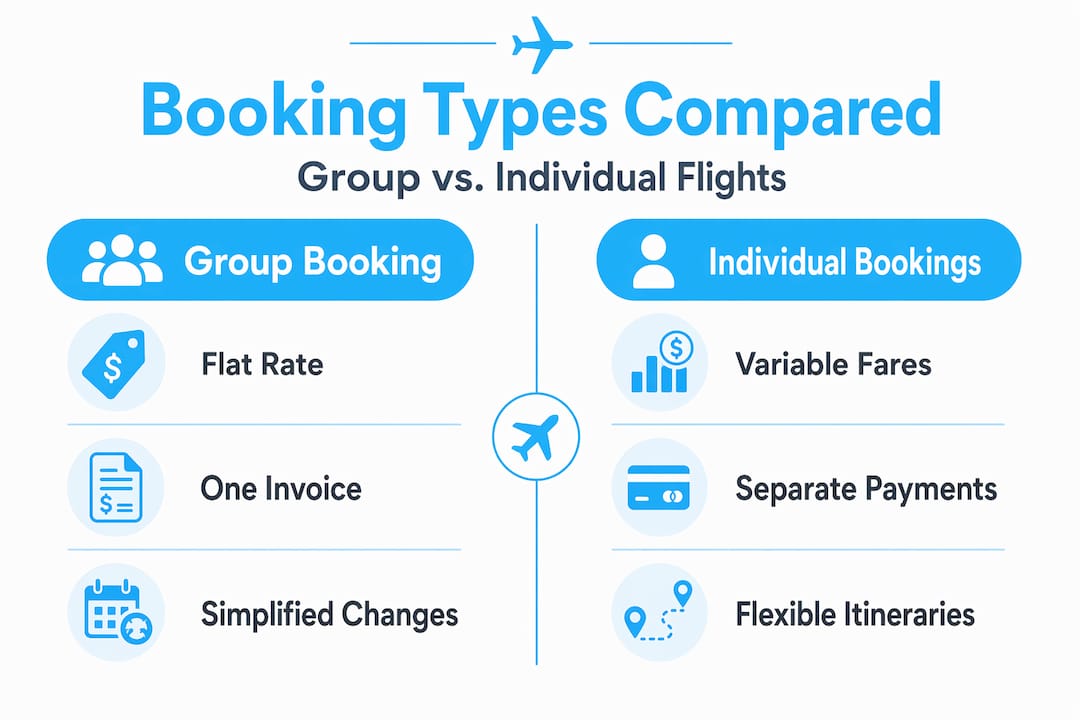
Here is a quick comparison to help you decide between group and individual bookings for team travel:
| Factor | Group booking | Individual bookings |
|---|---|---|
| Fare type | Negotiated flat rate | Market-variable |
| Minimum travelers | Usually 10+ | No minimum |
| Name change flexibility | Limited, deadline-driven | More flexible per ticket |
| Admin effort | Low (one reservation) | High (multiple itineraries) |
| Best for | Fixed teams, fixed dates | Mixed itineraries, flexible teams |
| Pricing advantage | Strong on high-demand routes | Better when fares are low |
Airlines vary widely on how they handle group bookings, so it pays to contact airline group desks directly or use a platform that negotiates on your behalf. You can also explore group booking discounts to understand what kinds of savings are realistically available for coordinated travel.
Pro Tip: If your group has even two or three travelers with different itineraries or return dates, split them into separate bookings. Group fares penalize itinerary changes heavily, and the savings rarely offset the flexibility loss when schedules are uncertain.
How corporate travel policies influence flight bookings and budgets
Corporate travel policies are the engine behind every well-run corporate air travel program. A policy is not just a document employees read once and forget. In modern booking systems, policy rules are embedded directly into the booking workflow so that compliance happens automatically, not retroactively.
What does that look like in practice? Airlines, fare classes, and booking windows that meet policy show up normally. Options outside those parameters trigger different responses depending on how the policy is configured:
- Soft stops display a warning that a selection is out of policy but allow the traveler to proceed, usually with a required justification
- Hard stops block the booking entirely until a manager overrides it
- Pre-trip approval workflows require sign-off before any booking confirms, adding a review layer for larger expenses
- Preferred supplier restrictions automatically surface negotiated rates with approved airlines first
“Corporate flight booking embeds policy controls like preferred suppliers, spending limits, soft and hard stops, and pre-trip approvals in the booking workflow, reducing exception handling and after-the-fact corrections.”
For budget-conscious small business owners, building even a simple policy into your booking process prevents the most common money leaks: last-minute bookings, premium cabin upgrades on short routes, and fares on non-preferred airlines where no negotiated rate exists. Policy does not have to be restrictive. It just has to be clear. Consistent guidelines also make it faster for employees to book without second-guessing whether a fare is acceptable.
A well-designed policy improves traveler satisfaction too, because it removes ambiguity. Employees know exactly what is approved, what requires justification, and what will be reimbursed without a fight. Finance teams get clean spend data without chasing receipts. Everyone wins. See how specific policy choices translate into real savings in these corporate travel savings strategies.
Tips for travelers and small business owners to get the most from corporate flight bookings
Knowing how corporate flight booking works is one thing. Using it effectively is another. These practical steps will help you and your business extract real value from the system rather than just going through the motions.
- Book early through approved channels. Negotiated corporate rates are sometimes only accessible through specific platforms. Booking outside those channels, even on the same airline, may forfeit the discount entirely. Book as soon as your travel dates are confirmed.
- Read your travel policy before you search, not after. Knowing your fare class limits, advance booking requirements, and preferred airline list before you open the booking tool prevents wasted time reviewing out-of-policy results.
- Use automated expense submission every time. Manual expense reports introduce errors and delays. Most corporate platforms sync booking data directly to your expense system. Let them do it. Managed corporate booking ties travel and expense records together, reducing reimbursement friction significantly.
- Compare group versus individual fares before defaulting to either. Run both scenarios when sending a team. Group rates win on some routes and lose on others. The 20 minutes spent comparing saves real money.
- Coordinate with your travel manager or finance contact before booking anything unusual. A quick message before booking a connecting itinerary or an upgraded fare class is far easier than explaining the exception after the fact.
- Set up mobile alerts and app access for your approved platform. Real-time flight updates, gate changes, and delay notifications through the corporate tool mean you stay informed without switching between apps.
For deeper guidance on planning business trips efficiently, these best business trip planning practices and travel smart tips are worth bookmarking.
Pro Tip: If you are a small business owner without a formal travel program, create a shared document with your team that lists your preferred booking platform, fare class limits, and advance booking window. It takes 30 minutes to write and saves hours of confusion per trip.
Why corporate flight booking is underappreciated by budget-conscious travelers
Here is the honest take: most budget-conscious travelers, especially freelancers and small business owners, treat corporate flight booking as something that applies to big companies with travel departments. That perception is costing them money.
The common complaint is that corporate systems feel restrictive. You cannot book the cheap red-eye you found on a consumer site. You have to use the approved platform. You need approval for anything over a certain amount. On the surface, it sounds like bureaucracy layered onto something that should be simple.
But look at what that structure actually delivers. Policy-driven booking catches the costly habits that feel harmless in the moment: booking three days out instead of three weeks, choosing a connecting flight on a non-preferred airline that costs more than a direct fare, or missing a negotiated rate because you searched outside the approved channel. The policy is not there to control you. It is there to catch the decisions you would regret at reimbursement time.
The other underappreciated benefit is speed. Expense reports built on manually collected receipts from personal bookings take time. Corporate platforms automate that entirely. For a small business owner billing hours, that time has a real dollar value. Understanding the latest business travel trends shows how much technology has shifted the balance in favor of the individual traveler, not just large corporations.
The most interesting shift happening right now is that self-service corporate platforms have removed the tradeoff between autonomy and compliance. You get to search, compare, and book yourself. The platform just ensures you are doing it within rules that protect your budget. That is not restriction. That is a better deal.
Explore affordable corporate travel options and tools at PilotTravelDeals.com
You now have a clear picture of how corporate flight booking works and how to use it smartly. The next step is making sure you have the right resources to find the best fares before you ever open a booking platform.
PilotTravelDeals.com gives budget-conscious business travelers a real advantage from the very start of the planning process. Use our flight comparison advantages to understand exactly why comparing fares across multiple providers consistently beats booking direct, and see why fare comparison is the move smart business travelers make first. Need to bundle accommodation? Our hotel booking steps walk you through locking in the best rates alongside your flights. From SIM cards to bike rentals, we cover every corner of the business trip so your budget goes further on every booking.
Frequently asked questions
What exactly does corporate flight booking mean?
Corporate flight booking involves arranging employee flights according to company travel policies, using approved channels and controls to manage costs and compliance. Specifically, it means arranging and managing flights for business trips within policy-driven systems rather than through open consumer channels.
How do corporate travel booking platforms benefit small businesses?
They centralize bookings, enforce policy compliance, automate expense tracking, and provide visibility into travel spending, simplifying management and reducing errors. Travel management software centralizes corporate travel from booking through expense reimbursement while aligning to policies and providing spending visibility.
Are group corporate flight bookings always cheaper than individual tickets?
Not always. While group bookings offer negotiated rates and simplified administration, they can sometimes cost more than individual fares depending on availability and airline pricing rules. Group bookings often provide discounts but may not always be the cheapest option given fare availability.
Can employees book outside company travel policies using corporate booking platforms?
Corporate platforms embed controls like soft and hard stops to guide or block bookings outside policy, though some soft stops can be overridden with approval. Embedded controls include soft stops (warnings) and hard stops (block bookings) as the two main enforcement mechanisms.
How can travelers ensure they get the best deals when booking corporate flights?
Booking early through approved platforms, understanding policy guidelines before searching, and using automated expense submissions are the most reliable ways to maximize savings. Managed corporate booking ties travel and expense records together, reducing reimbursement friction for budget-conscious travelers.
What is the difference between traditional travel agencies and modern corporate booking platforms?
Modern platforms offer online self-service booking, automated policy enforcement, and real-time spend visibility integrated with HR and expense systems, unlike agencies relying on manual processes. Modern platforms automate bookings, embed policy, and replace manual agency calls and paper-based reporting entirely.

