
If you’ve been booking flights on Tuesdays because someone told you that’s the cheapest day, you’ve been leaving real money on the table. That old rule is officially dead. New data for 2026 shows Friday has taken over as the best day to book and fly, with savings of up to 18% compared to weekend travel. But here’s the thing: chasing any single “magic day” is still the wrong approach. The travelers who consistently score the lowest ticket prices use a combination of the right tools, smart timing, and a few key habits that most people overlook.
Table of Contents
- Why ‘cheapest day’ advice changed in 2026
- Top tools for finding the lowest ticket prices
- Booking strategies that actually work
- Hidden pitfalls: What most people miss
- The uncomfortable truth: There’s no magic formula for lowest fares
- Smart next steps: Tools, deals, and more resources for travelers
- Frequently asked questions
Key Takeaways
| Point | Details |
|---|---|
| Best day myths busted | Friday is now often the cheapest day, but prices change daily—don’t rely on old rules. |
| Tool choice matters | Using flexible search and alerts with Google Flights or Skyscanner boosts your savings potential. |
| Avoid risky hacks | Shortcuts like hidden-city tickets can backfire—focus on proven comparison and timing strategies. |
| Consistent comparison wins | Stacking the basics—flexibility, alerts, and research—is the real secret to lower fare success. |
Why ‘cheapest day’ advice changed in 2026
For years, travel bloggers repeated the same advice: book on Tuesday afternoons. Airlines would release sales on Monday nights, competitors would match by Tuesday, and savvy shoppers would swoop in. It made sense at the time. The problem is that airline pricing no longer works that way.
Modern airlines use dynamic pricing algorithms that adjust fares hundreds of times per day based on supply, demand, competitor moves, and even browsing patterns. There is no scheduled “sale window” anymore. The idea that a specific weekday reliably produces cheaper fares is a leftover myth from a simpler era.
So what does the latest data actually say? According to the Expedia 2026 Air Hacks report, Friday is now the cheapest day to both depart and book flights, with savings ranging from 8% to 18% compared to peak weekend travel days. That’s a meaningful difference on a $500 ticket.
Other sources add nuance. NerdWallet notes that no single best day exists because prices fluctuate constantly, though Tuesday, Wednesday, and Saturday also tend to produce lower fares on many routes. The honest takeaway is that Friday leads the pack in 2026, but it’s not a guarantee on every route.
Here’s a quick look at how the days stack up:
| Day | Typical fare trend | Best for |
|---|---|---|
| Friday | Lowest overall (8-18% savings) | Booking and departing |
| Tuesday | Often low, route-dependent | Midweek flexibility |
| Wednesday | Competitive on many routes | Budget travelers |
| Saturday | Lower than Sunday and Monday | Weekend departures |
| Sunday | Higher demand, pricier | Avoid if flexible |
“Friday is the new cheapest day to depart and book, delivering up to 18% savings compared to the most expensive travel days.” — Expedia 2026 Air Hacks Report
The real lesson here isn’t to switch from Tuesday to Friday and call it a day. It’s to stop obsessing over calendar slots and start focusing on what actually moves the needle: booking windows, fare alerts, and flexibility. You can learn more about timing on our guide to the best day to find cheap flights.
Key takeaways from the data:
- Friday delivers the most consistent savings in 2026
- Tuesday, Wednesday, and Saturday are solid alternatives
- Algorithms drive prices, not fixed weekly schedules
- Flexibility matters far more than picking the “right” day
Top tools for finding the lowest ticket prices
Knowing when to look is only half the battle. The tools you use to search can make just as big a difference as the day you book. Not all fare search engines are created equal, and using the right combination gives you a serious edge.
Google Flights is the starting point for most experienced travelers. Its flexible date grid lets you scan an entire month at a glance, spotting the cheapest combinations instantly. The price graph feature is especially useful for spotting trends over time. It also searches across a wide range of online travel agencies, so you’re not stuck with one provider’s inventory.
Kayak stands out for its price forecast feature, which uses historical data to predict whether fares are likely to rise or fall. It’s not perfect, but it adds a useful layer of context when you’re deciding whether to book now or wait. Kayak also supports robust price alerts.
Skyscanner is the go-to for its “Everywhere” search, which lets you enter your departure city and find the cheapest destinations in the world for a given month. If you have flexibility on where you’re going, this feature is genuinely powerful.
Momondo often surfaces fares that other engines miss, particularly on international routes. It’s worth running a parallel search here even if you’ve already checked Google Flights.
According to Frommers’ 2026 roundup, these four platforms consistently rank as the best airfare search tools available. Using them together takes less than ten minutes and can reveal price gaps of $50 to $200 on the same route.
| Tool | Best feature | Alert support |
|---|---|---|
| Google Flights | Flexible date grid | Yes |
| Kayak | Price forecast | Yes |
| Skyscanner | Everywhere search | Yes |
| Momondo | International coverage | Yes |
For premium cabin travelers, our breakdown of business class ticket tools covers specialized options. If you’re focused on international routes, see how to compare international flight ticket prices effectively.
Pro Tip: Set price alerts on at least two platforms for the same route. Algorithms vary, and one tool may catch a fare drop that another misses entirely.
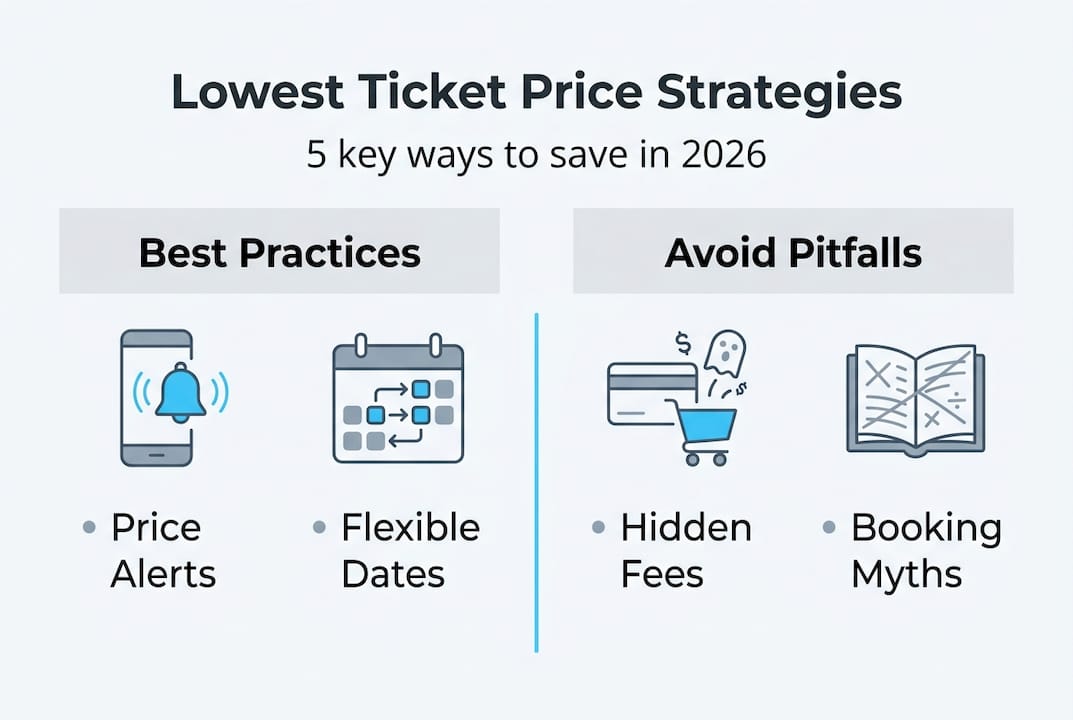
Booking strategies that actually work
With the right tools in hand, the next step is applying proven booking techniques. These aren’t hacks or loopholes. They’re consistent habits that give you better odds of landing a low fare.
- Book early for peak periods. For summer travel, holidays, and school breaks, fares rise sharply as the date approaches. Booking 3 to 6 months out for peak travel is a reliable way to lock in lower prices before demand spikes.
- Use flexible date search. Most major tools let you search across a range of dates. Even shifting your departure by one or two days can save $100 or more on popular routes.
- Set fare alerts and check them. Prices drop unpredictably. Alerts do the monitoring for you so you can act fast when a deal appears.
- Compare one-way and round-trip fares separately. Sometimes two one-way tickets on different carriers cost less than a single round-trip. It takes an extra two minutes to check and can be worth it.
- Consider alternative airports. Flying into a secondary airport near your destination often opens up cheaper options, especially in major metro areas with multiple airports.
NerdWallet confirms that focusing on booking windows and fare alerts consistently outperforms trying to time purchases around specific days of the week. The data backs up what experienced travelers already know: flexibility is your biggest asset.
One popular myth worth addressing is incognito browsing. Many travelers believe that searching in a private browser window prevents airlines from tracking their searches and raising prices. Experts have debunked this. Airlines don’t raise prices based on your browsing history. Incognito mode does nothing to lower your fares.

For more practical guidance, our resources on saving on flights, tips for booking flights, and cheap flight tips go deeper on each of these strategies.
Pro Tip: If you find a fare you’re happy with, book it. Waiting for a slightly better price often means losing the seat entirely, especially on popular routes during busy seasons.
Hidden pitfalls: What most people miss
Solid booking habits will get you far, but avoiding certain mistakes is just as important as following the right strategies. Some popular “hacks” carry real risks that most travelers don’t fully understand.
Hidden-city ticketing is one of the most talked-about tricks online. The idea is to book a flight with a layover at your actual destination, then skip the final leg. It can produce dramatically lower fares. However, National Geographic reports that airlines actively ban travelers caught doing this and may cancel return tickets or frequent flyer accounts without warning. The savings are rarely worth the risk.
Split ticketing involves booking two separate one-way tickets instead of a single itinerary. Done carefully, it can save money. Done carelessly, it means you’re responsible for your own connection if one flight is delayed. Airlines won’t rebook you onto a partner carrier’s flight if you miss it due to a delay on your first ticket.
“Hidden-city ticketing and split ticketing can result in banned accounts, canceled tickets, and lost miles. These aren’t just loopholes; they’re violations of airline contracts.” — National Geographic Travel
Budget carrier fees are another trap. An advertised $39 fare can balloon to $120 once you add a carry-on bag, seat selection, and a checked bag. Always calculate the total cost, not just the base fare, before assuming a budget airline is actually cheaper.
AI fare prediction tools have grown popular but experts warn they are often inaccurate. Airline pricing is too complex and too dynamic for current AI tools to predict reliably. Use them as one data point, not as a definitive guide.
Other common mistakes to avoid:
- Assuming the first fare you see is the best available
- Booking too close to departure on popular routes
- Ignoring total trip cost when comparing carriers
For more on avoiding these traps, check out our guides on cheap plane ticket tips, cheap airfare tips, and how to travel on a budget without falling for misleading deals.
The uncomfortable truth: There’s no magic formula for lowest fares
Here’s what years of watching travel pricing patterns makes clear: most travelers waste enormous energy chasing shortcuts that don’t exist. They refresh prices obsessively, switch browsers, try hidden-city tricks, and wait for a mythical “perfect moment” to book. Meanwhile, the travelers who consistently pay less do something far less exciting. They compare across multiple tools, set alerts, stay flexible on dates, and book when a fare meets their threshold.
The travel industry is genuinely complex. Algorithms, seat inventory, competitor pricing, and seasonal demand all interact in ways that no single rule can capture. There’s always some luck involved. But luck favors the prepared traveler who uses the advantages of flight comparison consistently rather than gambling on hacks.
Stack the basics. Skip the loopholes. That’s the real strategy.
Smart next steps: Tools, deals, and more resources for travelers
You now know which days tend to produce the lowest fares, which tools to use, and which pitfalls to avoid. The next step is putting it all together with a reliable comparison platform.

At PilotTravelDeals.com, we’ve built a one-stop resource for budget-conscious travelers who want real savings without the guesswork. Compare flights across multiple providers, find budget SIM cards to avoid roaming charges abroad, and browse hotel deals that can save you up to 80% on accommodations. Our platform aggregates vetted offers so you spend less time searching and more time traveling. Start with our guide on why use fare comparison to see exactly how the right tools put more money back in your pocket.
Frequently asked questions
Is there a single best day to buy airline tickets for lowest prices?
No. While Friday leads in 2026 with up to 18% savings, prices change constantly and no single day guarantees the lowest fare on every route.
Which websites help find the lowest ticket prices?
Google Flights, Kayak, Skyscanner, and Momondo are consistently rated the best platforms for flexible search, price alerts, and reliable fare comparisons in 2026.
Are hidden-city tickets or split ticketing good tricks to save money?
These tactics are risky. Airlines can ban travelers caught using hidden-city ticketing and may cancel tickets or frequent flyer accounts without refund.
Does searching in incognito mode get cheaper fares?
No. Experts confirm that incognito browsing has no effect on airfare prices, making it a persistent myth with no practical benefit.
Recommended
- Tricks to find cheap flights: expert tips for 2026 – PilotTravelDeals.com
- Unlock cheaper airfare: insider strategies for saving – PilotTravelDeals.com
- Cheap international flight tickets: save more in 2026 – PilotTravelDeals.com
- How to find super cheap flights in 2026: budget guide – PilotTravelDeals.com
- Travel Iceland on a budget: smart tips for affordable adventure | Fox Hostel – South Iceland
- Disney Schnäppchenangebote 2026: So sparst du bis 30%

