TL;DR:
- Travel expense tracking helps manage travel costs by capturing and categorizing expenses for better budget control. Automated tools reduce costs, errors, and processing time while supporting tax compliance and fraud prevention. Real-time tracking enables early problem detection and improved decision-making for both business and personal travel.
Travel expense tracking is defined as the systematic process of capturing, categorizing, and managing travel-related costs to maintain financial control and accountability. Whether you travel for business or personal reasons, this practice sits at the center of budget planning, tax compliance, and timely reimbursement. Tools like expense management apps, corporate cards, and OCR receipt scanning have made the process faster and more accurate than ever. Understanding how expense tracking works gives you a real advantage over your travel budget.
What is the role of travel expense tracking in budgeting?
Travel expense tracking gives you direct visibility into where your money goes. Without it, you are comparing a pre-trip estimate against a vague memory of what you spent. With it, you see real-time data: hotel costs versus the budgeted rate, meal spending by day, and transportation overages by category.
Comparing booked costs to actual expenses reveals overspending, policy leakage, and unauthorized claims before they compound. That comparison is the most underused tool in personal and corporate travel budgeting.
Monthly and quarterly expense reports also support smarter decisions over time. A business traveler who reviews three months of hotel data can identify which cities consistently push them over budget. That data supports negotiating corporate rates with hotel chains or switching to a more affordable booking platform. Personal travelers benefit equally. Tracking a summer road trip by category, fuel, lodging, food, and activities, shows exactly where the next trip can be trimmed.
- Real-time visibility: You catch overages while the trip is still happening, not weeks later.
- Pattern recognition: Repeated data across trips reveals which expense categories consistently run high.
- Negotiating power: Documented spending history supports rate negotiations with hotels, airlines, and car rental companies.
- Accurate forecasting: Past actuals replace guesswork when planning future trip budgets.
Pro Tip: Set a daily spending cap by category before each trip. Compare actuals against those caps at the end of each day using a mobile expense app. Catching a $40 overage on day two is far easier to correct than discovering a $280 overage on the last day.
Pilottraveldeals recommends pairing expense tracking with upfront deal comparison. Locking in lower rates on corporate travel savings before departure shrinks the gap between budgeted and actual costs from the start.
How does the tracking process work, and what tools help?
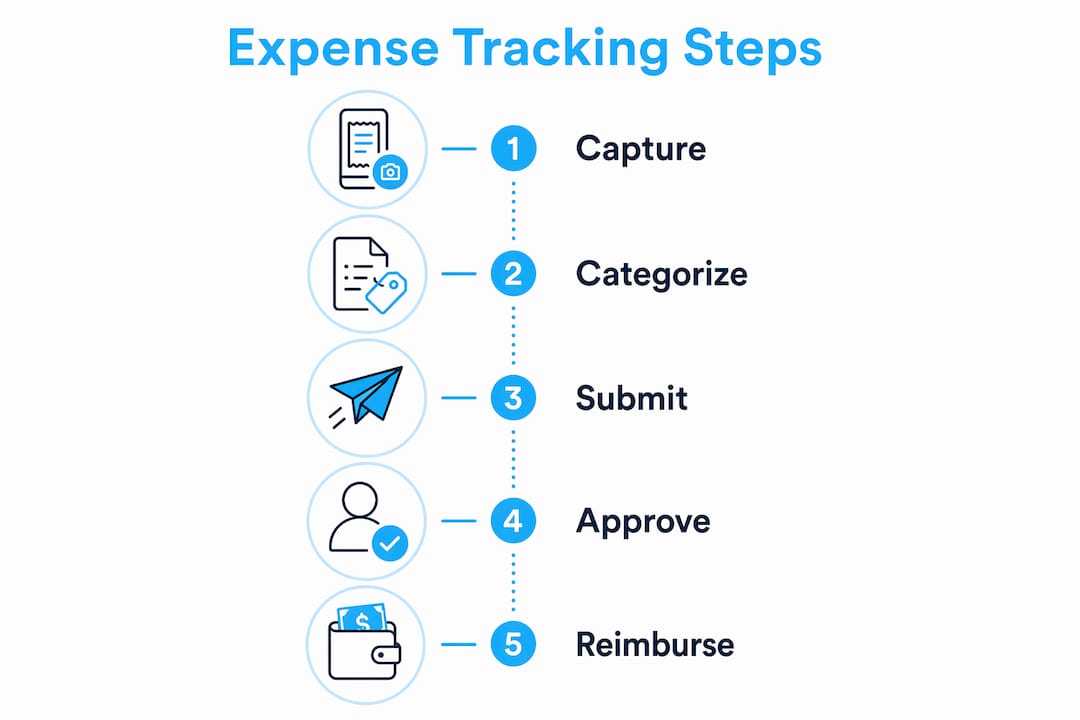
The standard expense management workflow follows five steps: capture, categorize, submit, approve, and reimburse. Each step is a potential failure point when done manually, and a potential efficiency gain when automated.

Capture is where most travelers fall behind. Paper receipts get lost, crumpled, or forgotten. Mobile apps with OCR (optical character recognition) scanning solve this by photographing a receipt and automatically extracting the vendor, date, and amount. Categorization follows, sorting expenses into buckets like lodging, meals, transportation, and incidentals. Submission sends the report to a manager or finance team. Approval checks the report against policy. Reimbursement closes the loop.
The cost difference between manual and automated systems is significant. Manual expense reports cost an average of $26.63 each and take 3–4 weeks to reimburse. Automated systems reduce that cost to $2–$7 and cut reimbursement time to 5 business days. That is a direct financial argument for switching to digital tools.
| Feature | Manual process | Automated system |
|---|---|---|
| Cost per report | $26.63 average | $2–$7 |
| Reimbursement time | 3–4 weeks | 5 business days |
| Error rate | High (19% require rework) | Significantly lower |
| Audit readiness | Inconsistent | Consistent digital trail |
| Policy enforcement | Manual review | Automatic rule checks |
Corporate virtual cards add another layer of control. Linking receipts to virtual card transactions captures the business purpose at the moment of purchase, reducing the documentation burden during review. That approach also makes it nearly impossible to submit a receipt for a personal expense against a business transaction.
Pro Tip: If your company does not yet use virtual cards, ask your finance team about tools like Expensify, Concur, or Brex. Each integrates with major accounting platforms and automates the categorization step almost entirely.
For personal travelers, free apps like Google Sheets templates or low-cost tools like TravelSpend give you the same category-level visibility without a corporate system behind them. The key is consistency: log every expense the same day it happens.
How does expense tracking support compliance and audit readiness?
Proper expense tracking is the foundation of tax compliance for business travelers. The IRS requires documentation of the time, place, and business purpose for any travel expense claimed as a deduction. Meal deductions are generally limited to 50% of the unreimbursed cost. Without detailed records, those deductions disappear under audit.
Travel expense reports serve as audit trails that connect employee spending to corporate ledgers. They are the document that proves a reimbursement was legitimate and tax compliant. A missing receipt or vague expense description can trigger a reclassification of a deductible expense as personal income.
The best compliance practices are straightforward:
- Document every expense at the time of purchase. Memory fades; receipts do not.
- Record the business purpose immediately. “Client dinner, Chicago, march 14” is audit-ready. “Dinner” is not.
- Keep itemized receipts, not just credit card statements. The IRS requires itemized documentation for meals and lodging.
- Store records digitally. Digital records with timestamps are harder to dispute than paper files.
- Apply consistent policies across all travelers. Inconsistent enforcement creates fairness problems and audit exposure.
Clear, short policies focused on substantiation are more effective than complex rule sets. Digital workflows that preserve receipt, approval, and accounting context become the gold standard for audit readiness. Finance teams that shift to this model spend less time policing individual reports and more time analyzing spending patterns.
What are the most common challenges in expense tracking?
Manual processes create predictable problems. 19% of manually submitted expense reports contain errors that require rework. Each rework cycle adds cost and delays reimbursement. For the traveler waiting on a $600 hotel reimbursement, a three-week wait creates real cash flow pressure.
-
Manual data entry errors. Transposed numbers, wrong categories, and missing fields are common in paper-based systems. Automation eliminates most of these at the capture stage.
-
Expense report fraud. 23% of organizational fraud stems from expense report manipulation. Duplicate submissions, inflated amounts, and personal expenses disguised as business costs are the most frequent tactics. Automated systems flag duplicates and compare submissions against policy limits automatically.
-
Reconciling booked versus actual costs. A hotel booked at $150 per night may appear on the expense report at $178 after taxes and fees. Without a system that tracks both figures, that $28 difference per night goes unnoticed across dozens of trips. Pilottraveldeals covers business travel trends that show how organizations address this gap with pre-trip approval workflows.
-
Policy complexity. Overly detailed travel policies confuse travelers and slow down submissions. Simpler policies with clear substantiation requirements produce faster, cleaner reports.
-
Lost receipts. A single missing receipt can hold up an entire expense report. Mobile capture at the point of sale is the most reliable fix.
Real-time visibility is the single most effective solution across all five challenges. When travelers and finance teams see spending data as it happens, problems surface early enough to fix.
Key takeaways
Effective travel expense tracking reduces costs, prevents fraud, and keeps both personal and business travel budgets accurate and audit-ready.
| Point | Details |
|---|---|
| Automated systems cut costs sharply | Automated expense processing costs $2–$7 per report versus $26.63 for manual methods. |
| Real-time data prevents overages | Tracking spending by category during a trip catches budget problems before they grow. |
| IRS compliance requires specific records | Document time, place, and business purpose for every deductible travel expense. |
| Simple policies outperform complex rules | Short, clear substantiation requirements produce faster submissions and stronger audit trails. |
| Fraud risk drops with automation | Automated tools flag duplicate submissions and policy violations that manual review misses. |
Why expense tracking changed how I think about travel budgets
The shift from paper receipts to digital tracking is not just a convenience upgrade. It changes the entire relationship between a traveler and their money. I have watched business travelers go from dreading the end-of-trip expense report to submitting it from the airport before their flight home. That shift happens when the process is simple enough to do in real time.
What surprises most travelers is how much the data teaches them. Tracking a single quarter of business travel reveals patterns that no amount of pre-trip planning could predict. One city always runs over on meals. Another consistently comes in under on lodging. That knowledge is worth more than any single receipt.
The balance between oversight and traveler experience matters more than most finance teams admit. Overly rigid policies create workarounds. Travelers start submitting expenses in ways that technically comply but obscure the real picture. Automated receipt policies that make travel predictable and fair reduce that friction. The goal is a system where doing the right thing is also the easiest thing.
Technology will keep closing the gap between booking and reporting. Virtual cards, AI-powered categorization, and real-time policy checks are already standard in enterprise tools. Personal travelers will see the same capabilities in consumer apps within a few years. The travelers who build good tracking habits now will adapt to those tools faster and benefit more.
— Asher
How Pilottraveldeals helps you spend less before you track
Expense tracking works best when the costs you are tracking are already low. Pilottraveldeals compares deals across flights, hotels, and travel essentials so you start every trip with a lower baseline.
Travelers who book discounted hotel rates through Pilottraveldeals reduce the gap between budgeted and actual lodging costs before the trip begins. The site also covers cheap airfare strategies that cut the largest single line item in most travel budgets. Combine lower upfront costs with consistent expense tracking, and your budget accuracy improves on both ends. Pilottraveldeals aggregates offers from multiple providers so you can compare, book, and travel with a realistic number in your expense system from day one.
FAQ
What is travel expense tracking?
Travel expense tracking is the systematic process of recording, categorizing, and managing travel costs to maintain budget control and support tax compliance. It covers everything from hotel receipts to meal costs and transportation fees.
Why does expense tracking matter for tax deductions?
The IRS requires documentation of the time, place, and business purpose for any travel expense claimed as a deduction. Without itemized records, deductions can be disallowed under audit.
How much does manual expense reporting cost compared to automated?
Manual expense reports cost an average of $26.63 each and take 3–4 weeks to process. Automated systems reduce that to $2–$7 and cut processing time to 5 business days.
What tools work best for tracking travel expenses?
Corporate travelers use platforms like Expensify, Concur, and Brex for automated capture and approval workflows. Personal travelers can use apps like TravelSpend or a structured spreadsheet to track expenses by category in real time.
How does expense tracking reduce fraud?
Automated systems flag duplicate submissions and compare expenses against policy limits without manual review. This catches the most common forms of expense report fraud, including inflated amounts and personal expenses submitted as business costs.