TL;DR:
- Hidden city ticketing allows travelers to save about 50 percent by skipping the final flight segment to their destination.
- Federal court rulings confirm that this practice remains legal, but airlines can still penalize travelers under their contracts.
A hidden city ticket is a flight booking where you intentionally skip the final leg of your itinerary, disembarking at a layover city that is your actual destination. Also called skiplagging, this practice saves travelers about 50% or roughly $180 on average per ticket. A June 2025 federal court ruling confirmed that hidden city ticketing remains legal, though airlines still prohibit it in their contracts of carriage. Understanding both sides of that distinction is what separates a smart traveler from a stranded one.
What is a hidden city ticket and how does the pricing logic work?

A hidden city ticket exploits a quirk in how airlines price routes. Airline pricing is based on competition at the final destination, not the intermediate stops. That means a flight from New York (JFK) to Dallas (DFW) with a layover in Chicago (ORD) can cost less than a direct JFK to ORD ticket, because Dallas has more competition driving prices down.
This is not a glitch or a loophole in the technical sense. It is a predictable outcome of how airlines build fare structures. The traveler books the JFK to DFW ticket, boards the first leg to Chicago, and simply does not continue to Dallas. The airline collects a lower fare. The traveler reaches their real destination for less money.
Understanding who sets airline fares and why helps clarify why this pricing gap exists in the first place. Routes with heavy competition at the final destination consistently produce these opportunities.
Why one-way tickets are the only safe format
Hidden city ticketing only works reliably on one-way tickets. When you skip a flight segment, the airline automatically cancels every remaining segment on that booking. On a round-trip ticket, skipping the first outbound leg cancels your return flight entirely. Booking two separate one-way tickets protects each leg independently.
What savings can travelers realistically expect?
The financial case for hidden city flight tickets is real and measurable. Travelers save roughly 50% or $180 on average per ticket using this method. The savings are not random. They are highest on domestic U.S. routes, for solo travelers, and when no frequent flyer account is attached to the booking.
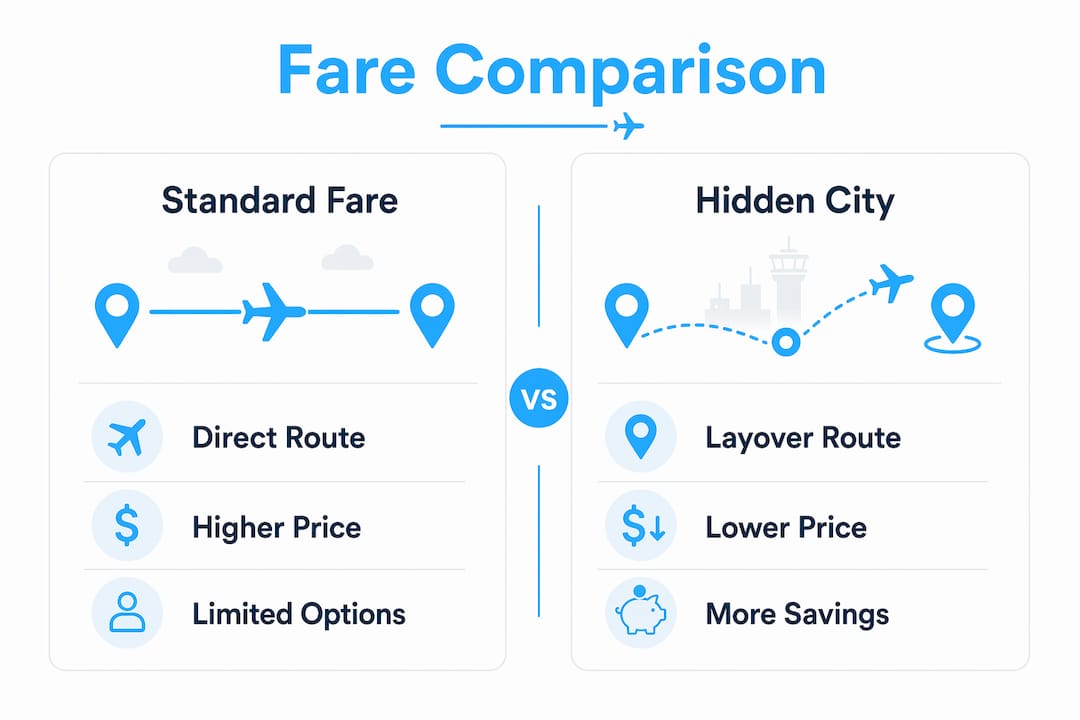
Hidden city ticketing is most viable for solo travelers on domestic U.S. routes where savings exceed $80 per ticket. Group travel complicates the strategy because every traveler must independently skip the final leg, and airlines notice patterns faster with multiple seats.
| Scenario | Standard direct fare | Hidden city fare | Estimated savings |
|---|---|---|---|
| JFK to ORD (direct) | $320 | $140 (via DFW) | $180 |
| LAX to SEA (direct) | $280 | $130 (via PDX) | $150 |
| MIA to ATL (direct) | $260 | $110 (via CLT) | $150 |
| BOS to DEN (direct) | $400 | $210 (via PHX) | $190 |
Note: Fares are illustrative examples based on typical pricing patterns. Actual fares vary by date and availability.
The savings unlock fares that simply do not appear when you search for a direct route. Tools like Skiplagged are built specifically to surface these hidden city fare opportunities by searching for routes where your target city appears as a layover.
Pro Tip: Search for your target city as a layover, not a destination. Skiplagged automates this, but you can also manually check multi-city searches on airline websites to find the same gaps.
What are the risks and airline policies on hidden city ticketing?
Airlines treat hidden city ticketing as a breach of contract. Delta and United explicitly warn that detection can result in ticket cancellation, fines, revocation of frequent flyer status, or legal action. Some carriers reserve the right to charge the full fare difference if they catch the practice at the gate.
The risks go beyond account penalties. Here is what travelers face in practice:
- Checked bags go to the final destination. Bags are routed to the last ticketed city, not your layover stop. Gate-checking a carry-on has the same result. You must travel with carry-on luggage only, no exceptions.
- No rebooking protection on delays. If the first leg is delayed or canceled, the airline’s obligation is to your ticketed final destination, not your layover city. You are left stranded at the hub with no recourse.
- Frequent use triggers detection. Repeating the same route pattern is the fastest way to get flagged by airline algorithms. One-off use rarely draws attention. A pattern does.
- Third-party booking sites add extra risk. Most OTAs prohibit hidden city ticketing in their terms and may cancel tickets if detected. Booking directly with the airline is safer.
- Round-trip tickets cancel entirely. Skipping any segment on a round-trip booking cancels all remaining flights on that reservation.
“Airlines have invested in sophisticated automated systems to detect and penalize hidden city ticketing in 2026, especially for frequent offenders.” — FlightKitten, 2026
Airlines also view the practice as a revenue loss and have pursued legal action against booking platforms that facilitate it. The legal risk to individual travelers remains low for one-time use, but the contractual risk is real every time.
How to use hidden city ticket strategies safely in 2026
The travelers who use this method successfully follow a consistent set of rules. Deviating from any one of them raises your risk significantly.
- Book one-way tickets only. Never book a round-trip with a hidden city segment. Use two separate one-way bookings to protect each leg independently.
- Avoid attaching loyalty accounts. Do not link your frequent flyer number to a hidden city booking. Airlines track account activity and flag anomalies. Protecting your miles account is worth more than earning points on a single trip.
- Pack carry-on only. Checked bags route to the final ticketed destination. There is no workaround for this rule except not checking a bag.
- Vary your routes. Skipping the same final leg repeatedly triggers airline detection algorithms. Use this strategy on different routes and do not make it a habit on any single itinerary.
- Book directly with the airline. Third-party sites prohibit the practice and can cancel your ticket. Booking direct gives you more flexibility if disruptions occur.
- Know the international customs exception. Some incoming international flights require baggage claim at the first U.S. entry point for customs, which creates a rare case where you can retrieve checked bags at your layover city. This exception is unreliable and should not be part of your planning.
- Only use it when savings are significant. The risk-to-reward math only works when you are saving a meaningful amount. A $30 difference does not justify the exposure.
Pro Tip: Use Skiplagged to identify routes where your target city appears as a layover. Once you find a promising route, verify the fare directly on the airline’s website before booking to avoid OTA cancellation risk.
What are the alternatives for budget-conscious travelers?
Hidden city ticketing is one tool in a larger set of airfare strategies. Knowing when to use it and when to reach for a different approach saves you both money and stress.
- Throwaway ticketing involves booking a cheaper fare that includes a segment you never use, similar in concept but applied differently. It carries the same contractual risks.
- Fare alerts from Google Flights, Hopper, or Kayak notify you when prices drop on specific routes. This requires flexibility on dates but zero contractual risk.
- Flexible date searches consistently find fares 20–40% lower than fixed-date searches on the same route. Shifting a departure by one or two days often produces significant savings.
- Positioning flights involve flying to a cheaper departure hub before your main trip. Flying from a nearby city with more competition can cut the main fare substantially.
For a broader set of travel booking hacks, combining multiple strategies produces better results than relying on any single method. Hidden city ticketing works best as a targeted tool for specific routes, not a default booking strategy.
Avoid hidden city ticketing entirely when traveling with checked bags, booking group travel, using a loyalty account you value, or flying internationally on complex itineraries. The risk profile changes significantly in each of those situations. For affordable domestic flights, the method is most practical and the savings are most predictable.
Key Takeaways
Hidden city ticketing saves travelers real money on specific routes, but the strategy only works safely when you follow strict rules around bag packing, booking format, and route variety.
| Point | Details |
|---|---|
| Legal but contractually prohibited | A 2025 court ruling confirmed legality, but airlines can still penalize you under their contracts. |
| Average savings are significant | Travelers save roughly 50% or $180 per ticket on qualifying routes. |
| Carry-on only is non-negotiable | Checked bags route to the final ticketed city and cannot be retrieved at the layover stop. |
| One-way tickets protect your trip | Round-trip bookings cancel entirely when you skip a segment. Book two separate one-ways. |
| Vary routes to avoid detection | Repeating the same hidden city pattern triggers airline algorithms and risks account bans. |
My honest read on skiplagging in 2026
Hidden city ticketing is genuinely useful, but most travelers overestimate how often the conditions align. The savings are real when they appear. The problem is that the right combination of route, timing, and carry-on-only travel does not come together as often as the headlines suggest.
I have seen travelers get burned not by airlines catching them, but by the first leg getting delayed. When that happens, you are stuck at a hub with no rebooking rights to your actual destination. The airline owes you nothing except a seat to the city on your ticket. That is a brutal outcome on a business trip or a tight connection.
The ethical debate around skiplagging is worth acknowledging. Airlines price tickets the way they do partly because of how passengers use them. The practice is legal, but it does put pressure on a pricing system that other travelers depend on. That does not make it wrong. It does mean you should use it deliberately, not reflexively.
My recommendation is straightforward. Use hidden city ticketing when the savings are above $80, you are traveling solo, you have only a carry-on, and you are booking a one-way ticket directly with the airline. Outside those conditions, the risk-to-reward ratio tips against you. There are plenty of other ways to find cheap flights that carry zero contractual exposure.
— Asher
Pilottraveldeals has more ways to cut your travel costs
Budget travel is rarely about one single trick. It is about stacking the right strategies together before you book.

Pilottraveldeals compares flights, hotels, and travel essentials from multiple providers so you can see your real options in one place. Whether you are hunting for cheap flight search tips or need to sort out a travel SIM card before you land, the site covers the full picture. For travelers who want to go beyond hidden city ticketing, Pilottraveldeals also offers step-by-step booking guidance to help you find the lowest fares without the contractual risk.
FAQ
What is a hidden city ticket in simple terms?
A hidden city ticket is a booking where your real destination is a layover city, not the final ticketed stop. You book the longer route because it costs less, then exit the airport at the layover.
Are hidden city tickets legal in the U.S.?
Hidden city ticketing is legal following a June 2025 federal court ruling. Airlines still prohibit it in their contracts and can penalize travelers who use it.
Can airlines cancel your ticket for skiplagging?
Yes. Airlines like Delta and United can cancel tickets, revoke frequent flyer status, or charge the fare difference if they detect the practice.
Do you have to check a bag on a hidden city flight?
No. You must travel with carry-on luggage only. Checked bags are sent to the final ticketed destination and cannot be retrieved at the layover city.
What happens if your first flight is delayed on a hidden city ticket?
The airline is only obligated to rebook you to your ticketed final destination. If the first leg is delayed or canceled, you have no protection for reaching your actual layover city.