

TL;DR:
- Flight price forecasting uses historical data and demand signals to predict price trends probabilistically.
- Airlines employ dynamic pricing and revenue management algorithms influenced by competition and demand.
- Effective savings strategies include early monitoring, flexible dates, cross-platform checks, and acting on confident predictions.
Most travelers treat airfare like a lottery ticket. They refresh booking sites obsessively, second-guess every search, and eventually pay whatever price appears on screen. But flight pricing is not random chaos. Behind every number is a system, and systems can be studied. Data tools, prediction algorithms, and smarter search habits now give budget travelers a real edge over the guessing game. This guide walks you through exactly how flight price forecasting works, what drives prices up or down, which tools to use, where forecasts fall short, and the specific strategies that consistently put more money back in your pocket.
Table of Contents
- How flight price forecasting works: The basics
- What drives airline pricing? Algorithms, demand, and the human factor
- Popular forecasting tools: How to use them and what to watch for
- Limits of forecasting: Volatility, ‘black swan’ events, and what models miss
- Smart forecasting strategies: Maximizing savings as a budget traveler
- Why most travelers misread flight forecasts—and how to truly get ahead
- Find and compare the best flight deals with PilotTravelDeals.com
- Frequently asked questions
Key Takeaways
| Point | Details |
|---|---|
| Forecasts guide, not guarantee | Flight price forecasting gives probability-based trends but never assures a specific deal. |
| Dynamic pricing dominates | Airfare shifts are driven by algorithms responding to market signals and personal data. |
| Combine tools for accuracy | Use multiple forecasting platforms, flexible dates, and cross-check dashboards for the best results. |
| Account for the unpredictable | Be aware that sudden events can disrupt even the best price predictions. |
| Stay flexible for savings | Adjust dates and search options while monitoring multiple forecasts to maximize travel savings. |
How flight price forecasting works: The basics
Now that you know why flight prices matter for your wallet, let’s explore how forecasting actually works.
Flight price forecasting is not a crystal ball. It is a calculated probability engine. The core idea is simple: by analyzing historical pricing patterns, current demand signals, booking windows, and route data, a model can tell you whether a price is likely to rise or fall over a given period. That period is called the prediction horizon, which is the window of time a forecast covers, usually ranging from a few days to several weeks out.
Forecasting flight prices is best treated as a probabilistic decision: models predict whether prices are likely to rise or fall within a horizon, not the exact future fare. Think of it like a weather forecast. A 70% chance of rain does not guarantee you’ll get wet. It means the conditions point strongly in that direction.
Here is what makes forecasting genuinely useful for budget travelers:
- Confidence scoring: Tools like Google Flights and Hopper attach a confidence level to their predictions. A “buy now” signal with 80% confidence means the data strongly suggests prices will rise if you wait.
- Price tracking: You can monitor a specific route over time, watching how prices behave weeks before your intended travel date.
- Historical benchmarking: Some tools compare the current price to what the same route cost over the past year, flagging whether you’re looking at a deal or an inflated rate.
- Volatility indicators: High-traffic routes like New York to London tend to show more price swings than regional hops with fewer competitors.
Here is a quick snapshot of how key forecasting terms compare:
| Term | What it means | Why it matters for you |
|---|---|---|
| Prediction horizon | How far out the forecast looks | Shorter horizons are more accurate |
| Confidence | How certain the model is | Higher confidence = stronger signal |
| Volatility | How much prices swing | High volatility = riskier to wait |
| Benchmark price | Historical average for that route | Helps you spot a genuinely good deal |
Tools like Google Flights, Hopper, and KAYAK each use some combination of these mechanics to surface insights. No tool gives you a guaranteed price. But they give you far better odds than refreshing a page and hoping for the best.
What drives airline pricing? Algorithms, demand, and the human factor
Understanding forecasts means digging into the pricing forces behind the scenes.
Airlines do not set prices the way a grocery store prices apples. Airline pricing is driven by dynamic pricing and revenue management algorithms that react to demand, time, and market signals in real time. That means a seat priced at $280 on Monday morning can cost $410 by Tuesday afternoon if enough people searched the same route.

Revenue management is the practice airlines use to maximize yield across every seat on every flight. It works by dividing cabin inventory into “fare buckets,” each with different prices and rules. As lower buckets sell out, the algorithm automatically unlocks more expensive ones. The closer a flight gets to departure with seats remaining, prices may either drop sharply (if the airline wants to fill seats) or stay high (if demand stays strong).
Understanding dynamic pricing also means knowing that competition between carriers matters a lot. If one airline drops fares on a popular route, competitors often follow within hours. This is why browsing multiple airlines simultaneously, rather than sticking to a single booking site, can surface meaningfully different prices.
There is also a more unsettling layer: surveillance pricing. Some pricing systems can factor in individual-level signals like your device type, location, browser history, or loyalty program status. This means the price you see may not be the same price your neighbor sees for the identical flight on the identical day.
Pro Tip: Search flights in a private or incognito browser window. This prevents cookies from potentially influencing the prices shown to you, giving you a cleaner read on the market rate.
Here is how different pricing drivers stack up in terms of how much you can control or predict them:
| Pricing driver | Predictable? | Can you influence it? |
|---|---|---|
| Booking window (timing) | Yes | Yes, book earlier or later strategically |
| Seasonal demand | Mostly yes | Yes, choose off-peak travel dates |
| Route competition | Partially | Yes, search nearby airports |
| Algorithm updates | No | No |
| Surveillance/personalization | No | Partially (incognito mode helps) |
Popular forecasting tools: How to use them and what to watch for
With the backstory on pricing, let’s apply these insights to the tools available today.
The good news is that you do not need to build a machine learning model to benefit from flight price forecasting. Several free platforms now embed prediction logic directly into their search interfaces. The key is knowing what each tool does well and where it has blind spots.
Here is how to get the most out of the main tools:
- Google Flights: Use the price graph feature to see how fares shift across a full month of departure dates. Enable “track prices” to receive email alerts when the fare changes. The platform signals whether the current price is “typical,” “low,” or “high” compared to historical data for that route.
- Hopper: This app specializes in predictions. It analyzes billions of flight prices and gives a simple “buy” or “wait” recommendation with a confidence percentage. It also offers “Price Freeze,” which lets you lock in a price for a small fee while you decide.
- KAYAK: Use the “Price Forecast” feature, which shows whether prices are predicted to rise or fall. The KAYAK airfare trends dashboard uses weekly aggregated search data, and year-over-year comparisons are not adjusted for seasonality, holidays, tourism, special city events, or weather and natural disasters. That is a meaningful caveat. A spike in searches from the previous year may reflect a one-time event, not a true seasonal trend.
- Skyscanner: Offers a “cheapest month” calendar view and price alerts. Particularly strong for international routes and budget carriers not always listed on Google Flights.
Academic research confirms that the most reliable forecasting approaches model ticket price as a function of historical patterns and contextual features, often using machine learning models like regression, tree-based methods, and neural networks. The tools listed above are simplified, consumer-facing versions of these same principles.
You can also use multi-platform travel tools that combine flight search, hotel comparison, and more in a single workflow, which saves time and catches deals you might miss by checking one site at a time.
To compare international flight ticket prices effectively, use at least two platforms and cross-reference their signals before committing. For a deeper look at stretching your travel budget further, the budget guide to cheap flights covers additional tactics worth adding to your toolkit.
Pro Tip: Run your search on at least two platforms with slightly varied travel dates before making a final decision. A one-day shift in departure can sometimes cut the price by 20% or more.
Limits of forecasting: Volatility, ‘black swan’ events, and what models miss
Of course, not every prediction comes true. Let’s look at what causes models to fail.
Every forecasting system has a ceiling. Models are only as good as the data they are trained on, and history does not always repeat itself. The biggest gap between a model’s prediction and reality tends to appear during what are called black swan events, a term for rare, high-impact occurrences that fall completely outside historical patterns.
Airline price forecasts weaken significantly when prices are driven by sudden shocks such as capacity shifts, geopolitical events, or extreme volatility, because models trained on historical data cannot anticipate changes that have no prior equivalent. A sudden armed conflict near a major travel hub, a global health emergency, or an oil price spike can render even the most sophisticated algorithm temporarily useless.
Here are the most common scenarios where flight price forecasts break down:
- Geopolitical events: Route prices to affected regions can surge or collapse overnight, with no historical parallel to guide the model.
- Fuel price shocks: Jet fuel costs directly influence ticket pricing. A sudden spike in oil markets can trigger airline surcharges within days.
- Airline capacity changes: If an airline abruptly reduces routes or goes bankrupt, supply drops and prices on competing flights spike unpredictably.
- Major global events: The COVID-19 pandemic is the clearest example. Every model built on pre-2020 data became effectively useless in March 2020.
- Natural disasters or severe weather: These can close airports, divert capacity, and create brief pricing chaos on nearby routes.
The practical takeaway is not that forecasts are useless. It is that they work best under normal market conditions. When the news cycle is calm and routes are running as expected, forecast accuracy improves substantially. When the world is turbulent, treat any prediction with extra skepticism and always have a backup plan.
For travelers who want to go further in protecting their budget against surprises, the insider airfare strategies guide covers protective booking approaches worth knowing.
Smart forecasting strategies: Maximizing savings as a budget traveler
Now let’s bring it all together into a clear approach for getting the best deal.
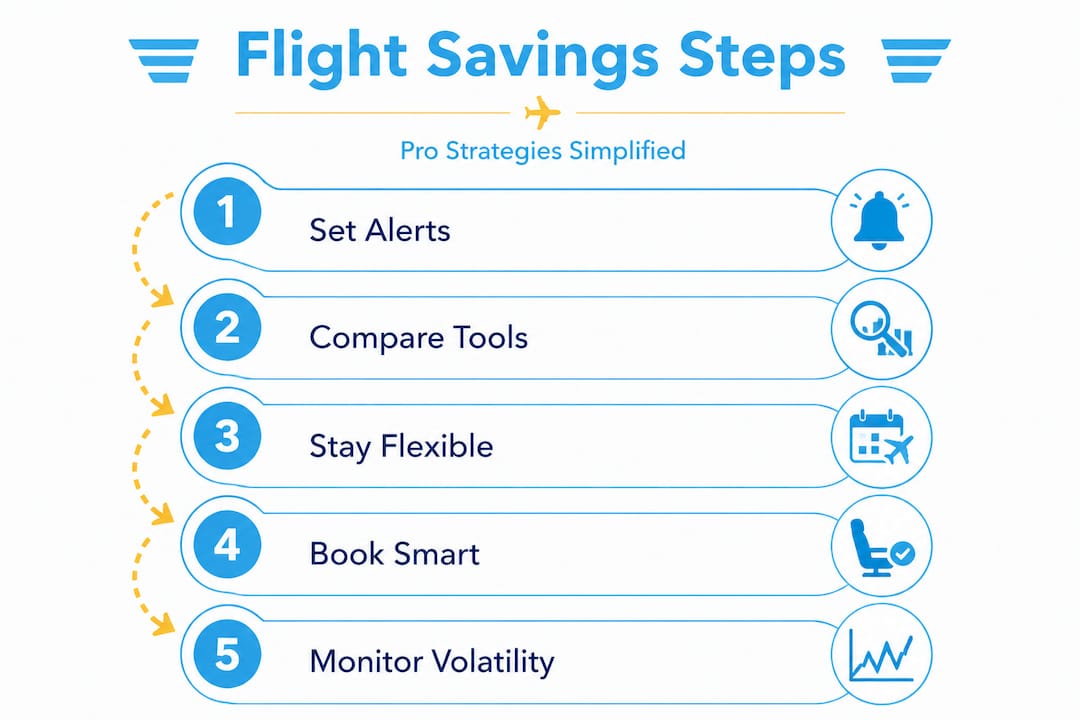
Knowing how forecasting works is step one. Turning that knowledge into consistent savings is step two. Here is a repeatable framework that works:
- Set up price alerts early. Start monitoring a route at least six to eight weeks before your intended travel date. Most tools let you track a specific origin-destination pair and alert you to meaningful price changes.
- Use flexible date and airport searches. Most forecasting tools perform better when you give them a range of dates rather than a fixed departure. Shifting travel by even a day or two can move you into a significantly cheaper fare bucket.
- Cross-check at least two tools before booking. Different platforms weight their data differently. If both Google Flights and Hopper say “buy now,” that is a much stronger signal than one platform acting alone.
- Treat forecasts as guidance, not guarantees. Always have a mental price ceiling. If a fare hits your target, book it. Do not wait indefinitely for a better prediction to materialize.
- Track route-level trends over weeks, not hours. A single price check tells you almost nothing. A two-week tracking window gives you real context for whether a price is rising, falling, or holding steady.
- Book in layers if you can. Some tools offer price lock features for a small fee. If you are unsure but the price looks good, locking it buys you decision time without losing your spot.
For budget-conscious planning, combining horizon-aware monitoring with flexible constraints such as nearby dates or “Any dates,” and cross-checking against multiple benchmarks rather than relying on a single model output, consistently outperforms single-source booking.
This approach is also covered in detail in our expert tips for cheap flights guide. And for route-specific savings tactics, the cheap airfare tips resource adds another layer of strategy.
Here is a quick summary of how each strategy maps to real savings potential:
| Strategy | Savings potential | Effort level |
|---|---|---|
| Price alerts on target routes | High | Low |
| Flexible date search | High | Low |
| Multi-platform cross-checking | Medium | Medium |
| Incognito browsing | Low to medium | Very low |
| Price lock features | Variable | Low |
Pairing these strategies with booking travel guides that cover timing, regional trends, and additional booking hacks can sharpen your approach further.
Why most travelers misread flight forecasts—and how to truly get ahead
Here is the mindset shift that most travelers miss entirely: a “best price” prediction is not universal. It is not the same for every person searching the same route on the same day.
Airline pricing can incorporate both general market data and, in some cases, individual-level signals, which affects what a given traveler sees and therefore how the forecast should be interpreted. In other words, your friend’s “buy now” recommendation might be calibrated to a slightly different price than yours, even if you searched the same route five minutes apart.
This matters because it changes how you should use forecasting tools. Instead of treating a predicted “best fare” as an objective market truth, treat it as a directional signal calibrated to your specific search context. The smarter move is to use that signal alongside your own flexibility and willingness to walk away.
The travelers who consistently win on airfare are not the ones who found the perfect algorithm. They are the ones who stay flexible on dates, search through multiple channels, use incognito mode, set alerts, and actually pull the trigger when a price hits their target. They do not wait for certainty because certainty does not exist in a dynamic pricing system. They use probability to tilt the odds in their favor and act decisively when the conditions are right.
You can layer this thinking with practical travel on a budget strategies that address hotels, SIM cards, and local transport so that your flight savings are not eaten up elsewhere in the trip.
Find and compare the best flight deals with PilotTravelDeals.com
Ready to apply these strategies? Here is how our platform can help you maximize savings.
At PilotTravelDeals.com, we have built a comparison platform that puts these forecasting principles into action without requiring a data science degree. Whether you are tracking a transatlantic fare or hunting for a budget route closer to home, our tools help you benchmark, compare, and book smarter.

Understanding the advantages of flight comparison is the first step to realizing just how much money gets left on the table when travelers rely on a single booking site. Our platform aggregates offers from multiple providers so you always see the competitive range, not just one airline’s preferred price. And if you are still not sure where to start, our guide on why to use fare comparison breaks down exactly how comparison tools translate directly into lower prices and smarter trips. Savings of up to 80% are possible when you shop the full market instead of the first result you see.
Frequently asked questions
How accurate are flight price forecasts?
Flight price forecasts are probabilistic, meaning they predict price direction rather than a guaranteed fare. Accuracy improves on stable, well-traveled routes with longer tracking histories.
Why do flight prices change so often?
Airlines use revenue management algorithms that continuously update prices based on demand, available seats, competition, and booking timing, sometimes adjusting within hours.
What makes flight price predictions sometimes unreliable?
Sudden shocks like geopolitical events or fuel price spikes fall outside historical training data, causing models to produce predictions that no longer reflect real market conditions.
Can I forecast the cheapest time to fly using free tools?
Yes. Tools like Google Flights offer price tracking and alerts at no cost, while KAYAK’s airfare trends dashboard surfaces weekly price patterns, though without seasonal or event adjustments.
Is it possible for two people to get different forecast results for the same route?
Yes. Because pricing can use individual signals like location or browsing history, two people searching the same flight can see different prices and different forecast outputs.
Recommended
- Tricks to find cheap flights: expert tips for 2026 – PilotTravelDeals.com
- Top Tips for Saving on Flights: Travel Smart in 2025 – PilotTravelDeals.com
- Smart Overseas Flight Tips: Save More and Travel Better – PilotTravelDeals.com
- 7 Best Websites to Find Cheap Flights for Smart Travelers – PilotTravelDeals.com
- Flights to Africa: smart travel tips for affordable adventures


