
TL;DR:
- A ticketed return travel itinerary confirms payment, includes an e-ticket number, and authorizes boarding. It is essential for visas, car rentals, and airline check-in, differentiating from reservations and dummy tickets. Understanding and obtaining a verified, fully paid itinerary reduces financial and travel risks significantly.
A ticketed return travel itinerary is a confirmed, paid travel document that includes an issued e-ticket number authorizing your outbound and return journeys on specified dates. Unlike a simple reservation or booking hold, a ticketed document must carry an e-ticket number to authorize boarding. This distinction matters more than most travelers realize. Whether you are applying for a visa, renting a car at an airport, or simply proving you plan to leave a country, understanding the difference between a ticketed itinerary and a reservation can save you money, time, and serious stress.
What is a ticketed return travel itinerary vs. other travel documents?
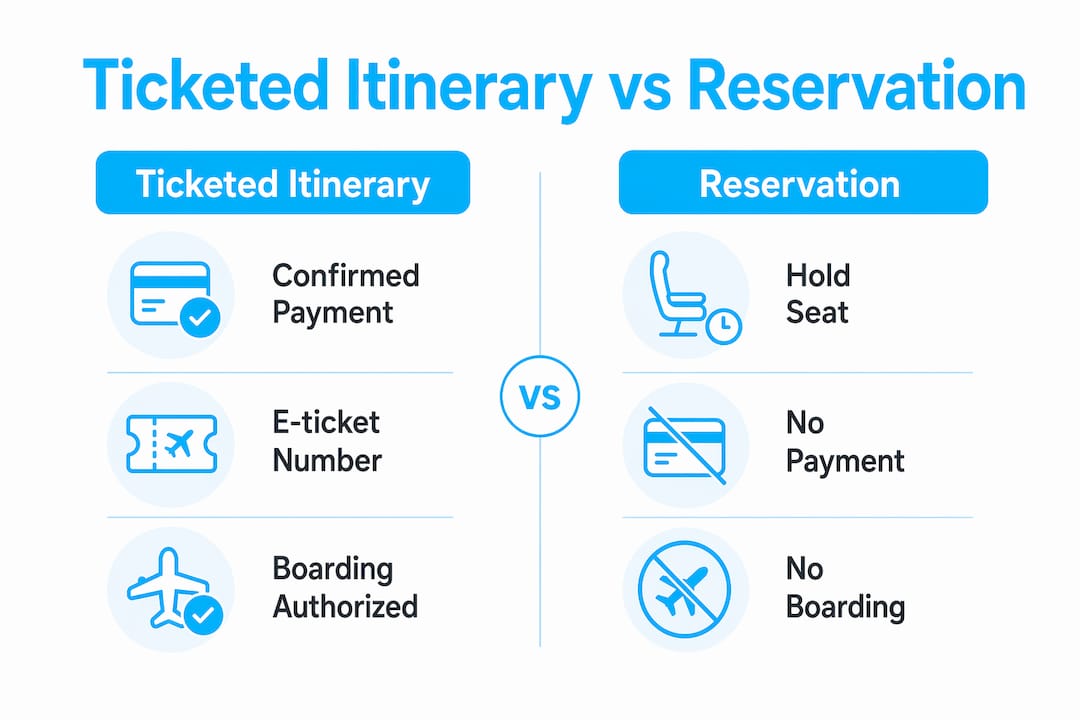
The travel industry uses several terms that sound interchangeable but carry very different weight with airlines, embassies, and border agents. A reservation holds a seat temporarily without payment. A booking may confirm your intent but does not always generate an e-ticket. A ticketed itinerary is the only document that proves you have paid and been issued a ticket.
Here is how the three document types compare:
| Document type | Payment required | E-ticket number | Embassy accepted | Boarding authorized |
|---|---|---|---|---|
| Reservation | No | No | Sometimes | No |
| Booking confirmation | Partial/full | Sometimes | Often | No |
| Ticketed itinerary | Yes | Yes | Yes | Yes |
A Passenger Name Record (PNR) is the unique code that links your booking to airline systems. Documents without a PNR risk rejection for visa or travel confirmation purposes. The PNR is what allows an embassy officer, airline agent, or border official to pull up your record and verify it in real time.
Modern itinerary systems go further. A formal travel itinerary often aggregates flights, hotels, and ground transportation into a single chronological record, sometimes called a “Super PNR,” with passenger names matching passport details. This level of documentation is what separates a credible travel plan from a printed screenshot.
Dummy tickets occupy a gray area. They simulate ticketed itineraries with real PNRs but do not prove payment. Many visa processes accept them as proof of intent, but they will not get you past an airline gate.
- Reservation: Seat hold only, no financial commitment, no e-ticket
- Booking confirmation: Confirms intent, may or may not include an e-ticket number
- Ticketed itinerary: Fully paid, e-ticket issued, PNR verifiable, boarding authorized
- Dummy ticket: Real PNR, no payment, accepted for visa intent but not for boarding
Why and when do you need a ticketed itinerary for visas and travel?
Visa applications are the most common reason travelers need to understand ticketed itinerary meaning. The rules vary by country and consulate, but the pattern is consistent: authorities want proof you plan to leave.
Many consulates accept flight reservations or itineraries without requiring full ticket purchase before visa approval. This policy exists specifically to protect travelers from financial loss if a visa is delayed or denied. Schengen visa applicants, for example, are routinely advised to submit a flight reservation rather than a paid ticket during the application stage.
That said, some embassies and border control points do require a fully ticketed return itinerary. Countries with stricter entry requirements, including the United States for certain visa categories and several Southeast Asian nations at land borders, may ask for proof of confirmed onward travel at the point of entry. In those cases, a reservation alone will not satisfy the officer.
Beyond visas, ticketed itineraries matter in two other practical situations:
- Car rentals at airports: Debit card payments require a ticketed return travel itinerary at many airport locations. Rental agencies like Alamo use the itinerary to reduce their financial risk. Without one, you face a credit card requirement or a deposit hold of $300 or more.
- Airline check-in: Some airlines operating routes into countries with strict immigration rules will ask for proof of onward travel before allowing boarding. A ticketed return itinerary satisfies this requirement instantly.
Pro Tip: When submitting visa documents, label your document clearly as a “flight reservation” or “proposed itinerary” rather than a “ticket” if you have not yet purchased. Clear document labeling prevents embassy officers from assuming a financial commitment you have not made.
Financial trade-offs: ticketed flights vs. reservations
Buying a fully ticketed return trip before your visa is approved is one of the most common and costly mistakes first-time international travelers make. Change or cancellation fees on ticketed flights often exceed $200 per segment. On a round trip, that exposure adds up fast.
The smarter approach depends on where you are in the travel planning process. Before visa approval, a reservation or dummy ticket reduces your financial exposure while still satisfying most embassy requirements. After visa approval, converting to a fully ticketed itinerary locks in your travel dates and authorizes boarding.
Flexible and refundable tickets exist in the middle ground. Airlines including United, Delta, and British Airways offer fully refundable fare classes that carry an e-ticket number from the moment of purchase. These cost more upfront but eliminate the penalty risk entirely. For travelers with uncertain visa timelines, flexible booking options are worth the premium.
The risks of overcommitting break down like this:
- Non-refundable ticket purchased before visa approval: Risk of losing the full ticket cost if the visa is denied
- Reservation without e-ticket: Accepted for many visa applications but will not authorize boarding
- Dummy ticket: Provides a verifiable PNR for visa purposes without financial commitment, but expires and cannot be used for travel
- Refundable ticketed itinerary: Full boarding authorization with financial protection if plans change
Pro Tip: Check the direct booking benefits of booking directly with airlines. Direct bookings often include more flexible change policies than third-party platforms, which matters enormously when visa timelines shift.
How to obtain, verify, and use a ticketed return itinerary
Getting a valid ticketed return itinerary is straightforward once you know what to look for. The process has four clear steps.
- Book through a verified source. Purchase directly from an airline website, a licensed travel agent, or a reputable comparison platform. Avoid unverified third-party sellers who may issue fraudulent confirmations without real e-ticket numbers.
- Confirm your e-ticket number. A valid ticketed itinerary includes a 13-digit e-ticket number, typically starting with the airline’s three-digit code. This number appears in your booking confirmation email. If it is missing, your booking is not yet ticketed.
- Verify your PNR. Use the airline’s website or app to look up your booking by PNR. If the record appears with your name, flight details, and ticket status showing “confirmed,” your itinerary is verifiable. A flight itinerary must include passenger names, flight numbers, dates, times, airports, and booking references to serve as official proof.
- Save both digital and printed copies. Store your itinerary in your email, a cloud service like Google Drive, and print one physical copy. Border agents and car rental desks occasionally request paper documentation, and connectivity at international airports is not always reliable.
For car rentals specifically, carry your ticketed itinerary to the counter alongside your driver’s license and payment method. Airport rental agencies use the itinerary to confirm your departure date and reduce the risk of unreturned vehicles.
Pro Tip: Use the business trip planning practices that corporate travelers rely on: keep all travel documents in a single folder, digital and physical, organized by date. This habit prevents last-minute scrambles at check-in or border control.

Key takeaways
A ticketed return travel itinerary is the only travel document that combines confirmed payment, an e-ticket number, and a verifiable PNR to authorize boarding and satisfy visa and border requirements.
| Point | Details |
|---|---|
| Ticketed vs. reservation | Only a ticketed itinerary includes an e-ticket number and authorizes boarding. |
| PNR is non-negotiable | Documents without a verifiable PNR risk rejection by embassies and airlines. |
| Visa timing matters | Buy a reservation or dummy ticket before visa approval to avoid costly change fees. |
| Car rentals require it | Debit card users at airport rental desks need a ticketed itinerary or face higher deposits. |
| Flexible fares reduce risk | Refundable fare classes provide full ticketing with financial protection if plans shift. |
Why I think most travelers get this wrong until it costs them
I have watched travelers at visa application centers hand over fully paid, non-refundable tickets when the embassy only asked for a flight reservation. The financial loss when those visas were delayed was entirely avoidable. The confusion comes from the fact that travel documents sound official regardless of what they actually authorize.
The shift toward what some travel industry observers call “living itineraries” is real. Travelers in 2026 increasingly hold a few ticketed anchors for key segments, like international flights, while keeping everything else flexible. That is the right instinct. Lock in the segments that require proof of confirmed travel. Keep the rest as reservations until your plans are certain.
My honest advice: read the exact wording of your embassy’s documentation requirements before purchasing anything. The word “ticketed” in an embassy checklist means something specific. So does “reservation.” Treating them as synonyms is the single most expensive mistake in travel document preparation. When in doubt, a dummy ticket with a real PNR satisfies most proof-of-intent requirements without putting hundreds of dollars at risk.
The travelers who handle this best are not the most experienced. They are the most deliberate. They check requirements, match their documents to the exact language requested, and keep their financial exposure low until the visa is in hand.
— Asher
Find affordable return tickets with Pilottraveldeals
Planning a trip that requires a ticketed return itinerary does not mean paying full price. Pilottraveldeals aggregates flight deals from multiple providers, giving you access to return tickets at prices that make locking in your itinerary financially sensible even before your visa is confirmed.

Start with the cheap airfare tips on Pilottraveldeals to find return flights that fit your budget and timeline. For travelers who want more options, the guide to finding cheap tickets covers strategies for booking flexible fares that give you a verifiable e-ticket number without locking you into a penalty-heavy fare class. Pilottraveldeals also covers hotels, so you can build a complete, documented itinerary in one place.
FAQ
What is the difference between a ticketed itinerary and a reservation?
A ticketed itinerary includes a paid, confirmed e-ticket number that authorizes boarding, while a reservation only holds a seat temporarily without payment or boarding authorization.
Do all visa applications require a fully ticketed return itinerary?
No. Many consulates accept flight reservations or dummy tickets with real PNRs during the visa application stage to reduce financial risk for travelers before approval.
What details must a valid ticketed itinerary include?
A valid ticketed itinerary must include passenger names matching passport details, flight numbers, departure and arrival airports, travel dates and times, a PNR, and a 13-digit e-ticket number.
Can I use a dummy ticket instead of a fully ticketed itinerary?
Dummy tickets work for most visa applications because they carry real PNRs, but they do not authorize boarding. Use a fully ticketed itinerary for airline check-in, car rentals, and border entry requirements.
Why do car rental companies ask for a ticketed return itinerary?
Airport rental agencies like Alamo require a ticketed return itinerary when customers pay by debit card to confirm a departure date and reduce the risk of unreturned vehicles, with deposits of $300 or more required otherwise.
Recommended
- What is a travel itinerary? Smart trip planning guide – PilotTravelDeals.com
- Flight Itinerary Sample: Plan Any Trip with Ease – PilotTravelDeals.com
- What Is an Open Jaw Airline Ticket? Your 2026 Guide – PilotTravelDeals.com
- What is a travel voucher? A 2026 guide for budget travelers – PilotTravelDeals.com
