TL;DR:
- Business travel costs in 2026 are increasing rapidly due to fuel surges, airline capacity cuts, and rising hotel labor costs. Geopolitical risks add hidden expenses by causing rerouted flights and requiring greater safety measures. Companies are responding by consolidating trips, negotiating better supplier deals, and leveraging technology for better expense management.
Business travel costs are rising faster than general inflation in 2026, driven by fuel price surges, airline capacity cuts, elevated hotel rates, and mounting geopolitical friction. Travel-related prices rose 9.8% year over year, more than double the overall CPI increase of 4.2%. That gap tells you something important: corporate travel budgets are being squeezed by forces that standard inflation models don’t fully capture. For travel managers and finance leaders, understanding the specific drivers behind these increases is the first step toward building a budget that actually holds.
Why business travel costs are rising: inflation and market dynamics
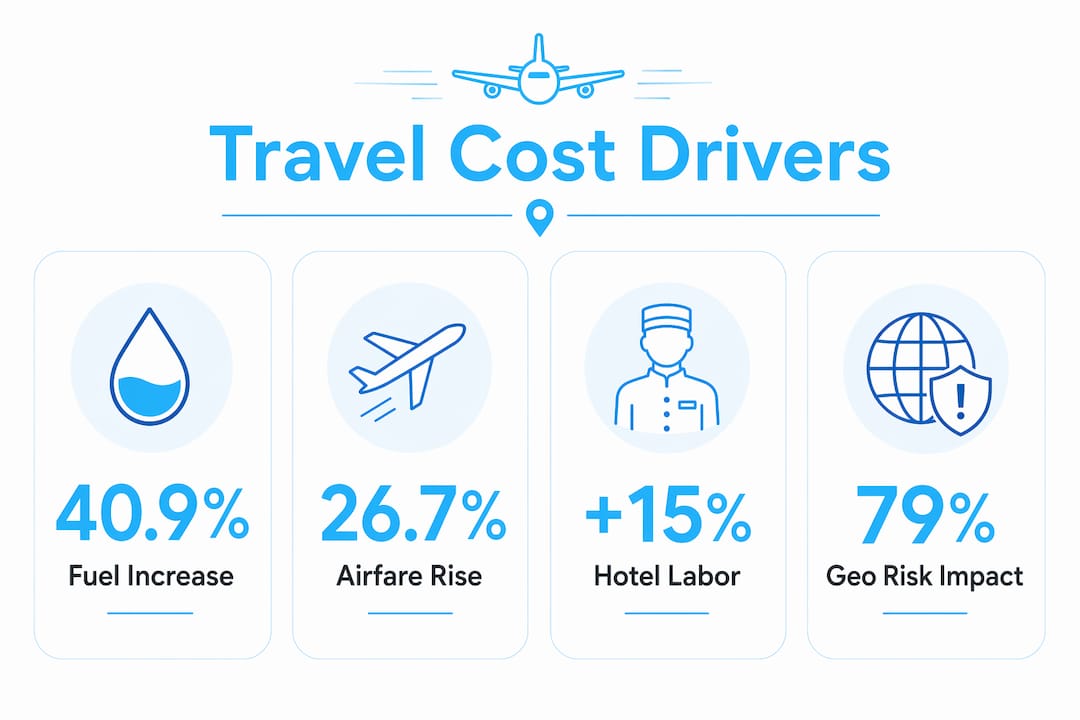
The Travel Price Index, published by the U.S. Travel Association, is the clearest measure of what corporate travelers actually pay. In 2026, it shows a 9.8% annual increase, with motor fuel prices surging 40.9% year over year and airline fares climbing 26.7%. Hotel rates added nearly 6% on top of that. These are not rounding errors. They represent a structural shift in what it costs to move people for business.
Fuel is the most volatile piece. Corporate fuel transaction costs increased roughly 22% globally between February and April 2026, with average gas spend per transaction rising from $50 to $61. That spike hit ground transportation budgets before most companies had time to revise their travel policies.
Airlines have compounded the problem through deliberate capacity management. Carriers reduce seat supply to keep load factors high, which keeps fares elevated even when jet fuel prices temporarily dip. This reflects a structural supply-demand shift in corporate travel that won’t self-correct when oil prices ease. Airlines also layer on baggage fees and seat upgrade charges that circumvent excise taxes on base fares, increasing hidden travel inflation and making the true cost of a ticket harder to track in expense systems.

Hotels face a different cost pressure. Labor costs in hospitality are rising faster than automation can offset them, unlike airlines that have absorbed some efficiency gains through technology. That dynamic pushes room rates up in ways that are sticky and persistent.
| Cost Category | Year-Over-Year Change (2026) |
|---|---|
| Motor fuel | +40.9% |
| Airline fares | +26.7% |
| Hotel rates | +5.9% |
| Car rentals | +5.0% |
| Overall CPI | +4.2% |
Pro Tip: Book flights at least 21 days out and use fare comparison tools like those available through Pilottraveldeals to lock in rates before airline capacity adjustments push prices higher.
How geopolitical instability is reshaping travel decisions
Geopolitical instability is now the top travel risk globally, cited by 79% of respondents in 2026 industry surveys. That figure has shifted how companies route trips, select destinations, and assess the true cost of sending employees abroad. Risk mitigation adds cost. Rerouted flights are longer and more expensive. Duty-of-care obligations require additional insurance and monitoring tools.
Traveler sentiment reflects this pressure. A full 67% of business travelers report hesitation this year due to safety concerns, disruptions, and unpredictability. That hesitation doesn’t eliminate trips. It adds friction, approval layers, and last-minute changes that drive up per-trip costs.
Operational complexity has grown alongside geopolitical risk. Travel managers report increasing friction from:
- Visa processing delays and new entry requirements in key markets
- Overcrowding at major hub airports, particularly in Europe
- Security screening backlogs that force earlier departures and longer stays
- Supply constraints in ground transportation at peak travel periods
Despite all of this, booking volumes have remained flat year over year. Companies are not pulling back on travel. They are paying more for the same number of trips, which is precisely why 24% of travel buyers are now pessimistic about affordability, up from just 9% in January 2026.
Pro Tip: Build a 15% cost buffer into any international travel budget that touches regions with active geopolitical risk. Reactive budget amendments cost more in management time than proactive contingency planning.
How companies are responding to rising travel budgets
The corporate response to higher travel costs has been measured, not panicked. 82% of CFOs plan to increase travel budgets in 2026, and 43% of travel buyers forecast total spending to rise this year. The catch is that more money is buying fewer trips. Budgets are up, but trip counts are down.
The most common adjustments companies are making include:
-
Consolidating itineraries. Instead of three separate trips to meet three clients in the same region, travelers combine meetings into one longer trip. This reduces per-meeting travel cost even as the total trip cost rises.
-
Shifting from car rentals to rail. Rail bookings increased around 4% globally while car rentals declined roughly 4%. Rail is more predictable in cost and less exposed to fuel price volatility.
-
Tightening approval workflows. More companies now require pre-trip approval for any booking above a defined cost threshold. This creates friction by design, filtering out lower-value trips before they generate expense reports.
-
Updating travel policies with real-time data. Static annual travel policies can’t keep pace with monthly price swings. Companies that update policies quarterly are better positioned to reflect actual market rates in their per diem and booking guidelines.
-
Negotiating preferred supplier agreements. Volume commitments with specific hotel chains or airlines unlock rates that are unavailable through open booking. The business travel budgeting process at most mature programs includes at least two or three preferred supplier contracts.
The companies managing this environment best are treating travel as a program, not a line item. That means dedicated ownership, defined metrics, and regular policy reviews tied to market data.
What role does technology play in controlling travel expenses?
Technology is the primary lever available to travel managers who need to do more with flat or modestly increased budgets. The challenge is that most organizations are underinvested in the tools that would actually close the gap between spending and results.
The SAP Concur Global Business Travel Survey 2026 identifies a clear “demonstration gap”: 89% of CFOs want ROI proof on travel spend, but most travel programs lack the data infrastructure to provide it. That gap is both a problem and an opportunity. Organizations that build centralized expense data systems can justify travel investment with evidence rather than assumption.
Corporate expense data has another underused application. Aggregated fuel transaction data from expense reports can predict gas price spikes weeks before retail prices move nationally. In early 2026, fuel transaction costs spiked 14% from February to March before broader retail prices followed. Travel managers with access to this data could have adjusted ground transportation budgets proactively.
The technology benefits that matter most for managing rising expenses include:
- AI-driven fare comparison that tracks price movements across multiple booking windows and surfaces the lowest available rate for each route
- Automated expense categorization that flags policy violations in real time rather than after the fact
- Predictive hotel rate tools that identify optimal booking windows based on historical pricing patterns, as explained in Pilottraveldeals’ guide to hotel dynamic rates
- Centralized dashboards that give travel managers a single view of spend by category, department, and supplier
- AI booking assistants that apply policy rules automatically, reducing the manual review burden on travel managers
The role of AI in travel booking has moved from experimental to operational for companies managing more than 500 trips per year. For smaller programs, even basic automation in expense reporting delivers measurable time and cost savings.
Key takeaways
Rising business travel costs in 2026 are driven by fuel surges, airline capacity strategy, hotel labor pressures, and geopolitical friction, and managing them requires data, policy discipline, and the right technology.
| Point | Details |
|---|---|
| Fuel is the biggest driver | Motor fuel costs rose 40.9% year over year, hitting ground transportation budgets hardest. |
| Airlines use fees to mask real costs | Baggage and upgrade fees bypass fare taxes, making total ticket costs higher than listed prices suggest. |
| Geopolitical risk adds hidden costs | 79% of travel managers cite instability as the top risk, driving rerouting and duty-of-care expenses. |
| Budgets are up but trips are down | 82% of CFOs increased budgets, yet trip counts are falling as per-trip costs rise. |
| Technology closes the ROI gap | Centralized expense data and AI tools help travel managers prove value and anticipate cost spikes. |
The uncomfortable truth about cutting travel budgets
I’ve watched companies make the same mistake repeatedly when travel costs spike: they cut budgets bluntly, reduce trip counts across the board, and call it cost discipline. It isn’t. It’s cost avoidance dressed up as strategy.
The data from 2026 tells a more nuanced story. Travel volumes are holding steady because the companies that understand travel’s role in revenue generation won’t sacrifice client relationships to save on airfare. The ones cutting indiscriminately are often the same ones struggling to close deals that require face-to-face trust-building.
What actually works is treating travel management as a professional function with real accountability. That means quarterly policy reviews, preferred supplier negotiations, and expense data that feeds back into budget planning. It means using tools like AI fare comparison and dynamic hotel rate tracking rather than relying on travelers to self-police against a static per diem.
The “demonstration gap” identified by SAP Concur is the real problem. When CFOs demand ROI proof but won’t fund the data infrastructure to generate it, travel managers are set up to fail. The answer isn’t to cut travel. It’s to build the measurement capability that makes the case for smart travel investment.
Traveler expectations have also shifted. Employees who travel frequently now factor safety, predictability, and comfort into their willingness to travel at all. Ignoring that in the name of cost reduction creates a different kind of cost: talent friction and reduced trip effectiveness. The companies winning this environment are the ones that treat their travelers as assets to protect, not expenses to minimize.
— Asher
How Pilottraveldeals helps you manage rising travel costs
When airfare is up 26.7% and hotel rates keep climbing, the difference between a well-managed travel budget and an overspent one often comes down to how you book. Pilottraveldeals aggregates flight and hotel deals from multiple providers, giving travel managers and business travelers a fast way to compare rates and identify genuine savings before committing to a booking.
Use Pilottraveldeals to compare hotel deals across providers and lock in rates before dynamic pricing pushes them higher. For flights, the flight comparison strategies guide walks through how to use fare comparison tools to find the lowest available rate on any route. With corporate travel cost trends moving against you in 2026, having a comparison-first booking habit is one of the simplest ways to protect your travel budget.
FAQ
Why are business travel costs rising so fast in 2026?
Travel-related prices rose 9.8% year over year in 2026, more than double the overall CPI increase of 4.2%, driven by a 40.9% surge in fuel costs, a 26.7% rise in airfare, and persistent hotel rate increases tied to labor cost pressures.
How are airlines contributing to higher corporate travel expenses?
Airlines reduce seat capacity to keep fares elevated and add fees for baggage and seat upgrades that bypass excise taxes on base fares, making the true cost of a ticket significantly higher than the listed price.
What is the biggest non-inflation factor driving up travel costs?
Geopolitical instability is now the top travel risk, cited by 79% of travel managers globally. It forces route changes, adds duty-of-care costs, and creates operational friction that increases per-trip expenses beyond what inflation alone explains.
How are companies adjusting their travel programs to control costs?
Most companies are consolidating itineraries, shifting from car rentals to rail, tightening pre-trip approval workflows, and updating travel policies quarterly to reflect real-time market rates rather than relying on static annual guidelines.
Can technology actually reduce business travel expenses?
Yes. AI-driven fare comparison, automated expense tracking, and predictive hotel rate tools help travel managers identify savings and anticipate cost spikes. SAP Concur data shows that centralized expense systems also help close the ROI demonstration gap that 89% of CFOs currently demand.
Recommended
- Find cheap business class flights in 2026: proven guide – PilotTravelDeals.com
- What Does Travel Insurance Cost in 2026? – PilotTravelDeals.com
- How to plan affordable business trips and maximize savings – PilotTravelDeals.com
- Business travel trends to optimize efficiency and costs – PilotTravelDeals.com