Flying Delta doesn’t have to drain your wallet if you know when to book. Research shows that choosing the right day to travel can slash your airfare by up to 15%. Tuesday and Wednesday flights consistently offer the lowest prices, while weekend departures command premium rates. This guide reveals exactly which days deliver the biggest savings and how to leverage Delta’s pricing patterns to keep more money in your pocket throughout 2026.
Table of Contents
- Understanding Airline Pricing And Demand Cycles
- Cheapest Days To Fly On Delta
- How Delta Pricing Algorithms Affect Airfares
- Common Misconceptions About Cheapest Days To Fly
- Booking Strategies To Maximize Cheapest Day Savings
- Impact Of Holidays And Seasons On Cheapest Delta Flights
- Case Studies Illustrating Cheapest Day Savings
- Optimizing Your Delta Travel Budget
- Save More On Your Next Delta Flight With PilotTravelDeals
Key takeaways
| Point | Details |
|---|---|
| Best travel days | Tuesday and Wednesday flights average 10-15% cheaper than weekend departures |
| Booking timing | Delta releases fare sales early in the week, triggering midweek price drops |
| Holiday exceptions | Peak season demand overrides typical day patterns, requiring flexible planning |
| Dynamic pricing impact | Algorithms adjust fares continuously based on demand and competition |
| Action steps | Monitor fares early week, book by Tuesday, and fly midweek for maximum savings |
Understanding airline pricing and demand cycles
Delta’s pricing structure revolves around predictable demand patterns that shift throughout the week. Business travelers typically fly Monday mornings and Friday afternoons, creating peak demand periods. Leisure travelers favor weekend departures, especially Friday evenings and Sunday afternoons. These patterns drive fare fluctuations that savvy travelers can exploit.
Dynamic pricing algorithms monitor booking velocity, competitor fares, and historical data to adjust Delta ticket prices in real time. When demand surges, prices climb. During slower periods, typically midweek, fares drop to fill seats. Understanding this rhythm helps you predict when deals appear.
The airline industry operates on a weekly cycle that repeats with remarkable consistency. Monday mornings see business commuters heading to meetings. By Tuesday, that rush subsides. Wednesday remains quiet before the weekend travel surge begins Thursday evening. This predictable pattern creates windows of opportunity for budget-conscious flyers.
Key demand factors include:
- Corporate travel concentrated at week start and end
- Leisure bookings clustering around weekends and holidays
- Reduced midweek demand creating pricing opportunities
- Seasonal variations amplifying or dampening weekly patterns
Cheapest days to fly on Delta
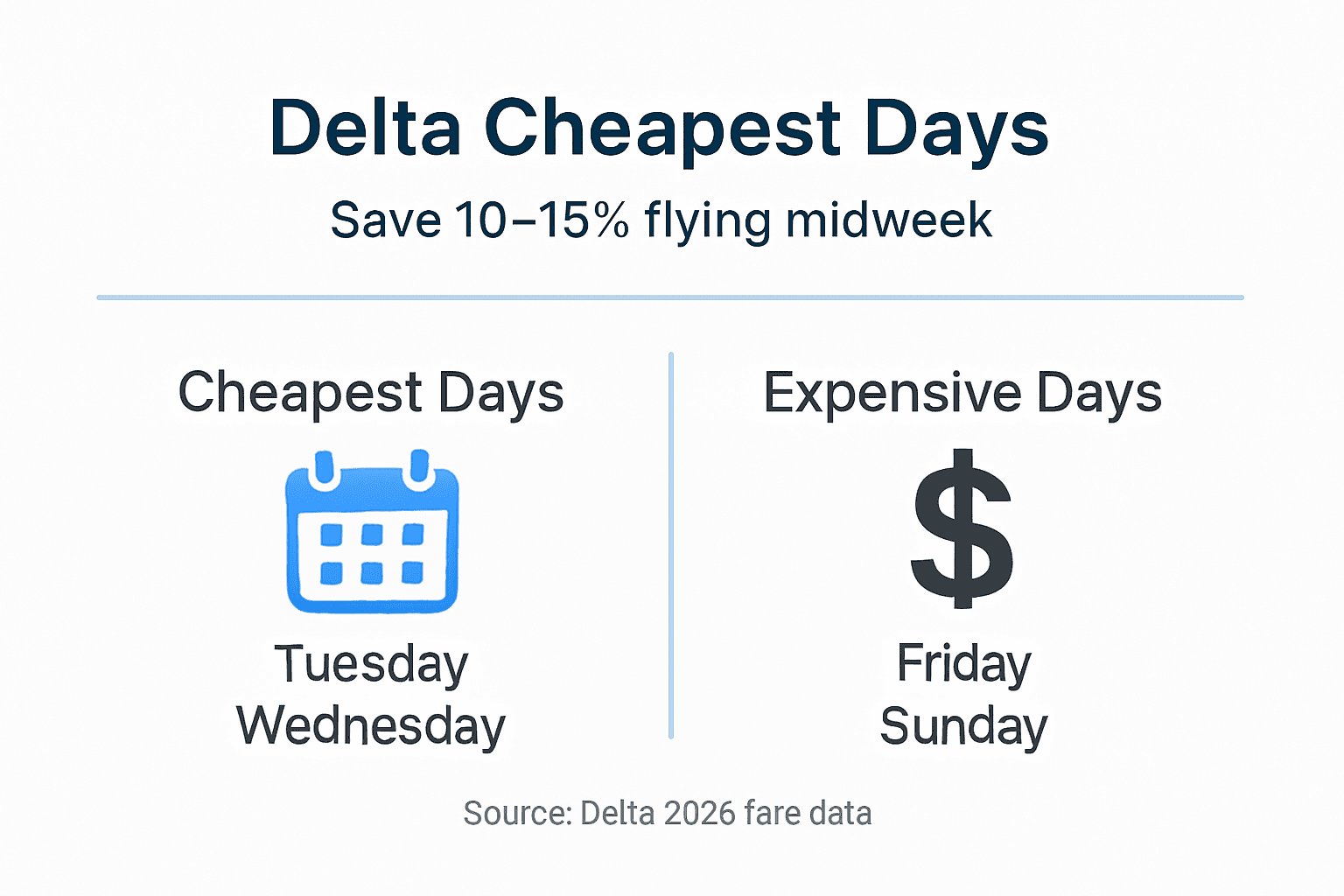
Data consistently identifies Tuesday and Wednesday as 10-15% cheaper than Friday and Sunday flights on comparable Delta routes. Tuesday claims the crown as the single cheapest day, with Wednesday running a close second. Thursday occupies middle ground, while Friday through Monday command premium fares.
Weekend flights cost more because leisure demand peaks. Friday departures accommodate travelers starting vacations. Sunday returns bring people home before Monday workweeks. Airlines capitalize on this concentrated demand by raising prices.
| Day of Week | Average Fare Difference |
|---|---|
| Tuesday | Baseline (cheapest) |
| Wednesday | +2% |
| Thursday | +5% |
| Monday | +8% |
| Saturday | +12% |
| Friday | +14% |
| Sunday | +15% |
These percentages represent typical domestic Delta routes. International flights and premium cabins may show different patterns, but the midweek advantage holds across most markets.
Practical takeaways for maximizing savings:
- Schedule outbound flights on Tuesday or Wednesday whenever possible
- Return midweek rather than Sunday to avoid premium return fares
- Build flexibility into travel dates to capture the cheapest options
- Expect holiday periods to override these patterns completely
How Delta pricing algorithms affect airfares
Delta employs sophisticated revenue management systems that recalculate fares multiple times daily. These algorithms analyze seat inventory, booking pace, competitor pricing, and historical trends to optimize revenue. When algorithms detect weak demand, they automatically reduce fares to stimulate bookings.

Fare sales typically launch Monday or Tuesday, creating a ripple effect throughout the week. Competitors match these sales within hours, triggering a brief window of reduced fares across multiple carriers. By Wednesday afternoon, many sales end as airlines assess results and adjust inventory.
The interplay between algorithmic pricing and human booking behavior creates predictable patterns. Business travelers book closer to departure and pay premium rates. Leisure travelers shop further in advance and hunt for deals. Airlines price accordingly, charging more when demand appears inelastic and discounting when seats remain empty.
Dynamic pricing means fares can change between page refreshes. A route showing $200 one minute might jump to $250 the next if another traveler books the last seat in that fare bucket. This volatility rewards travelers who monitor prices carefully and act quickly when deals appear.
Pro Tip: Set fare alerts for your desired routes and check prices Tuesday morning when new sales often launch. Book immediately when you spot a fare drop, as low inventory buckets sell out within hours.
Common misconceptions about cheapest days to fly
Many travelers believe flying at inconvenient times automatically means cheaper fares. The truth? Day of week matters far more than departure time. A 6am Tuesday flight typically costs less than a 6am Saturday flight on the same route, proving that timing within the week trumps time of day.
Another persistent myth suggests weekends offer better deals because fewer business travelers fly. Reality contradicts this assumption. Leisure demand floods weekend flights, driving prices higher despite reduced corporate travel. Airlines know vacationers fill Saturday and Sunday seats regardless of price, so they charge accordingly.
The last-minute booking myth claims procrastination yields savings as airlines desperately discount empty seats. Modern revenue management systems do the opposite, raising prices as departure approaches. Early midweek booking consistently delivers better fares than last-minute gambling.
Why these myths persist:
- Anecdotal experiences where someone got lucky with a last-minute deal
- Confusion between time of day and day of week pricing factors
- Outdated advice from pre-algorithm eras when pricing was simpler
- Marketing messages that obscure actual fare patterns
Data disproves these beliefs across thousands of routes and millions of bookings. Midweek departures average 10-15% savings regardless of departure time, holiday proximity, or booking window.
Booking strategies to maximize cheapest day savings
Executing a smart Delta booking strategy combines timing, flexibility, and persistence. Start by identifying your target travel window, then build in flexibility to capture midweek departures. Even shifting your trip by one day can unlock significant savings.
Follow these steps for optimal results:
- Begin monitoring fares 6-8 weeks before your desired travel date
- Check prices Tuesday morning when new sales typically launch
- Compare Tuesday and Wednesday departure options against your preferred days
- Set fare alerts on multiple booking platforms to catch price drops
- Book immediately when fares hit your target price, as deals vanish quickly
- Consider positioning flights to cheaper airports if driving distance permits
Flexibility around holidays and peak seasons becomes crucial. If you must travel during Thanksgiving week, shifting your departure from Wednesday to Tuesday or Monday can still yield modest savings even when overall demand inflates all fares.
Pro Tip: Delta often matches competitor fare sales within 24 hours, so if you see a great American or United price on your route, check Delta before the window closes. For more comprehensive booking tactics, explore our proven tips to find cheap flights and step-by-step booking guide.
Impact of holidays and seasons on cheapest Delta flights
Major holidays disrupt normal pricing patterns as demand overwhelms supply. Thanksgiving week sees all days command premium fares, though Tuesday before Thanksgiving and the Saturday after still typically cost less than Wednesday and Sunday. Christmas and New Year periods show similar compression, with traditionally cheap midweek days rising alongside weekends.
Summer peak season from June through August elevates baseline fares across all days. However, the Tuesday and Wednesday advantage persists even during peak season, just at higher absolute price points. A summer Tuesday flight might cost $300 versus $350 on Friday, maintaining the percentage savings despite inflated base fares.
Key considerations for holiday travel:
- Book holiday flights 2-3 months in advance before prices spike further
- Consider alternative airports that might show different demand patterns
- Fly on the actual holiday when possible as many avoid these dates
- Build flexibility to depart a day earlier or later than peak exodus dates
- Monitor shoulder season dates immediately before or after holiday windows
Spring break and other school vacation periods create regional demand spikes. Florida and Caribbean routes see elevated pricing regardless of weekday during March. Similarly, ski destinations command premiums on all days from December through February.
Case studies illustrating cheapest day savings
A Los Angeles to New York roundtrip booked for mid-April 2026 shows stark differences. Tuesday departure with Wednesday return: $287. Friday departure with Sunday return: $342. The midweek option saves $55 or 16% for identical cabin class and similar departure times.
Atlanta to Chicago presents another clear example. A Tuesday morning flight in February costs $127 while the same Thursday evening flight runs $156. Weekend options for this route climb to $178 for Sunday evening departures. Choosing Tuesday over Sunday saves $51 per ticket.
| Route | Tuesday/Wednesday | Friday/Sunday | Savings |
|---|---|---|---|
| LAX to JFK | $287 | $342 | $55 (16%) |
| ATL to ORD | $127 | $178 | $51 (29%) |
| SEA to DFW | $198 | $234 | $36 (15%) |
| BOS to SFO | $256 | $298 | $42 (14%) |
These examples demonstrate consistent patterns across different markets and distances. Short haul, long haul, and transcontinental routes all reward midweek travelers.
Traveler strategies validated by data:
- Flexible leisure travelers save hundreds annually by consistently choosing midweek flights
- Families flying together multiply per-ticket savings across multiple passengers
- Frequent flyers accumulate thousands in annual savings through disciplined day selection
- Remote workers who control their schedules gain maximum advantage
Optimizing your Delta travel budget
Tuesday and Wednesday flights deliver 10-15% savings compared to weekend departures across most Delta routes. This advantage stems from predictable demand cycles, with business and leisure travel concentrating on week edges while midweek sees reduced passenger loads.
Understanding Delta’s dynamic pricing reveals why early-week fare monitoring and booking yields results. Sales launch Monday or Tuesday, creating brief windows when smart travelers can capture discounted inventory before it sells out.
Holidays and peak seasons require adjusted expectations and added flexibility. While midweek advantages narrow during high demand periods, they rarely disappear completely. Even modest savings multiply across family bookings and multiple trips throughout the year.
Apply the booking strategies outlined here to systematically reduce your Delta spending in 2026. Monitor prices early week, prioritize Tuesday and Wednesday travel, book when fares drop, and maintain flexibility around your target dates. These habits transform occasional savings into consistent budget optimization.
Save more on your next Delta flight with PilotTravelDeals
Now that you understand when to fly Delta for maximum savings, PilotTravelDeals gives you the tools to find and book those deals efficiently. Our platform aggregates Delta fares alongside competitors, helping you compare options quickly and spot the best midweek opportunities.

We publish regular updates on fare sales, route-specific deals, and seasonal pricing trends through our travel news section. Our proven strategies for finding cheap flights expand on the tactics covered here, while our comprehensive flight search guide shows you how to navigate booking platforms like a pro. Stop overpaying for flights and start keeping more money for the experiences that matter at your destination.
FAQ
What is the cheapest day to fly on Delta?
Tuesday typically offers the lowest fares, with Wednesday running a close second, delivering 10-15% savings compared to Friday and Sunday flights. These midweek days see reduced demand as business travel subsides and leisure travelers haven’t yet begun weekend trips. However, major holidays and peak summer dates can override this pattern, compressing the price difference between all weekdays.
How do Delta’s pricing algorithms affect the cost of flights by day?
Delta’s revenue management systems adjust fares continuously based on demand signals, competitor pricing, and booking velocity. When midweek inventory remains unsold, algorithms automatically reduce prices to stimulate bookings. Conversely, strong demand on Fridays and Sundays triggers automatic price increases as algorithms maximize revenue from travelers with inflexible schedules.
What booking strategies maximize savings on Delta flights?
Book early in the week, ideally by Tuesday morning, to catch new fare sales before inventory depletes. Select Tuesday or Wednesday departure dates rather than weekends, and build flexibility into your travel plans to accommodate the cheapest options. Set fare alerts to monitor your target routes, and act immediately when prices drop since discounted fare buckets contain limited seats. For detailed tactics, review our comprehensive guide to finding cheap flights.
Do early morning or late night flights cost less than midday departures?
Time of day matters less than day of week for Delta pricing. A 6am Tuesday flight typically costs less than a 6am Saturday flight on the same route, proving weekday selection trumps departure time. While some routes show modest discounts for inconvenient hours, the difference rarely exceeds 5%, far below the 10-15% midweek advantage.
Recommended
- Cheapest Days to Buy Southwest Tickets in 2026: Save 15% – PilotTravelDeals.com
- Best Tips for Cheap Flights: Save More on Airfare – PilotTravelDeals.com
- Top Tips for Cheap Plane Tickets: Save on Every Flight – PilotTravelDeals.com
- How to Get Flight Discounts 2025: Step-by-Step Savings – PilotTravelDeals.com