
TL;DR:
- Booking multi-city flights under a single reservation often costs less and simplifies complex itineraries compared to piecing together separate tickets. It provides better disruption protection, easier baggage management, and streamlined itinerary planning, especially for travelers hitting multiple destinations. Despite common misconceptions, multi-city bookings offer substantial savings and reliability for efficient, multi-stop travel.
Most travelers assume that hunting down separate one-way tickets is the ultimate move for budget travel. It feels logical. More control, more flexibility, more chances to find the cheapest option for each leg. But this assumption costs people real money and real headaches every single year. Multi-city flight booking is one of the most underused strategies among budget-conscious travelers, and once you understand how it works, you’ll wonder why you ever booked any other way for complex trips. This article covers everything you need: what multi-city booking actually means, why it often beats pieced-together tickets, how baggage works, and how to build your own itinerary step by step.
Table of Contents
- What is multi-city flight booking?
- Major benefits of multi-city flight booking
- How baggage works with multi-city flights
- How to plan and book a multi-city itinerary
- The real value of multi-city bookings: what most travelers get wrong
- Get even more value with specialized travel tools
- Frequently asked questions
Key Takeaways
| Point | Details |
|---|---|
| Multi-city defined | A booking that links several destinations into one ticket, streamlining complex travel plans. |
| Cost and convenience | This approach can save money and reduce backtracking versus separate tickets, but always compare options. |
| Baggage nuances | Bags are more likely to be checked through with single-ticket bookings, but mixed airlines can require re-checking. |
| Step-by-step planning | Using smart tools and avoiding mistakes helps you build the most efficient multi-city itinerary. |
| Expert perspective | Cohesion and disruption handling can matter more than price for busy or complex trips. |
What is multi-city flight booking?
Multi-city flight booking means purchasing all your flights across multiple destinations in a single itinerary and under one booking transaction. Instead of going from City A to City B and then searching separately for City B to City C, you enter all your stops at once and the system finds you a connected set of flights.
This is fundamentally different from a round-trip ticket, which moves you from one origin to one destination and back. It’s also different from buying individual one-way tickets for each leg, which creates separate bookings with no shared structure. A multi-city booking treats your whole journey as one connected plan.
Who typically uses this approach? Travelers who are hitting multiple countries in one trip. Digital nomads moving between work hubs. Business travelers attending meetings in several cities. Honeymooners building a complex romance route through Southeast Asia or Europe. Basically, anyone whose travel plan looks more like a chain than a simple out-and-back.
The core advantages become clear quickly:
- Single booking process for your entire route
- Potentially lower combined fares compared to separate one-way tickets
- Reduced backtracking so you don’t fly east just to fly west again
- One point of contact if something goes wrong mid-trip
- Simplified itinerary management for complex, multi-stop plans
As noted in multi-city trip booking resources, the benefits for budget-conscious travelers include saving money versus piecing together some routes, reducing backtracking, and tying legs together under one ticket, which can simplify disruption handling considerably.
Pro Tip: When searching for multi-city options, always enter your actual travel dates first. Flexible date searches are great for simple round-trips, but multi-city tools work best when you give them real anchor dates to build your chain around.
Major benefits of multi-city flight booking
Having defined the concept, let’s see how booking multiple cities in one trip helps you save money and navigate complex itineraries more easily.
The single biggest misconception about booking multiple flights separately is that it always saves money. It doesn’t. When you piece together three or four one-way tickets, you’re often paying full one-way pricing on each leg, and one-way tickets frequently cost more per leg than what airlines offer when you bundle routes. Multi-city fares allow airlines to fill multiple seats across a connected journey, and they sometimes pass those savings on to you.
Here’s a quick comparison to illustrate the difference:
| Booking method | Example route | Typical cost range | Disruption protection | Baggage handling |
|---|---|---|---|---|
| Separate one-way tickets | NYC > London > Paris > Rome | Higher overall cost | None across legs | Re-check each leg |
| Multi-city single booking | NYC > London > Paris > Rome | Lower or comparable | Covered under one ticket | Often checked through |
| Round-trip with stopovers | NYC > London > NYC (with Paris add-on) | Variable | Partial | Varies by airline |
Beyond cost, the backtracking issue is massive and underappreciated. Imagine you want to visit Tokyo, Bangkok, and Bali. If you book separately and search only for the cheapest each-leg ticket, you might end up flying Tokyo to Singapore to Bangkok, then Bangkok to Kuala Lumpur to Bali. That’s two extra unnecessary stops. A multi-city booking maps your actual geographic route and can eliminate those wasteful connections.
Multi-city itineraries can be less expensive than booking one-way flights individually, though this isn’t always guaranteed. They can also avoid unnecessary layovers and backtracking, and provide a more connected travel process than separate tickets.
The disruption protection benefit is something most travelers don’t think about until they’re stranded. When all your legs are under one ticket and your first flight is delayed, the airline is responsible for getting you to your next destination. When you have separate tickets, the airline owes you nothing if their delay causes you to miss a flight you booked independently. You’re on your own. That’s a financial and logistical risk that can easily erase any savings you found on the separate booking.
“Tying your flights under one multi-city booking shifts the liability for disruptions from you to the airline. That’s not just convenience. That’s financial protection worth real dollars.”
Pro Tip: Use flight booking tips from comparison platforms to check whether the multi-city combined fare beats the sum of individual one-way tickets before committing. The difference can range from small to surprisingly large depending on your route.
Additional advantages worth calling out:
- One confirmation number for your whole trip makes airport check-ins faster
- Frequent flyer miles often accumulate more effectively on single-ticket bookings
- Travel credit card benefits like trip cancellation insurance apply more cleanly to single-ticket purchases
- Fewer login accounts and emails to manage across your whole journey
How baggage works with multi-city flights
Cost and convenience are major benefits of multi-city bookings, but understanding how your bags are handled is equally important.

Baggage handling on multi-city trips trips up even experienced travelers. The short version: your bags are more likely to travel with you seamlessly when all flights are under one ticket and operated by airlines with interline agreements. When you mix separate tickets or airlines that don’t share baggage agreements, expect to collect and re-check your bags at each connection.
Here’s how different scenarios break down:
| Ticket structure | Same airline throughout | Partner airlines | Unrelated airlines |
|---|---|---|---|
| Single multi-city ticket | Bags checked through | Usually checked through | Must collect and re-check |
| Separate one-way tickets | Must re-check | Must re-check | Must re-check |
| Codeshare flights on one ticket | Bags usually checked through | Bags usually checked through | Varies |
According to Finnair’s guide to traveling with multiple airlines, baggage is more likely to be checked through to your final destination on a single ticket or interline arrangement, but some journeys require collecting and re-checking. Separate-ticket behavior is more likely to require re-checking under each ticket.
Follow these steps to manage baggage smartly on a multi-city trip:
- Confirm the airline relationships before booking. Check if the airlines on your itinerary have interline baggage agreements.
- Ask at check-in explicitly whether your bags will be checked through to your final destination or just to your next stop.
- Allow extra time at connection airports where re-checking is required. Budget at least 90 minutes minimum.
- Keep valuables and essentials in carry-on luggage regardless of through-check status. Bags get lost. Protect the irreplaceable stuff yourself.
- Check destination baggage limits for every leg, not just the first flight. Allowances can vary between carriers on the same itinerary.
Pro Tip: When looking for booking cheap tickets on multi-city routes, try to stick to one airline family or alliance (like Star Alliance, Oneworld, or SkyTeam) for all legs. This dramatically increases the chance your bags travel smoothly from start to finish without requiring re-checking.
One commonly overlooked issue: connecting through certain airports, especially in the United States, requires all international passengers to collect bags and clear customs before re-checking even on the same ticket. Know your connection airports before you assume your bags will magically appear at the final destination.
How to plan and book a multi-city itinerary
With baggage nuances explained, let’s walk step by step through building your own multi-city itinerary and booking efficiently.
The process is simpler than most people expect, but the details matter.
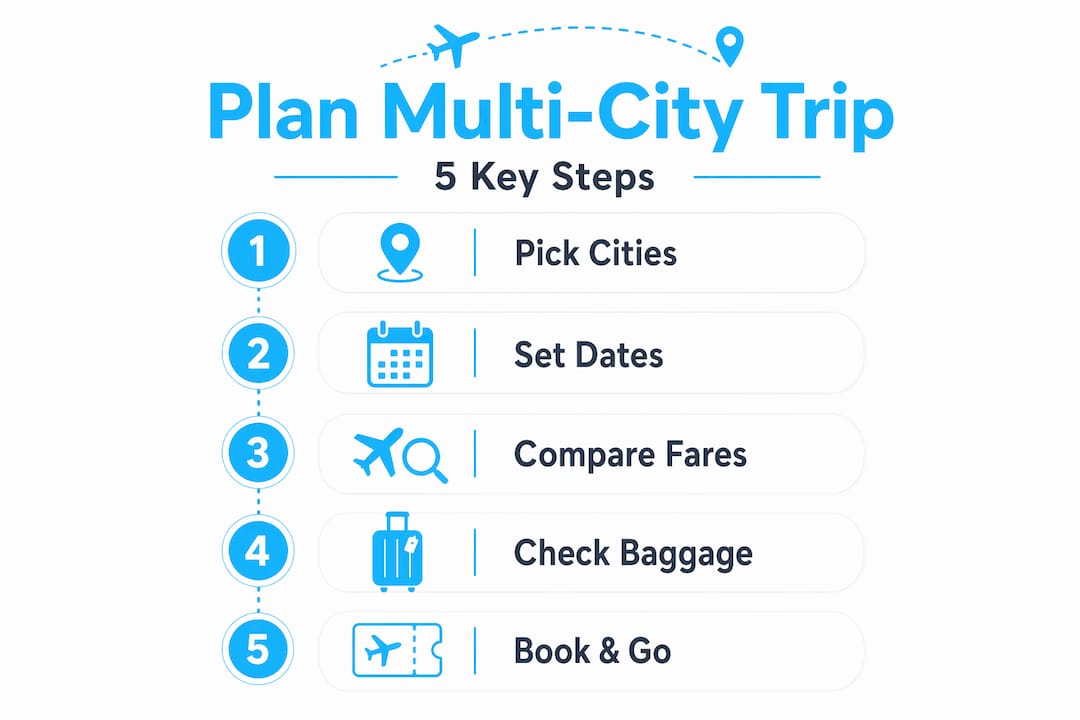
- Map your route geographically first. Before touching any booking tool, draw out your cities in actual geographic order. If you’re going from New York to Tokyo, Bangkok, and then Dubai, make sure you’re flying in the logical direction rather than crisscrossing the globe needlessly.
- Set your date anchors. Decide how many nights you need in each city. Work backward from your return date to set realistic stay lengths. Multi-city tools need actual or approximate dates to function properly.
- Choose your booking platform carefully. Use a platform that has a dedicated multi-city search mode, not just a simple round-trip or one-way toggle. Many tools bury this option under “more options” or “add another flight.”
- Enter all city pairs and dates in one session. Add your origin city, first destination, second destination, and so on, entering dates for each leg. The system will search for fare combinations across all legs simultaneously.
- Evaluate the results strategically. Don’t just click the cheapest top result. Look at layover times, total travel hours, and which airlines are operating each leg. A $40 saving isn’t worth a 14-hour layover in an airport with no services.
- Check the baggage rules for the full itinerary before finalizing. Look for one ticket vs. separate ticket structure in the booking summary.
- Book directly or through a trusted comparison platform. Direct airline bookings offer more control for changes; comparison platforms often surface deals the airline’s own site doesn’t highlight.
The advantages for itinerary-driven travelers remain consistent: saving money on some routes, reducing backtracking, and having legs tied together under one ticket simplifies the entire disruption-handling process.
Key mistakes to avoid when building your itinerary:
- Booking too-tight connections. A 45-minute layover sounds great until your first flight is 20 minutes late.
- Ignoring visa requirements at transit cities. Some connections require a transit visa even if you’re not leaving the airport.
- Assuming all platforms show the same prices. Fares genuinely vary across booking tools. Always check at least two sources.
- Forgetting to factor in airport transfer time. Some cities have multiple airports. Make sure your connecting flights use the same airport.
Pro Tip: Read up on overseas flight tips and flight hacks before finalizing any multi-city itinerary. Small adjustments in departure days or connection cities can sometimes cut your total fare by 15 to 20 percent.
The real value of multi-city bookings: what most travelers get wrong
Here’s something most travel advice never says out loud: flexibility is overrated when you’re managing a complex itinerary across multiple countries.
The argument for piecing together separate one-way tickets is usually about flexibility. “If something changes, I can adjust one leg without affecting the others.” That sounds smart. In practice, it creates a fragile chain where one disrupted flight collapses the entire trip financially. We’ve seen travelers lose hundreds of dollars in missed non-refundable hotel nights because their independent second ticket didn’t get them to the connection on time and no one owed them a rebooking.
Multi-city bookings under one ticket force a small amount of structure, and that structure pays you back in ways that aren’t immediately obvious. Insurance eligibility is cleaner. Trip cancellation policies from credit cards and third-party insurers often require all booked flights to be under a single reservation to qualify for full benefits. Scattered bookings across five different platforms can disqualify claims or make documentation nightmarish.
We also think travelers dramatically overestimate how often they actually change their plans mid-complex-trip. When you’ve arranged visas, hotels, tours, and ground transportation for a three-country journey, you’re not casually swapping out a flight leg at the last minute. The flexibility argument rarely holds up in real multi-destination travel.
The lesson we’d pass on: use cheap flight tips to find great fares, but don’t let the obsession with individual leg pricing cause you to ignore the structural advantages of booking cohesively. The best deal isn’t always the cheapest number. It’s the booking that delivers the most value across your whole journey, including disruption protection, baggage simplicity, and stress reduction.
Get even more value with specialized travel tools
Planning a multi-city trip means juggling fares, layover times, baggage rules, and visa requirements all at once. That’s a lot to manage alone.

At PilotTravelDeals.com, we’ve built a comparison platform designed specifically to help budget travelers cut through the complexity. Use our tools to explore flight comparison advantages across multiple booking sources at once, so you’re never leaving savings on the table. Beyond flights, our platform helps you compare hotels, SIM cards for international data, and travel discount types that stack with your multi-city bookings. One platform, one planning session, and a clearer picture of your real total trip cost before you commit to anything.
Frequently asked questions
Is booking a multi-city flight always cheaper than buying separate tickets?
No, but it often reduces costs and avoids extra fees, especially for complex routes. Always compare total fares across different booking methods before deciding.
Do all airlines allow baggage to be checked through on multi-city bookings?
Most do if all segments are under one ticket, but mixing airlines or buying separate tickets may require you to collect and re-check bags at each stop, as baggage transfer on single tickets is more reliable than on separate bookings.
How many cities can I add to a multi-city flight itinerary?
Most booking platforms allow 3 to 5 cities per itinerary, but some advanced tools and airline booking systems support even more stops on a single connected reservation.
Will multi-city booking affect travel insurance and disruption protections?
Travel insurance and airline protections are easier to manage when all legs are booked under one multi-city ticket, since tying legs together under one ticket can simplify disruption handling and strengthen insurance eligibility across the whole journey.
Recommended
- How to Book Multi-City Trips for Cheap and Easy Travel – PilotTravelDeals.com
- How to Book Multiple Flights and Save Money on Every Trip – PilotTravelDeals.com
- Smart ways to save money on flights every time – PilotTravelDeals.com
- Smart Overseas Flight Tips: Save More and Travel Better – PilotTravelDeals.com