TL;DR:
- A travel wishlist strategy converts scattered ideas into prioritized, bookable trips by attaching specific travel windows, budgets, and experiences. It differs from a bucket list by providing a decision-ready system with rules for active lists, scoring, and regular reviews. Using this approach helps travelers plan more efficiently and turn intentions into confirmed trips with minimal friction.
A travel wishlist strategy is a repeatable decision-making system that converts scattered travel ideas into prioritized, bookable trips. It is not a bucket list. The difference is structure: every entry carries a target travel window, a rough budget range, and one anchor experience. Without those three data points, a saved destination is just a name. With them, it becomes a planning-ready item you can act on the moment a deal or a free week appears.
Talker Research found that 60% of Americans feel they haven’t experienced enough of their own country, yet most lack a repeatable system to act on that desire. A wishlist strategy closes that gap. Start today by picking your single most-wanted destination, attaching a realistic travel season, and naming one experience you’d build the trip around.
Table of Contents
- What is a travel wishlist strategy, and how is it different from a bucket list?
- How to score every destination before it earns a spot on your shortlist
- How many destinations should you keep on your active shortlist?
- Step-by-step: how to turn one wishlist entry into a booked trip
- When to act: booking windows by trip type
- Tools and templates to build and maintain your wishlist
- Common mistakes that kill wishlists before they produce a trip
- A ready-to-copy wishlist entry template with two real examples
- Key takeaways
- The case for fewer, better entries
- How Pilottraveldeals helps you move from wishlist to booked
- Useful sources
What is a travel wishlist strategy, and how is it different from a bucket list?
A bucket list is a collection. A travel wishlist strategy is a system. Both store destination ideas, but only one tells you what to do next.
A bucket list entry looks like this: “Japan.” A strategy entry looks like this: “Japan, cherry blossom season (late March–early April), budget $3,200, anchor experience: Kyoto’s Philosopher’s Path.” The second version is decision-ready. You can immediately check fares, confirm the window fits your calendar, and set a booking deadline.
The key structural difference is context. A wishlist architecture requires ordering decisions around what you want to feel first, then working toward necessary bookings. Bucket lists grow indefinitely. A strategy has rules: a capped active shortlist, an archive for items that don’t fit right now, and a regular review cadence.
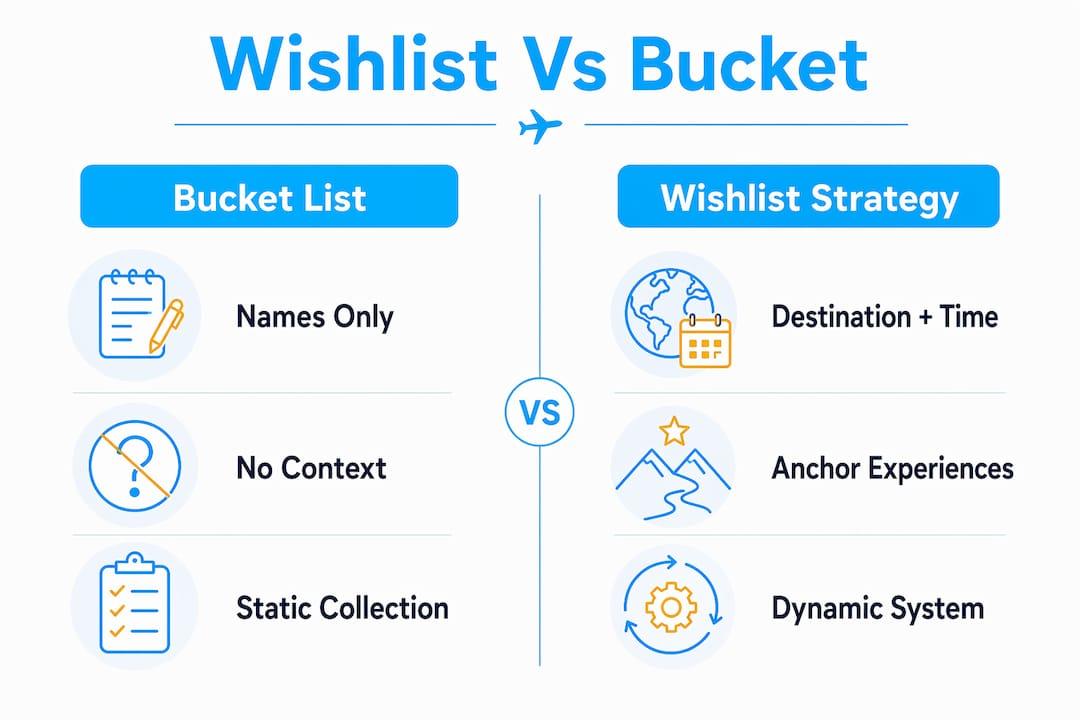
| Dimension | Bucket List | Wishlist Strategy |
|---|---|---|
| Entry format | Name only | Destination + window + budget + anchor |
| List size | Unlimited | 2–10 active; rest archived |
| Update cadence | Rarely | Monthly check, quarterly review |
| Decision-readiness | Low | High |
| Primary outcome | Inspiration | Booked trips |
Pro Tip: When you save any new destination, immediately attach two fields: the target travel window (e.g., “fall 2026”) and one anchor experience. Those two items do more to prevent planning paralysis than any additional detail.
How to score every destination before it earns a spot on your shortlist
Three criteria determine whether a destination belongs on your active list or gets archived as a “someday” entry: budget feasibility, seasonal compatibility, and experiential goal alignment. Score each on a 0–2 scale (0 = poor fit, 1 = workable, 2 = ideal) for a maximum of 6 points per entry.

Budget feasibility asks whether the all-in cost of the trip fits your savings timeline before the target window closes. Seasonal compatibility checks whether your available travel dates align with the destination’s best conditions. Experiential goal confirms the trip delivers the specific type of experience you’re after right now, whether that’s adventure, rest, culture, or family connection.
Here’s how a sample entry scores:
| Destination | Budget (0–2) | Season (0–2) | Experience (0–2) | Total |
|---|---|---|---|---|
| Costa Rica, Dec 2026 | 2 | 2 | 2 | 6 |
| Iceland, June 2026 | 1 | 2 | 2 | 5 |
| Morocco, Feb 2026 | 2 | 1 | 1 | 4 |
Costa Rica in December scores a 6: dry season starts, flights from the U.S. are affordable, and the anchor experience (wildlife + beaches) is fully available. Morocco in February scores a 4 because the experiential goal (desert camping) requires more logistics than the budget currently supports.
Checklist to run on every new entry:
- Can you fund this trip within the target window?
- Does your available time align with the destination’s best season?
- Does this trip deliver the specific experience you want right now?
Any entry scoring 3 or below moves directly to the “someday” archive.
How many destinations should you keep on your active shortlist?
Experts recommend keeping the active shortlist between 2 and 10 destinations. Four is the practical sweet spot. Below two, you lose flexibility when a deal doesn’t materialize. Above six, decision fatigue sets in and nothing gets booked.
Rules for moving items between active and someday:
- Move to someday when a destination scores below 4, when your budget timeline shifts, or when the best travel window passes.
- Reactivate from someday when a fare drops significantly, when you gain unexpected time off, or when a travel partner’s availability aligns.
Maintenance schedule: a quick monthly check (5 minutes, scan for new deals or calendar changes) and a quarterly deep review where you re-score every active entry and pull up to two items from the someday archive if they now qualify.
Pro Tip: Sort your active shortlist by “soonest realistic window,” not by excitement level. The trip you’re most excited about is rarely the one you should book next. The one with the nearest viable window and the highest score is.
Step-by-step: how to turn one wishlist entry into a booked trip
Start with one entry, not three. Splitting attention across multiple destinations at the booking stage is the most common reason wishlists stall. Pick the top-scoring item with the nearest window and run this sequence:
- Run pre-commitment checks. Confirm visa requirements, check for travel advisories, and verify the destination isn’t in a closure period (national parks, festivals with capacity limits).
- Search fares on flexible dates. Shift your window by three to five days in each direction. The fare difference is often significant.
- Confirm the budget fits. Total estimated cost (flights + accommodation + anchor experience + daily spend) must clear your savings by the target window. If it doesn’t, the entry goes back to someday.
- Set a booking deadline. A concrete date forces movement. A useful rule: if a fare comes in under budget, book within 14 days or the window closes.
- Book flights first. Accommodation is more flexible; flights drive the dates. Lock the flight, then book budget hotels around those dates.
- Reserve anchor experiences. Theme parks, popular tours, and high-demand restaurants sell out weeks ahead. Book these immediately after flights.
- Build the itinerary around anchors. Leave gaps for spontaneity. Pre-researched activities function as an insurance policy for spontaneity: you’ve already vetted the options, so you can choose on the ground without last-minute searching.
Deciding what you want from a trip before touching logistics prevents the most common planning mistake: anchoring your entire trip around a fare price instead of an experience.
When to act: booking windows by trip type
Lonely Planet’s month-by-month guide maps the planning calendar clearly. January is flexible and good for spontaneous short trips. February is when summer planning should begin in earnest. By early spring, major summer bookings (flights and accommodation) should be confirmed. November is deal season for travelers with pre-planned itineraries who can move quickly.
Booking windows by trip type:
- Domestic weekend trips: 3–6 weeks out is usually fine; price alerts help catch drops.
- International flights and first/last-night accommodation: book 2–3 months ahead for the best combination of availability and price.
- Theme parks and Disney packages: 6–12 months ahead to secure resort availability and dining reservations.
- Safaris, cruises, and luxury yacht charters: 12–18 months out; seasonal windows for yacht travel vary significantly by region, so confirm peak and shoulder seasons before setting your window.
- Family travel with school-calendar constraints: book as early as the window opens; school-holiday periods sell out faster than any other category.
Set a price alert the moment an entry moves to active status. Check fares every 30 days. When a fare hits your budget, the 14-day booking deadline rule applies.
Tools and templates to build and maintain your wishlist
The template structure every entry needs:
| Field | What to Enter |
|---|---|
| Destination | City/region + country |
| Target window | Month + year (e.g., “March 2026”) |
| Anchor experience | One specific activity or moment |
| Budget range | All-in estimate in USD |
| Score (0–6) | Sum of three criteria |
| Booking deadline | Date to book by once fare is found |
| Notes/links | Visa info, deal alerts, research links |
Tool categories and how each fits the workflow:
- Map-based saves (Google Maps lists, Wanderlog): pin destinations with notes attached; linkable addresses make research faster when you reactivate an entry.
- Notes apps (Notion, Apple Notes, Google Keep): store the full template table; sync across devices so you can update on the go.
- Fare-alert services (Google Flights price tracking, Hopper): set alerts the moment an entry goes active; alerts do the monitoring so you don’t have to check manually.
- Deal aggregators: use Pilottraveldeals at the “monitor fares and find deals” step. Search your top entry’s destination, compare flight and hotel options across providers, and check the travel deal comparison process to confirm you’re seeing the best available rate before committing.
Pro Tip: Mobile access and cross-device sync matter more than any specific app. The best tool is the one you’ll actually open when a deal notification arrives at 7 AM on a Tuesday.
Common mistakes that kill wishlists before they produce a trip
Most wishlists fail for predictable reasons. Each has a one-sentence fix.
- Name-only saves. Fix: never save a destination without attaching a travel window and one anchor experience before closing the tab.
- Oversized master lists. Fix: cap the active list at 10; everything else goes to someday immediately.
- Planning logistics before experience. Fix: write down what you want to feel on this trip before opening a flight search.
- Ignoring seasonality. Fix: check the destination’s best travel months as part of the initial save, not after you’ve already committed to dates.
- Skipping pre-commitment research. Fix: spend five minutes on visa requirements and travel advisories before a destination earns active status.
- Re-adding eliminated options. Fix: when you archive an entry, note the reason. A one-line note (“budget gap: $800”) stops you from cycling the same destination back onto the active list without addressing the original problem.
Pro Tip: Run a one-minute triage before any quarterly review: scan the someday list and delete any entry you’ve archived twice without reactivating. If it hasn’t cleared the criteria in two review cycles, it belongs on a different kind of list.
A ready-to-copy wishlist entry template with two real examples
Copy this template into any notes app or spreadsheet:
Destination:
Target window:
Anchor experience:
Budget range (USD):
Score (0–6):
Booking deadline:
Notes/links:
Example 1: Family trip
| Field | Entry |
|---|---|
| Destination | Orlando, Florida |
| Target window | June 2026 |
| Anchor experience | Walt Disney World, Magic Kingdom |
| Budget range | $3,200 |
| Score | 6/6 |
| Booking deadline | February 1, 2026 |
| Notes/links | Book park tickets + resort 6 months out; check family travel tips for group savings |
Score rationale: budget is funded, June aligns with school break (seasonal compatibility = 2), and the anchor experience is the entire reason for the trip (experiential goal = 2). Booking deadline is set early because Disney resort availability tightens fast.
Example 2: Solo adventure
| Field | Entry |
|---|---|
| Destination | Medellín, Colombia |
| Target window | October 2026 |
| Anchor experience | Coffee region day trip + street art tour |
| Score | 5/6 |
| Booking deadline | August 2026 |
| Notes/links | No visa required for U.S. citizens; shoulder season pricing; set fare alert now |
Score rationale: budget fits comfortably (2), October is dry season in the coffee region (2), but the experiential goal scores 1 because the traveler is still deciding between Medellín and Cartagena. Once that decision is made, the score becomes 6 and the booking deadline activates.
Usage notes: the two mandatory fields are target window and anchor experience. Everything else adds precision but those two fields are what make an entry actionable. Pilottraveldeals fits at the “notes/links” step: use it to compare current fares and hotel rates before setting your booking deadline.
Key takeaways
A travel wishlist strategy works because it replaces vague inspiration with three concrete inputs: a travel window, a budget check, and one anchor experience that defines the trip.
| Point | Details |
|---|---|
| Curation beats collection | Four well-contextualized entries outperform 40 unlabeled ones; cap your active list at 2–10 destinations. |
| Score before you commit | Rate every entry on budget, season, and experiential goal (0–2 each); archive anything scoring below 4. |
| Timing drives bookings | Book international flights 2–3 months out; lock summer plans by March; theme parks need 6–12 months. |
| Deadlines force movement | Set a booking deadline the moment a fare hits your budget; 14 days is a practical default. |
| Pilottraveldeals monitors deals | Use Pilottraveldeals at the fare-monitoring step to compare flights and hotels across providers before committing. |
The case for fewer, better entries
The conventional wisdom says to dream big and list everything. That advice is fine for a vision board. For a planning system, it’s counterproductive. A list of 40 destinations with no context attached is not a strategy. It’s a postponement mechanism.
The travelers who actually take the most trips tend to keep shorter, sharper lists. They know their next two or three moves. They’ve already done the five-minute pre-commitment check on each one. When a deal appears or a week of vacation opens up, they don’t spend three days researching from scratch. They pull up the top entry, confirm the fare, and book.
The goal of a wishlist strategy isn’t to catalog every place you might someday want to visit. It’s to make the next trip as frictionless as possible. Start with one entry today. Score it. Set a booking deadline. The rest follows.
How Pilottraveldeals helps you move from wishlist to booked
The hardest part of any wishlist strategy isn’t building the list. It’s the moment between “I want to go” and “I’ve actually booked it.” That gap is where most trips die. Pilottraveldeals closes it by putting flight comparisons, hotel deals, and aggregated offers in one place, so you spend less time hunting across tabs and more time confirming the trip is within budget.
Here’s the micro-workflow: take your top-scoring shortlist entry, run a destination search on Pilottraveldeals, compare current fares and accommodation options, and set a price alert. When a fare hits your budget, your booking deadline activates. Book the flight, then use Pilottraveldeals to lock cheap airfare and accommodation in the same session. The site aggregates offers from multiple providers, which means you’re comparing real options rather than guessing whether you’ve found the best rate. Start your search at Pilottraveldeals.com and turn your top wishlist entry into a confirmed trip.
Useful sources
- Travel Planning Guide: Wish List to Booked Trip in 7 Steps — covers the five-step pipeline from saved destination to scheduled trip, including the 60% of Americans stat and the two-field minimum for actionable entries.
- How to Build a Destination Shortlist That Actually Works — practical shortlist methodology including the 2–10 active item recommendation and criteria for moving entries to someday.
- A Month-by-Month Guide to Trip Planning — Lonely Planet’s calendar-based planning guide; supports the March summer deadline and November deal-season guidance.
- Why I Love Trip Wishlists for Travel Planning — explains the “insurance policy for spontaneity” concept and how pre-researched activities reduce on-the-ground decision fatigue.
- The Complete Guide to Planning Any Trip from Scratch — supports experience-first sequencing and the argument for deciding what you want before touching logistics.
- How to Plan a Trip: Step-by-Step Guide — covers practical booking windows including the 2–3 month rule for international flights and first/last-night accommodation.
- Crafting Your Dream Travel Wishlist — QuartzMountain overview of wishlist creation including scoring systems, budget planning, and timeline building.
- Best Seasons for Luxury Yacht Travel — Exotica Charters guide to seasonal windows for yacht and coastal trips; useful for high-end wishlist entries requiring long lead times.
Recommended
- What is travel credit? A 2026 guide for budget travelers – PilotTravelDeals.com
- Top tips for booking last-minute travel deals in 2026 – PilotTravelDeals.com
- Why Choose Long-Haul Destinations for Real Adventure – PilotTravelDeals.com
- What is a travel itinerary? Smart trip planning guide – PilotTravelDeals.com